If your phone says the AQI is orange or red, the workout decision should change before your shoes are tied. Use the U.S. EPA AQI scale this way: green can stay normal, yellow gets shortened, orange moves indoors and gets easier, red becomes controlled low-intensity indoor work, and purple is a rest-or-mobility day. This scale is U.S.-specific, so readers using Canada’s AQHI or another local index should follow the nearest official health guidance for their region.
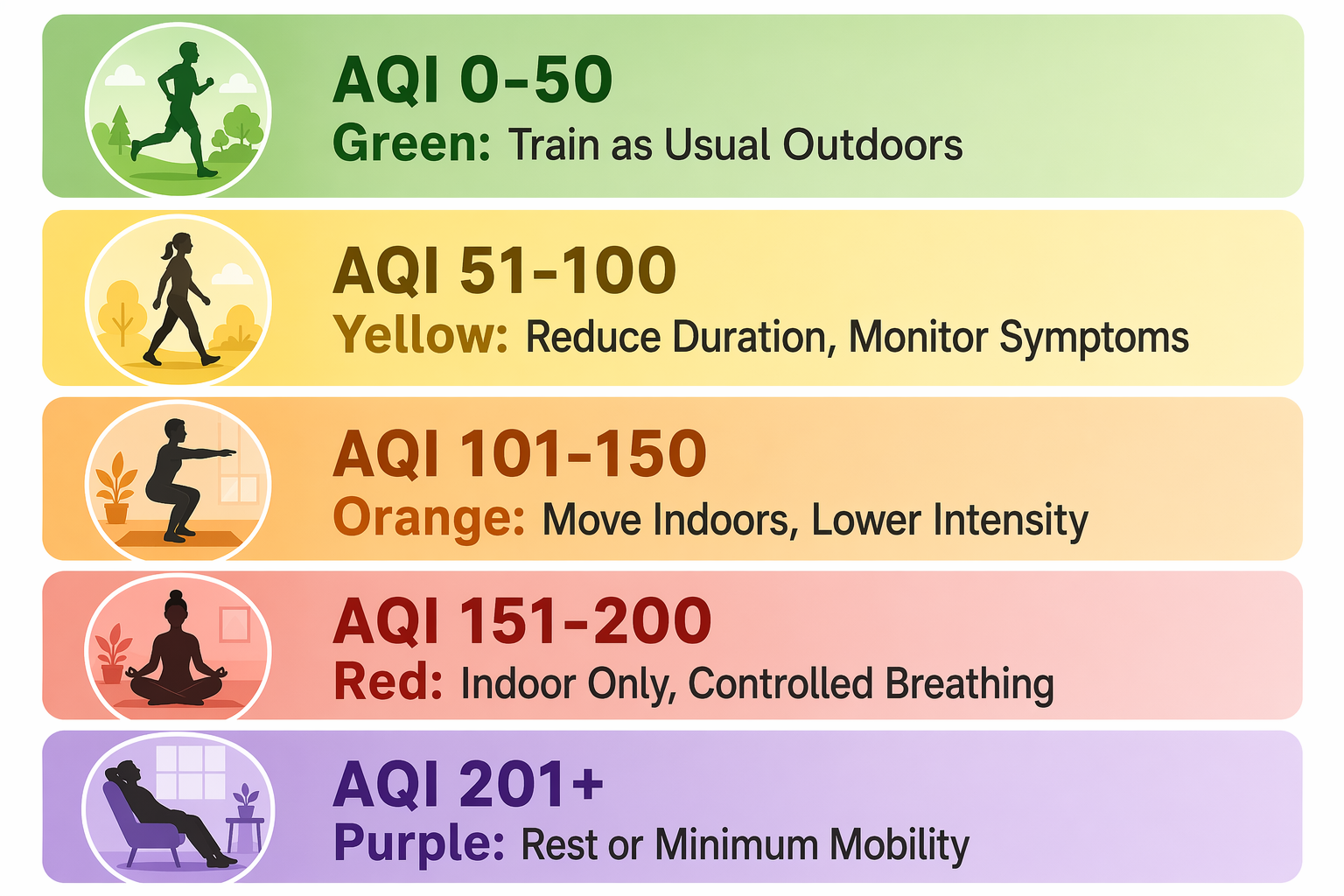
| AQI | Workout Decision | Intensity Cap | Duration | Sample Routine |
|---|---|---|---|---|
| Green: 0–50 | Train as usual outdoors if you feel well. | Normal planned effort | Normal planned duration | Run, ride, walk, strength session, or outdoor circuit as scheduled. |
| Yellow: 51–100 | Exercise is usually still reasonable for many people, but shorten the session and watch symptoms. | Moderate; avoid turning an easy day into intervals | About 25% shorter than planned | 30-minute easy run becomes 20–25 minutes; outdoor strength becomes fewer rounds. |
| Orange: 101–150 | Move indoors, close the room, and switch from heavy breathing to controlled effort. | RPE 5–6/10; no hard intervals | 20–35 minutes | Low-impact bodyweight circuit: squats to a chair, wall pushups, glute bridges, dead bugs, step-backs. |
| Red: 151–200 | Indoor only, after room prep. Keep breathing steady enough that you can speak in full sentences. | RPE 4–5/10 | 15–30 minutes | Mobility plus light strength: cat-cow, hip hinges, incline pushups, band rows if available, slow marching. |
| Purple: 201+ | Rest, or do minimum-effort mobility only if you need to move. | RPE 1–2/10 | 5–15 minutes | Breathing-easy mobility: neck rolls, shoulder circles, gentle spinal rotation, easy walking indoors. |
That table is intentionally conservative at orange and red because exercise changes the dose. The American College of Sports Medicine notes that an adult at moderate exertion exchanges about 6 liters of air per minute, and that an athlete racing at 70% VO₂max can inhale as much air during one marathon as a sedentary person inhales over two full days.[2] AtmoTube summarizes deposition research showing ventilation can rise 10–20 times above rest during exercise, with particle deposition in the lungs 4.5 times higher during exercise than at rest.[3]
Wildfire smoke makes that especially relevant because the pollutant of concern is usually fine particulate matter. University of Toronto guidance notes that more than 90% of wildfire smoke consists of PM2.5 or smaller particles, which are small enough to get deep into the lungs; when exercise pushes people into mouth-breathing, the nose filters less of that incoming air.[4]
First, Make Indoors Actually Better
An indoor workout when air quality is bad is not automatically safe just because the door is shut. Physical activity itself can raise indoor particulate concentrations in unventilated spaces; AtmoTube reports increases up to 300% during exercise in such settings.[3] The practical answer is not to panic about your living room. It is to prep the room before you start.
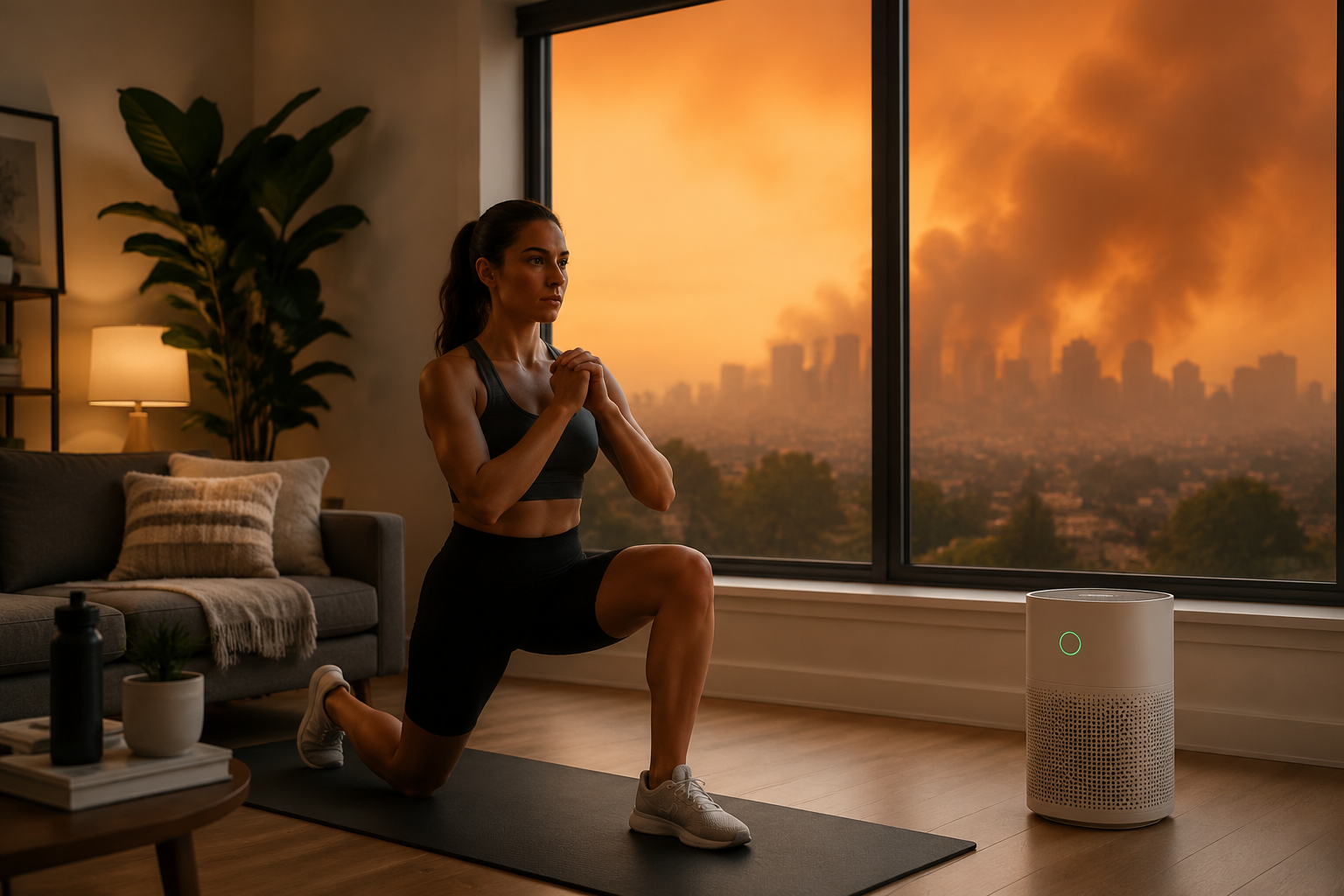
- Close windows and exterior doors before the workout, especially during wildfire smoke events.
- Run a HEPA purifier in the workout room for about 30 minutes before starting when you have one; EPA materials define HEPA filtration as capturing 99.97% of particles at least 0.3 microns in size.[5]
- If you have an indoor PM2.5 monitor, aim for a reading below 15 μg/m³ before exercising; that target matches the WHO 24-hour PM2.5 guideline cited in the research materials.
- If you track CO₂, treat 1,500 ppm as the point where the room needs attention; AtmoTube cites ASHRAE-linked guidance that workout spaces above 1,500–2,000 ppm indicate inadequate ventilation.[3]
- Avoid cooking, candles, incense, vacuuming, and dusty chores right before training, because the goal is to reduce particles you can control while outdoor particles are already high.
The awkward part is ventilation. On a normal day, opening a window may lower CO₂ and make a room feel better. During smoke or heavy outdoor pollution, that same window can bring in the particles you are trying to avoid. If CO₂ is climbing but outdoor AQI is red, the safer adjustment is usually to reduce workout intensity, shorten the session, use a larger interior room if available, and let the purifier keep working rather than forcing a hard workout in a sealed, stale room.
Green and Yellow: Keep the Plan, Trim the Edges
At green, the AQI number is not a reason to change a normal workout. Train outside if that was the plan, warm up normally, and use your usual judgment about heat, illness, asthma, pollen, and traffic.
Yellow is the first small edit. If the workout is easy and you feel fine, many people can still go outside, but the better default is to reduce duration by about a quarter and skip the part that turns breathing ragged. A planned 40-minute run becomes 30 minutes. A hill repeat day becomes an easy walk-jog. A long outdoor circuit becomes two rounds instead of four.
People with asthma, heart disease, pregnancy, recent respiratory infection, older age, or unusually strong smoke sensitivity should treat yellow more like orange. The American Lung Association advises checking local air quality before outdoor exercise and paying attention to symptoms such as coughing, wheezing, chest tightness, unusual shortness of breath, and dizziness.[6]
Orange: Move the Workout Indoors and Remove the Breathless Parts
Orange is the most common decision trap: the air is not apocalyptic, but it is no longer a great setting for hard breathing. This is where an indoor workout makes sense, as long as it is not just the outdoor workout copied into a living room at the same intensity.
Use a talk test. In orange, you should be able to speak in short sentences during the working portions and recover quickly between moves. If the routine makes you gulp air, it belongs on a cleaner day. Swap jump squats for chair squats, burpees for incline mountain climbers, running intervals for marching or step-ups, and timed AMRAP blocks for controlled sets.
| Outdoor Plan | Orange-Tier Indoor Swap | Why It Works Better Today |
|---|---|---|
| Tempo run or intervals | 20–30 minutes of brisk indoor walking, step-ups, or low-impact cardio | Maintains movement without sustained high ventilation. |
| Outdoor boot camp | 3 rounds of chair squats, incline pushups, glute bridges, bird dogs, and side planks | Keeps strength stimulus while limiting breathlessness. |
| Heavy lower-body day | Slower bodyweight strength with longer rests | Preserves pattern practice without turning the session into conditioning. |
| HIIT video | Low-impact routine with no jumping and no all-out intervals | Cuts the spikes in breathing demand that make pollution exposure more consequential. |
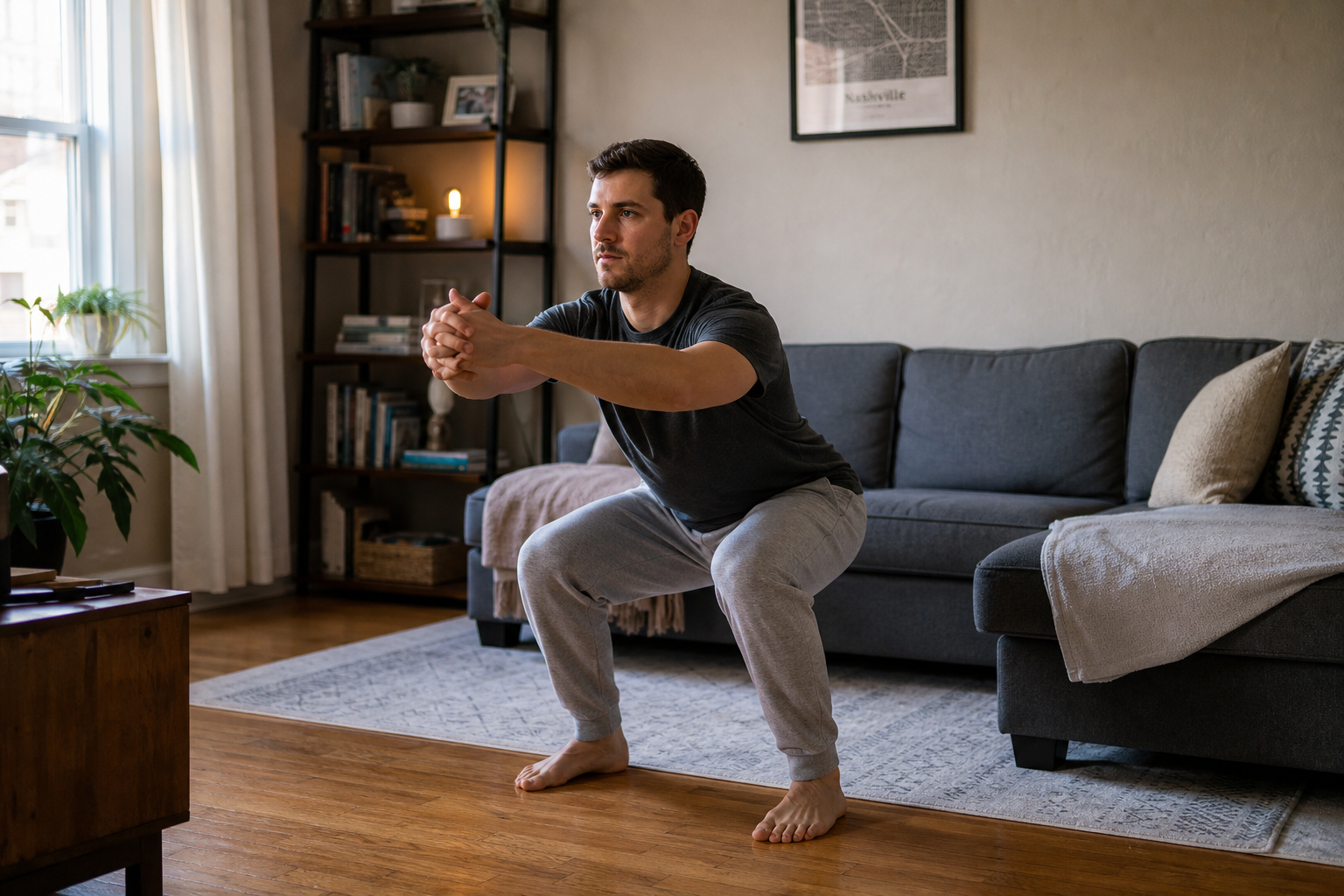
A simple orange-tier circuit can look like this: 8–12 chair squats, 8–12 incline pushups, 10 glute bridges, 6–8 step-backs per side, 20–30 seconds of dead bug, then 60–90 seconds of easy walking. Repeat two to four times. If you want a followable session with similar constraints, a low-impact workout you can do at home is a better fit than a high-intensity class on smoky days.
Bodyweight training is not a consolation prize here. A study in inactive adults found that bodyweight resistance training with minimal equipment enhanced cardiorespiratory fitness, which supports using no-equipment indoor work as real training rather than as a placeholder.[7] If you need more reassurance or progression ideas, see why no-equipment workouts work or the newer bodyweight training evidence guide.
Red: Indoor Only, and Keep the Ceiling Low
At red, the workout is no longer about preserving the original training effect. It is about keeping the habit alive without asking your lungs to process a large volume of bad air. Cap effort at RPE 4–5 out of 10. You should be able to talk in full sentences, breathe mostly through your nose if comfortable, and stop before the session feels cardiovascularly demanding.
This is also where high-intensity exercise loses its argument. CBS News reported on a 2021 European Heart Journal finding that, in highly polluted air, high-intensity exercise may increase rather than decrease cardiovascular disease risk; because the research brief does not provide the study’s exact thresholds or protocol, that finding is best used as a caution against hard intervals, not as a precise cutoff for every exerciser.[8]
Try this red-tier session after the room is closed and the purifier has been running: 3 minutes of easy walking around the room, 6 slow hip hinges, 6 incline pushups, 8 bodyweight box squats or sit-to-stands, 8 band rows if you own a band, 20 seconds of side plank per side, then 90 seconds of easy breathing. Do one to three rounds. Stop at the first sign that it is becoming a conditioning workout.
For repeat bad-air weeks, rotate body regions instead of raising intensity: lower-body mobility one day, upper-body strength the next, core and walking the next. A 4-week no-equipment plan can provide structure, and a no-equipment upper-body workout is useful when you want strength work without jumping, running, or heavy breathing.
Purple: Rest Is the Training Decision
At purple, do not negotiate yourself into a workout because the streak app is watching. Rest is the correct tier. If you are stiff or anxious and movement helps, keep it to minimum-effort mobility: shoulder circles, easy spinal rotations, ankle circles, slow walking indoors, or five minutes of gentle stretching. No sweat goal, no heart-rate goal, no make-up session.
The same rule applies if the AQI is lower but you have symptoms before you start. Coughing, wheezing, chest tightness, dizziness, unusual fatigue, burning throat, or shortness of breath at rest should cancel the workout. If symptoms are severe, unusual, or persistent, get medical advice rather than trying to train through them.
Small-Space Adjustments That Matter More Than Equipment
A small apartment can still work if the session is quiet, contained, and low-ventilation. Choose the room farthest from obvious outdoor leakage if you have that option. Put the purifier near the workout area without blocking airflow. Use a mat to reduce floor dust. Keep pets, laundry lint, and clutter away from the space where you will breathe hardest.
If your home setup is the reason you keep defaulting to outdoor workouts on bad-air days, solve the friction before the next alert. A compact mat, one resistance band, and a clear floor rectangle are enough for most orange and red sessions. For setup ideas, start with a small-space home gym plan or the home gym flooring guide for apartments.
Stop Rules During and After the Workout
Bad-air-day training should have a lower stop threshold than a normal workout. End the session if breathing becomes labored, your chest feels tight, you start coughing repeatedly, you feel lightheaded, your throat burns, or you cannot bring your breathing back down during rest periods. Do not restart the workout after symptoms settle; count the day as complete.
Afterward, cool down indoors for a few minutes, drink water, and keep the room filtration running. If smoke exposure irritated your nose or throat, a gentle recovery routine is more useful than adding extra exercise. The post-workout recovery routine at home gives you a calmer template for the part of the day when the workout is already done.
The repeatable rule is simple: match the workout to the air you are actually going to breathe. Green can be normal. Yellow gets shorter. Orange moves indoors and loses the breathless work. Red stays easy and controlled. Purple is rest or the gentlest mobility. Consistency is still possible during smoke and pollution spikes, but the session has to change with the exposure level.
References
- Should You Exercise Outside in Air Pollution? — US EPA
- Air Quality and Outdoor Exercise — ACSM
- Importance of Air Quality in Gyms — AtmoTube
- Tips from an exercise physiologist on how to stay fit safely when air quality is poor — University of Toronto
- Wildfires and Indoor Air Quality (IAQ) — US EPA
- Four Things to Know about Air Quality and Exercising Outdoors — American Lung Association
- Is Practicing Indoor Physical Activity Safe? Consideration of Exposure to PM2.5 — PMC / Iran J Public Health
- Exercising in bad air quality can lead to negative health effects — CBS News
Comments
Join the discussion with an anonymous comment.