You probably do not need another random list of squats, lunges, and glute bridges. You need to know which no-equipment leg workout fits what you are trying to change: better endurance, more muscle, harder conditioning, or a safe first leg day.
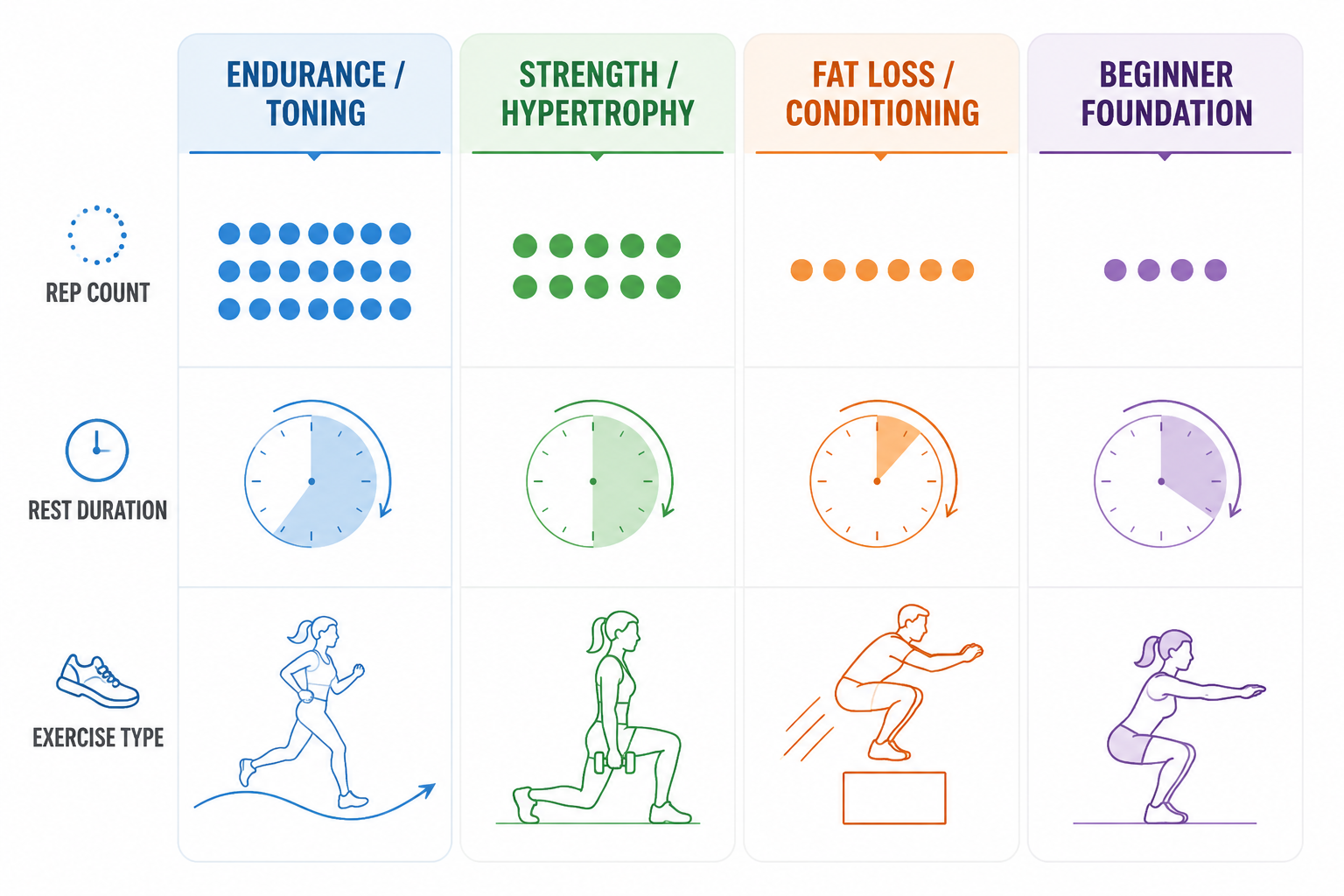
The same five square feet of floor can produce very different workouts. Short rests and high reps make a leg session feel like local muscular endurance work. Slower unilateral sets with longer rests push it closer to strength and hypertrophy. Timed intervals with jumps turn it into conditioning. Simpler movements with more breathing room help beginners practice without turning the session into a survival test.
| Goal | Best structure | Use this if |
|---|---|---|
| Endurance / toning | 15–20+ reps, 30–45 seconds rest, steady pacing | You want your legs to handle more repeated work without burning out early |
| Strength / hypertrophy | 3–4 sets of 8–12 reps, unilateral exercises, 60–90 seconds rest | You want the hardest muscle-building version possible without weights |
| Fat loss / conditioning | 40 seconds work, 20 seconds rest, compound and plyometric moves | You want a tough calorie-burning leg circuit that also trains conditioning |
| Beginner foundation | Controlled reps, low-complexity exercises, longer rest | You are learning form and building enough capacity to train consistently |
For scheduling, keep most no-equipment leg workouts in the 20–30 minute range. That duration shows up repeatedly in trainer-built bodyweight leg sessions from SELF, ATHLEAN-X, and Anytime Fitness, and it is long enough to accumulate useful work without padding the session with junk volume.[2][6][3]
Most people should train legs 2–3 times per week and leave at least 48 hours between harder lower-body sessions, especially if the workout includes deep lunges, split squats, jumps, or high-rep wall sits.[1][4][2]
Routine 1: Endurance and Toning
This is the version to choose when you want your legs to tolerate more repeated effort: stairs, hiking, long walks, recreational sports, or simply getting through a workout without your quads quitting halfway through. The structure is high-rep, moderately paced, and light on rest. PureGym and SELF both use 15–20+ rep ranges and short rest windows for bodyweight leg endurance work.[1][2]
| Exercise | Work | Rest |
|---|---|---|
| Bodyweight squat | 20 reps | 30 seconds |
| Alternating reverse lunge | 16–20 total reps | 30 seconds |
| Glute bridge | 20 reps | 30 seconds |
| Lateral lunge | 10–12 reps per side | 30–45 seconds |
| Calf raise | 25 reps | 30 seconds |
| Wall sit | 30–45 seconds | 60 seconds after the round |
Move at a pace you can repeat for all 3 rounds. The first round should feel manageable. The second should make your legs warm and slightly heavy. The third should require focus, but your reps should still look like reps, not a slow negotiation with the floor.
The order matters. Squats come first because they are the cleanest pattern and let you set depth. Reverse lunges follow because they add single-leg demand without the forward knee stress some beginners feel during forward lunges. Bridges shift work to the glutes and hamstrings before lateral lunges bring in side-to-side control. Calf raises and the wall sit finish the round without needing more coordination.
- Make it easier: use 2 rounds and cap every set at 15 reps.
- Make it harder: keep the same reps but reduce rest to 20–25 seconds.
- Progression target: complete all 3 rounds with steady breathing before adding reps.
Routine 2: Strength and Hypertrophy
This is where no-equipment leg training needs more care. If you do regular bodyweight squats forever, your legs will probably get better at regular bodyweight squats. For muscle-building stimulus, the session has to make each rep harder: one leg at a time, deeper range of motion, slower lowering, pauses, and sets that finish close to fatigue.
A small 2023 study by Wei et al. found that six weeks of structured bodyweight resistance training could improve several fitness measures in sedentary young women, but the bodyweight group was tiny, with n=6, and the participants had a mean age of about 20.[5] That is useful support for taking structured bodyweight work seriously. It is not a license to claim that bodyweight training matches loaded training for everyone.
| Exercise | Sets and reps | Rest |
|---|---|---|
| Bulgarian split squat or rear-foot-elevated split squat | 4 sets of 8–12 reps per side | 90 seconds |
| Single-leg glute bridge | 4 sets of 10–12 reps per side | 60–90 seconds |
| Tempo squat | 3 sets of 8–12 reps with a 3-second lowering phase | 60–90 seconds |
| Reverse lunge with 1-second bottom pause | 3 sets of 8–10 reps per side | 75–90 seconds |
| Single-leg calf raise | 3 sets of 12–15 reps per side | 60 seconds |
Men’s Health UK recommends unilateral bodyweight leg exercises such as Bulgarian split squats and single-leg glute bridge variations for making no-equipment training more demanding, and the 8–12 rep structure lines up with the bodyweight protocol range used in the Wei et al. study.[4][5]
Use the first exercise as the main lift of the day. If Bulgarian split squats are too unstable, do a regular split squat with both feet on the floor. If they are too easy, slow the lowering phase to 3–4 seconds and pause at the bottom before standing. The point is not to suffer creatively; the point is to make 8–12 controlled reps feel hard enough that you could only do a few more with clean form.
This routine also needs honest rest. Thirty seconds between hard split squat sets usually turns the session into cardio before the target muscles have been loaded well. Take 60–90 seconds, set up the next side cleanly, and let the set be difficult for the right reason.
For progressive overload, change only one lever at a time: add reps within the range, slow the eccentric, increase range of motion, add a pause, or shorten rest slightly. If you want the full progression system, use 5 Progression Levers for Home Leg Workouts rather than turning every set into a new variation.
The ceiling is real. Once you can do 15+ clean reps per side on your hardest unilateral options, bodyweight alone may stop being the best tool for muscle growth. At that point, a loaded backpack, bands, or dumbbells become more useful than inventing circus versions of lunges. For a comparison of bodyweight, banded, and dumbbell options, see Leg Workouts at Home: Three Complete Routines by Equipment Tier.
Routine 3: Fat Loss and Conditioning
This workout is for conditioning first. It can support fat loss because it raises energy expenditure and gives you a hard lower-body interval session, but it does not override diet, daily activity, sleep, or total weekly training volume.
ATHLEAN-X and BarBend both use interval-style bodyweight leg formats that combine compound movements and higher-intensity work, with 40 seconds on and 20 seconds off being a practical structure for a tough no-equipment session.[6][7]
| Exercise | Work | Rest |
|---|---|---|
| Squat to calf raise | 40 seconds | 20 seconds |
| Alternating reverse lunge | 40 seconds | 20 seconds |
| Skater step or skater hop | 40 seconds | 20 seconds |
| Glute bridge march | 40 seconds | 20 seconds |
| Squat jump or fast bodyweight squat | 40 seconds | 20 seconds |
| Wall sit | 40 seconds | 60–90 seconds after the round |
Choose the lower-impact option when your landings get loud. A skater step still trains lateral movement. A fast bodyweight squat still keeps the legs working. A squat jump done badly because you are tired is not a badge of effort; it is just a worse squat.
The Wei et al. study is a good reminder not to oversell this category. In that six-week study, the bodyweight training group did not significantly reduce body fat percentage, moving from 24.18% to 24.02%, while the barbell training group decreased from 28.66% to 24.96% with p=0.044.[5] That does not mean bodyweight conditioning is useless. It means a leg HIIT session should be presented as one part of an energy-balance picture, not as a standalone fat-loss solution.
Use this routine on days when you want sweat, breathing demand, and a clear finish line. Do not stack it the day before a hard hypertrophy leg day unless you already recover well from lower-body training.
- Beginner version: 30 seconds work, 30 seconds rest, 2–3 rounds.
- Standard version: 40 seconds work, 20 seconds rest, 3 rounds.
- Hard version: 40 seconds work, 20 seconds rest, 4 rounds, but only if jump mechanics stay clean.
Routine 4: Beginner Foundation
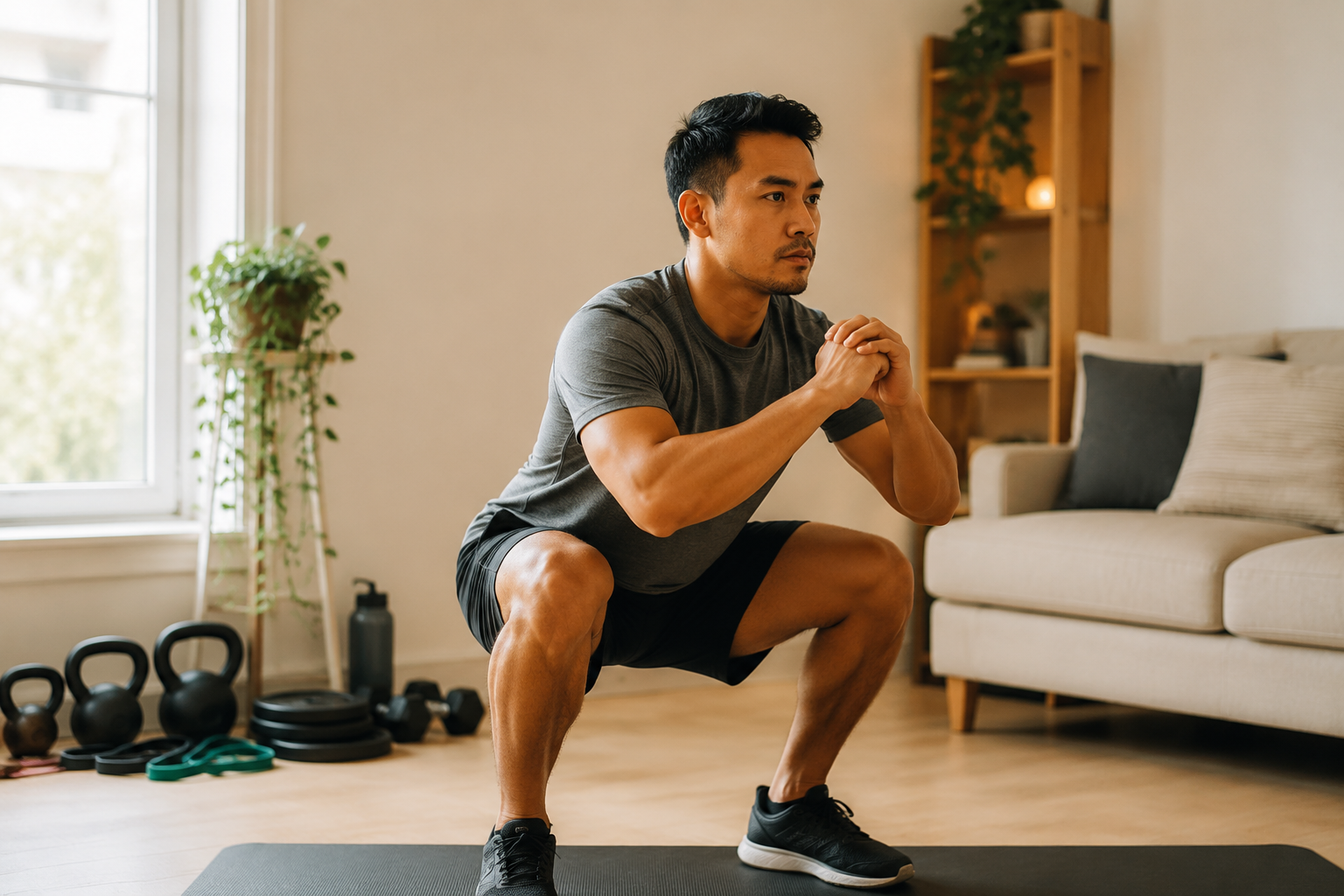
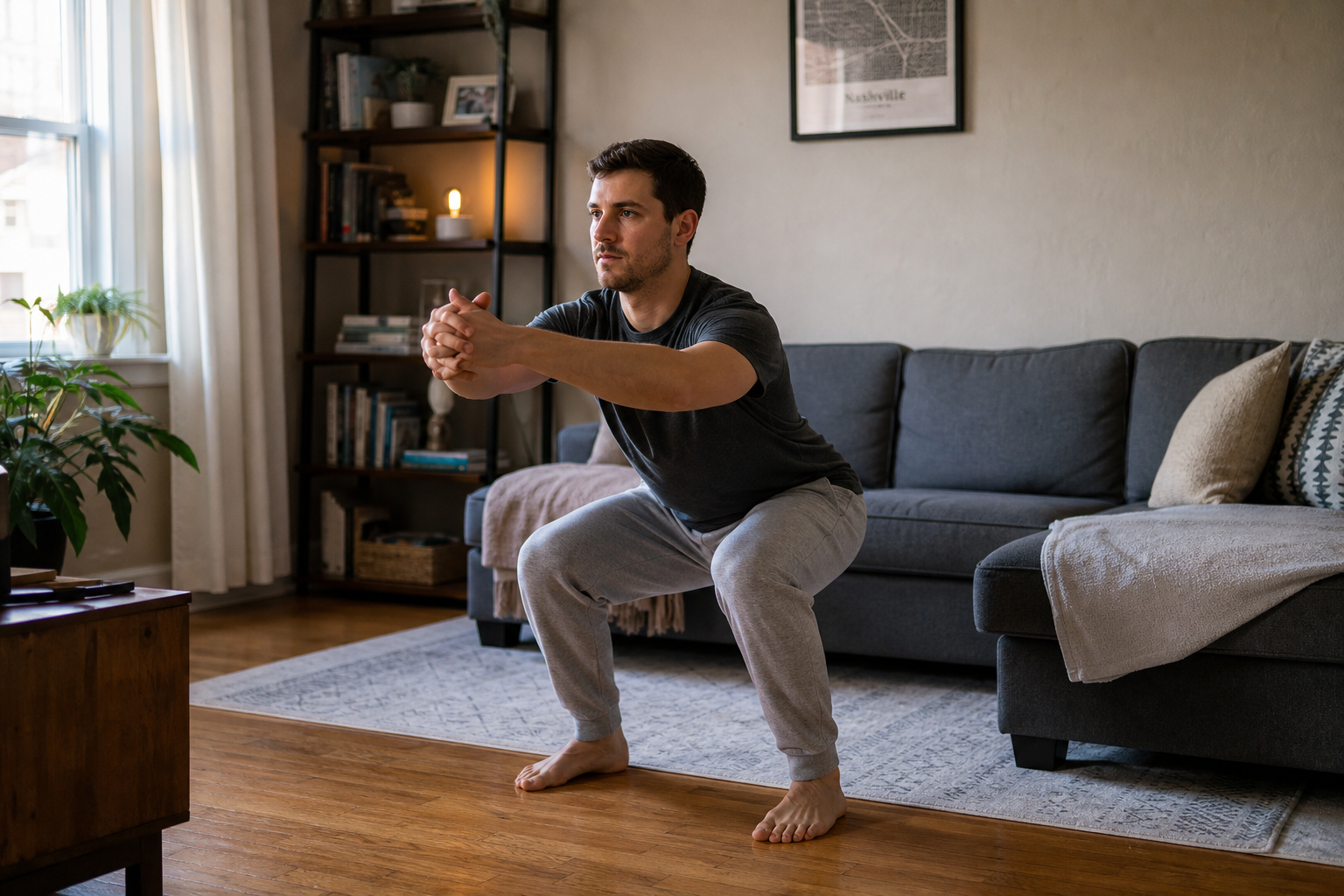
A beginner leg workout does not need ten exercises. It needs patterns you can repeat: squat, lunge, hip extension, calf raise, and an isometric hold. Healthline, SELF, Men’s Health UK, and Outside Online all include these basic bodyweight leg patterns among common effective no-equipment lower-body exercises.[8][2][4][9]
| Exercise | Sets and reps | Rest |
|---|---|---|
| Bodyweight squat | 2–3 sets of 8–12 reps | 60 seconds |
| Reverse lunge | 2 sets of 6–8 reps per side | 60–75 seconds |
| Glute bridge | 2–3 sets of 10–15 reps | 45–60 seconds |
| Standing calf raise | 2 sets of 12–15 reps | 45–60 seconds |
| Wall sit | 2 rounds of 20–30 seconds | 60 seconds |
Keep the first two weeks almost boring. Squat to a depth you can control. Step backward on lunges instead of forward. Press through the whole foot on glute bridges. Rise and lower slowly on calf raises. Leave one or two reps in reserve rather than chasing soreness.
Progress by adding reps before adding rounds. When you can finish the top end of every rep range with steady form, move from 2 sets to 3 sets where listed. If this routine still feels like too much, start with Leg Workouts at Home: A Beginner's Guide to Your First Leg Day. If it feels right and you want a longer runway, continue with Your First 8 Weeks of Home Leg Workouts: A Beginner's Guide.
How to Pick the Right Routine This Week
Do not rotate all four routines just because they exist. Pick the one that matches the main thing you want from your lower-body training right now, then repeat it long enough to see whether you are improving.
| Weekly goal | Simple schedule |
|---|---|
| Build a base | Beginner foundation on Monday and Thursday |
| Improve endurance | Endurance routine on Monday and Friday, optional easy walk or mobility day midweek |
| Build muscle with bodyweight | Hypertrophy routine on Monday and Thursday, with at least 48 hours between sessions |
| Conditioning focus | Fat loss / conditioning routine on Tuesday and Saturday, plus non-leg activity on other days |
| Mixed fitness | Hypertrophy routine early week, conditioning routine 48–72 hours later |
If your legs are still sore, your reps are getting worse, or your knees and hips feel irritated rather than worked, do not solve that by adding another leg day. Keep the 2–3 day weekly range and make the sessions cleaner before making them more frequent.[1][4][2]
When Bodyweight Is No Longer Enough
No-equipment leg training can take you a long way if the routine is actually structured. It can improve control, endurance, single-leg strength, and conditioning. It can also run into a ceiling, especially for stronger trainees whose legs need more external load to keep progressing.
A useful signal is the quality of your hardest sets. If you can perform 15+ smooth reps per side on split squats, single-leg bridges, and single-leg calf raises while staying several reps away from failure, you are probably not limited by motivation. You are limited by loading.
Exercise choice still matters, and some movements earn their place more easily than others. For a deeper look at which home leg exercises are worth prioritizing, use Home Leg Exercises, Ranked by Science. If you want to build your own sessions after trying these four, go to How to Design Your Own Leg Workout at Home.
The best no-equipment leg workout is not the one with the longest exercise list. It is the one whose reps, rest, order, and progression match what you are actually trying to change.
References
- Lower Body Bodyweight Workouts, PureGym
- Killer Legs, No Gear Required, SELF
- 25-Minute Leg Workout at Home, No Equipment, Anytime Fitness
- Bodyweight Leg Exercises, Men’s Health UK
- Wei et al. 2023 bodyweight resistance training study, Nature, 2023
- Bodyweight Leg Workout: No Equipment, ATHLEAN-X
- Best Bodyweight Leg Workouts, BarBend
- Bodyweight Leg Exercises, Healthline
- Bodyweight Leg Exercises, Outside Online
Comments
Join the discussion with an anonymous comment.