
How to Design Your Own Leg Workout at Home
Learn to build effective leg workouts at home by choosing one exercise from each of the three core movement patterns—squat, hinge, and lunge. This framework helps you create balanced, progressive sessions without needing a pre-written routine.
A useful home leg workout does not start with 31 exercise options. It starts with three jobs: pick one squat, one hinge, and one lunge or single-leg movement. That gives the session a front-of-leg pattern, a back-of-leg pattern, and a single-leg pattern before you worry about whether today’s variation is a goblet squat, a Romanian deadlift, or a reverse lunge.
That is the simplest way to design leg workouts at home without copying a new video every week. The exercises can change with your equipment, knees, space, and patience level. The structure stays steady.
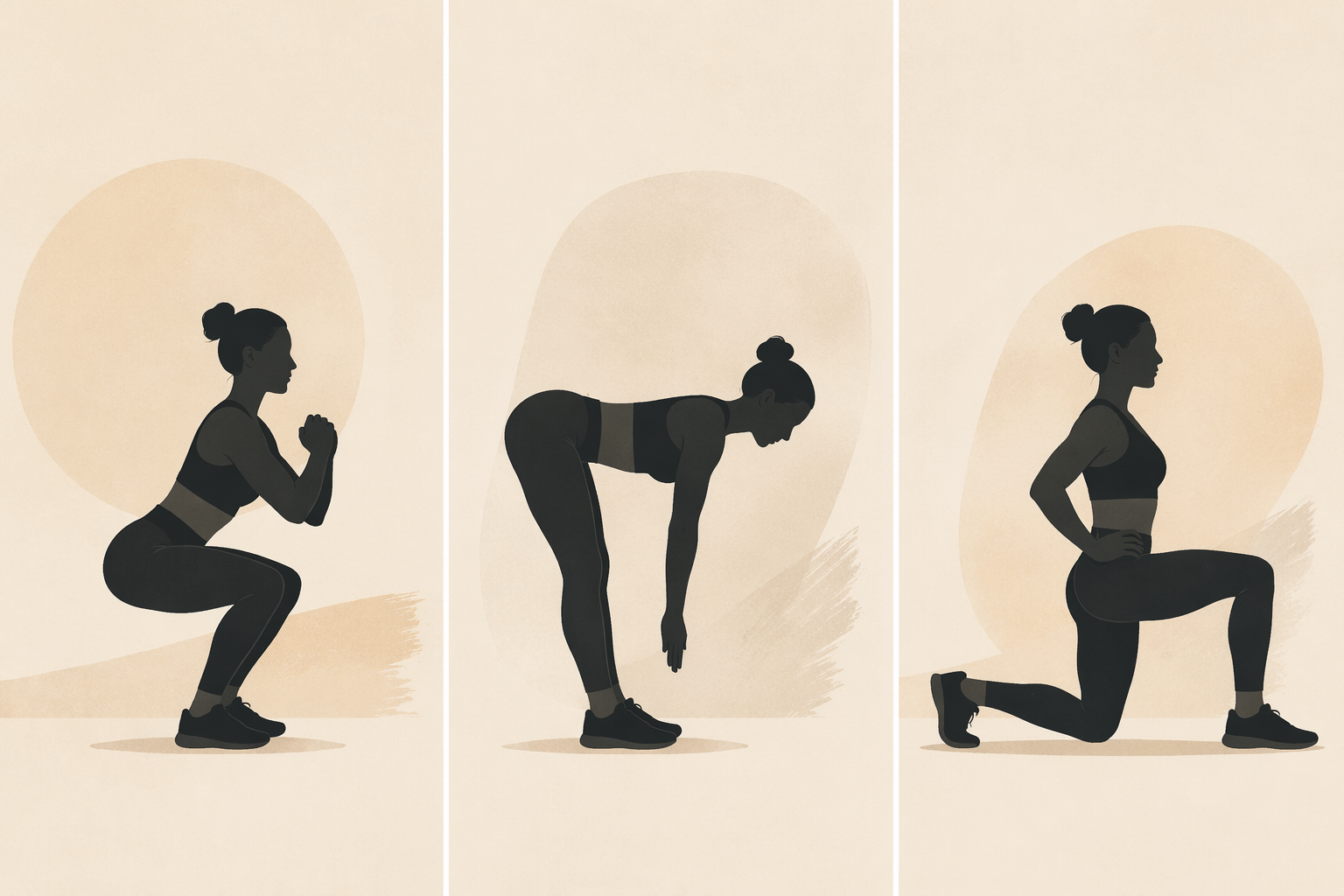
The three-pattern framework
The three patterns are not a perfect exercise taxonomy. Step-ups, lateral lunges, and split squats can blur the lines. That is fine. The point is not to win an anatomy argument; it is to stop building leg day from whatever exercise happens to appear next in a feed.
| Pattern | What it mainly trains | Home-friendly examples |
|---|---|---|
| Squat | Quads and glutes, with the knees and hips bending together | Bodyweight squat, goblet squat, box squat, wall sit |
| Hinge | Hamstrings and glutes, with the hips moving back | Glute bridge, hip thrust, Romanian deadlift, single-leg RDL |
| Lunge / single-leg | Quads, glutes, balance, and left-right control | Reverse lunge, split squat, Bulgarian split squat, step-up |
Healthline’s leg workout guide groups lower-body exercises by movement type and muscle emphasis in a similar way, including squat, hinge, and lunge-based options rather than treating every exercise as interchangeable [1].
Start with the squat pattern
The squat is usually the easiest anchor because most people understand the basic shape: bend the knees, sit down, stand back up. It gives your workout a clear quad-and-glute movement without needing much setup.
Choose the version that matches your current control, not the one that looks most impressive.
- Bodyweight only: bodyweight squat, box squat, squat to chair, wall sit.
- Dumbbell available: goblet squat, dumbbell front squat, suitcase squat.
- Band available: banded squat, banded box squat.
- Need a quieter or smaller-space choice: box squat, tempo squat, wall sit.
For a beginner, a squat to a chair often beats a loose, deep squat done with collapsing knees and a rushed bottom position. The chair gives a target. It also makes the workout repeatable, which is more useful than pretending every living room squat needs to look like a gym demonstration.
Add a hinge so the back of the legs does real work
A squat-heavy home workout can feel productive and still miss a lot of hamstring work. The hinge pattern fixes that. Instead of dropping straight down, you push the hips back or extend them against resistance. That is why glute bridges, hip thrusts, and Romanian deadlifts belong in the same conversation even though they do not look identical.
- Bodyweight only: glute bridge, single-leg glute bridge, hip thrust using a couch or bench.
- Dumbbell available: dumbbell Romanian deadlift, dumbbell hip thrust.
- Band available: banded glute bridge, banded pull-through if your setup is secure.
- Need a simple first hinge: glute bridge before Romanian deadlift.
The hinge is also where many home workouts quietly become better. A set of controlled Romanian deadlifts with a backpack or dumbbells may not look dramatic, but it gives the session something a squat cannot fully replace: loaded hip flexion and extension with the hamstrings involved.
Use the lunge or single-leg pattern to make light equipment matter
The lunge slot is where a home routine stops being just “squats plus something for glutes.” Reverse lunges, split squats, Bulgarian split squats, step-ups, and single-leg RDLs make each leg work more independently. That matters when your entire equipment collection is one pair of dumbbells and a stubborn resistance band.
SELF’s trainers discuss single-leg movements such as Bulgarian split squats and single-leg RDLs as a way to make bodyweight or light-load training more challenging because one leg carries more of the work [2]. Centr uses the same basic programming logic in its bodyweight leg exercise guidance: progress the exercise by changing leverage, tempo, range, or unilateral demand before assuming heavier equipment is required [3].
For many beginners, the reverse lunge is the cleanest entry point. It is usually easier to control than a forward lunge because the front foot stays planted. If balance is the limiter, use a split squat first. If strength is the limiter, shorten the range of motion and build it gradually.
- Most beginner-friendly: reverse lunge, supported split squat, low step-up.
- More demanding without much equipment: Bulgarian split squat, walking lunge, single-leg RDL.
- Quiet apartment choice: split squat, reverse lunge, slow step-up.
- Higher-impact option when appropriate: jump lunge or skater variation.
If impact is a problem, do not force jump lunges into the plan just because they appear in advanced routines. A slow Bulgarian split squat will make plenty of people reconsider their life choices without annoying the downstairs neighbor. For more quiet substitutions, use an apartment-friendly leg day instead of turning every progression into jumping.
Build the workout: one exercise per pattern
The base template is short on purpose:
- Pick one squat.
- Pick one hinge.
- Pick one lunge or single-leg movement.
- Do 3 sets of 8–12 reps for each exercise.
That three-exercise, 3-set, 8–12-rep structure lines up with beginner lower-body programming guidance from Verywell Fit and with exercise-selection advice from Healthline and SELF [1][2][4]. It is not a law of physiology. It is a sensible starting dose that gives you enough work to practice and progress without making the first session a 55-minute negotiation with your floor space.
| Equipment | Squat | Hinge | Lunge / single-leg |
|---|---|---|---|
| Bodyweight only | Box squat | Glute bridge | Reverse lunge |
| One pair of dumbbells | Goblet squat | Dumbbell Romanian deadlift | Dumbbell split squat |
| Bands | Banded squat | Banded glute bridge | Supported reverse lunge |
| Quiet apartment | Tempo squat | Hip thrust | Split squat |
Rest long enough that the next set still looks like the same exercise. For many home exercisers, that means not racing through the whole workout as if leg day must double as cardio. If your squat form falls apart because you gave yourself 20 seconds to recover, the rest period is not efficient; it is just short.
Progress without rebuilding the whole routine
Progression is where home leg workouts either become useful or become random. You do not need a fresh exercise menu every Monday. You need a way to make the same patterns gradually harder.
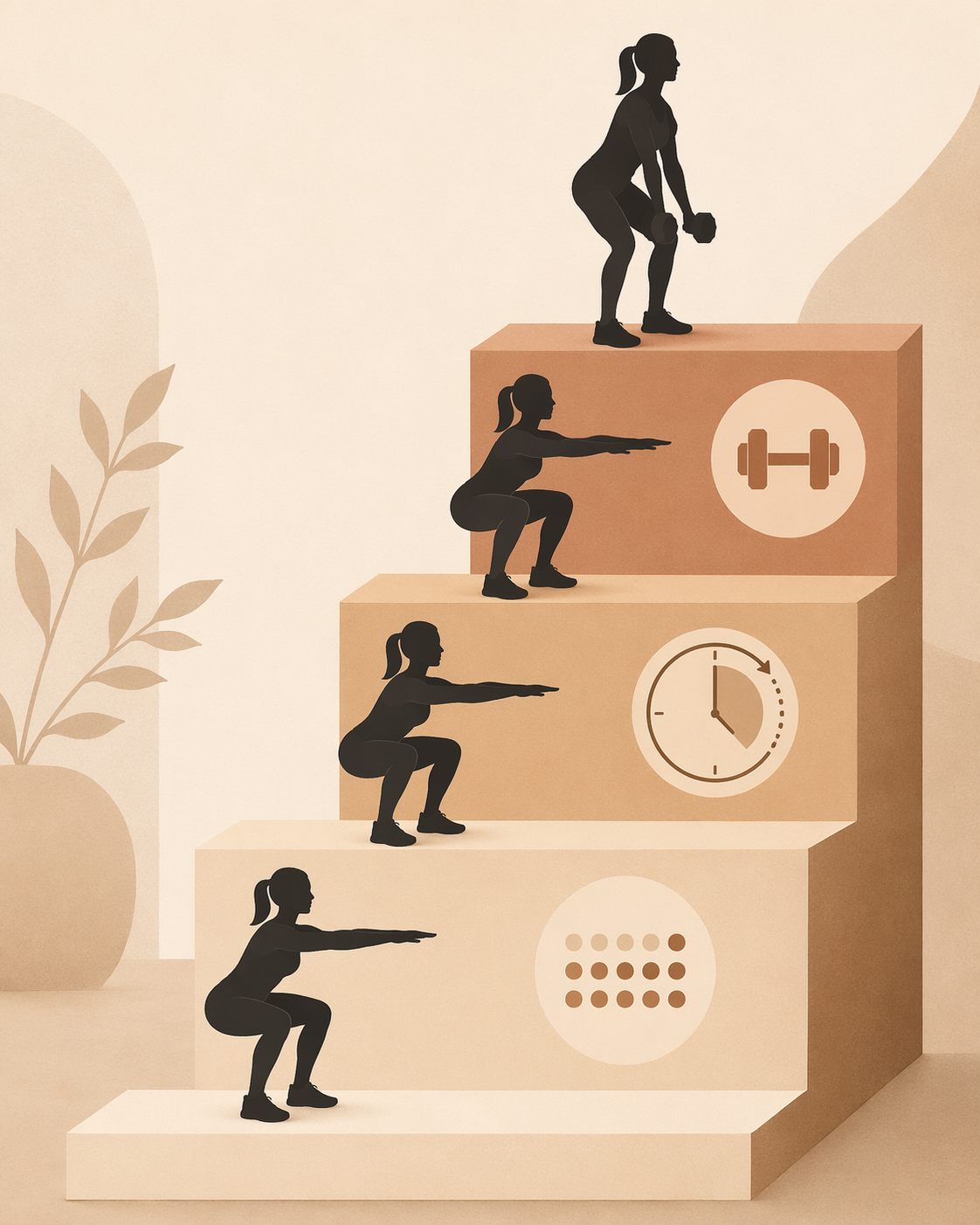
Use this ladder before chasing novelty:
- Master the bodyweight version. You should be able to repeat the movement with control, balance, and a consistent range of motion.
- Add reps. When 8–12 reps are solid, build toward 15–20 reps before changing the exercise or adding difficulty.
- Slow the lowering phase. A 3–5 second eccentric makes the same movement harder without requiring new equipment.
- Add load. Use dumbbells, a backpack, bands, or a more demanding unilateral version.
Centr’s bodyweight leg training guidance and SELF’s progression advice both support this kind of ladder: improve control first, then increase volume, tempo difficulty, or load rather than assuming bodyweight training has run out of options [2][3].
A practical example: if your current workout is bodyweight squats, glute bridges, and reverse lunges, do not replace all three the moment it feels manageable. First take the squats from 10 reps to 15. Then slow the descent. Then hold a dumbbell in a goblet position. The hinge might progress from glute bridge to single-leg glute bridge, while the lunge might progress from reverse lunge to split squat or Bulgarian split squat. Same pattern, harder job.
How often to use the template
For most beginners and intermediate home exercisers, using this lower-body template 2–3 times per week is more useful than saving all leg work for one overloaded day. Verywell Fit cites a 2015 strength-training frequency study when discussing why training a muscle group more than once weekly can be beneficial for strength and hypertrophy outcomes [4].
That does not mean every session has to be brutal. A two-day week might use the same three-pattern structure twice, with one day heavier or slower and the other cleaner and lighter. A three-day week might rotate emphasis: squat-focused, hinge-focused, then single-leg-focused, while still keeping all three patterns somewhere in the week.
If you want the scheduling question handled in more detail, use this guide to leg workout frequency at home. Frequency deserves its own decision process; otherwise, this article would turn into a calendar debate instead of helping you build the workout.
A few complete examples
These are examples of the framework at different levels, not mandatory routines. The useful part is the pattern balance.
| Level | Session |
|---|---|
| Beginner | Box squat — 3×8–12; glute bridge — 3×8–12; reverse lunge — 3×8–12 per side |
| Intermediate | Goblet squat — 3×8–12; dumbbell Romanian deadlift — 3×8–12; split squat — 3×8–12 per side; calf raise or wall sit as optional accessory |
| Advanced home setup | Tempo goblet squat; dumbbell Romanian deadlift; Bulgarian split squat; single-leg hip thrust; optional plyometric or loaded finisher if impact and recovery are appropriate |
The beginner version stays with three exercises because more is not automatically better. The intermediate version adds either load, tempo, or a small accessory. The advanced version earns its extra work by making each pattern harder, not by dumping every lower-body exercise into one session.
When the framework needs adjusting
If your goal is maximal strength, you may eventually need heavier loading and lower-rep work than a basic 8–12-rep home template provides. If your goal is muscular endurance, higher-rep sets and shorter rests may make more sense. If your knees, hips, or back object to a specific movement, swap the exercise inside the pattern rather than throwing away the whole session.
That last point matters. A painful forward lunge does not mean you cannot train single-leg work. It may mean you use a reverse lunge, supported split squat, step-up, or shorter range of motion. A Romanian deadlift that you cannot feel anywhere but your low back may need to become a glute bridge while you learn the hinge.
After you build your first version, the most useful troubleshooting is usually simple: check whether you skipped a pattern, made every exercise knee-dominant, progressed too fast, or turned the workout into a cardio circuit by accident. If that sounds familiar, the guide to common home leg workout mistakes is a better next stop than adding five more variations.
Build it, or use a ready-made version
If you can pick one squat, one hinge, and one lunge, you can build a usable leg workout at home. Start with 3 sets of 8–12 reps, progress by improving form, adding reps, slowing the lowering phase, and then adding load. Keep the same decision process next week instead of starting over.
If you would rather follow a finished plan, use these prebuilt leg workouts at home by equipment tier. The logic is the same; the choices are already made for you.
References
- Leg Workout, Healthline, https://www.healthline.com/health/fitness/leg-workout
- 31 Leg Exercises at Home That Require No Equipment, SELF, https://www.self.com/gallery/killer-legs-no-gear-required-slideshow
- The best bodyweight leg exercises for home workouts, Centr, https://centr.com/blog/show/16617/the-best-bodyweight-leg-exercises-for-home-workouts
- Beginner Leg Day Workout, Verywell Fit, https://www.verywellfit.com/beginner-leg-day-workout-5323162
What a small equipment investment adds
We don't have a build tagged to this exact tier yet. Browse all builds.
How often should you repeat this?
See our recovery and rest reference for citation-anchored rest-interval guidance.
Spot something off?
Tell us if a movement, tier assumption, or duration didn't match your experience.