
5 Progression Levers for Home Leg Workouts
Stuck doing the same bodyweight squats and lunges? This guide explains five research-backed progressive overload levers — tempo, unilateral loading, range of motion, volume, and plyometric complexity — organized into a beginner-to-advanced system for continuing leg strength gains at home without heavy weights.
- Duration
- 30 min
The awkward point in many leg workouts at home is not the first week. It is the week when squats no longer feel like work, lunges are just something to get through, and the only obvious options seem to be doing more reps, jumping around harder, or buying heavier equipment.
In a gym, the next step is often visible: add plates. At home, the next step has to be built. The useful progression levers are tempo, range of motion, unilateral loading, weekly volume, and plyometric complexity. Used deliberately, they turn a pile of bodyweight exercises into a system.
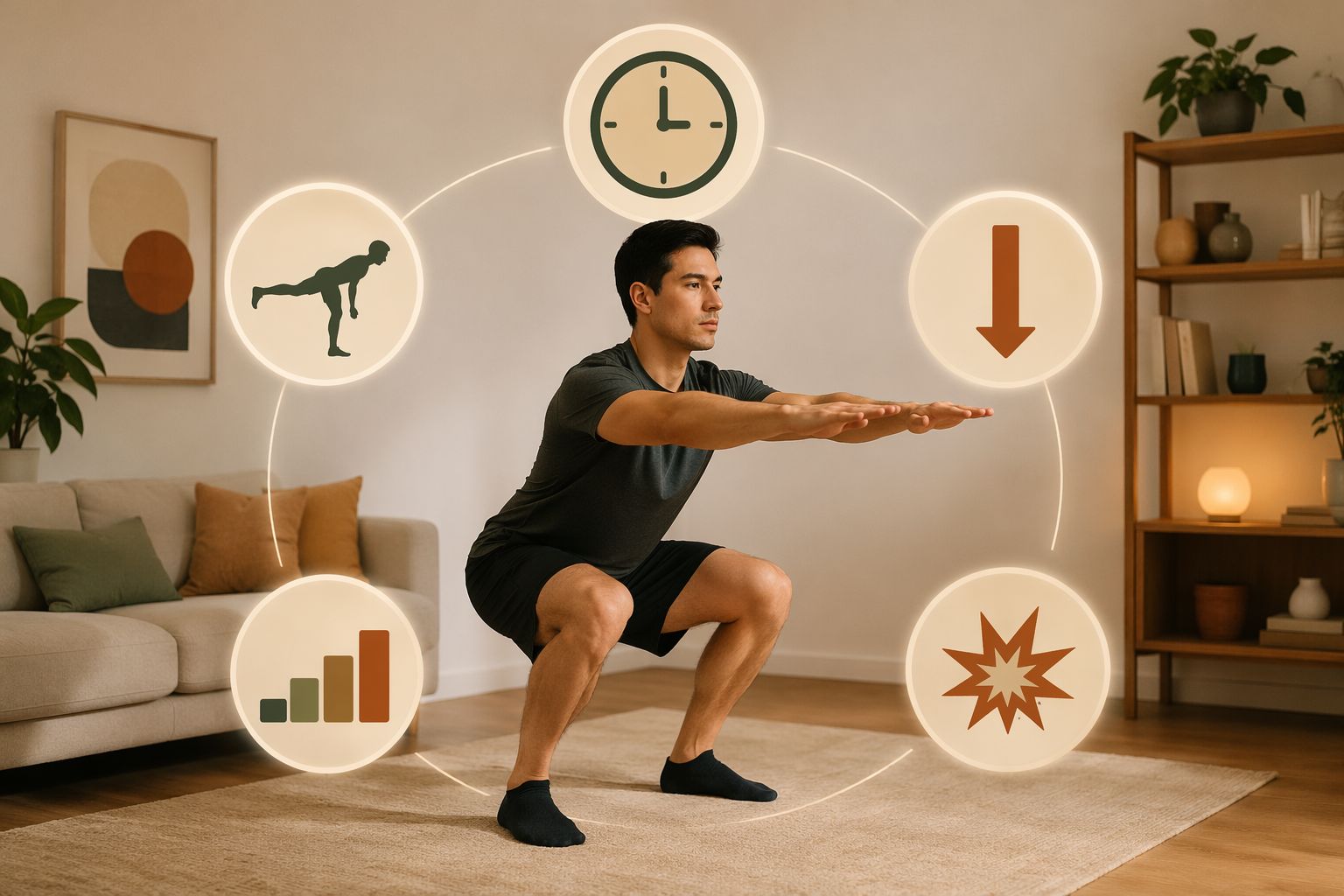
| Progression lever | What you change | Best used when |
|---|---|---|
| Tempo | Slow the lowering phase, pause, or control the lifting phase | An exercise is technically sound but feels too easy |
| Range of motion | Use a deeper, cleaner movement path | You are cutting depth to make reps easier or faster |
| Unilateral loading | Shift more work onto one leg | Two-leg versions no longer create enough tension |
| Volume | Add hard sets across the week | The exercise is hard enough, but total weekly work is too low |
| Plyometric complexity | Progress jumps, bounds, and landing demands | Strength, control, joints, and recovery are already prepared |
The first lever is control, not punishment
If a bodyweight squat is easy, the first useful question is not “How many more can I do?” It is “Can I make each rep harder without changing the exercise?” Tempo does that cleanly. Slowing the eccentric phase—the lowering part—to about 3–4 seconds is commonly used in home lower-body training to increase time under tension and make bodyweight movements more demanding without adding load.[1][2]
That means a squat rep stops being a quick drop-and-stand. It becomes a controlled descent, a stable bottom position, and a deliberate drive up. The same idea works for split squats, step-ups, glute bridges, hip thrusts, calf raises, and hinge patterns. A light movement becomes useful again because the muscle has to keep producing tension instead of borrowing momentum.
- For squats: lower for 3–4 seconds, pause briefly at your deepest controlled position, then stand.
- For split squats: keep the front foot rooted and lower slowly until the back knee approaches the floor without collapsing forward.
- For glute bridges or hip thrusts: pause at the top instead of bouncing through the strongest position.
- For calf raises: pause at the top and lower slowly until the ankle reaches a comfortable stretch.
Tempo is not a trick to make everything miserable. It is a way to expose whether the movement is actually owned. If a squat only feels hard when it is fast and sloppy, it has not run out of progression yet.
Depth changes the stimulus more than most people expect
Range of motion is often treated as a form detail. For home training, it is also a loading tool. A deeper squat asks the quads and glutes to work through a longer path. A deeper split squat increases the demand on the front leg. A calf raise that moves through a real stretch and full top position is not the same exercise as a quick ankle bounce.
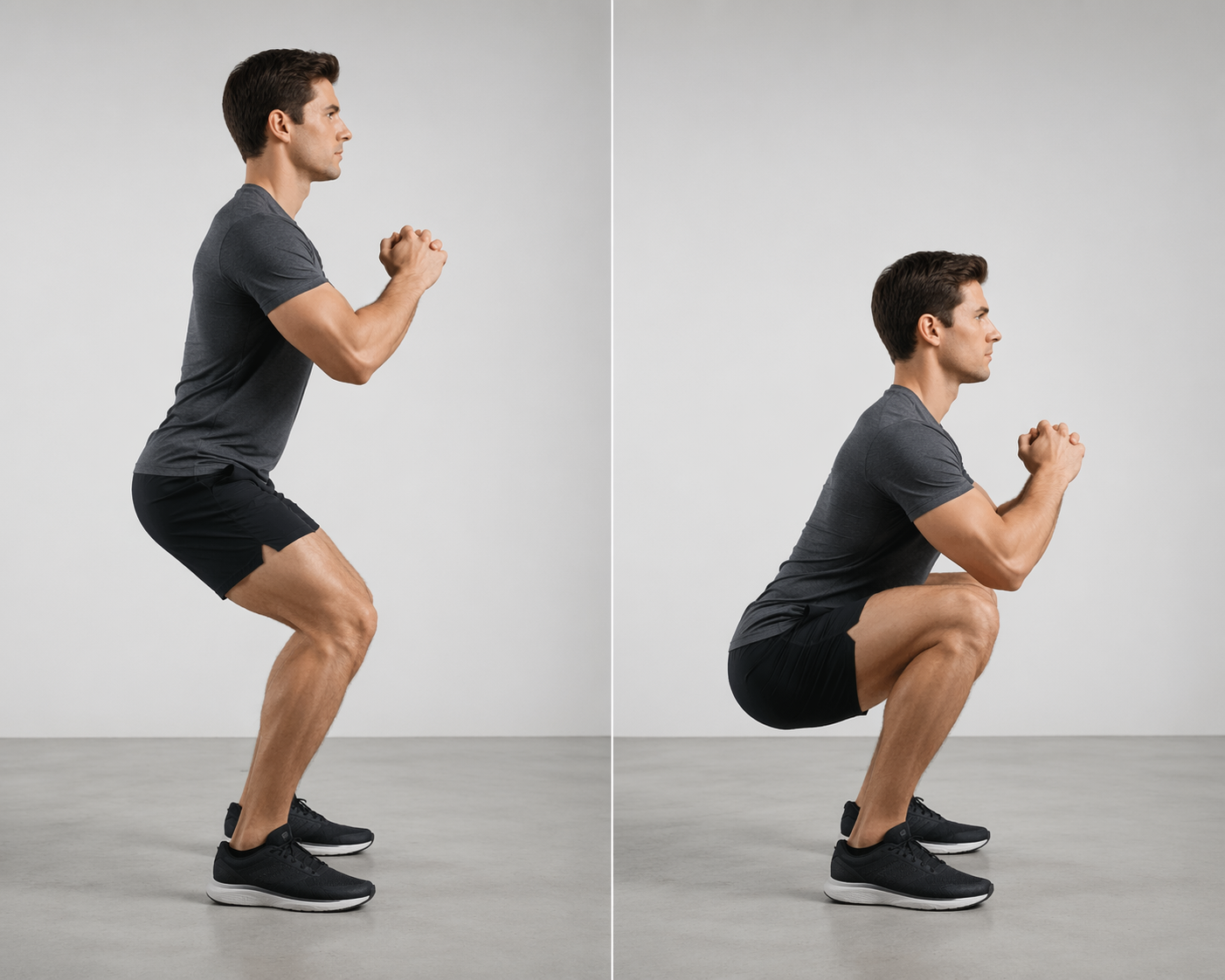
One often-cited 8-week study by Morse and colleagues found that full range-of-motion squats produced roughly twice the quad and glute hypertrophy of partial squats, even though the partial squats used heavier loads.[3] That is a small study and should not be inflated into a universal law. Still, it supports a practical point: before making a home exercise flashier, check whether you have made it complete.
Full range does not mean forcing positions your hips, knees, or ankles cannot tolerate. It means using the deepest controlled range available to you today, then trying to earn more over time. A controlled full-depth squat beats a shallow squat performed for a giant rep count because it gives the working muscles a clearer job.
When two legs are not enough, make one leg do more of the work
Unilateral work is the lever many home exercisers underuse. A regular squat spreads the work across both legs. A split squat, step-up, Bulgarian split squat, or single-leg squat pattern pushes much more of your bodyweight through one side at a time. Built With Science summarizes the single-leg loading problem plainly: a single-leg squat can channel roughly 85–100% of bodyweight through one leg.[3]
That is why the Bulgarian split squat deserves more than a passing mention. It is not magic, and it does not replace every benefit of heavy barbell work. But for someone training in a living room, it is one of the most credible ways to make legs work hard without a rack. Turner and colleagues, cited by Built With Science, found Bulgarian split squats may be as effective at increasing squat 1RM as back squats themselves, with less lower-back strain.[3]
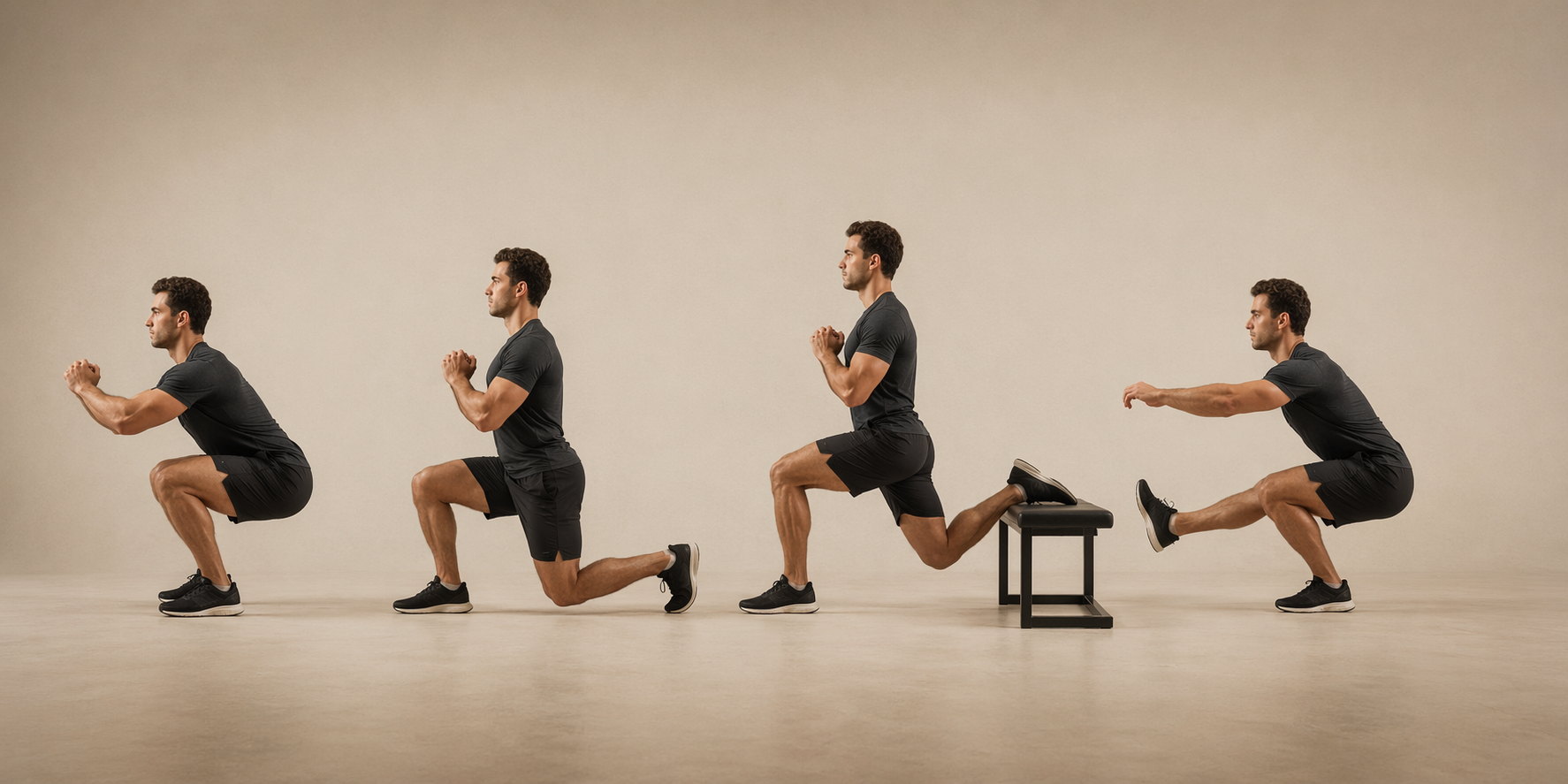
The sequence matters. Jumping from regular squats straight to pistol squats often turns strength training into a balance contest. A cleaner path is bodyweight squat, slow full-depth squat, split squat, rear-foot-elevated split squat, then more demanding single-leg squat variations if your control justifies them.
| If this is easy | Progress to this | What changed |
|---|---|---|
| Bodyweight squat | Slow full-depth squat | More time under tension and more useful range |
| Slow full-depth squat | Split squat | More load and stability demand on one leg |
| Split squat | Bulgarian split squat | Greater front-leg demand and deeper working range |
| Bulgarian split squat | Assisted single-leg squat variation | Higher unilateral demand with support as needed |
A complete home leg workout is not only squats and lunges
Squats and lunges can carry a lot of lower-body training, but they do not cover everything well. A useful home plan needs at least five movement patterns: squat, hinge, lunge or single-leg pattern, hip extension, and calf work.
| Pattern | Home exercise examples | Why it belongs |
|---|---|---|
| Squat | Bodyweight squat, tempo squat, heels-elevated squat | Trains quads and glutes through knee and hip flexion |
| Hinge | Hip hinge drill, good morning, single-leg Romanian deadlift pattern | Loads hamstrings and glutes through hip flexion and extension |
| Lunge / single-leg | Split squat, reverse lunge, step-up, Bulgarian split squat | Builds one-leg strength and stability |
| Hip extension | Glute bridge, feet-elevated bridge, hip thrust | Targets glutes in a shortened, locked-out position |
| Calf | Standing calf raise, single-leg calf raise, slow deficit calf raise if safe | Trains the lower leg through ankle movement |
This is where glute exercise debates can get noisy. The practical takeaway is simple: include more than one hip-dominant shape. Built With Science cites Bret Contreras’s research showing hip thrusts reaching about 100% of maximum voluntary contraction for the glutes, compared with squats at about 50–70%.[3] Those figures are protocol-dependent and come from a specific body of EMG work, so they should not be read as a command to abandon squats. They do explain why a home leg workout built only around squatting can leave hip extension undertrained.
Step-ups deserve space for the same reason. InBody summarizes a 2020 review in which step-ups showed the highest gluteus maximus activation across the exercises tested.[4] That does not make step-ups mandatory for every person, but it does make them useful when you have a stable surface and can control the lowering phase instead of dropping off the step.
The hinge pattern is the common missing piece. A Romanian-deadlift-style pattern, even without heavy weights, teaches the hamstrings to work while the hips move back and the spine stays controlled. Built With Science also points to hip-hinge variations such as Romanian deadlifts and good mornings as high-EMG hamstring options.[3] At home, that may start as a wall-touch hinge drill and later become a slow single-leg RDL pattern.
Volume is the guardrail, not the whole plan
Once an exercise is controlled, deep enough, and loaded well for your equipment situation, volume becomes the next dial. Men’s Health UK cites a systematic review preprint supporting 10–20 hard weekly sets as a useful muscle-building range.[5] Treat that as a working range, not a law. A hard set of Bulgarian split squats is not the same recovery cost as a casual set of bodyweight squats.
Frequency sets the shape of that volume. Research summarized by Verywell Fit cites Schoenfeld and colleagues’ 2015 work comparing 1x versus 3x weekly training in trained men, where the higher frequency was superior for hypertrophy outcomes.[6] That does not prove every beginner needs three hard leg days, but it does support the common home-training sweet spot of 2–3 lower-body sessions per week when recovery allows.
For most people, the better question is not “How destroyed should my legs feel today?” It is “How many hard, repeatable sets can I recover from this week?” If soreness from Monday ruins Wednesday and Friday, the plan is not more advanced. It is just harder to repeat.
- Beginner: 2 lower-body sessions per week, with a few hard sets per pattern and plenty of practice quality.
- Intermediate: 2–3 sessions per week, using harder unilateral and tempo variations while keeping weekly sets recoverable.
- Advanced home trainee: 3 exposures may work well, but only if exercise selection, plyometrics, and soreness are managed instead of piled together.
If frequency is the part you are unsure about, use a dedicated guide to how often to train legs at home rather than guessing based on soreness alone.
Plyometrics come later than people want them to
Plyometric work can absolutely belong in leg workouts at home. Squat jumps, skater hops, pogo hops, bounds, and jump lunges can train power and athletic coordination. The mistake is using impact as the first answer to boredom or stalled progress.
A jump is not automatically a progression from a squat. It is a different demand. The landing has to be quiet, the knee has to track cleanly, and the next rep should not be a rushed attempt to survive the previous one. If a person cannot perform slow split squats or controlled step-downs, jump lunges are probably not the missing ingredient.
| Plyometric level | Examples | Progress only when |
|---|---|---|
| Low impact / entry | Calf pogo prep, fast bodyweight squat to controlled stop | Landings stay quiet and joints tolerate the work |
| Basic jump | Squat jump, small broad jump | You can absorb force without knees caving or heels slamming |
| Lateral or single-leg emphasis | Skater hop, single-leg landing drill | Balance and hip control stay consistent |
| Complex repeated plyometrics | Jump lunges, repeated bounds | Recovery is good and strength work is not being compromised |
How to sequence the levers from beginner to advanced
The five levers are most useful when they are sequenced. If all of them are turned at once—slower reps, deeper range, harder unilateral work, more sets, and jumps—the plan becomes hard to interpret. You will know you are tired. You will not know what worked.
| Level | Main job | Useful exercise progressions |
|---|---|---|
| Beginner | Build control and usable range | Bodyweight squat to slow full-depth squat; glute bridge to paused bridge; hinge drill to controlled good morning; two-leg calf raise to slow calf raise |
| Early intermediate | Move more work onto one leg | Split squat; reverse lunge; step-up; single-leg glute bridge; supported single-leg RDL pattern |
| Late intermediate | Increase unilateral demand and weekly structure | Bulgarian split squat; feet-elevated hip thrust; slower single-leg RDL; single-leg calf raise; 2–3 weekly lower-body sessions |
| Advanced home trainee | Add complexity only where control remains high | Assisted pistol-squat progressions; deeper Bulgarian split squats; loaded backpack or dumbbell options if available; carefully selected plyometrics |
A beginner does not need twenty leg exercises. They need squats they can control, hinges they can feel in the hamstrings rather than the low back, bridges that actually reach hip extension, and calf raises that are not bounced. An intermediate trainee needs more one-leg work and enough weekly volume to make those hard sets add up. An advanced home trainee needs selectivity, because the hardest-looking variation is not always the best next variation.
If you want to build your own sessions from the movement patterns, use a guide to designing your own leg workout at home. If you would rather stop planning and follow a sequence, a progressive bodyweight leg training program is the cleaner next step.
A practical next-step rule
When an exercise in your home leg workout gets too easy, use this order:
- Improve control first: slow the lowering phase, remove bouncing, and own the hardest part of the rep.
- Use more range if your joints and technique allow it: deeper squats, deeper split squats, fuller calf raises, cleaner hip extension.
- Shift more work to one leg: split squats, step-ups, Bulgarian split squats, single-leg bridges, supported single-leg hinges.
- Adjust weekly volume and frequency: add hard sets or another weekly exposure only if recovery stays good.
- Add plyometric complexity last: only when landing control, joints, and recovery are ready.
Equipment can still be useful. A pair of dumbbells, bands, a step, or a weighted backpack can extend the runway. But equipment should solve a real limit, not cover up a missing progression system. If you have already worked through tempo, range, unilateral loading, and recoverable volume, then an equipment guide for training legs at home can help you choose what actually changes your training.
Home leg progression is not a lesser version of gym progression. It is less automatic. Without the easy “add weight” button, the system has to be clearer: control, depth, one-leg demand, weekly work, and then power.
References
- The Best Lower Body Bodyweight Workouts, PureGym, March 2026.
- Leg Workouts At Home With Dumbbells vs Alternatives, Centr.
- Best Leg Workouts (4 Exercises For Thicker Quads), Built With Science, January 2018.
- The Best Leg Workouts, According to Science, InBody USA.
- This Is How Many Leg Exercises You Really Need to Build Muscle, Men’s Health UK.
- Beginner Leg Day Workout, Verywell Fit, June 2022.
What a small equipment investment adds
We don't have a build tagged to this exact tier yet. Browse all builds.
How often should you repeat this?
How Whoop and Oura Ring track recovery for home workouts
For home exercisers deciding between WHOOP and Oura Ring, the better sleep and recovery tracker depends on training style: WHOOP's strength-aware tracking fits dumbbell and grip-heavy sessions, while Oura's sleep-first scoring suits yoga and indoor cycling. The verdict hinges on how each builds its daily recovery score, their home-workout tracking gaps, and who pays for hardware versus subscription.
Spot something off?
Tell us if a movement, tier assumption, or duration didn't match your experience.