
The step-up is usually treated like filler: something you do fast, between “real” leg exercises, until your breathing catches up with your ambition. That is a bad deal for anyone building leg workouts at home. In a 2020 review summarized by InBody, step-ups produced the highest gluteus maximus activation among the exercises studied, ahead of hip thrusts, squats, and deadlifts.[1]
That does not mean every rushed stair climb is suddenly a superior muscle-building plan. It means the usual home leg-day hierarchy deserves a hard edit. If a move gives you high activation, can be loaded with a backpack or single dumbbell, and does not require a machine, it earns a bigger share of your limited training time.
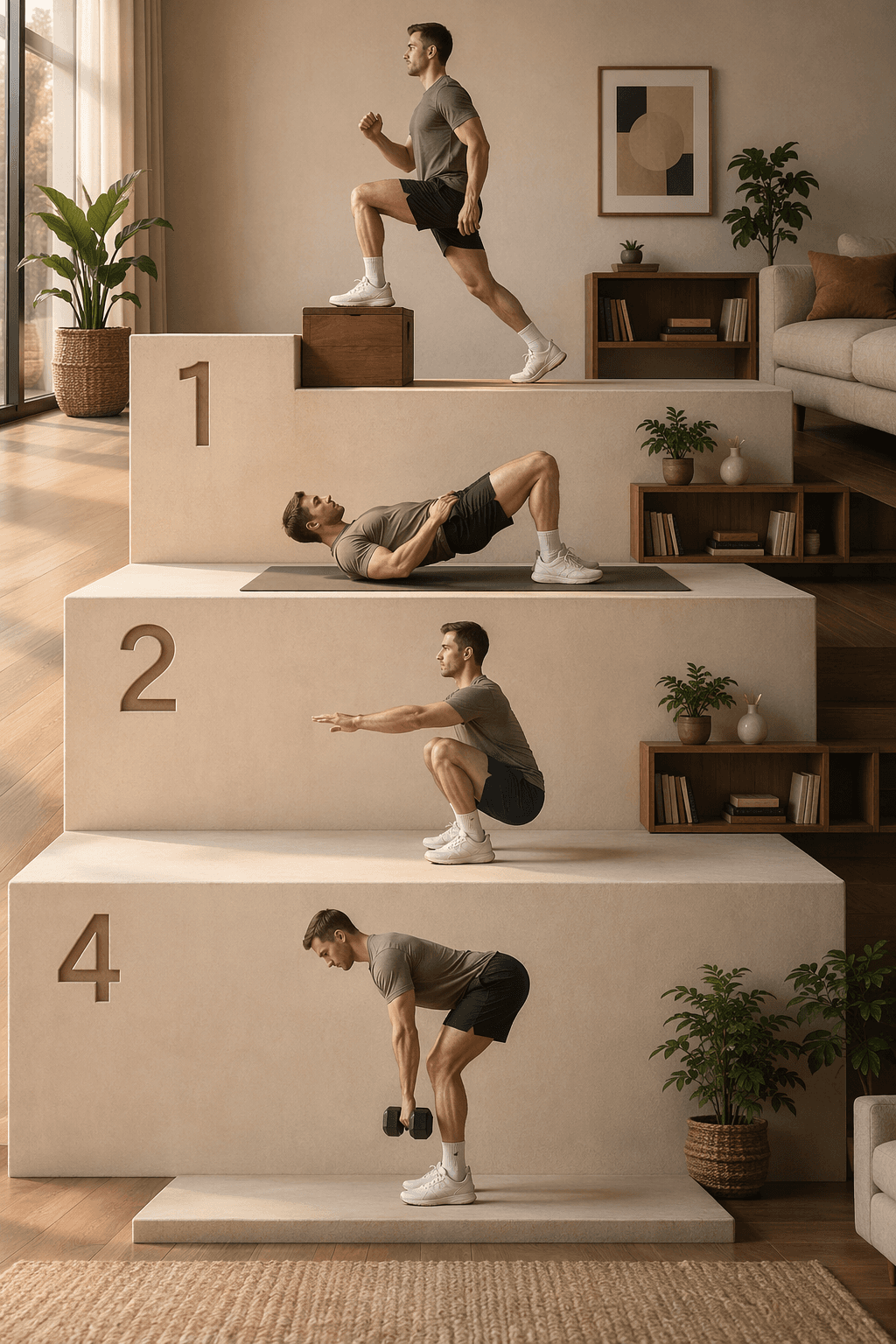
The ranking below uses three filters: measured muscle activation where the evidence supports it, home practicality, and stimulus-to-effort ratio. EMG is useful here because it tells us which muscles are working hard during an exercise. It is not a complete prediction of muscle growth, and it does not rescue sloppy execution. But for home training, where every set costs time and equipment is limited, it is a better starting point than another random “burnout” list.
The highest-value home leg exercises
| Rank | Exercise | Best use at home | Main caution |
|---|---|---|---|
| 1 | Step-up | Glute-focused unilateral strength with a box, bench, stair, or sturdy chair | Step height and control matter; a low, fast step-up is not the same exercise |
| 2 | Hip thrust | Heavy glute work with bodyweight, band, dumbbell, or backpack | Easy to rush or turn into a low-back extension if the rib cage and pelvis are not controlled |
| 3 | Full-depth squat | Quads, glutes, and adductors through a longer range of motion | Not everyone should force depth; hips, knees, ankles, and symptoms decide the range |
| 4 | Romanian deadlift | Hamstring and glute hinge work when machines are unavailable | Loading and bracing matter more than chasing a big stretch |
1. Step-ups: the underrated glute leader
The step-up’s ranking is the one that should change tomorrow’s workout. The 2020 review cited by InBody reported that step-ups produced the highest gluteus maximus activation of the included exercises, outperforming better-known glute staples such as hip thrusts, squats, and deadlifts.[1] For home training, that is not a cute trivia point. It means the sturdy box in the corner may deserve more respect than the tenth variation of a banded kickback.
The catch is that “step-up” is too broad a label. A low, springy step-up done for speed is mostly conditioning. A controlled step-up to a height that makes the working hip and knee travel through a meaningful range is a different stimulus. If the lead leg actually drives the rep instead of the trailing foot bouncing off the floor, the glute has to do more of the job.
For muscle-building home workouts, use a stable surface. Start at a height you can control without twisting or pushing hard through the back foot. Keep one leg as the lead leg for the full set before switching sides when the goal is strength and muscle, because alternating every rep often turns the exercise into a coordination drill. Add load only after the descent is quiet and repeatable.
- Best low-equipment loading options: one dumbbell held goblet-style, one dumbbell held suitcase-style, a loaded backpack, or a slow eccentric tempo.
- Best progression: increase control first, then height if your joints tolerate it, then external load.
- Common downgrade: choosing a step so low that the set feels tiring but never asks the glutes to produce much force.
2. Hip thrusts: still one of the best home glute builders
Hip thrusts did not disappear just because step-ups had the surprise win. The cited research reports greater gluteus maximus activation in hip thrusts than in squats, with the practical explanation that the hip thrust loads the glutes heavily near the shortened position.[1] That makes it especially useful at home, where you may not have enough weight to make a squat brutally heavy.
This is where the hip thrust earns its place: it lets you take a simple setup and make the glutes work hard without needing a rack, barbell, or leg press. Shoulders on a couch, feet planted, dumbbell or backpack across the hips, pause at the top, lower under control. The pause matters. A hip thrust bounced through the top half of the rep is more theater than training.
The best home version is usually boring in the right way: ribs down, pelvis controlled, shins roughly vertical near the top, and a clear lockout without arching the lower back. If the load slides around, wrap it in a towel. If two-leg thrusts are too easy and load is limited, move to single-leg hip thrusts before adding endless high-rep band pulses.
3. Full-depth squats: range of motion changes the result
Squats are not automatically high-value just because they are squats. Depth changes the training effect. A 2020 study found that full-range squats, with the hips traveling below the knees, were significantly more effective for developing the adductors and glutes than partial or half squats.[2]
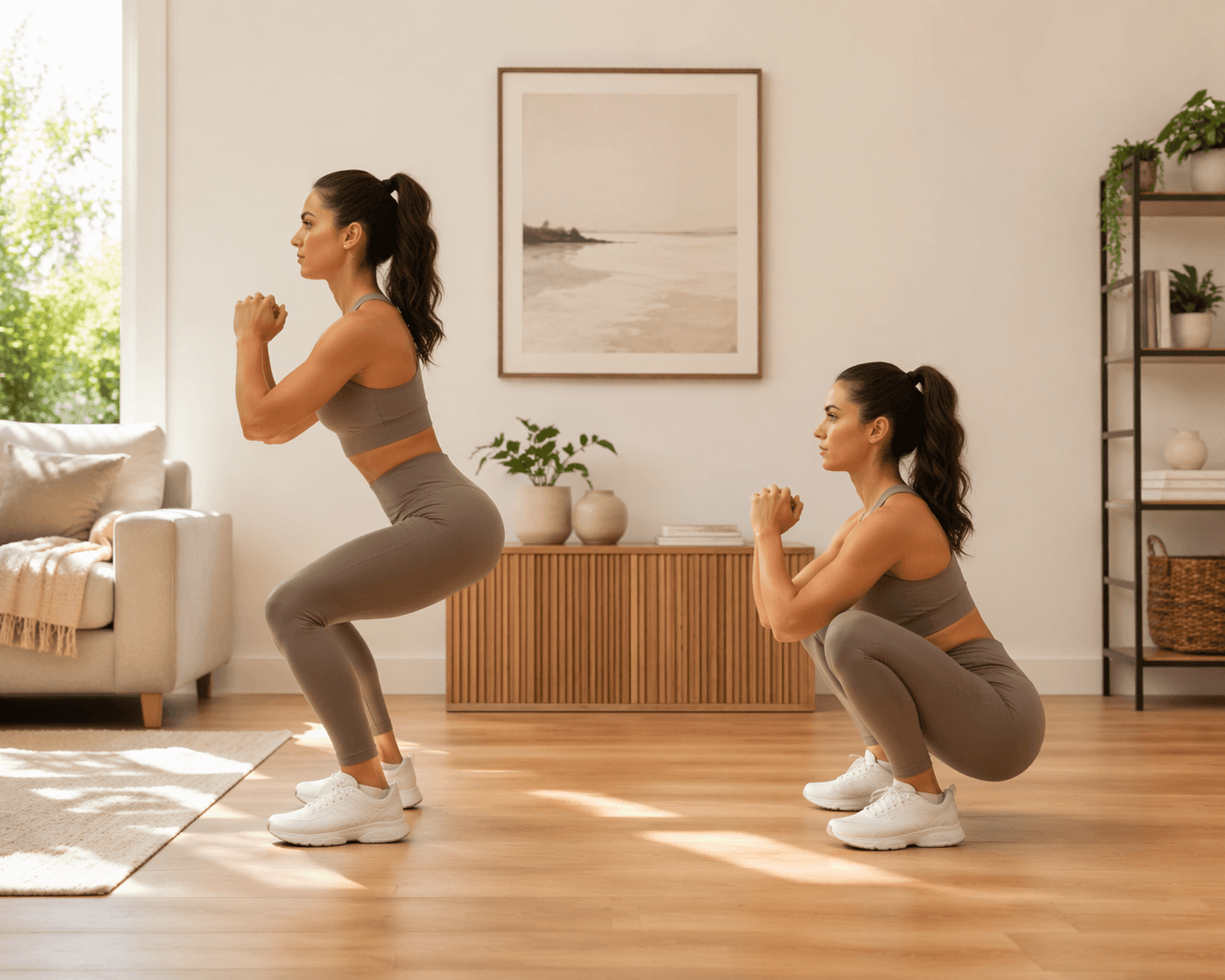
That is a range-of-motion argument, not a purity test. If your full-depth squat folds into a painful, unstable position, forcing it is not more scientific. But if you have been doing fast quarter squats because a video told you they “burn,” the research gives you a better direction: own a deeper pain-free range before adding more reps.
At home, a full-depth squat can be loaded with a dumbbell, kettlebell, backpack, or slow tempo. A heel elevation can help some people reach depth more comfortably, but it should not hide knee or hip pain. Readers with knee, hip, ankle, or back issues should get individualized guidance from a physical therapist or qualified clinician before pushing deep squats, weighted step-ups, or high-volume hinging.
4. Romanian deadlifts: the home hamstring anchor
Hamstrings are where many home leg workouts get thin. Without a leg curl machine, people default to squats, lunges, and more squats, then wonder why the back of the legs never seems to catch up. Romanian deadlifts solve that problem better than most living-room alternatives. A 2019 review reported very high hamstring activation for Romanian deadlifts across multiple studies.[3]
The home version does not need to be fancy. One dumbbell held with both hands, two dumbbells if you have them, a loaded backpack, or a heavy household object can work if the load is secure. The movement is a hinge: hips travel back, spine stays controlled, knees stay softly bent, and the weight stays close enough that your back is not doing a sloppy rescue mission.
If the available weight is light, slow the lowering phase, pause near the bottom without relaxing, or move to a single-leg Romanian deadlift. Single-leg versions are not automatically better; they are better when balance does not become the limiting factor before the hamstrings and glutes receive a real stimulus.
The moves that belong lower in the hierarchy
Overrated does not mean useless. It means a move is often given more space in a workout than its likely stimulus deserves. A five-minute finisher is one thing. Building the entire session around low-stimulus drills because they burn is where home leg training starts wasting effort.
| Lower-priority move | Why it drops | When it can still help |
|---|---|---|
| Shallow or partial squats | They shorten the range and underdeliver for glute and adductor development compared with full-depth squats. | Useful when temporarily modifying range for pain-free practice, warm-ups, or specific rehab guidance. |
| Isolation-only band drills | They can create a strong burn without matching the total stimulus of harder compound patterns. | Useful as warm-ups, finishers, or extra glute medius work after the main lifts. |
| Leg extensions | They can train the quads, but they are machine-based and rarely practical in a true home setup. | Useful if you have the machine or are following a rehab plan that specifically includes knee extension. |
| Random high-rep leg circuits | They often increase fatigue faster than meaningful mechanical tension. | Useful for conditioning, but they should not replace your hard sets of step-ups, squats, hip thrusts, and hinges. |
This is also where many people mistake sensation for selection. A banded abduction ladder can feel vicious. A hundred pulse squats can make your legs shake. Neither automatically beats a controlled set of loaded step-ups or Romanian deadlifts. If your best exercises keep failing in practice, the issue may be setup, depth, tempo, or progression rather than motivation; the most common execution traps are covered in 8 Common Home Leg Workout Mistakes That Kill Your Progress.
How to turn the ranking into a home leg workout
A good home leg workout does not need twelve exercises. It needs enough hard work on the right patterns. One important programming principle is that total training volume—sets multiplied by reps—matters more for muscle growth than simply training more often.[4] In plain English, two focused leg sessions can beat four scattered sessions if the hard sets are better chosen and progressed.
For a ready-made version of that approach, use The Science-Based Home Leg Workout. If you want to build your own session from the ranking, start with this structure:
| Slot | Choose from | Purpose |
|---|---|---|
| Main unilateral lift | Step-up | High glute stimulus, useful loading with minimal equipment |
| Main squat pattern | Full-depth goblet squat or bodyweight squat to a controlled depth | Quads, glutes, and adductors through a meaningful range |
| Main hinge | Romanian deadlift | Hamstrings and glutes without a machine |
| Glute accessory | Hip thrust or single-leg hip thrust | Extra glute loading, especially near lockout |
| Optional finisher | Band abductions, wall sit, calf raises, or bodyweight split squats | Extra local work after the high-value sets are done |
The set and rep targets can stay simple. General guidance places beginners around 2–3 sets of 12–15 reps and intermediate lifters around 3–5 sets of 8–12 reps, with at least 48 hours between sessions.[5][6] An intermediate home exerciser with one dumbbell might do fewer exercises than a gym program, but push those exercises closer to a meaningful effort.
- If your load is heavy enough: use 3–4 hard sets of 8–12 reps on step-ups, squats, hip thrusts, and Romanian deadlifts.
- If your load is light: use slower eccentrics, pauses, single-leg versions, or a longer range of motion before adding more exercises.
- If your joints are irritated: reduce range, load, or volume and get individualized advice rather than forcing the highest-ranked variation.
- If every set is becoming cardio: rest longer and choose harder variations instead of adding more reps.
Weekly structure matters, but it should serve volume instead of becoming a badge of seriousness. If you are deciding whether to train legs once, twice, or more often, the practical breakdown in Leg Workout Frequency at Home is a better next read than adding another random circuit.
A practical home leg-day order
Put the highest-skill or highest-load movement early, while you can still control it. For many home trainees, that means step-ups first. If step-ups bother your knees or your setup is unstable, start with squats or Romanian deadlifts instead. The ranking is a filter, not a commandment.
| Exercise | Sets and reps | Rest | Progression |
|---|---|---|---|
| Step-up | 3–4 sets of 8–12 per side | 60–120 seconds | Raise control, then height, then load |
| Romanian deadlift | 3–4 sets of 8–12 | 90–150 seconds | Add load, slow the lowering, or move to single-leg if balance allows |
| Full-depth goblet squat | 3 sets of 8–12 | 90–150 seconds | Increase depth you can own, then load |
| Hip thrust | 3 sets of 10–15 | 60–120 seconds | Add a pause, load, or single-leg version |
| Optional accessory | 1–2 sets of 12–20 | 45–90 seconds | Use only if it does not steal effort from the main work |
This is not the only possible order. A glute-focused day might place hip thrusts before squats. A hamstring-focused day might lead with Romanian deadlifts. A knee-sensitive trainee may need a shallower squat range for now. The rule is to protect the exercises that give the best return and stop letting low-priority burn work crowd them out.
Once the basic ranking makes sense, progression becomes the next bottleneck. More sweat is easy. More stimulus is planned. For a broader framework, use How to Design Your Own Leg Workout at Home or the Progressive Home Leg Blueprint when you are ready to manipulate tempo, unilateral work, range of motion, and load more deliberately.
The decision rule
Build home leg workouts around the movements with the strongest combination of activation, loadability, and practicality: step-ups, hip thrusts, full-depth squats, and Romanian deadlifts. Use shallow squats, band drills, pulses, and other burn-heavy accessories after the main work, not instead of it. Progress the hard movements before adding more random leg-day volume.
References
- The Best Leg Workouts, According to Science, InBody.
- Full-range-of-motion squat study cited in Healthline, 2020.
- Romanian deadlift hamstring activation review cited in Healthline, 2019.
- Resistance training volume and frequency guidance cited in Healthline.
- Beginner resistance-training set and rep guidance cited in Self.
- Intermediate resistance-training set and rest guidance cited in Verywell Fit.
Comments
Join the discussion with an anonymous comment.