
You’ve been doing bodyweight squats for three months. You can knock out 25 reps without breaking a sweat. Your legs aren’t growing, and they aren’t getting stronger. You don’t have a heavier dumbbell to grab. I hear this story every week. Now what?
Why More Reps Stops Working
That plateau isn’t a failure of effort. It’s a normal adaptation timeline. Based on neural and muscular adaptations, you are likely to see and experience changes in muscle strength and volume within roughly 2–3 months of regular strength training. After that, doing more reps of the same movement stops delivering new gains. The ACSM 2026 guidelines recommend at least 10 challenging sets per muscle group per week for hypertrophy, but for strength they suggest loads at ≥80% of your one-rep max. Without weight, you need different levers.
Most home exercisers know only one lever: more reps. The system below gives you six.
Six Levers That Replace Adding Weight
Each of these variables can drive adaptation on its own. Combine them and you have a progression system that works for months without a single new piece of gear.
1. Tempo. Slow down the eccentric (lowering) phase to three seconds instead of one. That increased time under tension recruits more muscle fibers. For a bodyweight squat, a 3-second descent turns an easy rep into a grind.
2. Range of motion. Going deeper is a progression in itself. One study found that full range of motion squats produced a two-fold increase in muscle size over 8 weeks compared to partial squats (Morse et al., 2013). That’s dramatic. I’d treat that number as a signal, not a guarantee — one eight-week study doesn’t make a rule. But the principle holds: depth matters. The trade-off is that full ROM also demands more recovery time (more on that later).
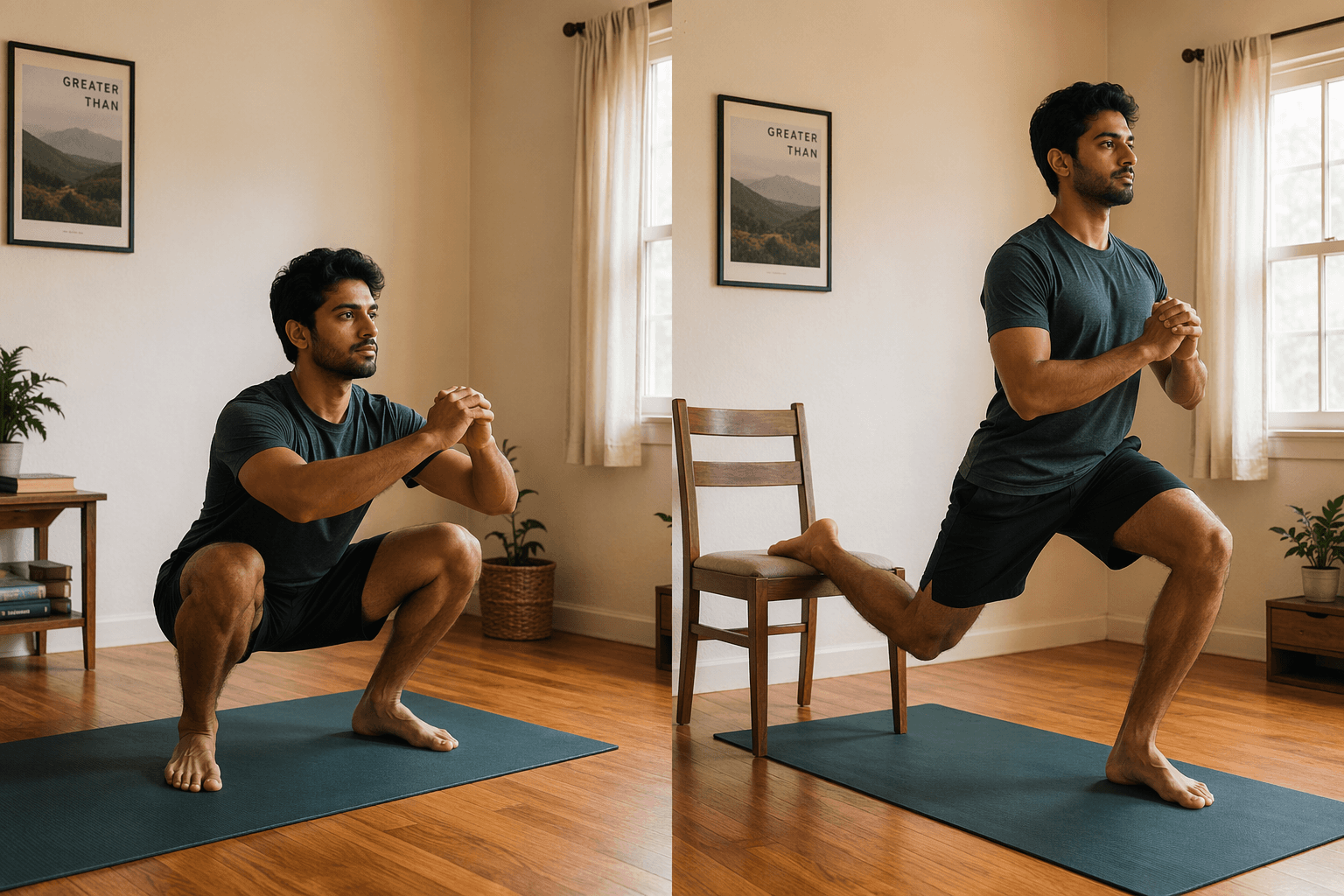
3. Unilateral work. Single-leg exercises like Bulgarian split squats force each leg to handle full bodyweight — roughly double the load per leg compared to a bilateral squat. Research shows Bulgarian split squats can increase back squat 1RM as effectively as the back squat itself, at least in trained lifters (Turner et al., 2015). For a home exerciser, the takeaway is that unilateral work builds strength that transfers to bilateral movements.
4. Rest reduction. Cutting rest from 60 seconds to 30 seconds increases metabolic stress and cardiovascular demand. The research support for hypertrophy from rest reduction alone is thin — it mostly benefits muscular endurance in bodyweight contexts. I’d keep this as an advanced tool for short windows, not the centerpiece of your progression.
5. Exercise advancement. Moving from a bodyweight squat to a Bulgarian split squat, then to a pistol squat progression, raises difficulty without adding weight. For a deeper dive on EMG-backed exercise selection, see The Science-Based Home Leg Workout.
6. Volume. More sets, not more reps. The ACSM recommends ≥10 challenging sets per muscle group per week. You can spread those across 2–3 sessions. This is the lever most people default to, but it works best when combined with others.
The six-lever framework overlaps with approaches in Progressive Overload for Legs at Home: 7 Ways. This article distills it into a single 4-week ladder with concrete instructions.
The 4-Week Ladder: Exactly How to Progress Each Week
The table below is the heart of this article. Each week has a specific rep target, tempo, rest interval, and an advancement signal that tells you when to move to the next week. Do not move up until you can complete all sets and reps with perfect form and the prescribed tempo.
| Week | Exercises | Sets × Reps | Tempo (eccentric–pause–concentric) | Rest | Advance when… |
|---|---|---|---|---|---|
| 1 | Bodyweight squat, Reverse lunge | 3 × 12–15 | 3–0–1 (3 sec down, no pause, 1 sec up) | 60 sec | You complete all reps with perfect depth and no tempo drift |
| 2 | Bodyweight squat, Reverse lunge, Glute bridge (single-leg) | 3 × 12–15 | 3–0–1 | 60 sec | Same as above — all reps clean |
| 3 | Bulgarian split squat (using a chair), Single-leg glute bridge | 3 × 10–12 per leg | 3–0–1 | 75 sec | You can do 12 reps per leg without wobbling or breaking form |
| 4 | Bulgarian split squat, Single-leg glute bridge, Reverse lunge (each rep at 3–0–1) | 3 × 8–10 per leg | 3–0–1 | 90 sec | You complete all reps with controlled tempo and no balance loss |
Total weekly volume: At 3 sets per exercise and 3 exercises per session, you’re doing 9 sets per session. Two sessions per week gives you 18 sets for quads, glutes, and hamstrings — well above the ACSM threshold of 10 sets per muscle group. That’s plenty.
For a more detailed program that extends beyond 4 weeks, check Progressive Bodyweight Leg Training: A 6-Week Program.
After the Ladder: Household Resistance as the Next Step
After week 4, you will have mastered deep unilateral work. The next plateau is real — bodyweight alone can only take you so far. That’s when household resistance becomes the natural next step, not an optional bonus.
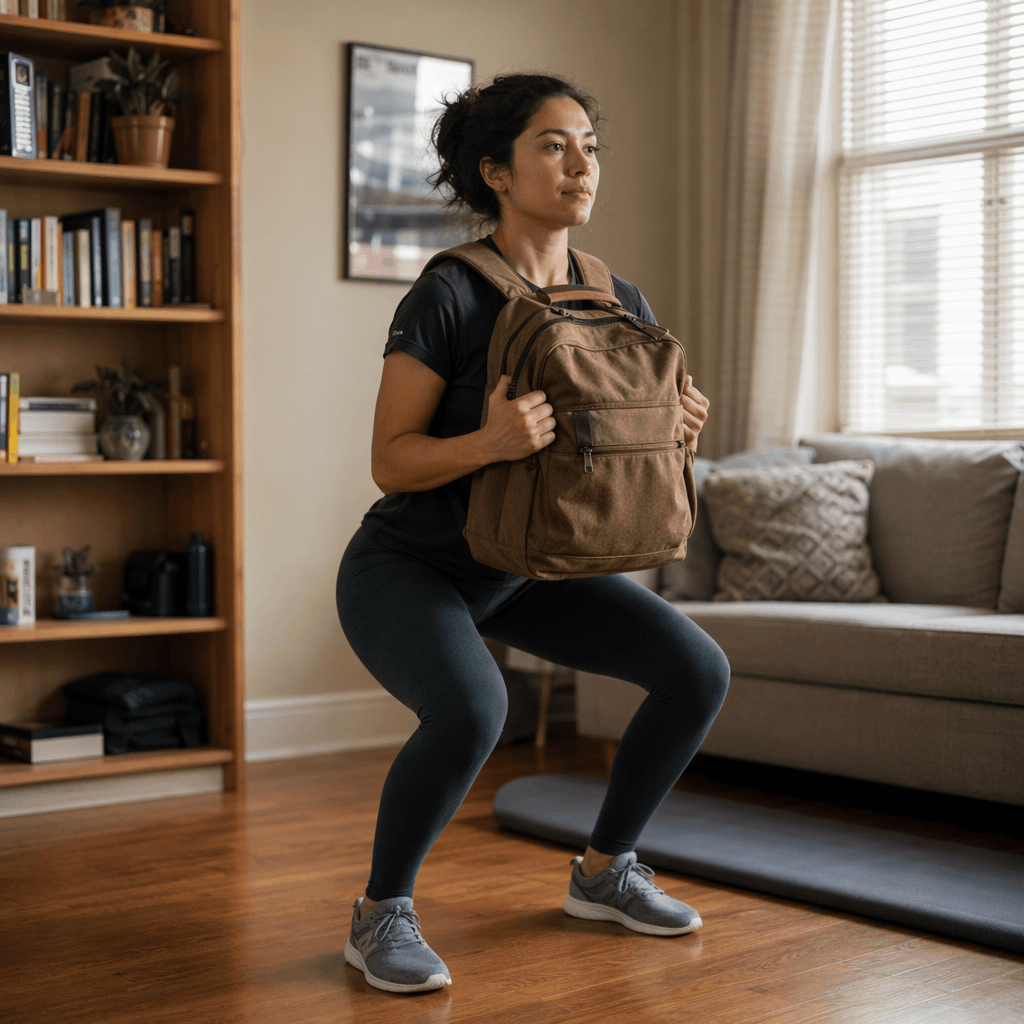
Load a sturdy backpack with books or water bottles (start with 10–15 pounds, add slowly). Hold it against your chest or wear it on your back for squats, lunges, and Bulgarian split squats. The same six levers still apply — you can now manipulate tempo and ROM under added load. If noise is a concern, The Apartment-Friendly Leg Day offers quiet alternatives.
Resistance bands also work, especially for glute bridges and lateral work. Anchor a band around your knees for glute activation or use a loop band above the knees during squats. The key is maintaining tension through the full range — not just at the top.
Three Mistakes That Undermine the Whole System
- Rushing to harder progressions before hitting the rep targets. Jumping to pistol squats in week 2 will break form and risk injury. The advancement signal exists for a reason.
- Ignoring hamstring work. Quad-dominant exercises like squats and lunges build only half the leg. Add single-leg glute bridges and sliding hamstring curls (feet on a towel on hardwood or tile) to keep balance. Without equipment, these bodyweight alternatives work.
- Underestimating recovery time after full ROM and unilateral work. The standard 48-hour rule is a minimum. Research shows full ROM induces greater muscle damage, with peak torque loss lasting up to 72 hours (Bruno et al., 2017). Some trainees — especially those new to single-leg work — need three full days between hard leg sessions. If you are still sore on day 2, take an extra rest day. For detailed frequency guidance, refer to How Often Should You Train Legs at Home?.
These mistakes are common. For a deeper look at each and how to fix them, read 8 Common Home Leg Workout Mistakes.
Your Next Move: Run the Ladder, Then Keep Climbing
You don’t need a gym or heavy weights to keep building leg strength. The six levers — tempo, ROM, unilateral work, rest reduction, exercise advancement, volume — plus the 4-week ladder give you a clear path forward. Start week 1 tomorrow. Follow the advancement signals. When the ladder feels easy, grab the backpack.
The system works if you stop treating 'more reps' as the only tool.
Comments
Join the discussion with an anonymous comment.