
Leg Workouts at Home: A Beginner's Guide to Your First Leg Day
Learn how to build an effective at-home leg workout from scratch using four core movement patterns. This guide provides a complete bodyweight starter routine, progression steps, and frequency guidance for absolute beginners.
- Duration
- 25 min
If you are searching for leg workouts at home, the first problem is usually not effort. It is order. A beginner can find hundreds of squats, lunges, pulses, kicks, jumps, and “burnout” moves in a few minutes, then still have no clear idea what to do first on the living-room floor.
Start smaller. You do not need dumbbells, a bench, or a giant exercise menu for your first leg day. You need a repeatable template built around four lower-body patterns: squat, hinge, lunge, and bridge or isolation. Several beginner leg-training guides organize lower-body sessions around these same basic movement patterns, even when they use different exercise names or equipment options.[1][2][3][4]
That framework is useful because it gives every exercise a job. Instead of asking, “Which move looks familiar?” you can ask, “Have I trained a squat pattern? A hinge? A lunge? A bridge or isolation move?” That is enough structure to build a balanced first session without pretending you already know gym programming.
The four patterns that make a home leg workout make sense
Think of the four patterns as a map, not a rulebook. You can swap exercises later, but the pattern tells you what kind of work the exercise is doing.
| Pattern | Beginner bodyweight example | What to feel |
|---|---|---|
| Squat | Bodyweight squat or sit-to-stand from a chair | Thighs, glutes, and controlled knee bend |
| Hinge | Bodyweight hip hinge or good morning | Glutes and hamstrings as the hips move back |
| Lunge | Reverse lunge or supported split squat | One leg working at a time, with balance and control |
| Bridge / isolation | Glute bridge or standing calf raise | Targeted work for glutes, calves, or a smaller lower-body area |
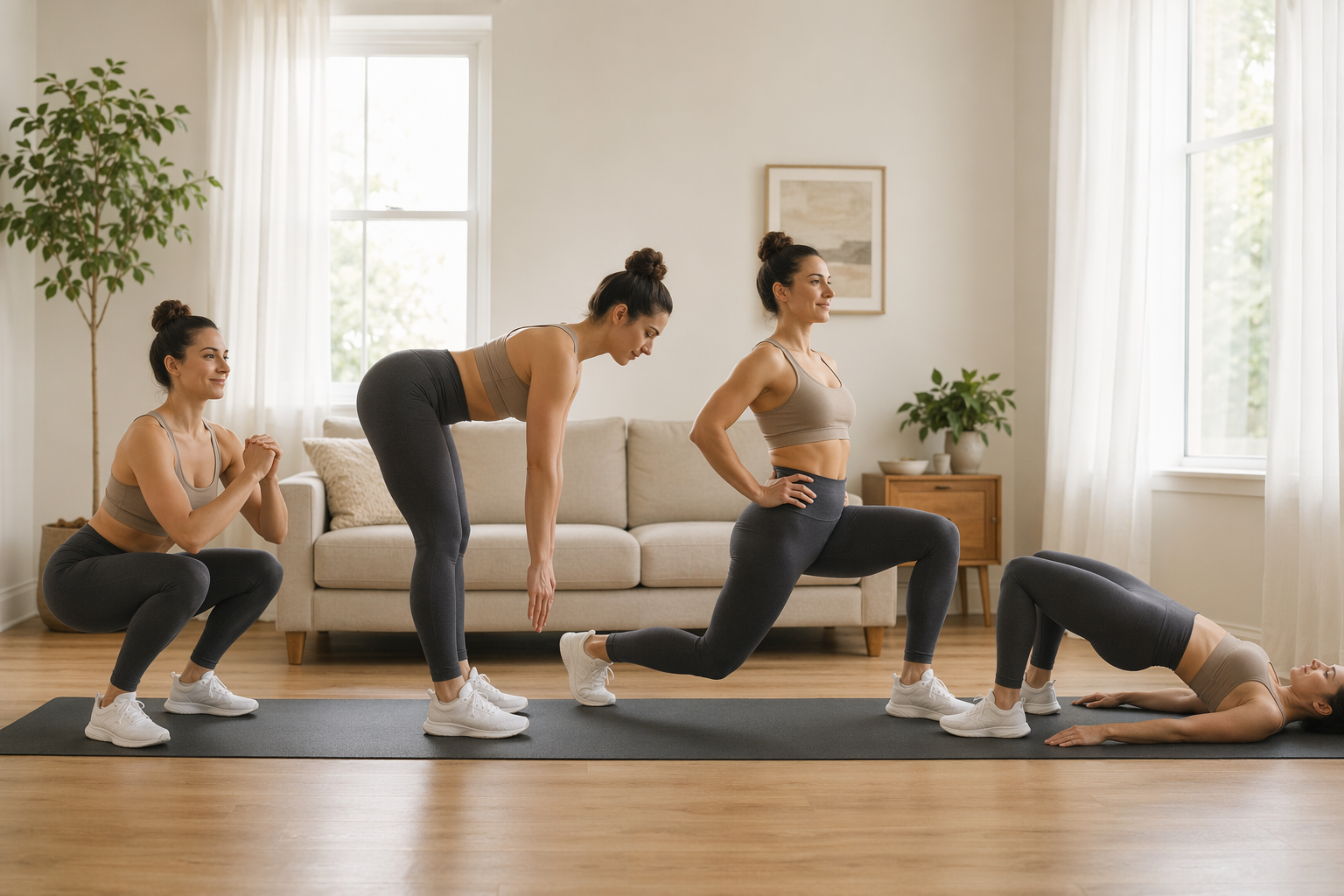
The squat pattern is the most familiar: knees bend, hips lower, and the whole lower body helps you stand back up. The hinge pattern is often the one beginners skip because it looks less dramatic, but it matters. In a hinge, the hips move back while the spine stays long, which shifts more work toward the glutes and hamstrings.
The lunge pattern adds single-leg control. It does not have to start with walking lunges across a room. A reverse lunge or supported split squat is often calmer for a first session because the movement is easier to slow down. The bridge or isolation slot lets you finish with focused work such as glute bridges or calf raises without turning the workout into a random pile of add-ons.
If you want a deeper programming breakdown later, this guide to designing your own leg workout at home expands the same idea. For now, the goal is simpler: use the map once, successfully, without equipment.
A complete beginner leg workout you can do at home
This session should take about 20–30 minutes. Verywell Fit’s beginner leg-day guidance uses 2–3 sets of 12–15 reps, while SELF’s trainer-led bodyweight leg exercise guide also frames beginner-friendly home leg work around manageable sets and movement categories.[1][3] Use the lower end if this is your first structured leg workout.
Move slowly enough that you can tell what your knees, hips, and back are doing. If a set starts tidy and ends with wobbling, shorten the range of motion, hold a wall or chair, or stop the set early. A clean set of 8–10 reps is more useful than 15 reps you have to survive.
Warm up: 3–5 minutes
- March in place for 60 seconds.
- Do 8–10 slow bodyweight good mornings, placing your hands on your hips and sending your hips back.
- Do 8–10 sit-to-stands from a chair or partial squats.
- Do 10 alternating reverse step-backs without dropping into a full lunge yet.
The warm-up is not a separate workout. It is a rehearsal. You are checking whether your feet feel stable, your knees can bend without surprise pain, and your hips are ready to move.
Main workout
| Exercise | Pattern | Sets and reps | Rest | Beginner modification |
|---|---|---|---|---|
| Bodyweight squat | Squat | 2–3 sets of 12–15 reps | 45–75 seconds | Use a chair behind you and lightly sit back before standing |
| Bodyweight hip hinge | Hinge | 2–3 sets of 12–15 reps | 45–75 seconds | Keep hands on hips and use a smaller range of motion |
| Reverse lunge | Lunge | 2 sets of 8–12 reps per side | 60–90 seconds | Hold a wall or chair; make it a small step-back lunge |
| Glute bridge | Bridge | 2–3 sets of 12–15 reps | 45–75 seconds | Pause for one second at the top without arching your lower back |
| Standing calf raise | Isolation | 2 sets of 12–15 reps | 45–60 seconds | Hold a wall and rise through both feet evenly |
| Optional step-up | Squat / single-leg | 1–2 sets of 8–10 reps per side | 60–90 seconds | Use only a low, sturdy step or skip it if your surface is not secure |
If you are brand-new, do the first five exercises and leave the optional step-up out. If you already move comfortably and have a low, stable stair or platform, step-ups can be a useful single-leg addition. A chair that slides, wobbles, or makes you nervous is not workout equipment.
How each exercise should look and feel
For the bodyweight squat, stand with your feet about hip- to shoulder-width apart. Bend your knees and hips together, then stand by pressing the floor away. Your knees can travel forward; the issue is not forward motion, but losing control. Keep your heels down, let your knees track in the same general direction as your toes, and use a chair if depth makes you fold or tip.
For the hip hinge, soften your knees and push your hips back as if closing a car door with your glutes. Your torso tilts because your hips move, not because you round your back. Stop when you feel a gentle stretch through the back of your thighs, then squeeze your glutes to stand tall. This is not a toe touch.
For the reverse lunge, step one foot back, lower only as far as you can control, then push through the front foot to return. A reverse lunge usually feels more manageable than a forward lunge because you are not catching your body weight as aggressively. If balance is the problem, place one hand on a wall or countertop and keep using it until the movement becomes boringly stable.
For the glute bridge, lie on your back with knees bent and feet on the floor. Press through your feet, lift your hips, pause briefly, then lower with control. You should feel your glutes working more than your lower back. If your back takes over, bring your ribs down, shorten the lift, and think about tucking your pelvis slightly before you raise your hips.
For calf raises, stand tall, hold support if needed, rise onto the balls of your feet, and lower slowly. Do not bounce. The lowering part is where many beginners rush because the exercise looks simple.
For step-ups, the working leg is the leg on the step. Put the whole foot on the surface, press down through that foot, and stand up without springing off the floor leg. If you have to launch yourself upward or twist to finish the rep, the step is too high for now.
How to run the session without turning it into chaos
Do the exercises in the order listed the first time. Squat, hinge, lunge, bridge, isolate. That order gives you the most coordination-heavy work before fatigue builds, then finishes with simpler targeted work.
Rest long enough that your next set looks like the previous one. For most beginners, that means about 45–90 seconds depending on the exercise. You are not failing the workout if you rest. You are preserving the quality of the next set.
If the workout feels too easy, first check tempo and range of motion. A slow squat with a controlled lower, steady foot pressure, and a clean stand-up is different from dropping and popping up for 15 reps. If the workout feels too hard, reduce the session before you abandon it: do 2 sets instead of 3, use chair-assisted squats, replace reverse lunges with supported split squats, and skip the optional step-up.
How often to do leg workouts at home
For a beginner, train legs 2–3 times per week, leaving at least 48 hours between leg sessions. Verywell Fit gives this same 2–3 day weekly range for beginner leg training, and PureGym’s beginner leg routine guidance also treats recovery between lower-body sessions as part of the plan rather than an afterthought.[3][4]
A simple week could look like this:
- Monday: beginner leg workout
- Tuesday: walk, mobility, or upper-body work
- Wednesday: rest or light activity
- Thursday: beginner leg workout
- Friday to Sunday: rest, walking, upper body, or a third leg session only if you are recovering well
Soreness alone is not the best coach. Pay attention to whether your next workout gets worse: shakier reps, shorter range of motion, or joints complaining before muscles do. If that happens, keep two weekly sessions for now. If you want more detail on weekly volume and recovery, use this guide to leg workout frequency at home.
How to progress before buying equipment
Bodyweight leg training works best when you treat it as something to progress, not something to repeat forever at the same difficulty. The first progression is not a dumbbell. It is better control.
| Stage | What to change | When to move on |
|---|---|---|
| Make the reps cleaner | Use the same sets and reps, but improve depth, balance, tempo, and control | You can finish every set without rushing, wobbling, or changing form |
| Add reps | Build from 12–15 reps toward 20–25 reps on bodyweight moves | You can hit the top of the range with good form |
| Add sets | Move from 2 sets to 3 sets, and eventually 4 sets for selected exercises | The workout still fits your recovery and does not drag into sloppy fatigue |
| Use harder bodyweight versions | Choose split squats, slower eccentrics, pauses, or carefully selected single-leg work | The basic version no longer feels challenging even with good control |
| Add external load | Use resistance bands or dumbbells | You need more challenge but do not want to keep adding endless reps |
SELF’s trainers note that single-leg exercises can make bodyweight work much more demanding, and beginner-friendly leg guidance from several sources uses unilateral moves such as lunges, split squats, or step-ups as a way to increase challenge without needing a full gym setup.[1][2][4]
Still, bodyweight training has a ceiling. At some point, if squats, bridges, and lunges are clean for high reps and multiple sets, adding load is the more sensible progression. Nourish Move Love’s beginner leg workout uses dumbbells in a broad beginner range, while many home routines start with light-to-moderate weights rather than specialized equipment.[5] You do not need to buy them for day one. You just should know why they may become useful later.
When to modify or stop
Muscle effort is expected. Sharp pain, joint pain that changes your movement, numbness, or pain that lingers beyond ordinary soreness is not something to push through. Modify the range of motion, remove the exercise, or stop the session.
For knees, the first modification is usually support and range. Use a chair squat instead of a free squat. Make lunges shallower. Hold a wall. For lower-back discomfort, check the hinge and bridge first: both can become back-dominant when the ribs flare, the spine rounds, or the hips lift higher than you can control.
If balance is the limiter, do not interpret that as weakness. Balance is a skill inside the exercise. Supported reverse lunges, supported split squats, and low step-ups let you train the leg pattern while the balance piece catches up.
The reusable template
Once you understand the four patterns, you can change the exercises without losing the workout. A beginner home leg session can stay as simple as this:
- Warm up for 3–5 minutes.
- Choose one squat-pattern exercise.
- Choose one hinge-pattern exercise.
- Choose one lunge or single-leg exercise.
- Choose one bridge or isolation exercise.
- Do 2–3 sets of mostly 12–15 controlled reps, resting enough to keep form steady.
- Repeat 2–3 times per week with at least 48 hours between leg sessions.
That is the difference between collecting leg exercises and building leg workouts at home. The exercise list can change. The map stays usable: squat, hinge, lunge, bridge, then progress the work when your body is ready for more.
References
- 31 Leg Exercises at Home That Require No Equipment, SELF.
- 15 Leg Exercises and How to Design a Leg Workout, Healthline.
- A Simple Beginner Leg Day Workout, Verywell Fit.
- The Best Leg Workout Routine For Beginners, PureGym.
- 20-Minute Beginner Leg Workout, Nourish Move Love.
What a small equipment investment adds
We don't have a build tagged to this exact tier yet. Browse all builds.
How often should you repeat this?
How Whoop and Oura Ring track recovery for home workouts
For home exercisers deciding between WHOOP and Oura Ring, the better sleep and recovery tracker depends on training style: WHOOP's strength-aware tracking fits dumbbell and grip-heavy sessions, while Oura's sleep-first scoring suits yoga and indoor cycling. The verdict hinges on how each builds its daily recovery score, their home-workout tracking gaps, and who pays for hardware versus subscription.
Spot something off?
Tell us if a movement, tier assumption, or duration didn't match your experience.