The quiet doubt behind a home workout routine without equipment is usually not about sweat. It is about legitimacy. If there is no rack, no cable machine, no dumbbell set in the corner, can the work still build strength, muscle, endurance, and fitness in a way that deserves to be called training?
The answer from the research is yes, with a condition that matters: bodyweight training works when it is programmed and progressed. It is not a consolation prize for people who cannot get to a gym. It is also not exempt from the same basic rules that govern every other kind of strength training.
The Evidence Is Stronger Than the Warm-Up Reputation
A useful place to start is not with slogans about “functional fitness,” but with measured changes. Harvard Health highlighted one study in which a 10-week bodyweight exercise program improved aerobic capacity by 33%, core muscle endurance by 11%, and lower-body power by 6% in young women.[1] That does not prove every no-equipment program will produce the same results. It does show that bodyweight-only training can move outcomes people often assume require machines or weights.
The lower-body evidence is especially interesting because it does not rely on a high-volume boot-camp setup. In a Japanese study cited by Harvard Health, active adults in their 60s performed eight lower-body bodyweight exercises over 10 months and increased muscle strength and power by approximately 15%, while training only six times per month.[1] The population matters; these were not elite lifters. Still, for anyone assuming squats and lunges stop counting the moment a barbell is absent, that result is hard to dismiss.

Upper-body comparisons are even more direct. Research in The Journal of Strength and Conditioning Research found that push-ups can be as effective as bench pressing for increasing upper-body strength and muscle density when the exercises are matched appropriately.[2] That finding does not mean a push-up and a bench press are identical forever. It means the familiar hierarchy — bench press as real strength, push-up as preparation — is too crude.
The underlying principle is not mysterious. A 2016 Physiology and Behavior study supports the idea that muscle can be built independent of an external load.[3] The body does not have a special sensor that only recognizes iron plates. It responds to mechanical tension, effort, volume, range of motion, fatigue, and repeated exposure to a stimulus it has not fully adapted to yet.
Fitness adaptations are part of the picture too. An ACSM Health & Fitness Journal feature reported that bodyweight high-intensity interval training can reduce body fat and improve VO2 max as much as or more than traditional weight training.[4] That comparison should be read carefully: HIIT and traditional weight training are not the same tool. But for the reader deciding whether a no-equipment routine can improve conditioning, the answer is plainly yes.
Why Bodyweight Training Can Build Muscle Without Added Weight
The strongest argument for bodyweight training is not that it feels hard. Many things feel hard and do not produce much adaptation. The stronger argument is that bodyweight exercises can create enough mechanical tension and can be progressed over time.
Progressive overload is often explained as “add more weight,” because in a gym that is the cleanest lever. Bodyweight training has to use a wider set of levers. The most important are proximity to failure, leverage, and progression strategy. The supporting levers are volume, tempo, range of motion, stability, rest periods, and exercise variation.
| Progression lever | What changes in practice |
|---|---|
| More reps or sets | The same movement accumulates more challenging work before the body adapts. |
| Slower tempo | The muscle spends more time under tension, especially during the lowering phase. |
| Harder leverage | A small change in body angle shifts more load onto the target muscles. |
| Deeper range of motion | The muscle works through a longer path instead of repeating partial reps. |
| Less stability | Single-limb or offset positions demand more control from the working side. |
| Shorter rest | The same exercise becomes more metabolically demanding. |
| Harder variation | The movement changes enough to create a new strength demand. |
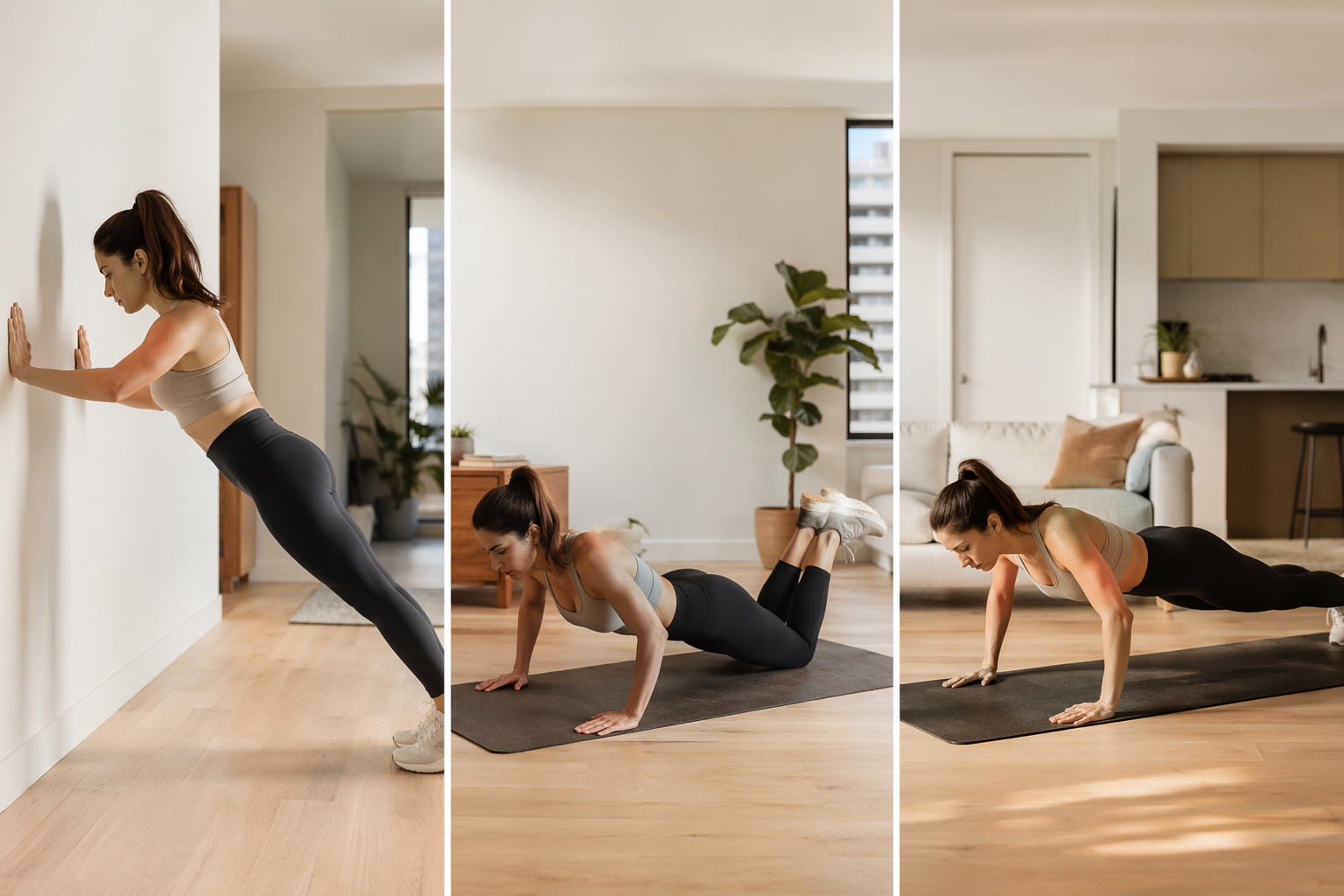
Leverage is the lever beginners underestimate most. A wall push-up, incline push-up, floor push-up, decline push-up, pike push-up, and handstand push-up are not just different-looking versions of the same thing. They change how much of the body’s mass must be controlled and which muscles have to produce force. That is why a person can outgrow one version without outgrowing push-ups as a category.

Proximity to failure is the other missing piece. A set of 10 easy squats done while scrolling between notifications is movement, not much of a training signal. A set that approaches the point where clean reps are nearly gone is different. Plotkin et al. found in PeerJ that rep progression alone, without adding load, can stimulate muscle growth when sets are taken close to failure.[5] That finding matters because rep progression is exactly how many bodyweight programs advance before they need harder variations.
This is where many no-equipment routines fail the person doing them. The problem is not that the living room is biologically inferior to the gym floor. The problem is that random circuits often stop tracking the stimulus. If Monday is 20 squats, Wednesday is “some lunges,” and Friday is a collection of tired mountain climbers, the body has no clear reason to adapt in a measurable direction.
The Common Objections Are Real, Just Smaller Than They Sound
Can you train legs seriously without weights?
Yes, especially for beginners and many intermediates. Squats, split squats, reverse lunges, step-back lunges, glute bridges, calf raises, wall sits, tempo work, and single-leg progressions can create a meaningful lower-body stimulus. The Japanese study in active older adults is a useful reminder that lower-body bodyweight work can increase strength and power, even at a modest monthly training frequency.[1]
The honest limitation is loading ceiling. A strong trainee with years of barbell squatting may need external load for maximal strength development. A beginner deciding whether to start, however, is usually nowhere near that ceiling. The right question is not whether bodyweight squats replace every loaded squat variation forever. It is whether bodyweight lower-body training can build a base worth having. The evidence says it can.
What about back training without a pull-up bar?
This is the toughest no-equipment gap. Pushing, squatting, hinging, bracing, and conditioning are easy to program on the floor. Horizontal and vertical pulling are harder without something stable to pull against. Prone Y-T-W raises, reverse snow angels, swimmers, isometric towel pulls, and floor-based scapular work can train the upper back and shoulder control, but they do not perfectly replace rows or pull-ups.
That does not make the whole method invalid. It means the program should be honest about the pattern. If a person can safely add a doorway pull-up bar, suspension trainer, resistance band, or sturdy table row later, back training becomes easier to load. If they cannot, they can still start training today while recognizing that pulling strength may need supplementation sooner than push-ups or squats do.
Will you eventually plateau?
Of course. Plateaus happen in gyms too. The important distinction is between a true ceiling and a programming stall. If push-ups have been stuck at three casual sets for months, that is not the limit of bodyweight training. It is a missing progression plan. Elevating the feet, slowing the eccentric, increasing range of motion, narrowing hand position, adding paused reps, or moving toward pike and handstand progressions can all change the demand.
A true ceiling is more likely when the goal is highly specific: competitive powerlifting, maximal loaded strength, advanced hypertrophy specialization, or precise loading in very strong trainees. At that point, external load is not a moral upgrade. It is simply the more efficient tool.
Why the No-Equipment Question Matters in 2026
Home training is not a fringe behavior. PTPioneer’s home fitness statistics report that 51% of U.S. exercisers prefer home workouts, while fewer than 30% of U.S. adults meet muscle-strengthening guidelines, citing CDC physical activity data.[6] Those two facts sit uncomfortably close together: many people want the convenience of home training, but many still are not getting enough strength work.
ACSM’s 2026 fitness trends also keep bodyweight training and home fitness in the conversation.[7] Trend status is not proof of effectiveness; plenty of popular things are mediocre. But it does explain why this question keeps coming back. If home workouts are where many people are willing to train, then no-equipment strength work needs to be judged by evidence and programming quality, not by whether it resembles a gym setup.
What a Serious Bodyweight Routine Has to Include
A serious bodyweight plan does not need to be complicated. It does need to make the training signal visible. The routine should cover the major patterns it can cover well: squat or lunge, hip hinge or bridge, push, core bracing, controlled rotation or anti-rotation, and conditioning. Pulling should be included where possible and honestly modified where equipment is unavailable.
- Choose variations that are challenging within a useful rep range, not so easy that every set becomes warm-up work.
- Take most strength sets close enough to failure that the final clean reps require attention.
- Track reps, sets, rest, tempo, or variation so progression is visible from week to week.
- Advance one lever at a time when possible, instead of changing every exercise every session.
- Respect recovery, because hard bodyweight sets still create fatigue.
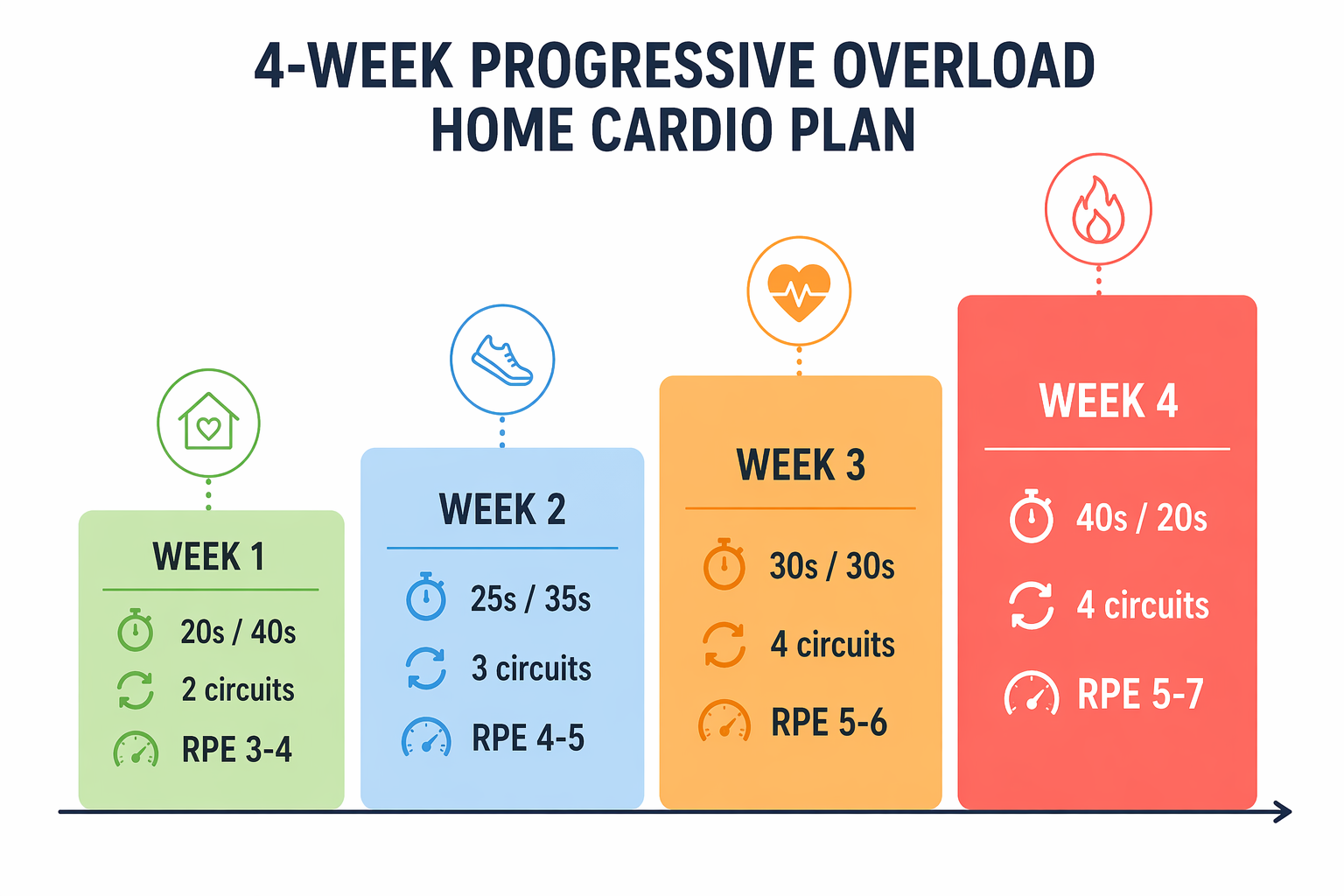
This is also why a beginner does not need to wait until they can design the perfect program. The science gives enough permission to start, and the first practical job is consistency with progression. A structured 4-week no-equipment home workout plan for beginners is the natural next step once the question shifts from “does this count?” to “what do I do on Monday?”
For readers who struggle less with exercise selection and more with actually showing up, the better companion is a guide on how to start working out at home and stick with it. If the appeal is short, intense sessions, the evidence around the 7-minute workout’s real results and limits is worth reading before treating brevity as magic. And if guided sessions make the difference between planning and doing, a free workout app matched to your fitness goal can provide structure without buying equipment first.
Bodyweight training works when it is treated as training: specific exercises, hard-enough sets, repeat exposure, and a progression plan. It fails when it is reduced to random exercise snacks with no overload. That is not a weakness unique to no-equipment workouts. That is how training works everywhere.
References
- The advantages of body-weight exercise, Harvard Health Publishing, January 2026.
- Bench Press and Push-up at Comparable Levels of Muscle Activity Results in Similar Strength Gains, The Journal of Strength and Conditioning Research.
- Effects of low-load resistance training with different degrees of effort on muscle hypertrophy and strength, Physiology & Behavior, 2016.
- High-Intensity Circuit Training Using Body Weight: Maximum Results With Minimal Investment, ACSM’s Health & Fitness Journal.
- Progressive overload without progressing load? The effects of load or repetition progression on muscular adaptations, PeerJ, 2022.
- Home Fitness Industry Statistics, PTPioneer, 2024-2026.
- ACSM's Health & Fitness Journal Releases Top Fitness Trends for 2026, ACSM.org.
Comments
Join the discussion with an anonymous comment.