
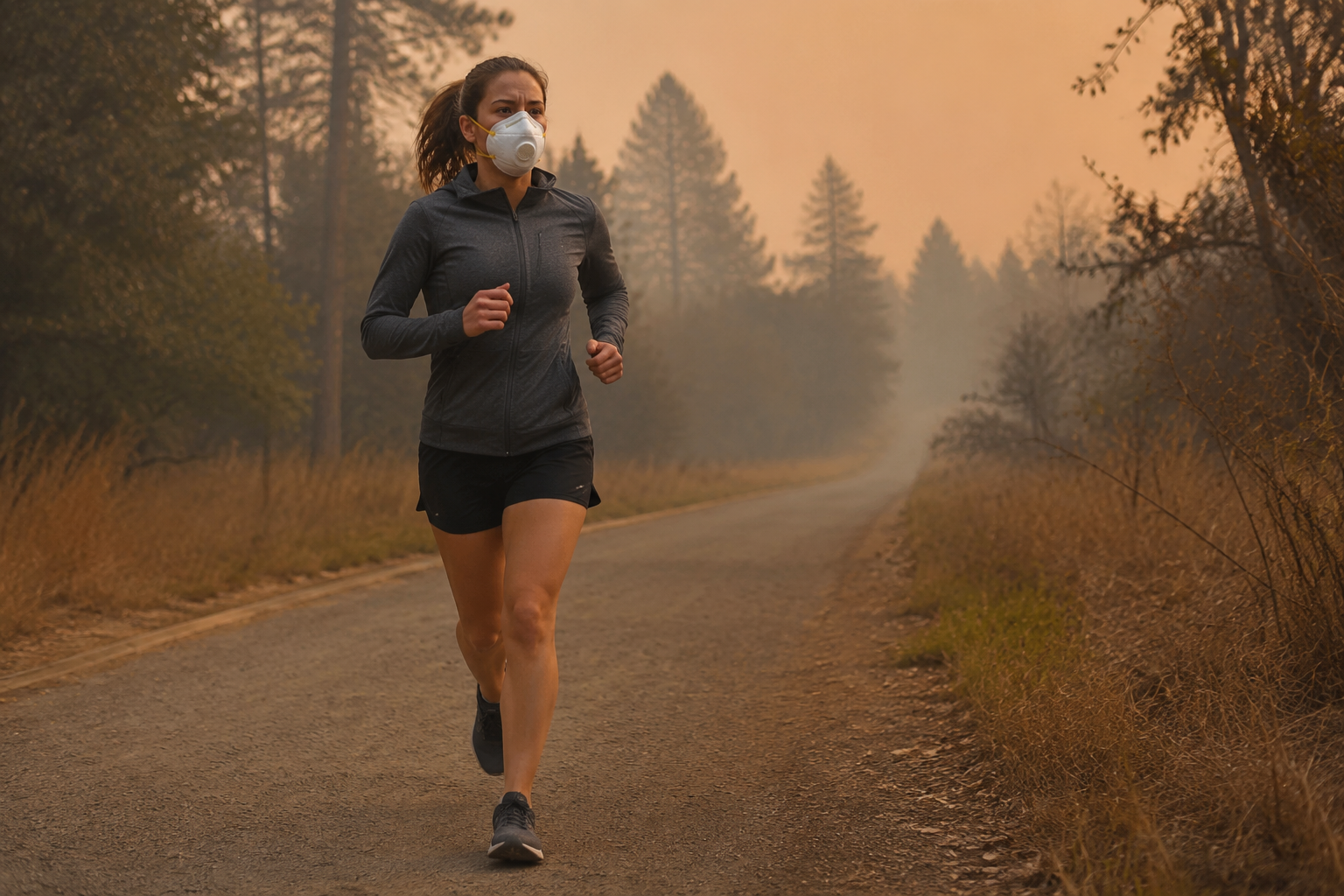
If you are standing by the door with smoky air outside, an AQI app open, and an N95 in your hand, the honest answer is this: a real N95 or P100 respirator can reduce the amount of wildfire PM2.5 you breathe when it seals well, but that does not automatically make an outdoor workout in wildfire smoke a good plan. The mask may be doing its job on a test bench while your run, ride, sweat, breathing rate, and face shape quietly undo the protection you were counting on.
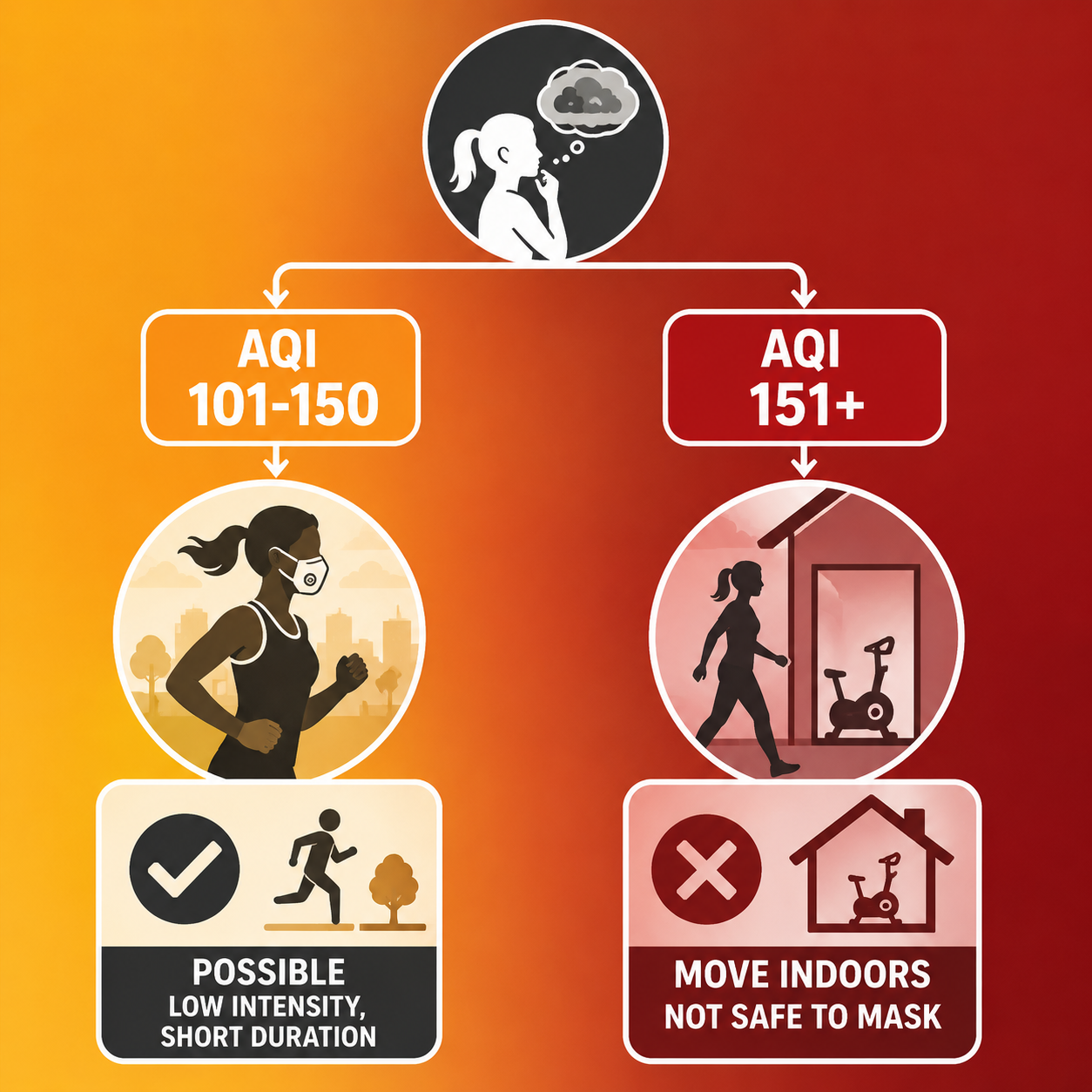
The workable distinction is narrow. For some healthy adults, a short, easy outdoor session in AQI 101–150 with a well-fitting, valved N95 may be a tolerable compromise. Once the AQI is 151 or higher, the workout is hard or long, the seal is uncertain, or the only mask available is cloth, the better answer is to move the session indoors.
What an N95 can actually protect you from
Wildfire smoke is dangerous largely because of fine particulate matter, especially PM2.5. N95 respirators are designed to filter at least 95% of airborne particles that are 0.3 microns and larger, which covers PM2.5 particles. KN95 masks can offer similar filtration when they are legitimate and fit well. Cloth masks, by contrast, provide minimal protection from wildfire smoke; smoke particles are far smaller than the respiratory droplets those masks were mainly used to reduce during infectious-disease surges.[1]
That filtration number is why people reach for an N95 in the first place. It is not irrational. If the respirator is certified, properly worn, and sealed against the face, it can reduce particle exposure. A P100 respirator can filter even more particulate matter. For sitting, walking briefly, or doing necessary outdoor tasks, that protection can matter.
But wildfire smoke is not only particles. N95 respirators do not filter hazardous gases or volatile organic compounds in smoke. That does not make them useless, because PM2.5 is still a major concern, but it does mean the mask is not a complete smoke shield.[3]
Exercise changes the math
The mask question looks different once the activity is a workout rather than an errand. During strenuous exercise, an adult breathes at least 10 to 20 times as much air as at rest.[2] That means every leak, every awkward inhale, and every minute outside matters more than it would during a slow walk to the mailbox.
More air movement also means more work. A tight respirator adds breathing resistance. In easy conditions, that may feel like annoyance. On a hill, during intervals, or into a headwind, it can turn into a limiter. The body wants more ventilation; the respirator makes that exchange harder; the smoky air gives you less margin for pretending everything is normal.
Heat and moisture add another layer. A mask traps warm, humid air around the mouth and nose. Sweat can make the facepiece slide. The straps can shift as you look over your shoulder on a bike or change cadence on a climb. None of those things means the respirator instantly stops working, but they all push it away from the clean conditions under which “filters 95%” sounds reassuring.
The seal is the part most workouts break
For an N95 or P100 to protect your lungs, air has to pass through the filter instead of around the edges. CDC and AirNow guidance emphasizes proper straps and a tight seal against the face; facial hair, poor sizing, and loose fit can compromise protection.[4][5]
Running and cycling are almost designed to test that seal. Your jaw moves. Your breathing pattern changes. Sunglasses, helmet straps, hair, sunscreen, and sweat all compete for space on the same few inches of skin. Even a mask that felt solid in the bathroom mirror can leak after 15 minutes outside.
A quick user seal check helps, but it is not the same as a professional fit test. If the respirator collapses slightly when you inhale and you do not feel air rushing around the nose, cheeks, or chin, that is a better sign than nothing. If your glasses fog immediately, the nose bridge lifts when you talk, or you can feel air escaping along the sides, the mask is not doing the job you are asking it to do.
A practical decision path for smoky workouts
AQI thresholds are not magic biological borders. A reading of 149 is not safe in a way that 151 is suddenly dangerous for every body. Still, thresholds are useful because they keep a smoky-day decision from turning into wishful thinking. If you want the broader AQI-first framework before you even consider a mask, start with how to exercise safely when air quality is poor.
| Situation | Mask judgment | Better workout choice |
|---|---|---|
| AQI 101–150, healthy adult, short and easy session, well-sealed valved N95 or P100 | Possible fallback if you accept discomfort and uncertainty | Keep intensity conversational and duration short |
| AQI 101–150, hard intervals, tempo run, long ride, hill workout, or heavy breathing | Not a good trade-off | Move the quality session indoors or postpone it |
| AQI 151 or higher | Masking is not enough for exercise | Train indoors |
| Poor mask seal, facial hair breaking the seal, non-valved mask that feels intolerable, or cloth mask only | Do not treat it as smoke protection | Choose an indoor substitute |
The 101–150 range is where the mask discussion has some room. It is not a green light. It is the range where a healthy adult might decide that a short, easy session with a well-sealed respirator is an acceptable compromise. Easy means you can back off immediately, breathe through your nose or at a controlled conversational effort, and stop if the mask feels restrictive. Short means you are not trying to turn a smoky day into your long run, race simulation, or big aerobic build.
A valved respirator is usually the more realistic choice for exercise because the exhalation valve can reduce heat and moisture buildup. That valve does not make the outdoor air cleaner, and it does not solve the seal problem, but it can make the mask less miserable during light exertion. Non-valved respirators can feel much hotter and wetter once breathing picks up.
The line gets much firmer at AQI 151 and above. Sources from CDC, PHI, Stanford, UCSF, and The Conversation converge on the same practical advice: above this level, outdoor exercise is generally discouraged, and the safer choice is to train indoors rather than trying to mask your way through the smoke.[6][7][8]
Intensity and duration matter as much as the AQI number
A 20-minute easy jog and a 90-minute ride are not the same exposure problem. Neither are a relaxed walk and a threshold workout. The harder and longer you go, the more air you move through your lungs, the more likely you are to disturb the seal, and the more likely the mask becomes a performance and comfort problem.
This is where a lot of smoky-day bargaining goes wrong. The workout you planned before checking the air is not the workout the conditions now support. If the session requires discipline to hold pace, climb hard, stay in a training zone, or finish a prescribed duration, it is already too ambitious for a mask-based compromise.
Where experts agree, and where they do not
The broad expert consensus is cautious: if the air is bad enough that you feel you need a respirator for outdoor exercise, it is probably bad enough to move the workout indoors. That view appears across public-health and sports-medicine guidance, including CTS, PHI, and Outside’s reporting with experts from institutions such as Stanford, UCSF, and UC Davis.[6][7][8]
There is a minority view worth taking seriously because it describes what some experienced, healthy adults actually do. Dr. Gina Solomon of PHI has said she personally uses a well-fitting N95 for moderate outdoor exercise during smoke events, while framing that as a personal risk calculation rather than a general recommendation.[7]
That distinction matters. A public-health recommendation has to work for people with asthma, heart disease, pregnancy, older age, lower fitness, less mask experience, and no way to judge whether a seal is leaking. A personal decision by a knowledgeable adult under moderate conditions should not become blanket advice for every runner who wants to keep a streak alive.
The evidence is still thinner than the confidence online
There is much more evidence that respirators can filter particles than there is direct evidence that exercising in wildfire smoke with a respirator is safe across real-world conditions. A University of Montana study published in June 2025 tested only 20 healthy participants in their mid-20s under controlled conditions, which makes it useful but limited. It cannot tell us how older adults, people with respiratory conditions, different fitness levels, longer workouts, shifting smoke concentrations, or imperfect mask fits will respond.[9]
That uncertainty should lower your ambition, not raise your tolerance for risk. The absence of perfect exercise-specific data does not mean every smoky run is secretly fine. It means the conservative choice deserves more weight, especially when the easy alternative is not “do nothing,” but “move the workout.”
If you do mask outside, make the session smaller
If conditions fall into the narrow compromise zone, treat the outdoor session as maintenance, not training progress. Use a certified N95, P100, or legitimate KN95 that seals well. Choose a valved respirator if heat and moisture would otherwise make you remove it. Keep the effort easy enough that you can stop without blowing up the rest of your day. Turn around early if the mask shifts, breathing feels strained, your chest feels tight, your throat burns, or the smoke worsens.
- Do not use a cloth mask as wildfire smoke protection for exercise.
- Do not count a loose N95, a mask with gaps, or a respirator over facial hair as reliable protection.
- Do not do intervals, long runs, hard climbs, or race-pace work in smoke just because you have a respirator.
- Do not keep going to protect a streak if symptoms show up.
People with asthma, COPD, cardiovascular disease, pregnancy, recent respiratory illness, or unusual sensitivity to smoke should use a stricter standard. For those groups, the “maybe” zone for healthy adults may not be a reasonable zone at all.
The safer substitute is still a workout
Moving indoors should not feel like canceling the day. It is a change in venue and stimulus. A planned easy run can become an incline walk, step-up circuit, low-impact cardio session, mobility block, or easy spin if you have equipment. A planned hard workout can move to intervals on a bike, treadmill, rower, stairs, or a no-equipment conditioning circuit if your indoor air is clean enough.
For practical substitutions, use how to work out indoors when the air quality is bad or how to exercise indoors during wildfire smoke. If cardio is the piece you are trying to replace, the complete guide to cardio at home can help you choose a swap that fits your space, joints, and equipment.
The final call is simple enough to use at the door: AQI 101–150, short and easy, healthy adult, valved respirator, good seal — maybe. AQI 151 or higher, hard or long workout, bad seal, symptoms, higher-risk health status, or cloth mask — indoors.
References
- Can N95 Masks Help Protect Against Wildfire Smoke? — HealthLine
- Wildfire Smoke and Outdoor Exercise — BC Centre for Disease Control
- Wildfire Smoke: A Guide for Public Health Officials — U.S. Environmental Protection Agency
- Safety Guidelines: Wildfires and Wildfire Smoke — CDC
- When Smoke is in the Air — AirNow.gov
- Adjusting Outdoor Exercise for Air Pollution and Wildfire Smoke — California Thoracic Society
- Experts Offer Advice on Working Out During Wildfire Smoke Events — Public Health Institute
- What to Know About Air Quality When Exercising Outdoors — Outside Online
- University of Montana wildfire smoke exercise study — University of Montana, June 2025
Comments
Join the discussion with an anonymous comment.