
If you are standing by the window in running shoes and the air quality app is showing Red, move the workout indoors. For most people, AQI above 150 is the point where outdoor exercise should come off the table, not get renegotiated into “just an easy jog.” Wildfire smoke is not a normal bad-weather nuisance; the harder you breathe, the more fine particle pollution you pull into your lungs.
Be more conservative if you are in a sensitive group. The American Lung Association advises children under 18, adults 65 and older, pregnant people, and people with heart or lung conditions to move activity indoors when AQI is above 100, which falls in the Orange range.[1] And if the number looks acceptable but the street is hazy, smoke smells strong, or nearby landmarks are disappearing, do not argue with the plume. AQI readings can lag or miss hyperlocal smoke pockets.
| Current Conditions | Workout Decision |
|---|---|
| AQI 0–100 and no visible or smelled smoke | Outdoor exercise may be reasonable for many healthy adults; keep checking conditions. |
| AQI 101–150 | Sensitive groups should move indoors. Others should shorten the session, lower total exposure, and watch local smoke cues. |
| AQI above 150 | Move exercise indoors regardless of usual fitness level. |
| Visible smoke, strong smoke smell, symptoms, or uncertain readings | Choose an indoor low- to moderate-intensity workout or rest. |
Why the Outdoor Run Changes the Risk
The problem with exercise during wildfire smoke is not only that the air is dirty. It is that exercise changes the dose. Athletes can breathe 10 to 20 times more air per minute than sedentary people, which means the same outdoor PM2.5 concentration can become a much larger inhaled particle load during a hard workout.[2]
High intensity adds another issue: mouth breathing. As effort rises, more air bypasses the nose, which normally helps filter some larger particles before they travel deeper into the respiratory tract. UCSF physician John Balmes has pointed to this mouth-breathing shift as one reason hard outdoor training is a poor fit for smoky days.[3]
This is where “I feel fine” becomes weak evidence. Wildfire smoke exposure does not always announce itself immediately with dramatic symptoms. A University of Montana study published in June 2025 had 20 healthy participants cycle for 2 hours at 50% of maximum effort while breathing simulated wildfire smoke from pine combustion. Researchers measured declines in blood vessel and nervous system function after exposure, although values returned to baseline within 1 hour in clean air. Half the participants showed stronger declines, suggesting individual responses vary even among young, healthy adults.[4]
That study should not be inflated into a universal prediction. It was small, the participants were generally healthy and in their mid-20s, and simulated pine smoke is not the same as every real wildfire plume. But it gives a useful reason to stop treating a smoky run as harmless just because it is familiar.
Masks Are Not a Good Workout Loophole
A cloth face covering is not a fix for PM2.5 during outdoor exercise. AirNow states that cloth masks do not protect against fine particles in smoke.[5] N95 respirators can filter particles when they fit correctly, but for exercise, public-health guidance still points toward reducing exposure rather than trying to train through smoke behind a mask.
That matters because a respirator that slips, leaks, gets damp, or feels intolerable at higher breathing rates can give a false sense of control. If the day is smoky enough that you are considering a mask for your run, it is smoky enough to choose an indoor session instead.
Set Up the Cleanest Room You Can
“Exercise indoors” only helps if the indoor air is actually better. During wildfire smoke, the best available workout room is usually the smallest practical room where you can close windows and doors, run filtration, and avoid adding new indoor pollution.
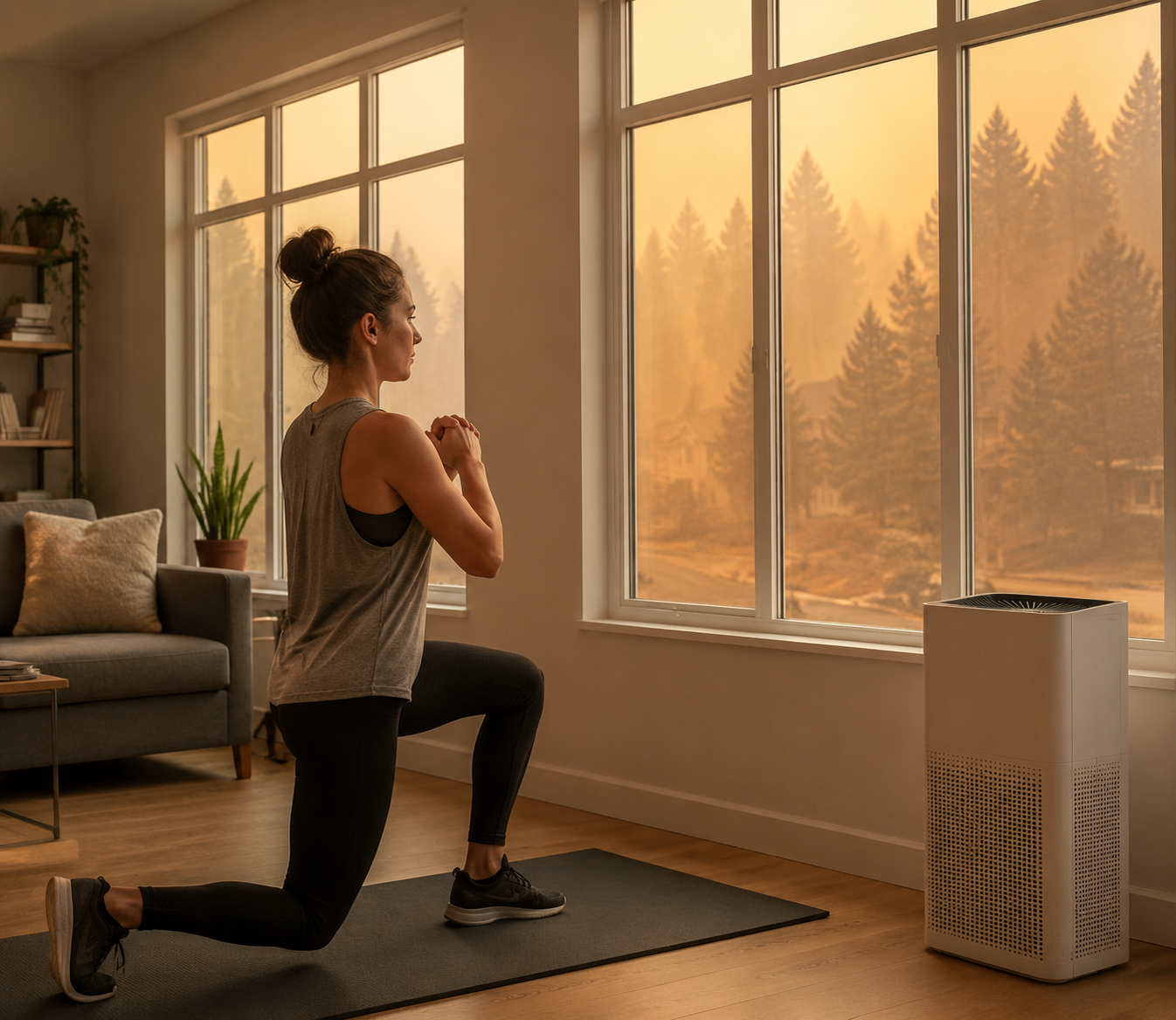
Colorado State University notes that in a well-sealed room with air conditioning and filtration, indoor AQI can be less than half of outdoor levels.[6] Oregon State University Extension reports that HEPA air purifiers can reduce indoor particle concentrations by up to 45% during wildfire events.[7] Those figures are encouraging, not guaranteed. Room size, purifier capacity, building leakage, filter condition, and outdoor smoke concentration all change the result.
- Close windows and exterior doors before you start moving.
- Choose one room and keep the door closed as much as practical.
- Run a HEPA air cleaner continuously, preferably before and during the workout.
- If using central HVAC, follow your system guidance for recirculation and filtration so smoky outdoor air is not being pulled inside.
- Skip indoor particle sources: frying, candles, incense, smoking, fireplace use, and vacuuming during the smoke event.
The American Lung Association’s clean-room guidance is blunt on this point: keep windows and doors closed, use a HEPA air cleaner, and avoid activities that pollute indoor air.[8] That is not aesthetic housekeeping. It is part of the workout decision. A living-room strength session beside an open window is not meaningfully the same choice as a controlled session in a filtered room.
Pick a Workout That Does Not Spike Breathing
On smoky days, the goal is to preserve the habit without turning the indoor room into a cardio chamber. Low- to moderate-intensity movement is the better default because it keeps breathing more controlled and limits total inhaled air compared with long steady cardio or all-out intervals.
Use perceived effort, but do not make it the only safety tool. A useful target is a session where you can breathe mostly through your nose or speak in short sentences without gasping. If the room feels stuffy, your chest tightens, or you start coughing, stop. The workout has already done its job for the day if it kept you moving without pushing deeper exposure.
Option 1: Low-Impact Bodyweight Circuit
This is the closest substitute for someone who wanted a run but should not chase running-level breathlessness indoors. Move steadily, leave a little rest between exercises, and stop before the session becomes HIIT.
- Bodyweight squats or sit-to-stands
- Reverse lunges or supported split squats
- Incline push-ups against a counter or wall
- Glute bridges
- Dead bugs or bird dogs
- Slow step-touches or marching in place as recovery
Do 1 to 3 easy-to-moderate rounds. Avoid jump squats, burpees, mountain climbers, sprint intervals, and any format that turns the room into a breathless competition with the clock.
Option 2: Strength Session With Longer Rest
Strength work is often the best smoky-day compromise because effort can be real without being continuous. Use dumbbells, resistance bands, a backpack, or bodyweight. Keep sets crisp, rest longer than you normally would, and avoid pairing exercises so aggressively that the session becomes conditioning.
| Movement | Smoke-Day Adjustment |
|---|---|
| Squat pattern | Goblet squat, chair squat, or slow bodyweight squat |
| Hinge pattern | Romanian deadlift with light weights, backpack deadlift, or hip hinge drill |
| Push | Incline push-up, floor push-up, or light overhead press |
| Pull | Band row, towel row setup, or light dumbbell row |
| Core | Dead bug, side plank, Pallof press, or farmer carry if space allows |
The key adjustment is the rest interval. If you normally compress rest to make strength training feel like cardio, do the opposite today. Let your breathing settle before the next set.
Option 3: Mobility or Yoga-Style Flow
A mobility session is not a consolation prize. It is the right choice when the air is bad, you feel mentally restless, and you need movement more than a training stimulus. Keep transitions smooth rather than fast.
- Cat-cow to thoracic rotations
- World’s greatest stretch, held longer than usual
- Low lunge with gentle hip flexor work
- Downward dog to calf pedal, if comfortable
- Supine hamstring stretch and figure-four stretch
- Easy breathing in a comfortable position to finish
Choose this option if you are in a sensitive group, if your indoor air setup is imperfect, or if smoke has already been bothering your throat, eyes, or chest.
What to Avoid Indoors During a Smoke Event
Moving indoors reduces exposure only if the workout itself does not drive ventilation through the roof. Long treadmill runs, hard indoor cycling sessions, jump-rope intervals, and HIIT circuits can still multiply the amount of air you breathe. If outdoor air has infiltrated the home, a maximal indoor session is not automatically safe just because it happens under a roof.
During AQI 101–150, Colorado State University notes that reducing workout duration may be more beneficial than reducing intensity, based on diesel-exhaust studies that experts infer may apply to wildfire smoke.[6] That does not mean “go hard no matter what.” It means total exposure time matters. If conditions are only moderately smoky and you are not in a sensitive group, a shorter controlled workout is usually more defensible than a long one.
Once AQI is Red or conditions look worse than the number, the decision changes. Do not use timing, grit, or a favorite route as the workaround. Use the cleanest indoor air you can create, lower the ventilation demand, and keep the session brief enough that you are not spending an hour breathing harder in a compromised space.
Should You Wait Until Evening?
Sometimes, but only on lower-AQI days and only if local readings improve. University of Montana exercise scientist John Quindry has noted that wildfire smoke exposure may be lower in the evening than in the morning because afternoon heat can expand the air column and winds can disperse particulates.[4] That is different from typical urban smog advice, where morning workouts are often favored.
Treat timing as a secondary adjustment, not a loophole. If the AQI is above 150, if smoke is visible, or if you are in a sensitive group and the AQI is above 100, waiting for a prettier hour is not the main safety move. Moving indoors is.
When Rest Is the Safer Workout
There are days when even the modified version should become rest, especially if you cannot create a reasonably clean indoor room. Rest is also the better call if smoke is already causing symptoms or if you have a condition that makes respiratory stress more consequential.
- Skip exercise and consider medical guidance if you have chest pain, wheezing, unusual shortness of breath, dizziness, or symptoms that do not settle in clean air.
- Choose rest if your indoor space is smoky, hot, or poorly ventilated and you do not have filtration available.
- Be conservative if you are pregnant, older, under 18, or managing asthma, COPD, cardiovascular disease, or another condition affected by air quality.
- Do not try to “make up” a missed run with a harder session the next smoky day.
One missed workout is easier to recover from than a respiratory flare that ruins the next several. The routine survives better when the default plan is boring and repeatable: check the AQI, check the sky, move indoors at the appropriate threshold, filter and seal the room as well as possible, keep effort controlled, and rest when symptoms, sensitivity, or uncertainty make the risk too high.
References
- Four Things to Know about Air Quality and Exercising Outdoors, American Lung Association
- Adjusting Outdoor Exercise for Air Pollution and Wildfire Smoke, TrainRight/CTS
- Experts Offer Advice on Working Out During Wildfire Smoke Events, PHI
- Wildfire smoke can make your outdoor workout hazardous to your health, The Conversation
- When Smoke is in the Air, AirNow.gov
- Is it safe to exercise outside when there is wildfire smoke in the air?, Colorado State University
- Protecting Indoor Air from Wildfire Smoke, OSU Extension
- How to Create a Clean Room to Help Protect Against Wildfire Smoke, American Lung Association
Comments
Join the discussion with an anonymous comment.