The mistake is thinking that indoor exercise when air quality is bad has one safety label. A slow mobility session on the floor and a 45-minute treadmill interval workout both happen indoors, but they do not ask your lungs to do the same job. The useful question is not simply whether you moved the workout inside. It is how much air you are pulling in while you train.
At rest, minute ventilation is roughly 12 liters per minute. During exercise, it can climb toward about 100 liters per minute, and many exercisers shift from nasal breathing to mouth breathing as effort rises, reducing the filtering role of the nasal passages.[1][2] That is why the safest poor-air-quality workout is usually the one that keeps breathing quiet, not the one that feels most like your normal run.
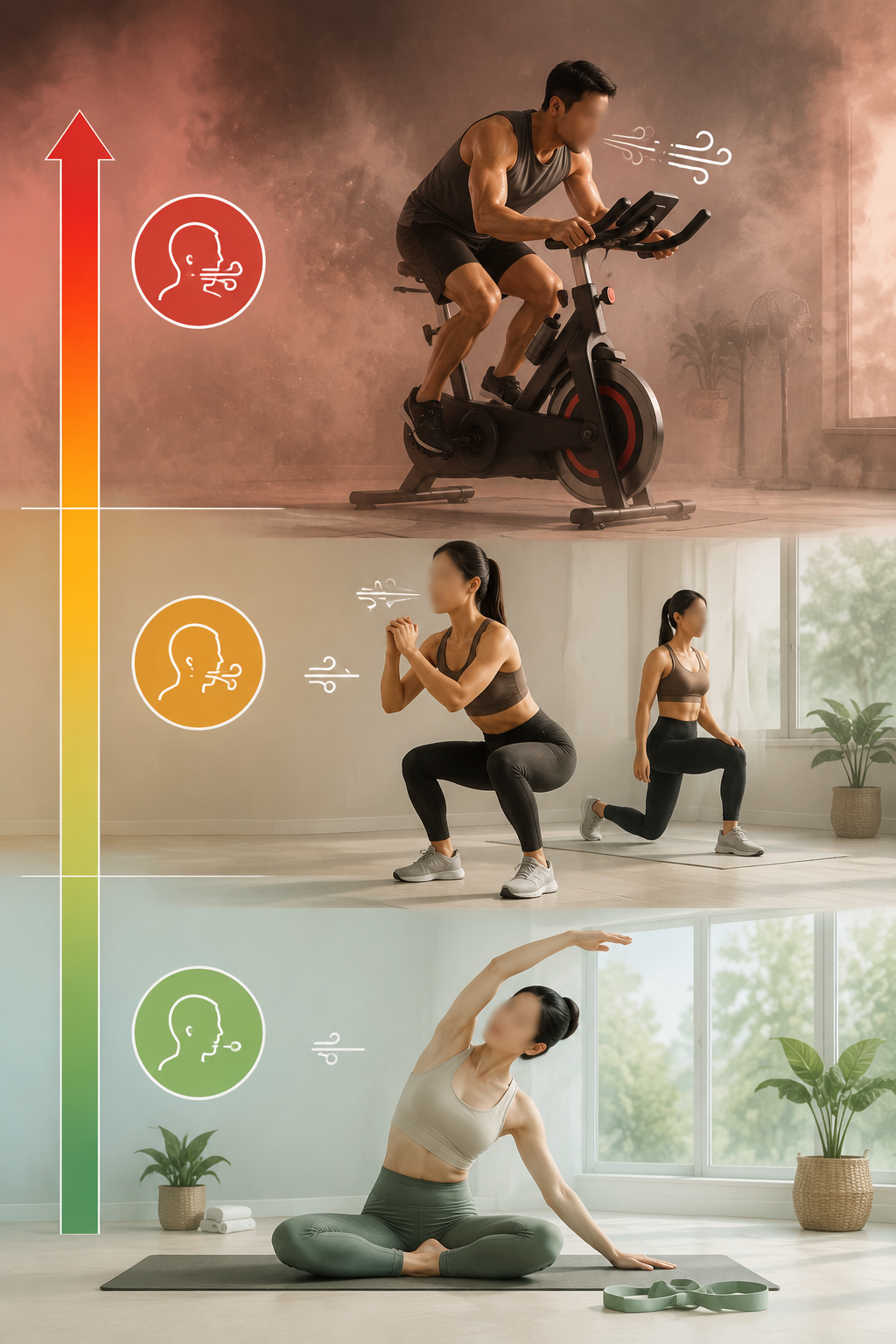
| Rank | Workout type | Respiratory demand | Best use on poor air days |
|---|---|---|---|
| 1 | Gentle yoga, mobility, stretching, breath-controlled Pilates-style work | Lowest | Best default choice when indoor air is questionable and no stop symptoms are present |
| 2 | Light resistance bands, easy dumbbell technique work, slow core work | Low | Keeps the habit alive without turning the session into cardio |
| 3 | Moderate bodyweight strength circuits | Moderate | Useful if rests stay generous and the session stays short |
| 4 | Steady indoor cycling, treadmill walking, longer brisk circuits | Moderate to high | Only a good trade when indoor air is clearly better and symptoms are absent |
| 5 | HIIT, treadmill intervals, hard indoor cycling, long vigorous sessions | Highest | Usually the first category to skip during smoke or pollution events |
Start With the Lowest-Breathing Option That Still Feels Like Training
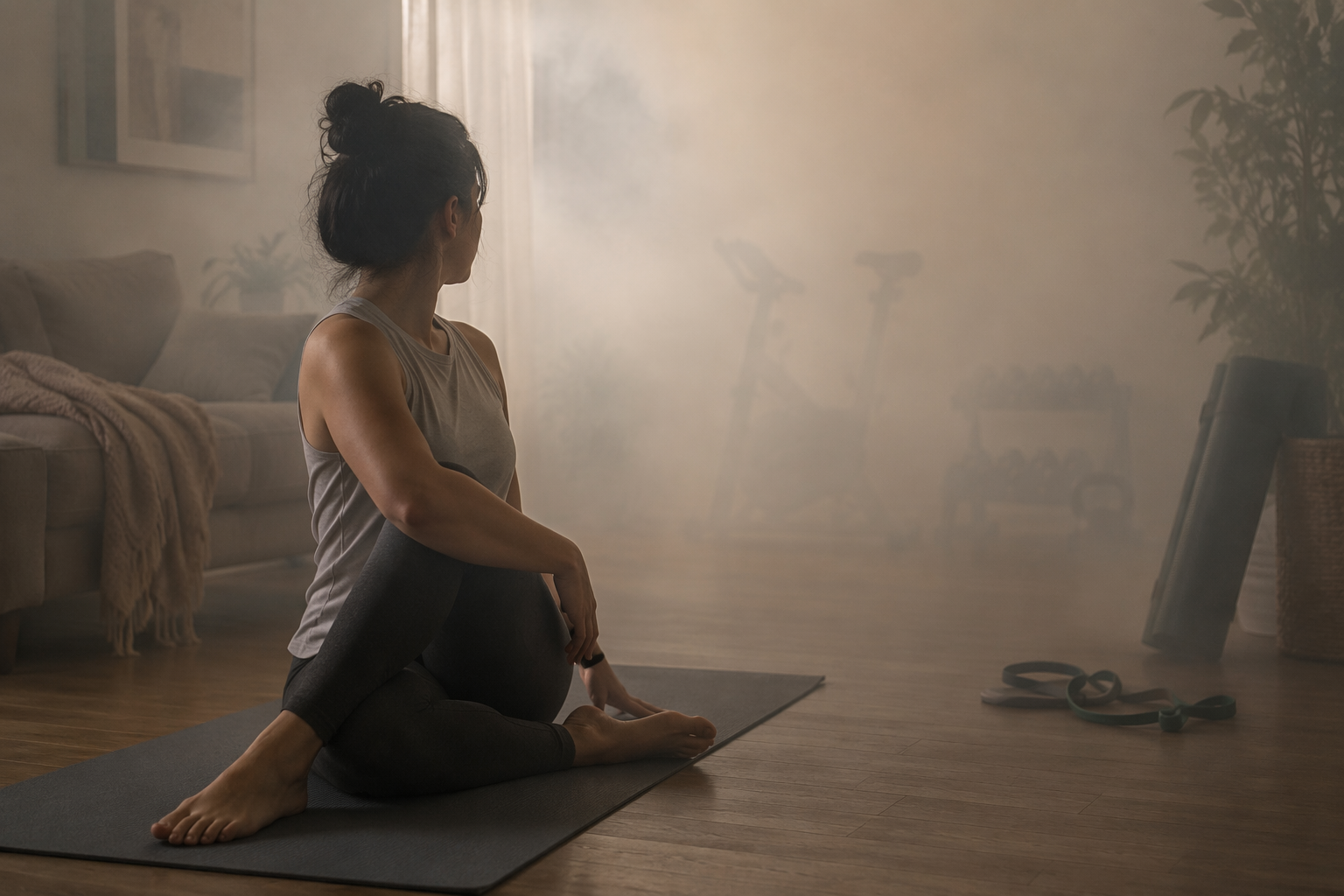
On poor air days, gentle yoga, mobility, stretching, slow Pilates-style work, and light resistance bands deserve the top rank because they solve the right problem. They reduce respiratory demand. You may still move, load joints, maintain range of motion, and leave the session calmer than when you started, but you are not multiplying the volume of air moving through your lungs.
This is especially useful during wildfire smoke or pollution stretches that last several days. The body may want the normal emotional release of a hard run, but the lungs are not counting emotional need. They are dealing with exposure. A mat-based session keeps the routine from disappearing without pretending that a living room automatically cancels the air problem.
A good low-demand session has a few recognizable signs: you can breathe through your nose most of the time, you can speak in full sentences, and you are not stacking moves so quickly that stretching quietly becomes conditioning. If a yoga flow turns into repeated fast transitions, long plank holds, and breathless power work, it has moved out of the lowest tier.
- Best choices: gentle yoga, floor mobility, easy stretching, relaxed Pilates-style mat work, light resistance bands.
- Keep: nasal breathing, longer pauses, controlled tempo, low heat buildup.
- Avoid turning it into: power yoga, fast circuits, or “just one finisher.”
- For a low-demand equipment route, a Pilates home setup can make these sessions feel less improvised.
Use Light Strength When You Need More Than Stretching
Light resistance work is the next useful tier because it gives restless exercisers something concrete to do. Bands, slow dumbbell rows, glute bridges, dead bugs, wall sits, calf raises, and controlled step-ups can feel like a real session while keeping breathing closer to normal. The trick is to treat the rest periods as part of the workout, not as wasted time.
This is where indoor training can be genuinely helpful. A person who normally uses a run to manage stress may not be satisfied with twenty minutes of stretching every day of a smoke week. Light strength gives the nervous system a task: count reps, control tempo, hold posture, finish a set. It offers structure without demanding the air exchange of hard cardio.
Keep sets comfortably submaximal. If the last few reps make you gasp, the load or pace is no longer serving the poor-air-quality goal. A quiet strength plan is a good fit here because the same choices that reduce impact and noise usually reduce frantic pacing, too; see this quiet bodyweight strength plan if you want a session built around controlled movement rather than sweat chasing.
Moderate Bodyweight Circuits Are the Middle Ground, Not the Free Pass
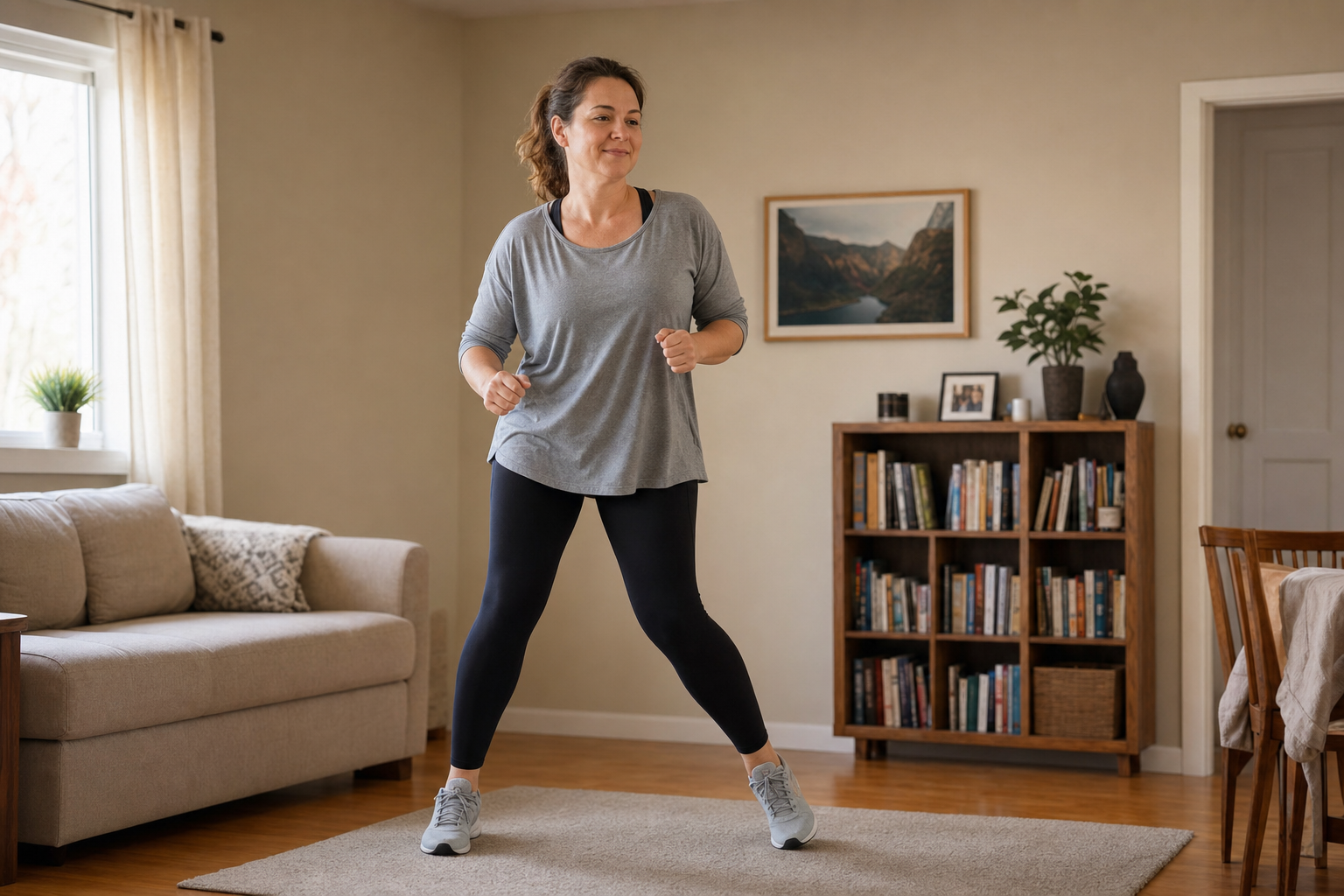
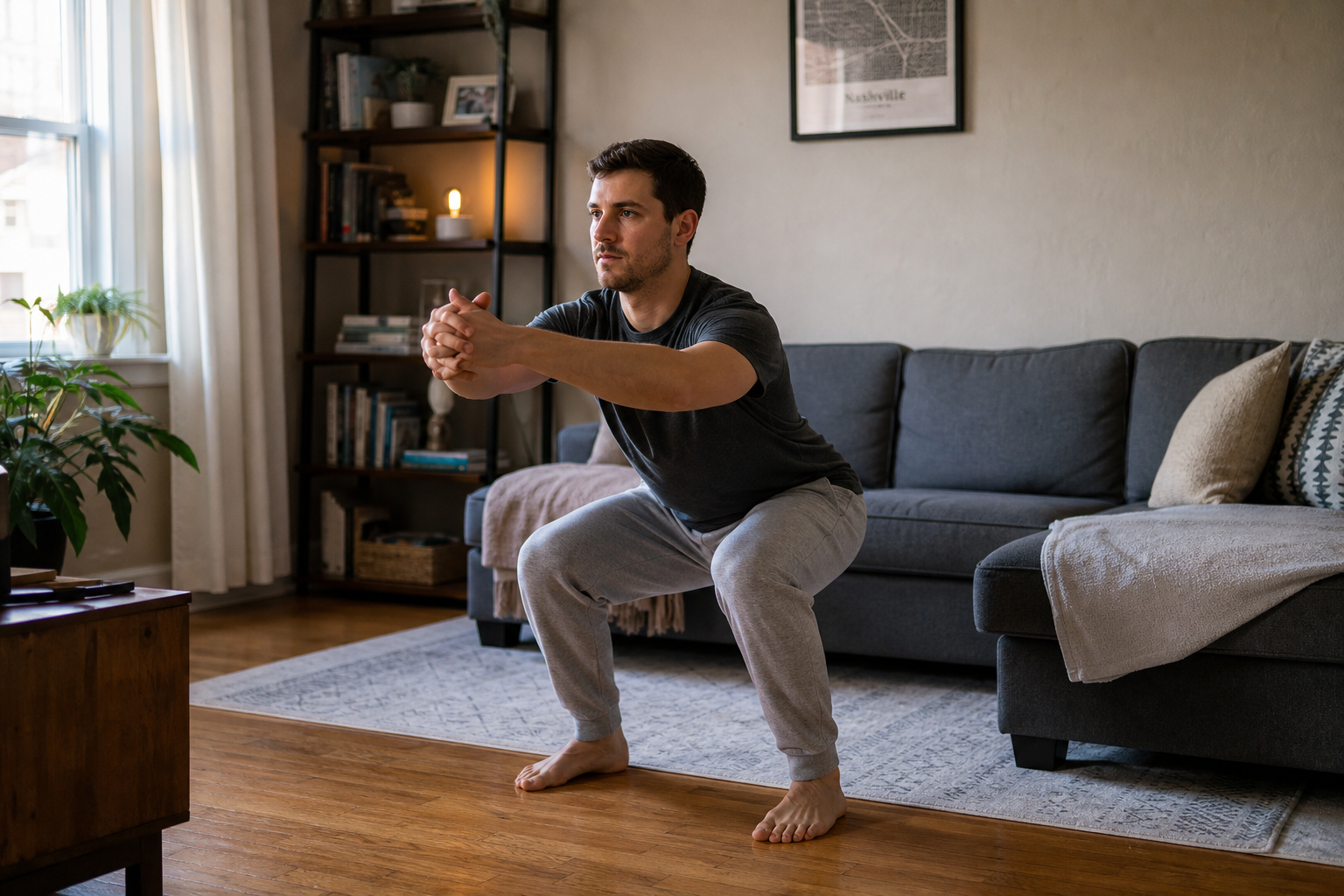
Bodyweight strength is where many home exercisers accidentally cross the line. Squats, lunges, bent-knee pushups, crunches, and shoulder raises are all reasonable no-equipment exercises, and MedlinePlus lists them as examples of moves that can be used for strength work at home.[3] The problem is not the exercise names. It is how they are arranged.
Five slow squats with a full pause between sets belong in a different air-quality category than jump-free squats performed for time with no rest. A moderate circuit can maintain strength and routine, but it should not be built like a disguised interval class when smoke or pollution is the reason you are indoors.
| Exercise | Poor-air-quality version | What to avoid |
|---|---|---|
| Squat | Slow reps, stop well before breathlessness | Timed burnout sets |
| Lunge | Stationary or reverse lunges with rest | Fast alternating lunges for conditioning |
| Bent-knee pushup | Small sets with full recovery | Pushup ladders that spike breathing |
| Crunch or dead bug | Controlled core work on the floor | Continuous ab circuits with no pauses |
| Shoulder raise | Light load, steady tempo | Racing reps to create fatigue |
A practical structure is three to five movements, two or three rounds, and enough rest that breathing settles before the next set. If the room feels stale, smoky, or irritating, shorten the session before you start bargaining with intensity.
For readers who want the middle tier already assembled, this indoor wildfire-smoke workout is the more sensible direction than inventing a hard circuit because the missed outdoor run is bothering you.
Treat Hard Cardio as the Highest-Exposure Indoor Choice
The workouts to be most careful with are the ones that feel most satisfying to outdoor runners and cyclists: treadmill intervals, hard indoor cycling, HIIT, vigorous rowing, stair circuits, and long tempo-style sessions. These sessions are effective training tools in clean conditions. During poor air quality, they are also the quickest way to raise minute ventilation.
That matters because particulate intake rises with the amount of air you move. Exercise can push ventilation from roughly 12 liters per minute at rest toward about 100 liters per minute, and athlete-facing guidance has warned that PM₂.₅ intake during hard exercise can rise about 10 to 20 times compared with rest.[1] If the indoor air still contains smoke or fine particles, a harder workout can turn a protective decision—staying inside—into a larger dose.
A 2025 simulated wildfire smoke study gives a useful caution without proving more than it can prove. In that study, two hours of moderate exercise in simulated wildfire smoke caused immediate declines in blood vessel and nervous system function, and people with stronger stress responses showed larger declines.[5] The sample was small: 20 healthy participants in their mid-20s, so the result should not be stretched into a universal prediction for every age or health status.[5] It does, however, make “moderate exercise in smoky air is harmless” a hard position to defend.
If you are healthy, your indoor air is clearly improved, and you have no symptoms, an easy walk or short low-zone ride may be reasonable. But the workout should stay honest. Once it becomes mouth-breathing, sweat-chasing cardio, it belongs in the high-exposure tier. TrainingPeaks’ athlete guidance uses AQI thresholds to help athletes modify or cancel outdoor sessions, but the same decision habit applies indoors: air conditions should change the workout before symptoms force the issue.[6]
Match the Workout to the Air You Actually Have
Indoor air is not automatically clean air. Outdoor smoke and pollution can enter through leaks, open doors, windows, ventilation systems, and repeated foot traffic. Indoor air can also be more polluted than outdoor air, depending on the home and the source of contamination. If the room smells smoky, your throat is irritated, or you can see haze in sunlight, do not reward yourself for being indoors by choosing the hardest workout on the list.
There is also no U.S. EPA exercise-specific indoor air-quality cutoff that tells home exercisers exactly when a treadmill interval session becomes safe. The closest reference points are general air-quality standards, not workout permissions: the WHO 24-hour PM₂.₅ guideline is 15 μg/m³, while Health Canada’s 1-hour PM₂.₅ value is 100 μg/m³.[7][8] Those numbers can help interpret monitors, but they are not magic lines where hard exercise suddenly stops carrying exposure risk.
| Indoor condition | Best workout tier | Session decision |
|---|---|---|
| Smell of smoke, visible haze, throat or eye irritation | Gentle mobility, stretching, or rest | Keep it short; skip cardio and circuits |
| No obvious smoke but outdoor AQI is poor and indoor filtration is uncertain | Yoga, Pilates-style work, light bands | Choose low breathing demand first |
| Indoor air feels clear and symptoms are absent | Light strength or moderate bodyweight work | Use rests; cap duration |
| Indoor air is clearly improved and you are not in a sensitive group | Easy steady cardio may be acceptable | Avoid intervals and long vigorous sessions |
| Any coughing, chest tightness, lightheadedness, or unusual shortness of breath | Stop | End the session rather than modifying it |
The American College of Sports Medicine and the American Lung Association both emphasize modifying exercise plans when air quality is poor, especially for people at higher risk.[9][10] That group includes children under 18, adults 65 and older, pregnant people, and anyone with heart or lung conditions. For those exercisers, “probably fine for a healthy adult” is not a useful standard. The lower tiers should be the default, and symptoms should end the session early.
Shorter Often Beats Gentler-but-Longer
A common compromise is to make the workout “a little easier” but keep the usual duration. That is not always the better exposure trade. If cumulative particulate intake is the concern, time matters. A shorter session gives you fewer minutes of elevated breathing, and Colorado State’s smoke guidance specifically points to reducing duration as likely more beneficial than reducing intensity alone for cumulative particulate exposure.[4]
That does not mean intensity is irrelevant. A hard 12-minute HIIT workout can still drive ventilation sharply upward. But if you are choosing between a 60-minute “easy” indoor ride that gradually becomes mouth-breathing and a 20-minute controlled strength session with rest, the shorter strength session is usually the cleaner poor-air-quality decision.
- If air is clearly compromised: choose 10 to 20 minutes of mobility, stretching, or light bands.
- If air is uncertain but symptoms are absent: choose short strength with full rests.
- If you already trained hard in poor air: prioritize recovery; this guide to post-workout recovery after poor air exposure is the better next read.
- If you want a broader poor-air-quality routine framework: use this indoor workout guide for poor air quality.
Stop Signals Are Not Intensity Cues
Coughing, chest tightness, lightheadedness, or unusual shortness of breath ends the workout. Not after one more round. Not after dropping the resistance. These symptoms mean the session has stopped being a training problem and has become a health trade you do not need to make.
The best indoor exercise when air quality is bad is the lowest-breathing-demand workout that preserves the habit. Some days that is gentle yoga. Some days it is light bands or a short strength circuit. On poor air days, the win is not proving fitness toughness indoors; it is keeping movement alive without turning exercise into a larger exposure event.
References
- The AQI Dilemma: Is It Safe to Exercise, GU Energy Labs, link
- Tips from an exercise physiologist on how to stay fit safely when air quality is poor, University of Toronto, link
- Exercise and physical activity, MedlinePlus, link
- Is it safe to exercise outside when there is wildfire smoke in the air?, Colorado State University, link
- Wildfire smoke can make your outdoor workout hazardous to your health – an exercise scientist explains how to gauge the risk, The Conversation, link
- High AQI: Is it Safe to Exercise Outside?, TrainingPeaks, link
- WHO global air quality guidelines, World Health Organization, link
- Residential Indoor Air Quality Guidelines: Fine Particulate Matter, Health Canada, link
- Air Quality and Outdoor Exercise, ACSM, link
- Four Things to Know About Air Quality and Exercise, American Lung Association, link
Comments
Join the discussion with an anonymous comment.