This plan is built for small spaces and noise-sensitive floors: four strength days per week, bodyweight only, no jumping, no fast footwork, and no movement that depends on landing hard to feel difficult. You need about the footprint of a yoga mat. The intensity comes from slower reps, one-side-at-a-time work, and holds that make ordinary exercises stop feeling ordinary.
The rule is simple enough to remember when you are tired: control every contact point with the floor. Feet stay planted when they can. Knees do not drop. Hands do not slap down between exercises. Transitions are part of the workout, not a noisy break from it.
The Four-Week Progression
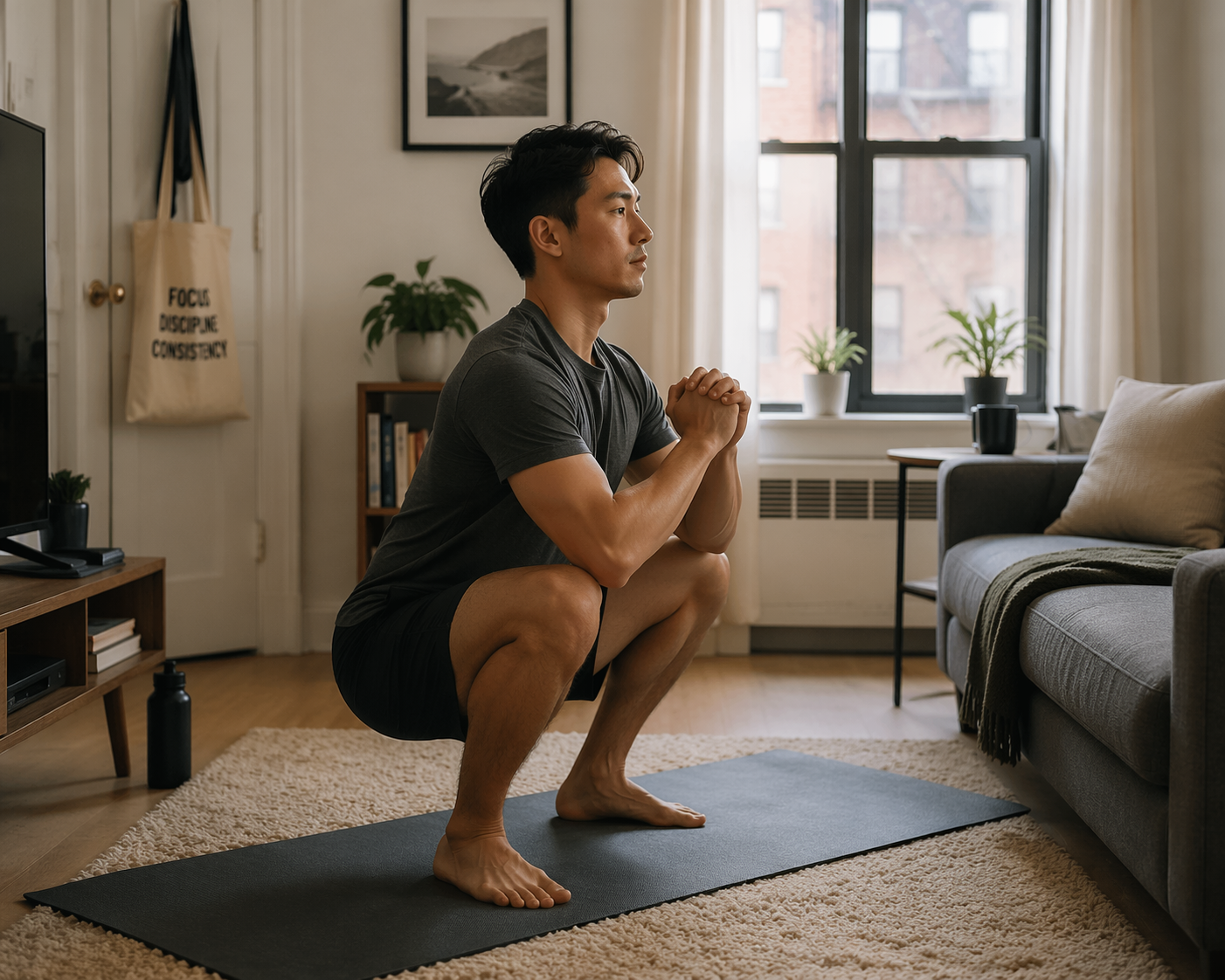
A quiet program needs progression more than it needs novelty. If every session is just a softer version of a loud workout, it will either become too easy or turn into a random list of substitutions. The cleaner approach is to keep the movement patterns stable and change the stress.
The progression here borrows the useful Level 1-to-3 idea from Nerd Fitness: start with a controllable version, make it harder through tempo, then progress to more demanding variations instead of chasing plyometric intensity.[1] Healthline’s at-home exercise library is also useful because it organizes movements across beginner, intermediate, and advanced options, which makes substitutions less haphazard.[2]
| Week | Main stress | How it feels | Quiet training cue |
|---|---|---|---|
| Week 1 | Baseline form | You learn the exercise, range of motion, and setup. | No dropped knees, heel thuds, or rushed transitions. |
| Week 2 | Slow tempo | Use 3-0-3 or 5-0-5 reps to increase time under tension. | Move as if the downstairs neighbor can hear every sloppy rep. |
| Week 3 | Unilateral emphasis | Use one-leg or one-arm-biased variations to increase relative load. | Shift weight deliberately before the rep starts. |
| Week 4 | Isometric holds | Pause in the hardest safe position and own it. | Freeze the body without bracing so hard that you stomp or shake loose. |
Week 1 is not a throwaway week. It is where you find the version of each exercise you can repeat without noise or compensation. A squat that only stays quiet when you cut the depth in half is not ready to become a faster squat; it is ready to become a better squat.
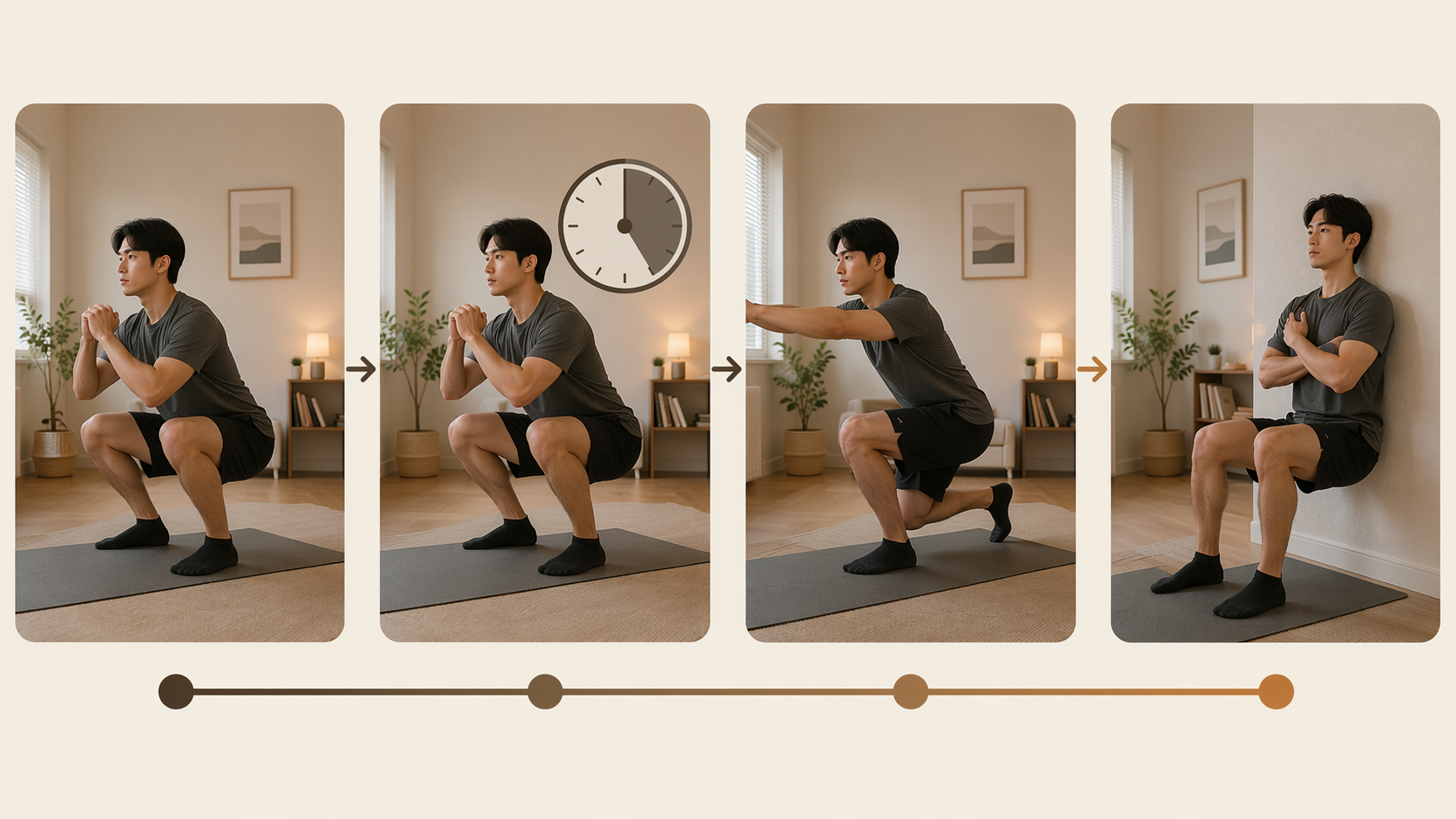
Week 2 slows the same movements down. A 3-0-3 tempo means three seconds down, no pause, three seconds up. A 5-0-5 tempo is more punishing and should be used only when the movement stays clean. This is how the plan adds work without adding jumps, hops, or extra floor space.[1]
Week 3 moves the load toward one side. Split squats, single-leg glute bridges, staggered push-ups, and side planks all make bodyweight feel heavier without needing dumbbells or a longer room. This is also where ego gets loud even if the workout does not: if a single-leg variation makes you tap the floor or crash out of position, use the supported version.
Week 4 uses isometric holds. You pause near the bottom of a squat, the hardest point of a push-up, the top of a glute bridge, or the braced position of a plank. Holds are apartment-friendly because the body is working hard while the floor is not being punished.
Weekly Schedule
Train four days per week. Put at least one easier day between the two lower-body sessions if your legs need it.
| Day | Focus | Session length | Main patterns |
|---|---|---|---|
| Day 1 | Push + squat | 30-40 minutes | Push-up, squat, core |
| Day 2 | Pull + hinge | 30-40 minutes | Prone pull, bridge, anti-rotation |
| Day 3 | Squat + conditioning | 25-35 minutes | Lower body circuit, controlled cardio |
| Day 4 | Full-body strength | 30-40 minutes | Push, pull, squat, hinge |
| Optional Day 5 | Mobility or easy recovery | 15-25 minutes | Hips, thoracic spine, breathing |
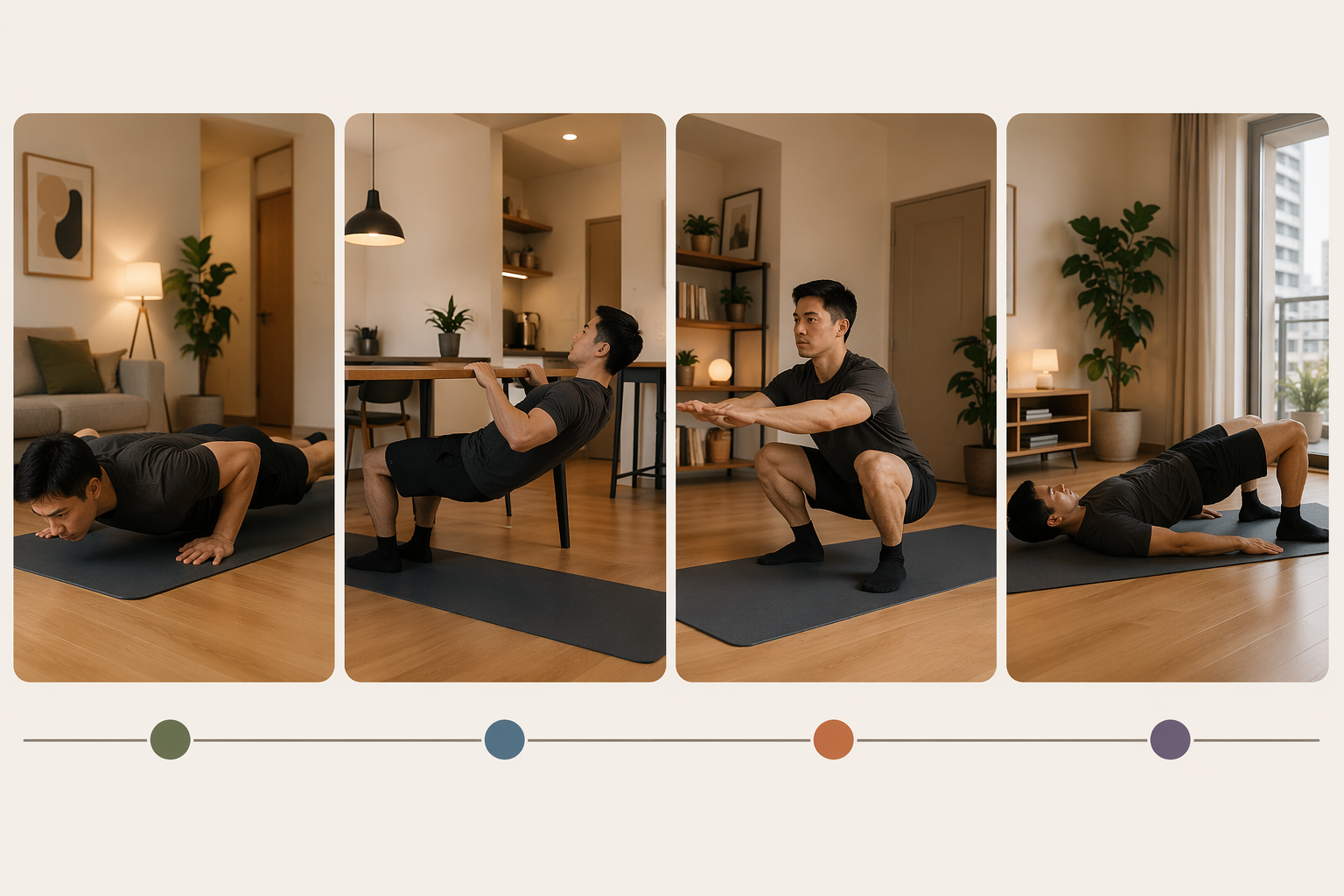
The movement pillars are push, pull, squat, and hinge. Pulling is the awkward one in a bodyweight-only apartment plan because there is no pull-up bar or heavy row. Here, it means floor-based upper-back work: prone Y-T-W raises, reverse snow angels, swimmers, and tabletop row variations if your setup allows them. If you already have a safe table or a door-anchor band, you can make pulling stronger, but the base plan does not require it.
Day 1: Push + Squat
Warm up for five minutes: cat-cow, shoulder circles, hip hinges, slow bodyweight squats, and incline plank holds. Nothing in the warm-up should bounce.
| Exercise | Week 1 | Week 2 | Week 3 | Week 4 | Rest |
|---|---|---|---|---|---|
| Push-up variation | 3 sets of 6-10 | 3 sets of 5-8 at 3-0-3 | 3 sets of 5-8 staggered or decline if quiet | 3 sets of 15-25 sec low hold | 60-90 sec |
| Bodyweight squat | 3 sets of 10-15 | 3 sets of 6-10 at 5-0-5 | 3 sets of 8-10 split squats per side | 3 sets of 20-30 sec squat hold | 60 sec |
| Dead bug | 3 sets of 8 per side | 3 sets of 6 per side, slower | 3 sets of long-lever dead bugs | 3 sets of 20-30 sec hollow hold or dead bug hold | 45 sec |
| Wall sit calf raise | 2 sets of 12-15 | 2 sets of 8-12 slow | 2 sets of 10 single-leg-biased per side | 2 sets of 20 sec wall sit | 45 sec |
For push-ups, choose the version that lets your chest and hips move together: wall, counter, sofa-edge, knee, full, or feet-elevated. Healthline’s beginner-to-advanced structure is helpful here because the point is not to “graduate” as fast as possible; it is to find the hardest version you can control.[2] If you need a fuller upper-body ladder, use this no-equipment upper-body progression after you finish the four-week cycle.
Quiet cue: place your hands before you load them, and step your feet into position one at a time. The push-up itself is rarely the loud part. The flop into the plank is.
Day 2: Pull + Hinge
This day trains the back side of the body without pretending that floor pull exercises are the same as heavy rows. They are still worth doing. Most small-space routines overfeed the front of the body with push-ups and underfeed the upper back; this day keeps the plan more balanced.
| Exercise | Week 1 | Week 2 | Week 3 | Week 4 | Rest |
|---|---|---|---|---|---|
| Prone Y-T-W raise | 3 rounds of 6 each shape | 3 rounds of 4 each at slow tempo | 3 rounds with 2-sec squeeze each rep | 3 rounds with 10-sec hold each shape | 45-60 sec |
| Glute bridge | 3 sets of 12-15 | 3 sets of 8-10 at 3-0-3 | 3 sets of 8-12 single-leg per side | 3 sets of 25-40 sec top hold | 60 sec |
| Bodyweight good morning | 3 sets of 10-12 | 3 sets of 8 at 5-0-5 | 3 sets of 8 staggered-stance per side | 3 sets of 20-sec hinge hold | 60 sec |
| Side plank | 2 sets of 15-25 sec per side | 2 sets of 20-30 sec per side | 2 sets with top-leg lift if quiet | 2 sets of 30-40 sec per side | 45 sec |
Keep glute bridges quiet by setting your feet first, pressing through the whole foot, and lowering your hips as if the mat is thinner than it is. Single-leg bridges are not a license to twist and drop. If the working hamstring cramps, switch to a staggered stance before forcing more reps.
For the hinge, imagine closing a car door with your hips. The knees soften, the hips move back, and the spine stays long. If you feel it only in your low back, shorten the range and slow down.
Day 3: Squat + Quiet Conditioning
Conditioning does not have to mean jumping jacks, burpees, or mountain climbers hammered into the floor. Greatist’s quiet workout model shows a full-body routine can be built around no-impact exercises rather than landing noise.[3] The useful test is whether you can keep breathing hard while both feet, or at least one controlled contact point, stay honest.
Do the following circuit for 3-5 rounds. Rest 30-60 seconds between movements and 90 seconds between rounds. In Week 1, use the lower end. In Week 4, add the holds.
| Movement | Work | Progression | Quiet cue |
|---|---|---|---|
| Reverse lunge or split squat | 8-10 reps per side | Week 2 slow lower; Week 3 rear-foot-light split squat; Week 4 bottom hold | Step back like you are placing the foot, not catching yourself. |
| Slow squat to calf raise | 10-12 reps | Use 3-0-3 tempo before adding reps | Rise onto the toes without snapping the heels back down. |
| Plank shoulder tap | 8-12 taps per side | Widen feet, then slow the tap | Tap the shoulder; do not shift and slap. |
| Bear hover | 15-30 sec | Add alternating hand lift only if silent | Knees hover close to the floor; they do not knock into it. |
| Standing march with reach | 30-45 sec | Slow the knee lift and reach higher | Lift and place each foot instead of marching through the heel. |
The “both feet on the ground” rule from tiny-space training is a good filter when you are tempted to add intensity.[4] It does not mean every exercise literally keeps both feet planted forever. It means the default replacement for a jump is a controlled version that removes the landing.
If you want a separate cardio option on a non-lifting day, use a no-jumping HIIT workout and keep the same floor-contact standard.
Day 4: Full-Body Strength
Day 4 ties the week together. It is not a test of how fast you can move through exercises in a small room. It is a density session: clean reps, steady rest, and enough total work to make the week feel like training.
| Exercise | Sets | Week 1 | Week 2 | Week 3 | Week 4 |
|---|---|---|---|---|---|
| Push-up variation | 3 | 6-10 reps | 5-8 reps at 3-0-3 | Staggered hands, 5-8 per side bias | 15-25 sec low hold |
| Split squat | 3 | 8 reps per side | 6 reps per side slow | Rear-foot-light or longer stance | 20-sec bottom hold per side |
| Prone swimmer | 3 | 8-10 reps | 6-8 slow reps | Add 2-sec squeeze | 20-30 sec hold in extended position |
| Single-leg or staggered glute bridge | 3 | 10 per side | 8 per side slow | Single-leg if quiet and level | 25-40 sec top hold |
| Forearm plank | 2-3 | 20-30 sec | 30-40 sec | Shoulder-tap plank if silent | Hard-style plank, 15-25 sec |
Rest 60-90 seconds between exercises. If the session starts getting noisy, do not cut the rest to prove fitness. Add rest, regain control, and continue. Quiet training punishes rushing quickly.
How To Choose the Right Version
Use the hardest version that lets you finish every set with two things intact: joint position and floor control. If either one breaks, regress the exercise before adding more reps.
| Pattern | Easier | Baseline | Harder |
|---|---|---|---|
| Push | Wall or counter push-up | Knee or full push-up | Staggered, decline, or slow low-hold push-up |
| Squat | Box squat to a chair | Bodyweight squat | Split squat, slow squat, or squat hold |
| Hinge | Glute bridge | Good morning plus glute bridge | Single-leg bridge or staggered hinge |
| Pull | Prone W raise | Y-T-W raise or swimmer | Longer holds, squeezes, or safe tabletop row |
| Core | Dead bug | Plank or side plank | Long-lever dead bug, bear hover, or hard-style plank |
Beginners should not be embarrassed by incline push-ups, box squats, or short planks. Those are not “less real” exercises; they are the versions that let the body learn quietly. If this four-day pace is too much right now, start with a no-equipment beginner workout plan or an 8-week beginner strength plan first.
Advanced lifters may run into the ceiling of bodyweight-only training sooner. Slower reps and holds can extend the runway, but they cannot replace every loading option forever. When the hardest quiet variation no longer challenges you, add quiet-compatible resistance: bands, sliders, a weighted backpack that does not shift, or another tool you can control without clanking.
Set Up the Room So the Workout Stays Quiet
A mat helps, but it is not magic. SELF’s trainer guidance emphasizes low-impact substitutions and flooring choices as practical ways to reduce neighbor irritation during at-home workouts.[5] In an upstairs apartment, the best setup is usually a stable exercise mat over a rug or other sound-dampening surface, with enough grip that your hands and feet do not slide.
- Train away from the thinnest or creakiest part of the floor if you know where it is.
- Keep water bottles, phones, and timers off the floor edge where they can rattle.
- Use socks only if they do not make you slide; sliding often turns quiet reps into sudden catches.
- Step into plank, lunge, and bridge positions deliberately instead of dropping into them.
If flooring is the real weak point, solve that before blaming the program. A thicker surface can make a large difference in how training feels under your body, even though exact sound reduction will vary by building. Use an apartment home gym flooring guide or a broader guide to choosing home gym flooring if your floor turns every heel touch into a drum hit.
What “No Noise” Can and Cannot Promise
The exercises in this plan are quiet by design because they remove jumping, landing, and fast impact. That does not mean anyone has lab-tested each movement and assigned it a reliable decibel score. The available guidance is trainer-based and experience-based, not a peer-reviewed acoustic ranking of home exercises.
Buildings also differ. A ground-floor tenant can usually be less cautious about heel contact than someone over a bedroom. An old upper-floor unit with hollow-sounding boards may require slower transitions, extra matting, and fewer plank-to-standing changes than a newer building with better floor assembly.
The standard is practical: if an exercise makes you brace for the sound before you brace for the rep, change the exercise. Replace reverse lunges with split squats. Replace plank shoulder taps with a regular plank. Replace marching with a slow standing knee lift. The muscle does not know you were trying to impress a timer.
After Four Weeks
At the end of Week 4, do not automatically chase a harder-looking routine. Look at what changed: cleaner push-ups, deeper squats, longer holds, steadier single-leg work, shorter rest, or better control at the same workload. Those are measurable results in a small-space program.
- Repeat the cycle if you still have obvious room to improve the same variations.
- Move to harder exercise versions if all sets are quiet, controlled, and no longer challenging.
- Add bands, sliders, or another quiet resistance option if bodyweight progress has stalled.
- Continue into a longer 8-week bodyweight workout plan if you want more structure after this block.
If you still doubt whether bodyweight training can build muscle, read the evidence-focused guide on building muscle without weights. The short version for this plan is more direct: quiet is not the same as easy. When tempo, unilateral loading, and isometric holds are programmed deliberately, a small room is enough space to train hard.
References
- The Small Space Workout (Train in Any Room), Nerd Fitness
- 30 Moves to Make the Most of Your At-Home Workout, Healthline
- The Quiet Workout: A Killer Home Routine That Won't Annoy Your Neighbors, Greatist
- The Cozy Training Plan: Workouts You Can Do in a Tiny Space, 12 Minute Athlete
- 7 Quiet Workout Tips So You Can Exercise at Home Without Infuriating Your Neighbors, SELF
Comments
Join the discussion with an anonymous comment.