
How to Progress Your No-Equipment Upper Body Workout When Push-Ups Stop Working
Learn how to keep building upper body strength without weights by systematically applying five progressive overload variables to bodyweight exercises.
- Duration
- 20 min
Push-ups usually stop feeling impressive in a very specific way. At first, every rep asks for attention: hands set, ribs down, chest moving as one piece, elbows behaving. Then the set becomes manageable. Then you add more reps, and the workout gets longer without feeling meaningfully stronger.
That is the point where a lot of people decide they have outgrown a no-equipment upper body setup. Sometimes they are right that the current workout has stopped doing much. They are usually wrong about why. Push-ups did not stop working. The workout stopped changing.
Progressive overload without weights is not magic and it is not a purity contest. It means the body has to solve a harder version of the same training problem over time. If the change cannot be observed, counted, repeated next week, or felt clearly in the quality of the rep, it is probably not a progression strategy. It is just variety.
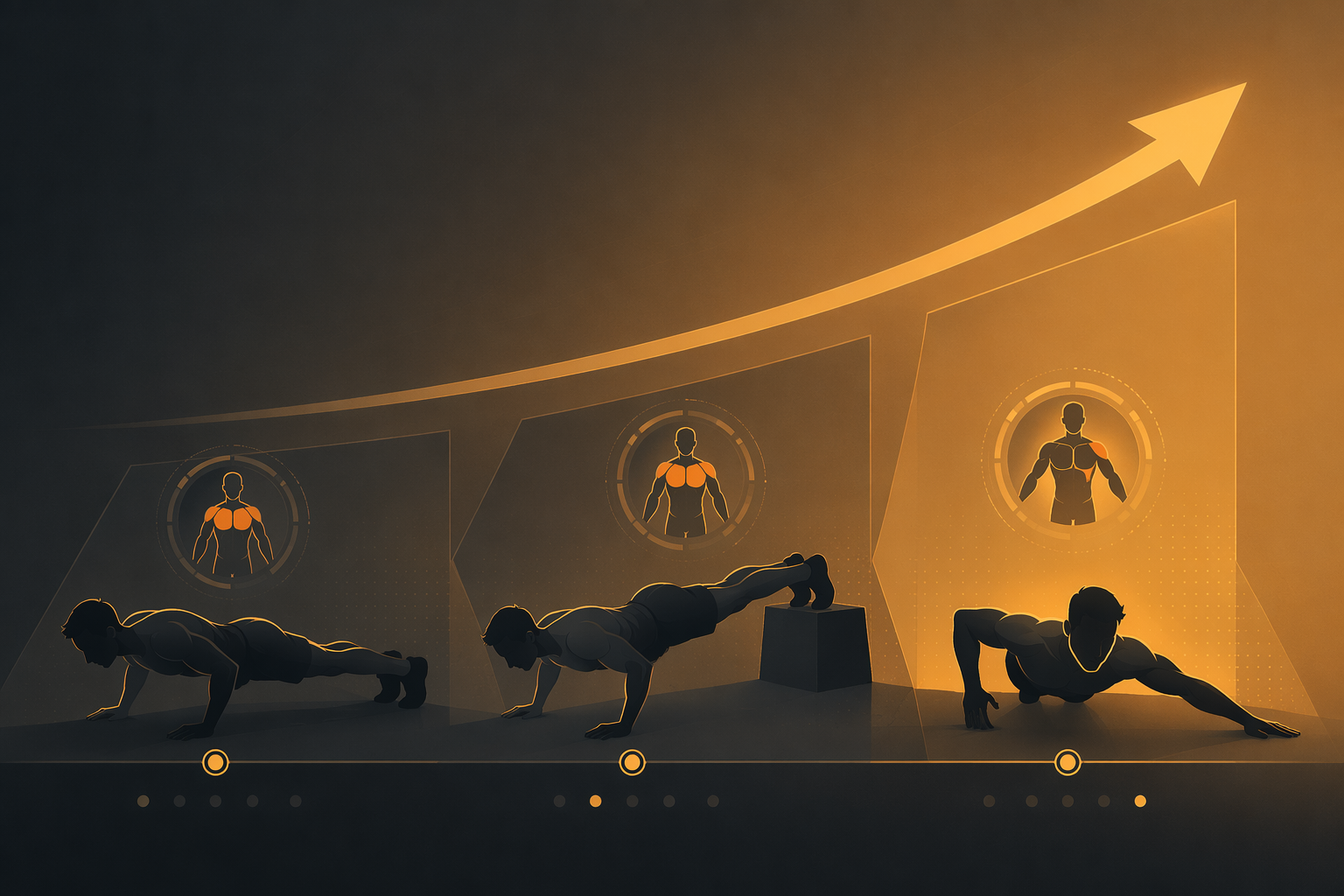
The Five Levers That Replace Added Weight
A barbell makes progression obvious because the number on the plates changes. Bodyweight training needs a little more accounting. The load can still increase, but it usually increases through the way the exercise is performed.
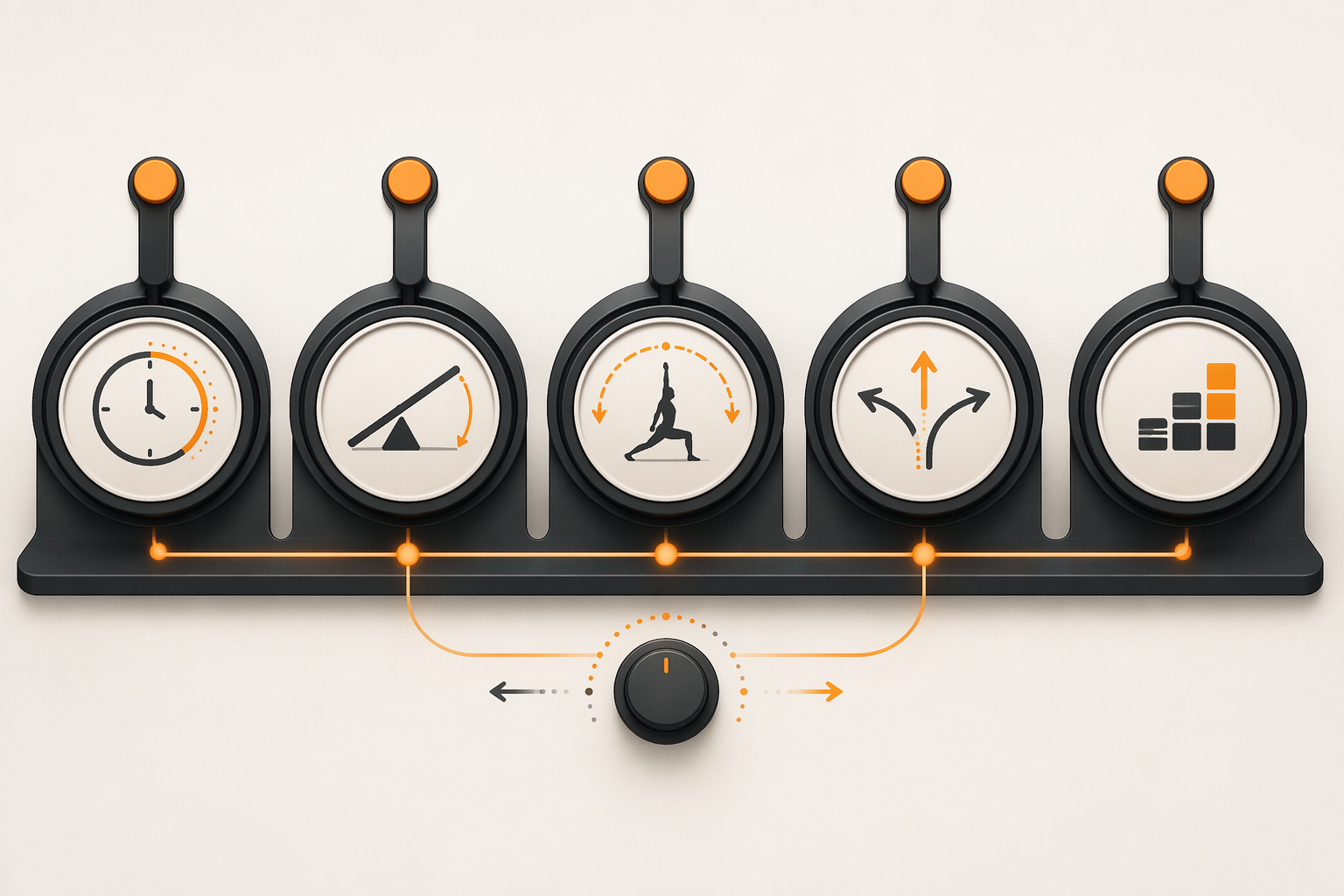
| Progression lever | What changes | What it looks like in upper body training |
|---|---|---|
| Tempo | The speed of each rep | A 3- to 5-second lowering phase on push-ups or dips |
| Leverage | How much of your bodyweight the working muscles have to manage | Feet-elevated push-ups, archer push-ups, steeper bodyweight rows |
| Range of motion | How far the joints travel under control | Deeper push-ups between stable raised surfaces |
| Exercise variation | The movement pattern becomes harder or more specific | Diamond push-ups, pike push-ups, plyometric push-ups |
| Volume | The total useful work done across a session or week | More hard sets, not just more tired reps |
These are not five things to add at once. They are controls. Turn one at a time, train it long enough to know whether it worked, then adjust again.
Tempo Is the First Lever to Fix
Most home push-up plateaus are partly tempo problems. The set has become a fast bounce from top to bottom, so the muscles spend less useful time controlling the hardest part of the movement. You can make the next set harder without changing the exercise by slowing the lowering phase to three to five seconds.
For a standard push-up, that means locking in the top position, lowering for a controlled count, pausing briefly near the floor without collapsing, then pressing back up with clean tension. The rep count may drop. That is not a failure if the reps became harder and more repeatable.
Tempo works well because it gives you a progression before you need a new exercise. If you have been doing three sets of 20 quick push-ups, try three sets of 8 to 12 with a slow eccentric. Keep the torso quiet. Keep the shoulder blades moving naturally. Stop the set when the lowering phase turns into a fall.
A useful tempo block does not need to be complicated. Run it for two to four weeks. Use the same hand position. Keep the same rest periods. Add reps only while the lowering phase stays honest. That gives you a clearer signal than swapping exercises every session and hoping soreness means progress.
Leverage Changes the Load Even When Bodyweight Stays the Same
Leverage is where bodyweight training stops looking vague. A standard push-up loads about 64% of bodyweight, while elevating the feet 60 cm raises the load to about 75% of bodyweight, according to push-up loading research by Kotarsky and colleagues in the Journal of Strength and Conditioning Research.[1]
That is not a tiny tweak. For a 180-pound person, the difference between those two positions is roughly the difference between pressing about 115 pounds and about 135 pounds of bodyweight through the movement. The exact load at the hands will vary by body proportions and setup, but the practical point is solid: changing body angle changes the demand.
Feet-elevated push-ups are the cleanest example. Raise the feet a little, keep the same controlled push-up, and the upper body has to handle more of the system. Raise them too high too soon, and the shoulders may take over before the chest and triceps get useful work. Progression is not the highest possible setup. It is the hardest setup you can still control.
Archer push-ups use leverage differently. Instead of making both arms share the work evenly, you shift more demand toward one side while the other arm assists. This is a practical bridge between regular push-ups and one-arm work. It also exposes side-to-side control problems that high-rep regular push-ups can hide.
Pike push-ups change the angle again. The torso moves toward a more vertical pressing pattern, so the shoulders take more of the job. For someone whose no-equipment upper body routine has been all horizontal pressing, pike push-ups are not just harder push-ups. They train a different pressing emphasis.
Rows follow the same logic if you have a sturdy table edge, a secure doorframe setup, or another safe anchor. The more horizontal your body becomes, the harder the row. The more upright you stand, the easier it becomes. The equipment question matters less than the angle and safety of the anchor. If the setup is unstable, the progression is not worth it.
Use Range of Motion After Control Is Already There
Range of motion is a good progression only when the extra range is controlled. A deeper push-up between two stable raised surfaces can ask more from the chest and shoulders because the body travels farther before pressing back up. It can also become a messy shoulder stretch if the bottom position is loose.
The test is simple: can you pause at the deepest point without the shoulders dumping forward, the lower back sagging, or the elbows flaring into a position you cannot reproduce? If not, earn the range in smaller increments. A slightly deeper controlled rep beats a dramatic bottom position that you cannot own.
Chair dips deserve the same suspicion. They are common in no-equipment lists, but the shoulder position can be cranky for some people, especially when the hips drift too far forward and the bottom becomes uncontrolled. If dips feel sharp in the front of the shoulder, do not keep them just because they are traditional. Use close-grip push-ups, slow push-ups, or pike push-ups instead.
Variation Should Solve a Specific Problem
Exercise variation is useful when it changes the training demand in a direction you actually need. It is less useful when it turns every workout into a sampler.
- If regular push-ups are too easy but your control is good, move to slow eccentrics or feet elevation.
- If one side is clearly weaker, use archer push-ups or offset-hand push-ups with conservative volume.
- If your shoulders need more direct pressing work, add pike push-ups.
- If your triceps are the limiting factor, use diamond or close-grip push-ups, provided your wrists and elbows tolerate them.
- If power is the goal and basic strength is already there, plyometric push-ups can fit, but they should not replace controlled strength work.
A harder variation is not automatically a better variation. A clean feet-elevated push-up will do more for most people than an archer push-up that twists, shortens, and turns into a shoulder shrug. The progression ladder only works when each rung is still a real rep.
If you still want the broader evidence question answered before trusting bodyweight training at all, read the full evidence breakdown on whether you can build muscle without weights. This article is narrower: once you accept that bodyweight training can work, the job is to make it progress on purpose.
Volume Comes Last Because It Is Easy to Abuse
Adding volume is the most obvious progression and often the least disciplined one. More reps can help. More sets can help. More weekly exposure can help. But if the first three sets are crisp and the next four are half-depth survival reps, the extra work is mostly fatigue dressed up as training.
Use volume after the exercise is appropriately hard. For upper body pushing, that might mean moving from 3 hard sets twice per week to 4 hard sets twice per week, or adding a third weekly exposure with lower volume. For pulling, it might mean spreading rows across the week instead of burying them at the end of one tired session.
The useful question is not, “Can I do more?” It is, “Can I recover from more and perform it with the same standard next time?” If the answer is no, choose tempo, leverage, or range of motion before piling on more work.
A Simple Progression Block for Push-Up Plateaus
Instead of rebuilding the whole workout, keep the main pattern and change one lever for the next block. Here is a practical example for someone who can already perform regular push-ups well.
| Training block | Main change | Working standard |
|---|---|---|
| Block 1 | Slow the lowering phase | 3 sets of 8-12 push-ups with a 3-second eccentric |
| Block 2 | Add leverage | 3-4 sets of feet-elevated push-ups with the same controlled descent |
| Block 3 | Shift variation | Archer push-up practice or pike push-ups, depending on the weak point |
| Block 4 | Add volume if recovery is good | One additional hard set or one additional weekly exposure |
This is only an example, not a required timeline. Some people need several weeks on tempo before elevation makes sense. Others already have clean slow reps and should move straight to leverage. The point is that each block has one main job, so you can tell what changed.
Do Not Let Pressing Crowd Out Pulling
No-equipment upper body training tends to overfeed push-ups because the floor is always available. Pulling is less convenient, but it still matters. If every session is push-ups, planks, mountain climbers, and more push-ups, the program is not complete just because it is difficult.
A bodyweight row variation, if you have a safe setup, gives the upper back and biceps a job that push-ups cannot replace. If you do not have a safe rowing option at home, that is one of the few moments where the equipment conversation becomes practical instead of impulsive. A suspension trainer, pull-up bar, or bands may solve a real programming gap. Buying them because push-ups got boring is a different decision.
For lower-body work, the same progression logic applies with different exercises and different sticking points. The companion guide on progression levers for home leg workouts uses the same framework where squats, lunges, and single-leg variations are the main tools.
What the Evidence Can and Cannot Say
The strongest practical evidence in this discussion is the mechanical kind: body position changes the percentage of bodyweight loaded during a push-up, and that gives you a measurable way to progress without external weight.[1] That does not prove bodyweight training is superior to weight training. It proves the “no added weight means no added challenge” argument is too shallow.
Broader health claims should be handled more carefully. Harvard Health has reported on a small study in young women where 10 weeks of bodyweight exercise improved aerobic capacity by 33% and muscle endurance by 11%.[2] That is encouraging, but it is not a universal promise for every age group, training history, or goal. It is better treated as early support for bodyweight training being useful, not as proof that any random home circuit will build the upper body you want.
Claims comparing calisthenics directly with weight training also need precision. Some fitness articles cite an 8-week comparison in which calisthenics produced similar improvements in strength and body composition to weight training, but that citation is indirect and should be treated as secondary support rather than a primary claim. The safer conclusion is narrower: bodyweight training can remain legitimate when progression is programmed, while weights remain a useful and often efficient way to load movement.
How to Choose the Next Lever
When a no-equipment upper body workout stalls, do not change everything. Look at the failed set and choose the lever that matches the problem.
- If reps are fast and loose, change tempo first.
- If reps are clean but too easy, change leverage.
- If the movement is controlled but shallow, increase range of motion carefully.
- If a specific muscle group or angle is undertrained, choose a harder variation that targets it.
- If the exercise is hard enough and recovery is solid, add volume.
For a complete schedule that puts upper and lower body work into a longer progression, use the 12-week at-home bodyweight workout plan. If you are coming from short circuit training and everything has turned into more rounds against the clock, the guide on progressing the 7-minute workout is the better next read.
Before buying weights because push-ups stopped working, run the workout through the five-lever checklist. Slow the rep. Change the angle. Add controlled range. Pick a variation for a real reason. Increase volume only when the work is still high quality. Progress is not endless novelty, and it is not endless reps. It is a planned increase in difficulty that the body has to adapt to.
References
- Effect of Progressive Calisthenic Push-up Training on Muscle Strength and Thickness, Journal of Strength and Conditioning Research, 2018
- The advantages of body-weight exercise, Harvard Health Publishing
What a small equipment investment adds
We don't have a build tagged to this exact tier yet. Browse all builds.
How often should you repeat this?
How Whoop and Oura Ring track recovery for home workouts
For home exercisers deciding between WHOOP and Oura Ring, the better sleep and recovery tracker depends on training style: WHOOP's strength-aware tracking fits dumbbell and grip-heavy sessions, while Oura's sleep-first scoring suits yoga and indoor cycling. The verdict hinges on how each builds its daily recovery score, their home-workout tracking gaps, and who pays for hardware versus subscription.
Spot something off?
Tell us if a movement, tier assumption, or duration didn't match your experience.