
A list of “best cardio exercises at home” gives you options. A program decides what happens with those options: how hard you work, how long you work, where the hard sessions go, what stays easy, and how next week becomes slightly different from this week.
That is the piece most home cardio plans skip. You can do mountain climbers, step-ups, shadow boxing, jump rope, squat-to-reach patterns, low-impact circuits, and burpees until the carpet gives up. If every session is chosen by mood, novelty, or whatever video looks most punishing, your fitness has no clear signal to adapt to. You are working hard, but the week is not being trained.
The goal here is not to hand you another fixed routine. It is to show you how to build cardio at home as a weekly program: using intensity zones, total minutes, recovery spacing, and progressive overload. If you would rather have the programming done for you, use the 4-week progressive home cardio plan. If you want to understand how to build your own, start with the week, not the exercise list.
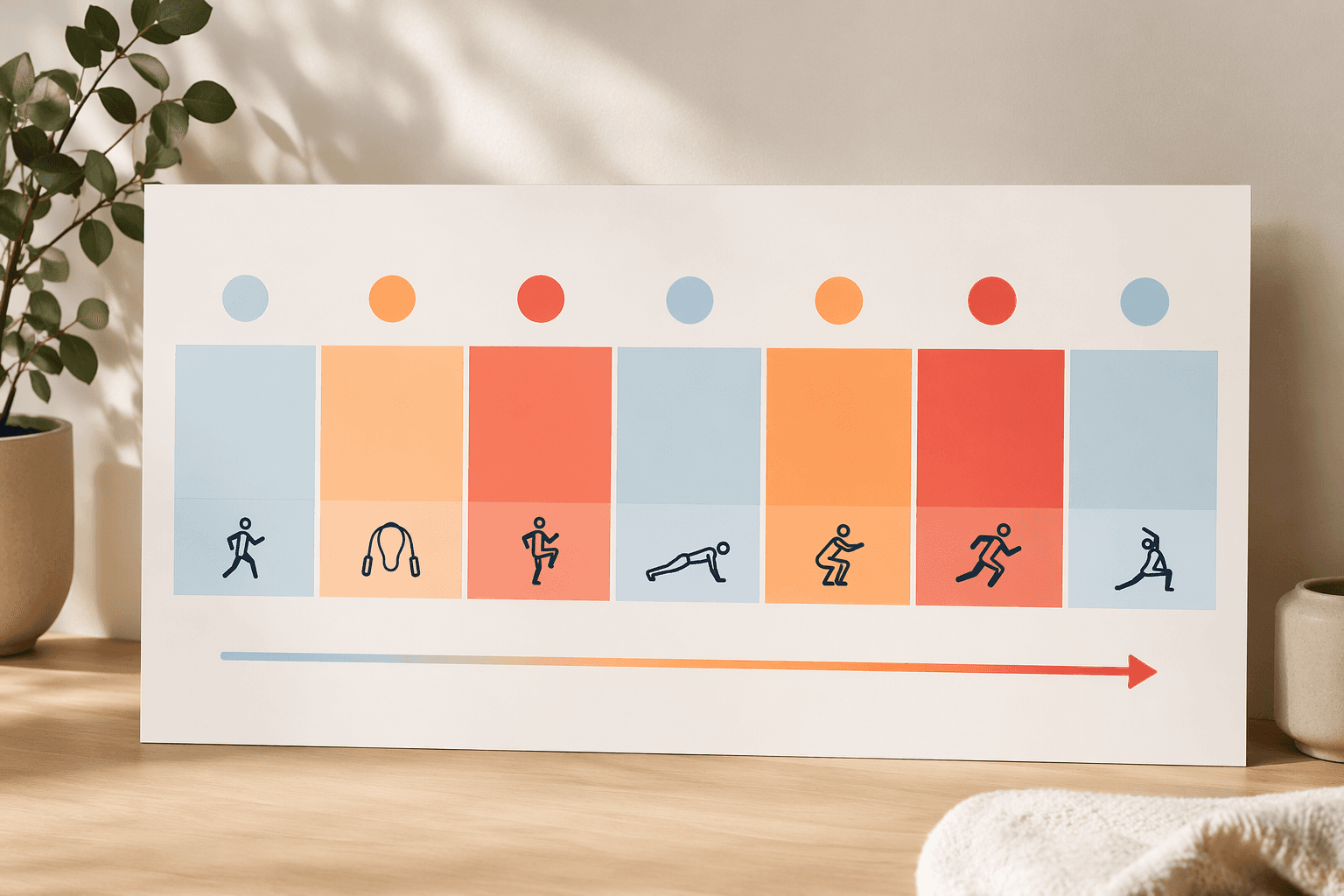
Start with the weekly target, then distribute the work
The common public-health target is a useful destination: adults are advised to get at least 150 minutes of moderate-intensity aerobic activity per week, or 75 minutes of vigorous-intensity activity, or an equivalent combination of the two.[1] That does not mean every home exerciser needs to jump straight to 150 minutes next Monday. It gives your plan a direction.
For an intermediate exerciser, the first useful question is not “Which move burns the most?” It is “How much quality cardio can I repeat this week without turning every session into a recovery problem?” A week with three sustainable sessions will usually beat a week with one heroic interval workout, one half-hearted follow-up, and four days of bargaining with sore calves.
Think of the guideline as a volume range you build toward. If you currently do about 80 total minutes per week, a jump to 150 minutes may be too much. If you already do 120 minutes but all of it feels like a red-line effort, the issue is not only volume. It is intensity distribution.
Use RPE and the talk test to give each session a job
At home, most people do not need a heart-rate monitor to make better cardio decisions. You need a reliable way to stop calling every sweaty circuit “cardio” and start assigning intensity. Rate of perceived exertion, or RPE, does that well enough for most programming decisions.

| Zone | RPE | Talk test cue | What it should feel like | Common home-cardio uses |
|---|---|---|---|---|
| Low | 3–4 | You can hold a full conversation. | Easy, warm, controlled, repeatable. | Recovery-friendly movement, longer easy sessions, warm-ups, cooldowns, low-impact circulation work. |
| Moderate | 5–7 | You can speak in short sentences, but you would rather not give a speech. | Steady work that requires attention but does not feel desperate. | Main aerobic sessions, step-up blocks, marching intervals, shadow boxing rounds, low-impact circuits. |
| Vigorous | 7–9 | You can only get out short phrases or single words. | Hard, breathing-dominant, limited in duration. | HIIT intervals, faster jump-rope work, burpee variations, mountain climber intervals, dense bodyweight circuits. |
Low intensity is not wasted time. It lets you add volume without making every day compete for your nervous system, joints, and motivation. Moderate intensity is the workhorse for many home cardio plans because it is challenging enough to build capacity and controlled enough to repeat. Vigorous work has its place, but it has to be placed. If you do it whenever you feel guilty, bored, or impatient, it stops being programming and becomes stress with a timer.
The mistake I see often is not that people do too little hard work. It is that they make every session look like a different version of the same hard circuit. Monday is “HIIT legs.” Wednesday is “fat-burning cardio.” Friday is “no-equipment sweat.” The names change; the intensity does not. Then the person wonders why their conditioning stalls even though they are drenched three times a week.
A usable weekly template for cardio at home
Build the week around roles. You do not need seven unique workouts. You need enough easy and moderate work to create an aerobic base, enough vigorous work to push the ceiling, and enough recovery space to make the next session productive.
| Day | Session role | Intensity | Example duration | What to protect |
|---|---|---|---|---|
| Monday | Main steady cardio | Moderate | 25–40 minutes | Keep it repeatable; do not race the first 10 minutes. |
| Tuesday | Strength training or mobility | Low to moderate overall | Varies | Avoid turning every strength circuit into accidental HIIT. |
| Wednesday | Recovery-friendly cardio | Low | 20–35 minutes | Finish fresher than you started. |
| Thursday | Intervals | Vigorous work bouts with easy recoveries | 15–25 minutes total | Limit the number of truly hard rounds. |
| Friday | Rest, mobility, or strength | Low | Varies | Let Thursday’s work absorb. |
| Saturday | Longer mixed cardio | Low to moderate | 30–50 minutes | Use sustainable movement choices. |
| Sunday | Rest or easy walk-style movement | Low | Optional | Do not chase missed intensity. |
This is a template, not a law. If Thursday is your worst day for energy, do not put intervals there just because the table does. The principle is the spacing: a moderate day, an easier day, one deliberate vigorous day, and another lower-to-moderate volume day. That gives you four cardio exposures without asking every workout to be the hardest one of the week.
If you are building toward the 150-minute moderate target, the template might eventually total something like 25–40 minutes on Monday, 20–35 minutes on Wednesday, 15–25 minutes of interval work on Thursday, and 30–50 minutes on Saturday. The exact combination depends on how much of your week is moderate versus vigorous. The guideline allows either 150 minutes of moderate activity, 75 minutes of vigorous activity, or a combination, so you do not need to force all minutes into one style.[1]
If you only have three days
Use one moderate steady session, one interval session, and one longer low-to-moderate session. Keep at least one day between the interval session and your hardest lower-body strength day if jumping, lunging, or squat-heavy cardio tends to leave your legs flat.
If you want five cardio days
Add low intensity first. Most intermediate home exercisers do not need a second HIIT day before they can handle more easy volume. A fifth day can be a low-impact session built from marching variations, gentle step-ups, light shadow boxing, or an easy circuit where breathing stays under control.
Progress one variable at a time
Progressive overload for cardio at home does not mean making every workout more brutal. It means giving the body a slightly stronger signal while keeping the plan recognizable. If Monday, Wednesday, Thursday, and Saturday all change at once, you will not know what worked, what was too much, or what caused the next week to fall apart.
Pick one progression lever for a week or two, then watch how your recovery responds.
- Increase total minutes: add 5–10 minutes to one or two low/moderate sessions instead of extending every workout.
- Increase interval count: add one hard interval to the vigorous session while keeping the work and rest length the same.
- Change the work/rest ratio: move from equal work and rest to slightly shorter rest, but only after the current version stays controlled.
- Increase density: complete the same amount of work in slightly less total time by reducing transition time, not by rushing sloppy reps.
- Increase movement difficulty: shift from marching to step-ups, from incline mountain climbers to floor mountain climbers, or from low-impact squat reaches to a more powerful version.
A clean progression might look like this: keep the same four weekly sessions for two weeks, add five minutes to the Saturday low-to-moderate session in week three, then add one interval to Thursday in week four. That is enough change to create direction without turning the plan into a guessing game.
Use performance and recovery markers together. If your moderate session feels easier at the same pace, your talk test improves, and you are not dragging through strength training, the plan is probably moving well. If your warm-up feels like the workout, your knees or calves complain more often, or you need hype just to start every session, stop adding difficulty. Hold the week steady or make the next vigorous session shorter.
Choose exercises after you choose the zone
Exercise selection matters, but it should serve the session’s job. A movement is not “low,” “moderate,” or “vigorous” by name alone. Step-ups can be low intensity if the step is low and the pace is easy. They can be moderate if the rhythm is steady and continuous. They can become vigorous if the step is higher, the pace is aggressive, and rest is limited.
| Session goal | Better movement choices | Usually avoid |
|---|---|---|
| Low recovery-friendly cardio | Marching variations, easy shadow boxing, low step-ups, gentle low-impact circuits | Moves that spike breathing within the first minute |
| Moderate steady work | Step-ups, squat-to-reach patterns, controlled mountain climber variations, continuous shadow boxing rounds, low-impact bodyweight circuits | Max-effort jumps, burpee races, complex combinations that break rhythm |
| Vigorous intervals | Jump rope, faster mountain climbers, burpee variations, powerful bodyweight combinations, harder shadow boxing rounds | High-skill moves you cannot repeat safely under fatigue |
Compound, multi-joint bodyweight movements can create real cardiovascular demand when they are performed with enough intensity and minimal rest. That is why home cardio can work without a treadmill or bike. The caveat is important: that does not prove every sweaty bodyweight circuit is automatically equivalent to a well-built machine-based cardio program. There is not a direct head-to-head trial showing that home bodyweight cardio and gym machine cardio produce identical results in all settings.
This is where good coaching judgment beats exercise novelty. For a moderate day, choose movements you can repeat smoothly for long enough to accumulate time. For a vigorous interval day, choose movements that raise breathing quickly but do not collapse into ugly reps after round three. For a low day, choose movements so easy you are almost tempted to make them harder — and then do not.
How to combine cardio with strength without blurring everything together
Many home exercisers are not doing cardio in a separate little box. They do squats, lunges, push-ups, dumbbell work, kettlebell swings, core circuits, and cardio finishers in the same week. That can be a strength, as long as the whole week is not secretly one long metabolic circuit.
The CardioRACE trial is useful here. In a 1-year supervised study of 406 participants from Iowa State University, researchers found that splitting the recommended physical activity amount between aerobic and resistance exercise reduced cardiovascular disease risks about as much as aerobic-only exercise.[2] That supports the broad value of combining aerobic and resistance training, especially for people who do not want their entire fitness plan to be cardio-only.
But keep the boundary clear. CardioRACE used supervised exercise and gym equipment such as treadmills, bikes, and weight machines; it was not a direct test of bodyweight-only cardio in a living room.[2] The practical takeaway is not “any home circuit has the same evidence.” It is that mixed training can be a legitimate cardiovascular-risk strategy, and home exercisers should organize cardio and strength so the two support each other instead of constantly interfering.
A simple weekly rule helps: do not stack your hardest lower-body strength day next to your highest-impact interval day unless you already know you tolerate it. If Tuesday has heavy split squats, Thursday can be intervals. If Wednesday has jump rope sprints, Thursday probably should not be a lunge-heavy strength circuit done for time.
- If strength is the priority: keep most cardio low to moderate, with one short vigorous session per week.
- If conditioning is the priority: place strength on days that do not compromise your key cardio sessions.
- If you use circuits: decide whether the session is strength-biased or cardio-biased before you start. The rest periods, loads, and movement choices should match that decision.
For a deeper look at the evidence behind home training and combined cardio approaches, you can read the science of home cardio. For interval-specific structure, use the HIIT at home guide rather than inventing a new all-out format every week.
Adjust the plan for space, impact, and equipment
A home program has to survive the room you actually train in. If you live above neighbors, high-impact jumping is not the foundation of your plan. If your knees dislike repeated floor-to-standing transitions, burpee-heavy intervals are not a badge of seriousness. If you have a step, rope, or light dumbbells, those tools can help, but they do not replace the need for intensity control.
| Constraint | Programming adjustment | Example swap |
|---|---|---|
| Small space | Use stationary patterns and time blocks instead of traveling drills. | Shadow boxing rounds instead of shuttle runs. |
| Low-impact need | Remove jumps before removing intensity entirely. | Fast step-ups or squat-to-reach patterns instead of jump squats. |
| No equipment | Use tempo, range of motion, and rest control. | Mountain climber intervals or bodyweight circuits. |
| Jump rope available | Treat rope work as a tool, not the whole plan. | Short vigorous rope intervals once or twice weekly, depending on recovery. |
| Step available | Use step height and pace to control intensity. | Low step for easy volume, higher or faster step for moderate blocks. |
The best exercise is often the one that lets you hit the intended zone cleanly. A low-impact step circuit that you can repeat for 35 minutes may do more for your weekly conditioning than a spectacular 12-minute jump workout that irritates your Achilles and disappears from the schedule by week two.
A four-week progression example
Here is a simple way to turn the template into a month of training. The movements can change based on your space and preferences, but the weekly structure should stay stable enough that you can see progress.
| Week | Monday | Wednesday | Thursday | Saturday | Progression focus |
|---|---|---|---|---|---|
| 1 | 25 min moderate | 20 min low | 6 hard intervals | 30 min low/moderate | Establish baseline |
| 2 | 25 min moderate | 25 min low | 6 hard intervals | 30 min low/moderate | Add easy volume |
| 3 | 30 min moderate | 25 min low | 6 hard intervals | 35 min low/moderate | Increase total minutes |
| 4 | 30 min moderate | 25 min low | 7 hard intervals | 35 min low/moderate | Add one interval only |
Notice what does not happen: the moderate day does not suddenly become HIIT, the low day does not get upgraded because it feels too easy, and the interval day does not double in volume. The plan progresses because one or two variables move while the rest of the week holds its shape.
If your main goal is weight loss, higher weekly activity volumes are sometimes used in that context, but do not let that hijack the first job of the program. Build a week you can repeat, then add minutes gradually. More cardio only helps if your joints, schedule, appetite, sleep, and strength training can live with it.
What to track so the plan can actually improve
You do not need a spreadsheet full of physiological data. You need enough information to stop guessing. Track the session role, duration, RPE, movement choices, and one quick recovery note.
| What to record | Why it matters |
|---|---|
| Session role | Keeps low, moderate, and vigorous days from blending together. |
| Duration | Shows whether weekly volume is actually increasing. |
| RPE | Reveals when a planned moderate day is drifting into hard work. |
| Talk test note | Adds a simple breathing-based check to the RPE number. |
| Recovery note | Connects today’s workout to tomorrow’s performance. |
A planner app can make this easier if you like seeing the week laid out before you train. The important part is not the tool; it is that Monday’s decision is connected to Thursday’s session and next week’s progression. If you want help organizing that calendar, compare options in the free workout planner app guide.
At-home cardio becomes effective when the week has a purpose. Hard days are limited and placed deliberately. Easier volume is respected instead of treated as filler. Progression is tracked in small, visible changes. Once those pieces are in place, the living room, step, rope, or bodyweight circuit stops being a random workout source and starts acting like a real training program.
References
- How much cardio should you do? — Harvard Health
- Split recommended exercise in two? Aerobic and resistance training combo reduces cardiovascular disease risks — Iowa State University News, January 17, 2024


Comments
Join the discussion with an anonymous comment.