
What Actually Stops You in an Apartment
You stand in your living room, two dumbbells on the floor, a patch of carpet barely six feet by six. You’ve read “anywhere” workout articles before. Then the routine tells you to do jump squats. Or split squat jumps. Or burpees over the dumbbell. Your downstairs neighbour already sent a message last week about the thud of a dropped kettlebell. The polite thing is to not test their patience.
Most home fitness content treats space and noise as an afterthought. The default assumption is you have a bench, enough ceiling height for overhead pressing without grazing the light fixture, and a subfloor that can absorb a heavy deadlift drop. If you live in an apartment, none of those hold. The real barrier isn’t the price of a pair of adjustable dumbbells — it’s figuring out how to get a full-body workout done in a small, shared building without getting a noise complaint. This article is built from that floor up.
You Don’t Need a Bench
When you strip away the bench, the first doubt is usually: “Can I really build a decent chest without bench pressing?” Short answer is yes — floor pressing activates the pecs, triceps, and front delts with enough stimulus to drive growth, especially when volume is equated. But the concern goes deeper than one exercise.
A 2024 meta-analysis by Ramos‑Campo et al. pooled 14 studies with 392 subjects and found that full-body and split routines produce identical hypertrophy and strength gains when weekly volume is equated. The I² statistic was 0% for all hypertrophy variables — meaning zero variability between studies. That’s a strong signal. For apartment dwellers, the full-body approach fits practical constraints: three sessions per week, each hitting every major muscle group, no need to dedicate an entire day to chest or legs.
Training frequency also matters. Stronger by Science’s meta‑analysis of 13 studies with 305 subjects showed that higher frequency leads to 38% faster hypertrophy — 0.58% per week for higher frequency versus 0.42% for lower. That supports a three-day full-body setup. But the data come from gym-based studies using barbells and machines. The principle holds — muscles benefit from more frequent stimulation — but the exact magnitude for dumbbell-only, bench-free work is a logical extension, not a proven maximum. I wouldn’t bet the farm on that 38% number translating perfectly to floor presses and goblet squats, but the direction is solid.
Then there’s the case for multi-joint exercises. A 2017 study by Paoli et al. compared equal-volume multi-joint vs. single-joint training in 36 active males over 8 weeks. Multi-joint work improved VO₂max by 12.5% (versus 5.1%) and bench press 1RM by 10.9% (versus 8.1%). The apartment-friendly exercises in this article — goblet squat, floor press, bent-over row, overhead press, Romanian deadlift — are all multi-joint movements. They deliver more bang per square foot than isolation work.
None of these studies were conducted in a 6x6-foot living room with dumbbells on a foam mat. The equivalence principle and frequency advantage are well-supported, but the exact numbers should be read as directional support for a well-designed program, not a guarantee of identical results. I’m comfortable enough to build a routine on them.
How to Make Each Rep Quiet
A routine is only apartment-friendly if every exercise in it actually stays quiet. I’ve read articles that promise “no noise” and then describe a deadlift with “controlled lowering.” A controlled lowering still makes noise when the plates meet a wooden subfloor. A mat helps, but the technique needs to change too.
Here are the three modifications I use to keep each movement silent enough that my downstairs neighbor doesn’t know I worked out:
- Touch‑and‑go with a mat: For deadlifts, RDLs, and any exercise that puts the dumbbell on the floor, place a thick rubber mat (at least ½ inch) under the area and lower the weight until it barely touches the mat. Do not let go. Aim for a controlled touchdown where the plates kiss the mat — no thud, no bounce. A folded towel under each bell adds extra damping.
- No dropping, ever: Floor presses, rows, and overhead work all end with the dumbbell being placed, not dropped. For floor press, lower under control until your elbows touch the mat, press back up. For rows, bring the dumbbell to the floor with your hand still on the handle. If you have to let go to rerack, you’re using too much weight.
- Pause and breathe: The loudest part of most exercises is the exhale grunt combined with momentum. Compensate by pausing at the bottom of each rep — one full second on squats, deadlifts, and lunges. This kills elastic rebound and forces a slow, controlled start. It’s quieter, and it actually increases time under tension.
For a deeper look at mat options and noise control, see Home Gym Flooring by Workout Type: A Buyer's Guide and The Apartment Dweller's Compact Home Gym Setup. Both cover layout strategies and sound-dampening materials that let you train without fear.
Program 1: 30-Minute AMRAP – Beat Your Last Score
The Men’s Health UK 30‑minute no‑bench dumbbell workout uses a solid AMRAP format: as many rounds as possible in 30 minutes, track total reps, beat that number next session. The original includes split squat jumps and burpees over dumbbells — those go straight out. Replace them with reverse lunges and floor-to-stand burpees without the hop. The muscle-group coverage stays balanced, and you keep the density-training principle that drives progressive overload.
Here’s the full circuit with quiet modifications:
| Exercise | Quiet Mod / Cue | Sets & Reps |
|---|---|---|
| Floor Press | Lower until elbows touch mat. Press up. No bounce. | AMRAP 30 min |
| Bent‑Over Row | Place dumbbells on mat. Use touch‑and‑go between reps. | AMRAP 30 min |
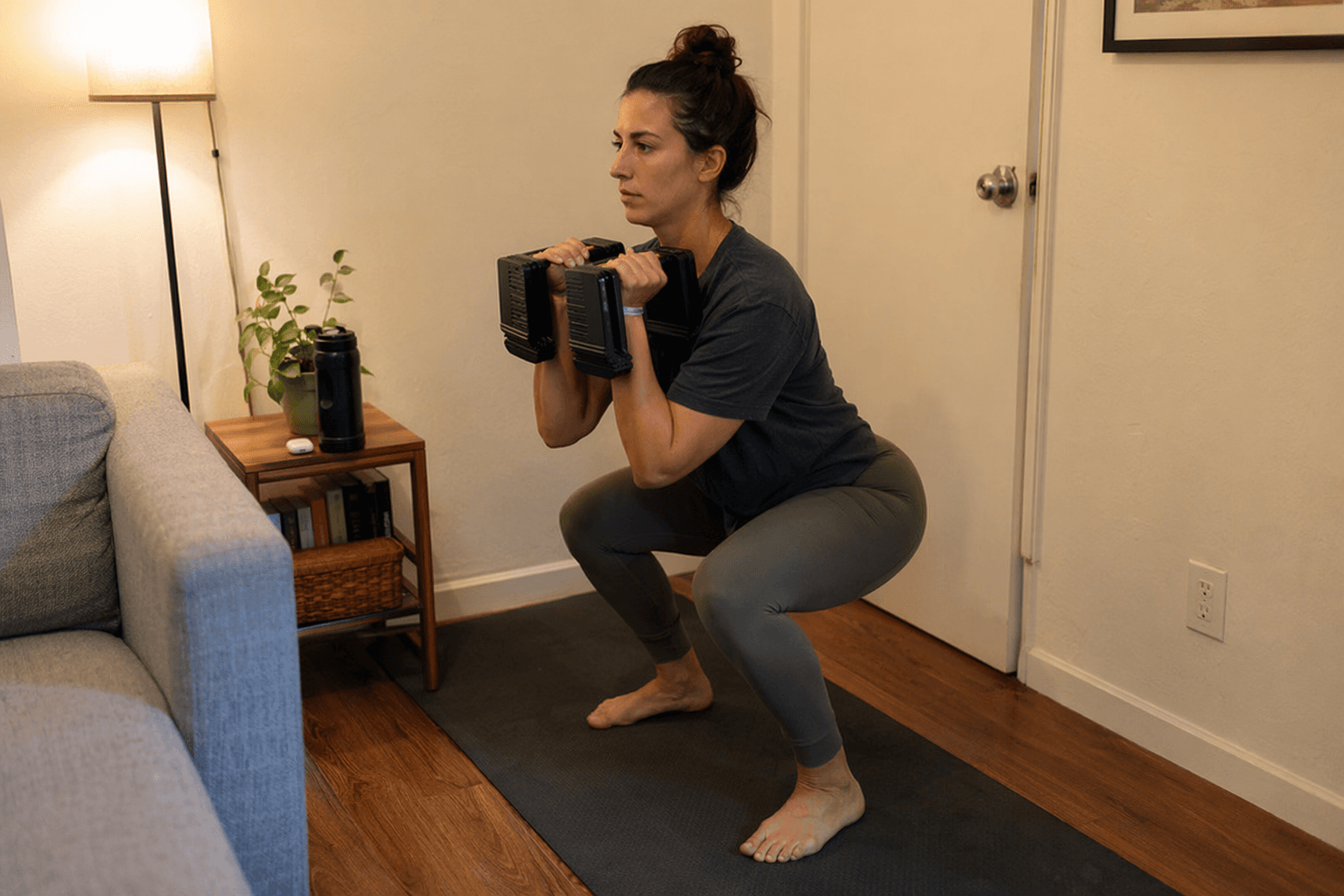
| Goblet Squat | Hold a dumbbell at chest. Pause 1 sec at bottom. | AMRAP 30 min |
| Romanian Deadlift | Lower dumbbells to shins. Touch mat softly. | AMRAP 30 min |
| Standing Overhead Press | Lower under control. No clank at top. | AMRAP 30 min |
| Reverse Lunge (no jump) | Step back, rear knee barely touches mat. Stand up. | AMRAP 30 min |
Track your total reps for each exercise across the 30 minutes. Next session, try to beat the previous total by at least one rep per exercise. Once you can add about 10% more reps compared to your original score, it’s time to increase weight — that signals you’ve adapted to the load.
The 2022 minimal‑dose review from Sports Medicine (Fyfe et al.) supports the idea that lower loads at higher frequencies can improve strength and reduce cardiometabolic risk. It’s a narrative review, not a prescription for exact reps, but it fits the philosophy behind this format.
Program 2: 3×/Week Straight Sets – Clean Progression
AMRAP isn’t everyone’s style. Some people want clean sets, clear rep targets, and a simple rule for when to add weight. Here’s a standard three‑day full‑body split using the same quiet‑exercise base. It follows the frequency advantage from Stronger by Science and uses a conservative progression method from Bony to Beastly: add weight only after you hit 10 reps on all sets of an exercise.
| Exercise | Quiet Mod / Cue | Sets x Reps |
|---|---|---|
| Goblet Squat | Pause 1 sec at bottom. | 3 x 8-10 |
| Floor Press | Elbows at 45°. No bounce. | 3 x 8-10 |
| Bent‑Over Row | Touch‑and‑go on mat. | 3 x 8-10 |
| Standing Overhead Press | Lower under control. | 3 x 8-10 |
| Romanian Deadlift | Touch mat lightly. | 3 x 8-10 |
| Lateral Raise | Slow tempo, no swing. | 3 x 12-15 |
| Farmer Carry | Walk 20 steps, turn, repeat – quiet steps. | 3 x 20 steps each hand |
Progression rule: If you complete 3×10 on an exercise with perfect form and all reps controlled, add 2.5–5 lbs next session. If you fail to hit 8 on the second or third set, stay at the same weight and work toward 10. Straight sets allow linear progression without the chaos of AMRAP — both work, so pick the one that keeps you showing up.
The Bony to Beastly article goes deeper into conservative vs. aggressive methods. I use the conservative approach for apartment work because rushing to add weight often leads to jerky reps that make noise and risk joints.
What You Actually Need (And Don’t Need)
- A pair of adjustable dumbbells. PowerBlock or Bowflex are the most famous, but any set that can increment in small steps (2.5 lbs) and feels solid will do. One set replaces a whole rack and stores in under 2 sq ft. Head to the Compact Home Gym Buyer's Guide for Apartment Renters for specific recommendations on noise, flooring, and storage.
- A thick exercise mat (at least ½ inch, preferably 1 inch where the dumbbells land). It saves your floor, dampens sound, and gives you a stable surface for floor press and lunges. See the flooring buyer’s guide for thickness recommendations by exercise type.
- A 6×6 foot clear floor area. That’s roughly the size of a yoga mat with a foot of clearance on each side. If you have less than that, you can still do most exercises standing in place — the lunges and farmer carries need the length, but everything else fits in a 4×4 zone.
For a complete apartment gym layout, Your Compact Home Gym in an Apartment: Train Heavy Without Losing Your Deposit walks through storage and deposit protection. The budget‑tier setup guide also covers builds from $50 to $500, which pairs well with this workout’s minimal equipment list.
Why This Won’t Piss Off Your Neighbors
Every quiet modification in this article has a single goal: let you train hard without turning the space between you and your downstairs neighbor into a war zone. The floor press doesn’t need a bench. The deadlifts don’t thud. The lunges don’t stomp. You get the same full-body stimulus — back, chest, legs, shoulders, core — in a footprint smaller than a doorway. The evidence says it works; the practical test says it won’t cost you your security deposit.
Pick the AMRAP or the straight sets. Start tomorrow. See if you can add a rep next week.
Comments
Join the discussion with an anonymous comment.