
The Complete Guide to Building an Affordable Home Gym in a Small Space: Budget Tiers from $50 to $500
Building a home gym on a tight budget in a small space is possible with the right strategy. This guide breaks down exactly what to buy at three budget tiers ($100, $300, $500) with specific product picks, space estimates, and a purchase order that maximizes versatility per square foot.
- Budget tier
- under $500
- Space type
- apartment
Items included: —
How I Stopped Wasting Money on Gym Equipment
Most small-space home gyms fail because of the same error: buying a pile of single-purpose gear that neither fits the room nor pushes your strength beyond the first few weeks. I've made that mistake. A cheap barbell that can't load enough weight, a cage that takes up half the living room, a set of fixed dumbbells that top out at 25 pounds — each purchase seemed reasonable in isolation. Together they become a clutter of limitations.
The fix is three rules I use as a filter before I click 'add to cart':
- Versatility per square foot. Can this single piece replace two or three others? The REP QuickDraw Adjustable Dumbbells occupy 1.2 square feet of floor space and replace up to 12 pairs of fixed dumbbells. That's the standard.
- Plateau-proof weight ceiling. If the equipment maxes out before you stop progressing, it's not cheap — it's wasted. A set of resistance bands that only goes to 20 pounds of tension can't drive lower-body strength gains past the first month.
- Purchase order over impulse. Buy in sequence: dumbbells first, then a bench, then everything else. The order matters more than the total.
These rules produce a concrete answer to the question: what can you actually build for $50 to $500 in a 6x4 foot space? The First-Time Home Gym Buyer's Decision Framework is a more thorough walkthrough of the mindset, but this guide is the spreadsheet: tier by tier, piece by piece.
What $50 Actually Buys (and Where It Falls Apart)
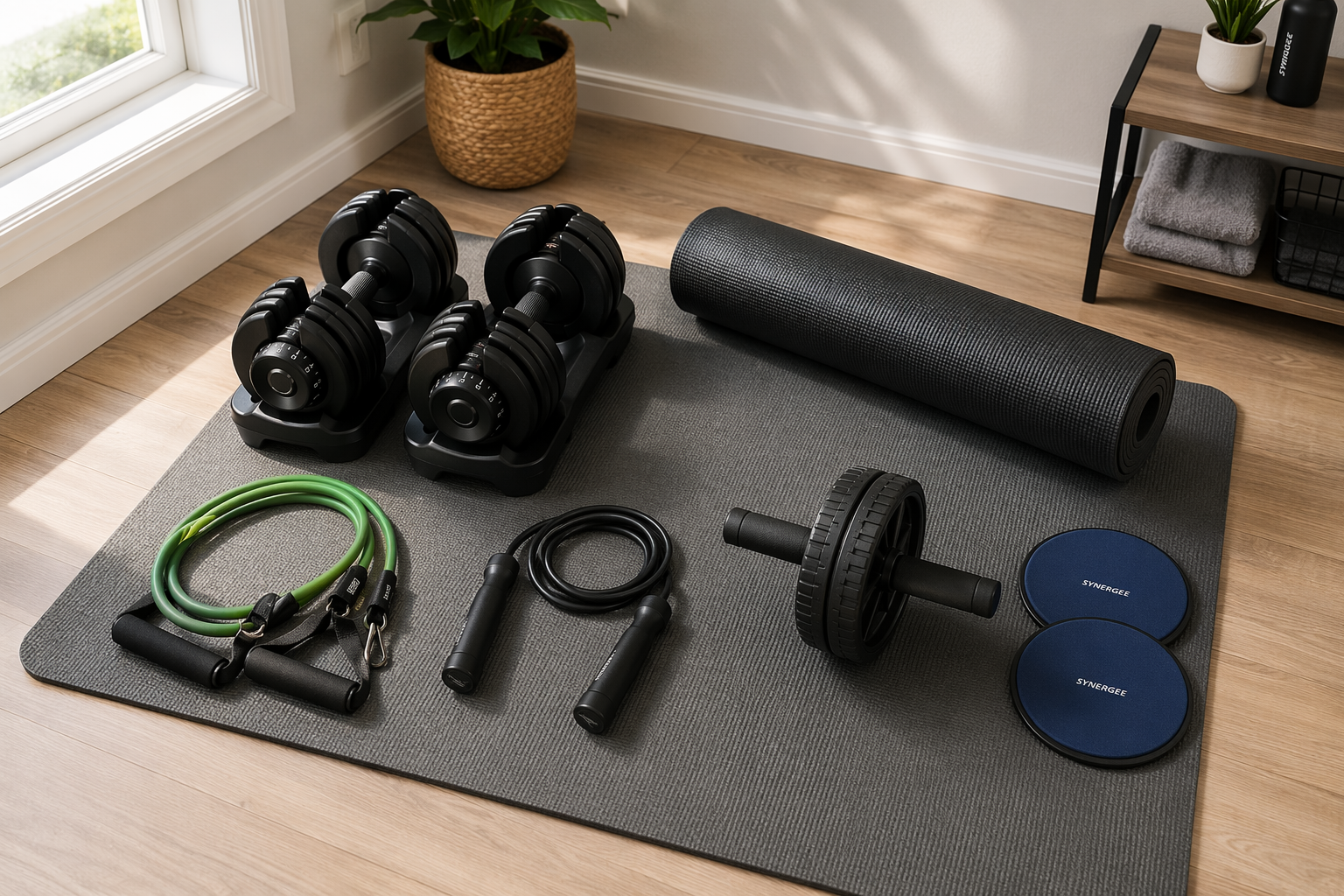
You can assemble a full-body starter kit for under $50. Tribe Lifting notes that resistance bands and a jump rope cover strength, cardio, and mobility in a single bundle. Add an ab roller and core sliders, and you've got a surprisingly functional circuit. I've used this exact combo. It works for about a month.
Here is what that $50 looks like with real products:
- Gymb Non-Slip Resistance Bands (set of three, light/medium/strong) — $15
- WOD Nation Double Under Speed Rope — $18.99
- Synergee Core Sliders — $10
- Amazon Basics Foam Roller — $23 (optional, pushes total past $50 but worth it for recovery)
Total: about $43 without the foam roller, $66 with it. For a first month of training, this is genuinely useful. You can do rows, presses, squats (with bands looped under feet), and get your heart rate up with the rope.
The Cleveland Clinic experts note that resistance bands 'can provide similar strength gains to traditional weights' — but that comparison is context-dependent and generally applies to early-stage training. For an intermediate lifter, bands are a supplement, not a primary driver. I'd add: buy a separate heavy band (50+ pounds) if you plan to use this kit more than a month.
Why the First $100 Should Go to Adjustable Dumbbells
Once the band kit shows its limits, your first real investment should be adjustable dumbbells. Not a barbell. Not a cage. Not a fancy cable machine. The reason is pure arithmetic: one pair of adjustable dumbbells replaces a whole rack of fixed ones and takes up about the same space as a shoebox.
The entry-level option is the BCBIG Adjustable Dumbbells at $100. Each dumbbell goes from 10 to 40 pounds and can be converted into a barbell. But — and this is a real caveat — that barbell mode is short and poorly balanced. It works for light deadlifts and bent-over rows, but do not treat it as a full barbell replacement. The moment you try to bench press 80 pounds with that conversion, you'll feel the instability.
If you can spend more, the upgrade path is clear:
| Model | Price | Weight Range | Footprint | Replaces How Many Fixed Pairs |
|---|---|---|---|---|
| BCBIG Adjustable | $100 | 10–40 lbs per dumbbell | ~2 sq ft (two dumbbells) | ~8 pairs |
| REP QuickDraw (40-lb) | $336–$416 | 5–40 lbs per dumbbell | 1.2 sq ft (cradle) | 12 pairs |
| PowerBlock Sport Series | $409 | 5–50 lbs per dumbbell | 12" x 6.5" per dumbbell | 15 pairs |
The PowerBlock Sport Series claims 90% floor space savings over fixed dumbbells. The actual footprint — 12" x 6.5" per dumbbell — is close to the REP QuickDraw's 1.2 sq ft cradle. Both are real space-savers, not marketing exaggerations.
Then the Bench – But Not Before
After adjustable dumbbells, your next dollar should go to an adjustable bench. Without it, you're limited to standing presses, rows, and curls. With it, you unlock dumbbell bench press, seated shoulder press, incline press, rows, split squats, and dozens more exercises.
The Major Fitness Adjustable Bench costs $219.99, supports 1,300 pounds, and offers 10 back pad adjustments. That's a lifetime piece of equipment. The REP Nighthawk is another strong option: it takes up about 9 square feet when flat but stores upright in 1.8 square feet — small enough to lean against a wall in a corner.
One practical note: measure your ceiling height. When you're seated on an upright bench pressing dumbbells overhead, you need at least a foot of clearance above your fists. In a room with 8-foot ceilings, a 6-foot person on a standard bench can press overhead without issue, but a 6'4" lifter may be close to the ceiling.
Three Budget Builds That Actually Fit Your Space
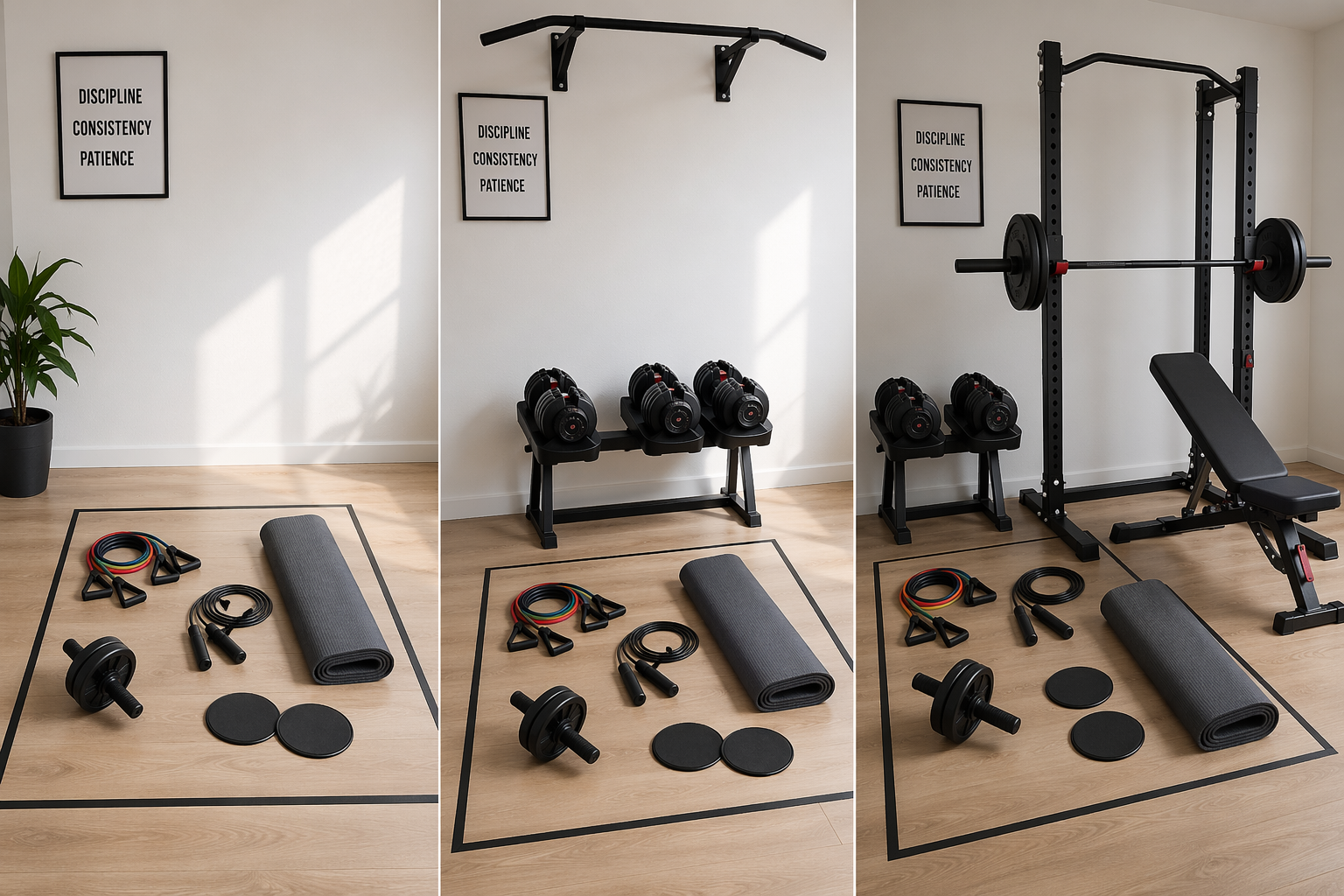
Here are three complete build blueprints. Each one fits within a 6x4 foot workout area (the minimum space Tribe Lifting recommends) and follows the purchase order we've set. Prices are based on current retail from June 2026 — they'll shift with sales cycles, but the ratios hold.
The $100 Starter – Good for a Month
| Item | Cost | Footprint |
|---|---|---|
| Resistance bands set (Gymb) | $15 | Fits in a drawer |
| Jump rope (WOD Nation) | $18.99 | Fits in a drawer |
| Core sliders (Synergee) | $10 | Fits in a drawer |
| BCBIG adjustable dumbbells | $100 | ~2 sq ft |
| Total | ~$144 | ~2 sq ft floor space |
The $300 Sweet Spot – Where Real Strength Starts
| Item | Cost | Footprint |
|---|---|---|
| BCBIG adjustable dumbbells | $100 | ~2 sq ft |
| Major Fitness adjustable bench | $219.99 | 9 sq ft flat / 1.8 sq ft stored |
| Resistance bands set | $15 | Drawer |
| Jump rope | $18.99 | Drawer |
| Total | ~$354 | ~4 sq ft when stored (with bench upright) |
The $500 Cage Build – Only If You're Honest About the Trade-Off
At $500 you can add a squat cage — but you must account for the barbell and weight plates separately. The Fitness Reality 810XLT Super Max Power Cage is $249 and has 800-pound capacity. That leaves about $250 for a barbell and plates. A solid starter barbell like the Synergee Games Cerakote is $179.95. Add a set of 255 pounds of cast iron plates (roughly $280 at $1.10/lb) and you're over budget.
The realistic $500 cage build looks like this:
| Item | Cost | Footprint |
|---|---|---|
| Fitness Reality 810XLT cage | $249 | ~12 sq ft |
| Synergee Cerakote barbell | $179.95 | ~6 ft length |
| 150 lbs of weight plates | ~$165 | Stored on cage pegs |
| Total | ~$594 | ~12+ sq ft |
| (Alternative: skip the cage and use a folding squat stand ~$150, then add plates) |
If you're strictly at $500, I'd recommend the $300 blueprint (dumbbell + bench) plus a pull-up bar and a heavier resistance band ($25). That covers more movement patterns for less money and less floor space.
Three Mistakes I See Renters Make All the Time
- Buying a cheap pull-up bar that doesn't fit your doorframe. Standard door frames are about 24–32 inches wide, but many budget bars rely on friction mounting that fails on thick frames or arched openings. For renters, a doorframe pull-up bar with padded brackets and no-screw installation is safest. Measure the frame width and depth before you buy.
- Underestimating overhead clearance. When you do seated dumbbell presses on an upright bench, your fists go above your head. Check ceiling height while seated. A simple test: sit on a chair, raise your arms straight up, and see if you have clearance. If not, choose floor-based pressing (like floor presses) or use lighter weights that don't require full arm extension.
- Buying single-purpose machines. A lat pulldown machine, a leg extension machine, a cable crossover station — each takes up 10–20 square feet and serves one function. An adjustable bench and resistance bands cover lat pulldowns, rows, and cable movements with a fraction of the footprint. The Garage Gym Equipment Priority Tier List breaks down exactly what to skip.
For a deeper dive into these pitfalls, see our full article on common compact home gym mistakes.
The First Step
The thesis holds: $500 is enough for a small-space home gym that can drive real strength progress — if you follow the purchase order. Start with the $50 band kit if you need immediate workouts, but skip straight to adjustable dumbbells as soon as you can. That single purchase changes everything.
Measure your 6x4 foot space first. Pick your budget tier. Then buy the first item on the list. The rest builds naturally.
Some links on this page are affiliate links — they may earn us a commission at no extra cost to you. Our tier and tests are decided before we ever check which links pay; see our full affiliate disclosure.
Spot something off?
Noise and floor-damage claims carry real deposit-risk consequences if we get them wrong — tell us if your experience with this build didn't match what's above.