
Beyond the 12-Move Circuit: How to Progress the 7-Minute Workout When Bodyweight Isn't Enough
Hit a plateau with the 7-minute workout? This guide shows you when your body has adapted, how to challenge it with bodyweight-only tweaks, and when to add dumbbells or longer circuits for continued progress.
The 7-minute workout plateaus — and that's not your fault
You've been doing the 12-move circuit for weeks. The first month felt like something was happening — heart rate up, legs shaking, that post-workout glow. Then somewhere between week five and week eight, the buzz faded. You finish the seven minutes without breathing hard. The numbers on the scale stopped moving. Your push-up count hasn't budged in three weeks.
It's tempting to think you're slacking. You're not. The problem is the protocol itself. Brett Klika and Chris Jordan, the exercise physiologists who designed it for ACSM's Health & Fitness Journal, were upfront: the 7-minute workout may be inferior to create absolute strength and power, specific endurance, and other specific performance variables. That's not a flaw in your effort — it's a built-in ceiling.
The ceiling at 4–8 weeks: what the studies show and how to spot it
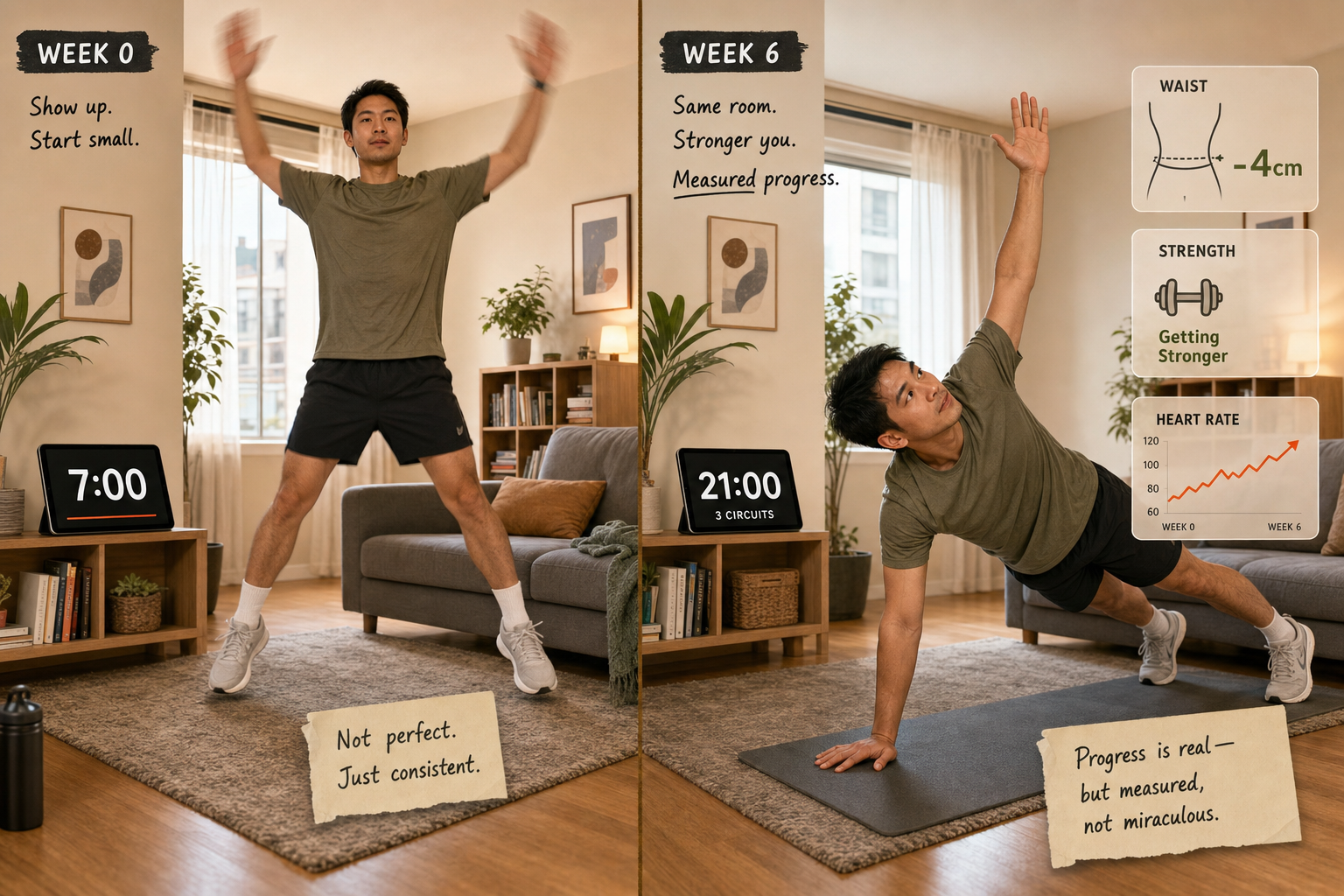
Most people assume the problem is that they need to try harder. But the data points to a different explanation: the stimulus stops working once the body adapts. Mattar's 2017 study had 29 people do the daily 7-minute workout for six weeks. Waist circumference dropped by about 4 cm, fat mass decreased — and then everything flattened. The paper noted the changes happened in the early weeks and plateaued. The body had adapted.
Schmidt's 2016 study pushed the timeline to eight weeks with 96 recreationally active subjects. Both the 7-minute and 14-minute circuit groups improved push-up endurance. Strength gains showed up only in men. The load just wasn't enough to drive strength adaptation in both sexes. The authors concluded that short-duration circuit training may improve muscle endurance in moderately fit populations — not strength or power.
| Study | Participants | Duration | Key Outcome | Where It Plateaued |
|---|---|---|---|---|
| Mattar et al. 2017 | 29 | 6 weeks daily | ~4 cm waist loss | After 4–5 weeks |
| Schmidt et al. 2016 | 96 | 8 weeks | Push-up improvement, strength only in men | Strength ceiling at 8 weeks |
| Klika & Jordan 2013 | — | — | Inferior for strength/power | Built-in from design |
I don't read this as "the workout is useless." I read it as "the workout solves a specific problem for a specific window." After that window, the same circuit is a maintenance dose — not a progression driver. You don't need a lab test to know you've hit it. Check these three concrete signs today.
- Your rep count hasn't budged in three weeks. If you're cranking out the same number of push-ups, squat jumps, and plank holds session after session, you have adapted. Progressive overload requires increasing resistance, volume, or density. You're not increasing anything.
- You can complete all 30-second intervals without reaching an RPE of 8. The original NYT article prescribed intensity at about 8 on a discomfort scale of 1 to 10. If you finish each interval feeling like a 6 or 7 — or worse, you can hold a conversation while doing it — that's a clear signal. The Washington Post's 2025 Power Workout progression uses the same criterion: if you can easily hold a conversation without gasping, it's time to level up.
- You're no longer sore the next day. Delayed-onset muscle soreness isn't the goal of fitness, but its absence after weeks of consistent training tells you the stimulus no longer challenges the muscle fibers. If you can roll out of bed and feel nothing, your body has fully adapted.
Bodyweight tweaks: real, temporary, and about 4–6 more weeks
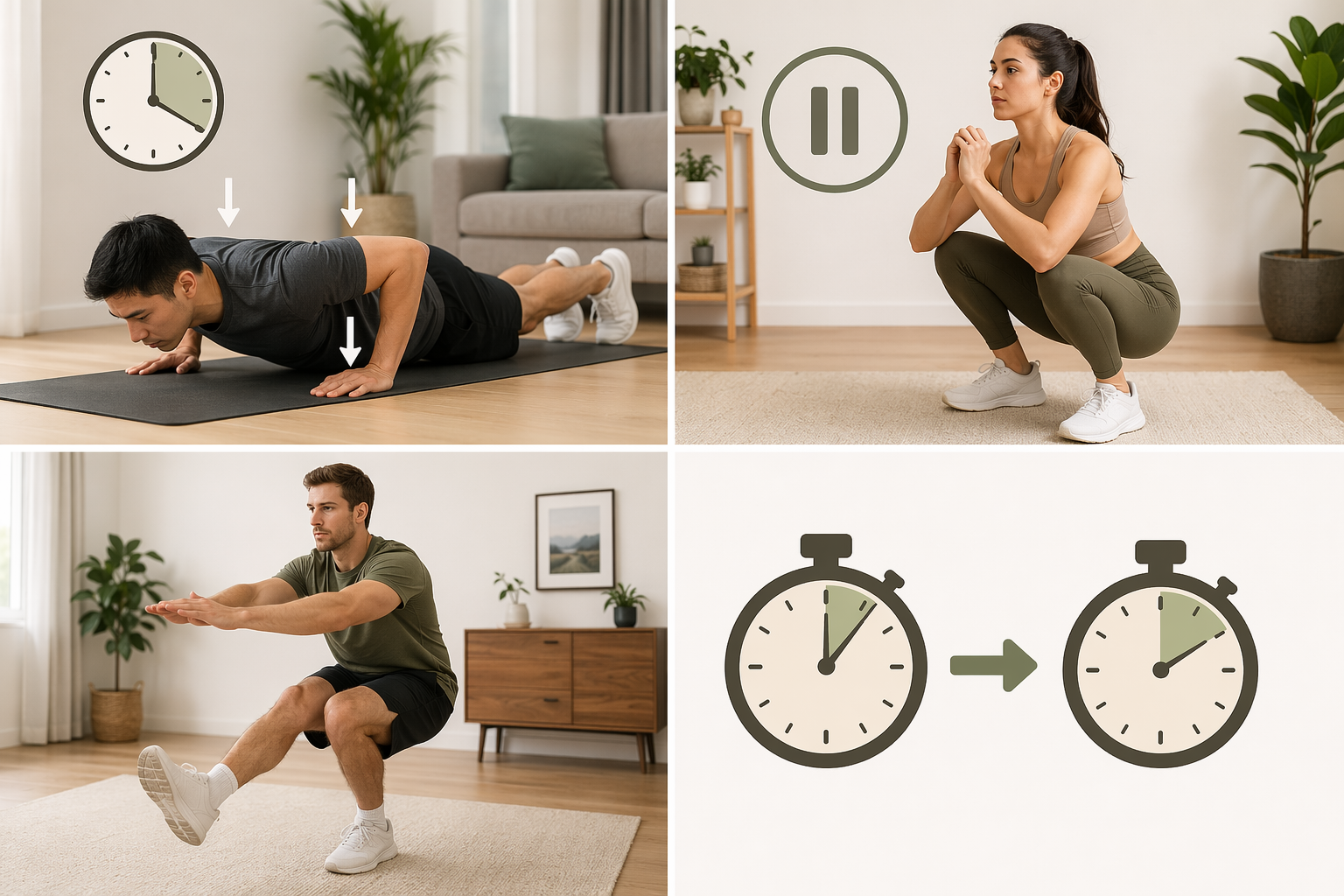
Before you reach for dumbbells, there are ways to crank up the difficulty without adding weight. They work by increasing time under tension, changing leverage, or compressing rest. They are legitimate — but I want to be honest about their limits. These methods buy you another four to six weeks, not a permanent upgrade.
- Eccentric slowing: Lower yourself over three seconds on every rep (push-ups, squats, lunges). The lowering phase is where muscle damage and adaptation signals happen most. A 3-second eccentric can nearly double the time under tension without adding a pound.
- Pause reps: Hold the hardest position for one to two seconds. For push-ups, that's the bottom; for squats, the bottom; for planks, you can add shoulder taps or leg lifts. The pause removes momentum and forces the muscle to work isometrically.
- Unilateral moves: Single-leg squats (pistol progressions), archer push-ups, single-arm plank variations. By shifting the load to one limb, you effectively double the resistance on that side. These are the bodyweight equivalent of adding weight.
- Cut rest from 10 seconds to 5: The standard 10-second rest between exercises is already short. Halve it, and you reduce recovery time, increase metabolic demand, and force the heart and lungs to work harder. This is the same density tactic used in themed circuits (Men's Health uses 20-second blocks and EMOM formats).
After those four to six weeks, you'll be back at the same plateau — only now you'll know why. The ceiling isn't your effort; it's the fact that bodyweight cannot provide the progressive overload needed for continued strength or muscle gains.
When to add dumbbells — and which path to choose
The moment you decide to move beyond bodyweight-only, the question becomes: what's the goal? The answer determines which path makes sense.
If your primary goal is general fitness or endurance, the bodyweight-only tweaks above can keep you progressing for a few more weeks. But if you want to build strength, add muscle, or break through a fat-loss plateau, you need to add load or volume.
| Goal | Best Adjustment | Example |
|---|---|---|
| Strength | Add dumbbells to key moves | NYT Advanced 7-Minute Workout (Romanian deadlift, renegade rows) |
| Muscle endurance / general fitness | Increase to 2–3 circuits | Repeat the 12-move circuit 2–3 times (14–21 min total) |
| Power / athletic performance | Incorporate explosive moves | Burpees, box jumps, plyometric lunges in a circuit |
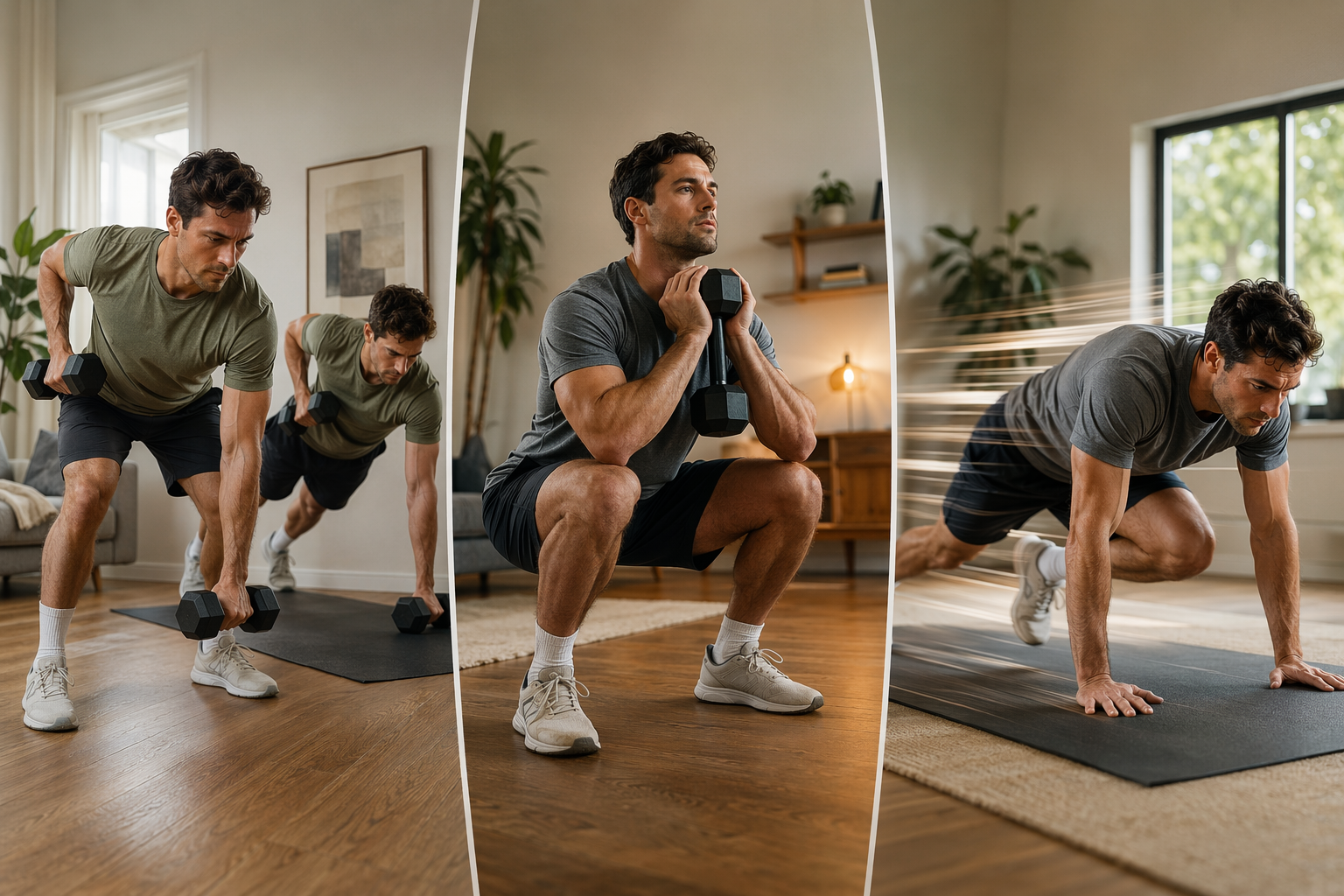
The NYT Advanced 7-Minute Workout, designed by Mark Verstegen of EXOS, is the most natural next step. It keeps the 30:10 format but replaces several bodyweight moves with dumbbell versions: single-leg Romanian deadlift to curl to press, push-up to row to burpee, lateral pillar bridge. It's still seven minutes, but the added resistance makes it a genuine strength stimulus. And it's scalable — you control the dumbbell weight.
If you don't have dumbbells or prefer to stay bodyweight, running multiple circuits is the Cleveland Clinic's recommendation: repeat the circuit two to three times to meet the ACSM's minimum of 20 minutes of high-intensity exercise. That turns a seven-minute session into a 14- or 21-minute workout, which changes the metabolic demand substantially.
For power, Men's Health has published themed circuits that layer explosive moves like squat jumps, burpees, and fast mountain climbers into the same 30:10 format. The density and intensity spike — but the trade-off is that you probably can't sustain more than one or two circuits at that level.
What the 7-minute workout is still good for
None of this means the 7-minute workout is worthless once you've outgrown it. That's the wrong conclusion. The right one is that the tool has specific use cases — and after the plateau, it moves into a supporting role.
- As a metabolic finisher. After a strength training session, a single 7-minute circuit can spike heart rate and burn extra calories without adding fatigue that compromises recovery. The Cleveland Clinic calls it a good filler workout between gym days or when traveling.
- As a travel tool. Hotel room, no equipment, no time. The 12-move circuit still delivers a decent sweat and maintains baseline fitness. Better to do seven minutes than nothing.
- As active recovery. On a rest day, a single circuit at lower intensity can promote blood flow without taxing the nervous system. You're not trying to break a PR — you're just moving.
A short workout you actually do will always beat the longer one you skip because you didn't have time.
That quote from Men's Health sums up the real value. The 7-minute workout never promised to get you jacked or make you a marathoner. It promised a short, evidence-based sweat that fits into a busy day. For that job, it still works — as long as you know when to move on.
Here is the truth: bodyweight can only take you so far. That is not failure. It is physics. Honest progression beats pretending. If you need more, go get more. And if the basic circuit still serves a purpose in your week, keep it. Just don't expect it to do what it never was designed to do.
What a small equipment investment adds
We don't have a build tagged to this exact tier yet. Browse all builds.
How often should you repeat this?
See our recovery and rest reference for citation-anchored rest-interval guidance.
Spot something off?
Tell us if a movement, tier assumption, or duration didn't match your experience.