
The apartment version of home gym flooring starts with a less exciting question than “What can survive a barbell?” It starts with: what can sit on this floor for months, come back up cleanly, keep dumbbells from chewing up the finish, and avoid turning every workout into a ceiling-thump conversation with the person downstairs?
That changes the buying order. In a garage, durability usually wins first. In an apartment, the first filters are noise behavior, removability, floor protection, smell, weight, and whether the room still feels like somewhere you want to live. A mat that makes sense on concrete can be a bad renter choice if it needs adhesive, traps moisture against old hardwood, arrives with a strong rubber odor, or weighs so much that moving it becomes its own lease-risk event.

What Flooring Can and Cannot Fix in an Apartment
Flooring can help with scratches, small dents, grip, comfort, and some everyday thud from setting equipment down. It cannot make upstairs jump rope, burpees, or plyometrics silent. Impact movements send vibration through the floor structure itself, and practical apartment guides warn that this transfer happens regardless of the surface material placed on top.[1]
That does not make flooring useless. It just keeps the promise honest. If your workout includes yoga, Pilates, mobility work, bodyweight strength, kettlebell flows without drops, resistance bands, or controlled dumbbell work, the right surface can make the space safer and easier to use. If your workout depends on repeated jumping in an upstairs unit, flooring should be treated as one layer of courtesy, not a soundproofing plan.
The practical move is to separate impact from contact. Contact is the dumbbell touching the floor, your knee pressing into a plank, or a bench foot sitting on hardwood. Flooring is good at managing that. Impact is your body or equipment driving force into the building. Flooring may soften the edge, but it does not erase the path through joists, subfloor, and ceiling.
Start With the Smallest Zone That Actually Works
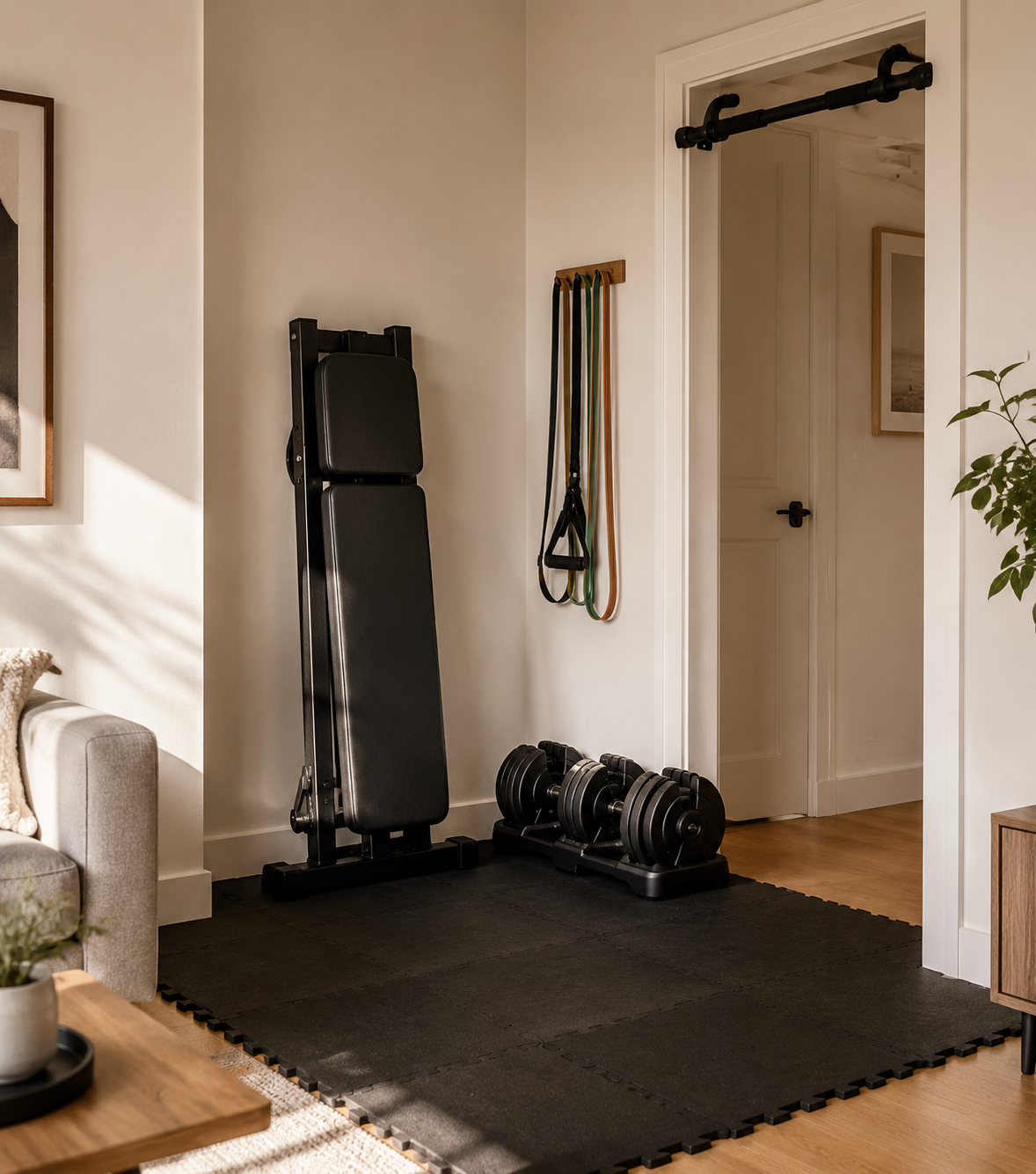
Most renters do not need wall-to-wall gym flooring. A realistic workout island is often enough. One small-apartment setup guide puts a functional floor-based training zone at about 35 to 45 square feet, roughly a 5-by-7-foot to 6-by-9-foot area, for Pilates, yoga, bodyweight work, and light dumbbell sessions.[1]
That range matters because it keeps the project from taking over the apartment. A full-room install creates more seams, more material to store or move, more places for trapped grit to scratch the floor, and more visual weight in a room that may already be doing three jobs. A defined zone also trains better habits: weights stay on the protected surface, shoes stay off the exposed floor, and equipment has a home instead of migrating under the coffee table.
| Workout style | Flooring priority | Apartment note |
|---|---|---|
| Yoga, Pilates, mobility, stretching | Comfort, clean surface, visual fit | A rug-like single-piece mat can be enough if no weights are being dropped. |
| Bodyweight strength and light dumbbells | Grip, dent protection, easy removal | Interlocking rubber tiles are usually the balanced choice. |
| Kettlebells, adjustable dumbbells, bench work | Compression resistance and floor protection | Use thicker rubber or stall mats carefully, with attention to weight and underlayment. |
| Jump rope, burpees, plyometrics | Neighbor impact management | Flooring alone should not be treated as a fix, especially above another unit. |
The Three Flooring Routes That Make Sense for Renters
There are plenty of materials sold as gym flooring, but apartment life narrows the field quickly. The useful choices are not the ones with the most heroic product copy. They are the ones you can install without adhesive, live with visually, clean around, and remove without leaving a story for your landlord.
8mm Interlocking Rubber Tiles: The Safest Balanced Default
For most apartment workouts, 8mm interlocking rubber tiles are the boring answer in the best way. They are thick enough to feel like gym flooring, stable enough for dumbbell and bodyweight work, and modular enough to fit around furniture. More importantly for renters, they can usually be laid down without adhesive and pulled apart when you move.
Garage Gym Reviews scored Living.Fit interlocking rubber tiles 4.3 out of 5 in its 2026 home gym flooring testing, noting easy DIY installation and removable, no-adhesive use.[2] That combination is exactly why this category works better in an apartment than rubber rolls for many renters. A roll may look cleaner in a dedicated gym, but cutting, positioning, storing, and moving a large roll in a walk-up or elevator building is less charming in real life.
Tiles also let you buy only the footprint you need. If the workout zone is 6 by 8 feet, you do not need to solve the whole living room. If one tile gets damaged, the failure stays local. If the apartment has a radiator, oddly placed closet door, or sofa leg invading the training zone, modular pieces are easier to negotiate than a single slab.
- Choose interlocking rubber tiles when you train with dumbbells, kettlebells, resistance bands, a foldable bench, or controlled bodyweight strength.
- Avoid adhesive, tape, or anything sold as a permanent installation unless your lease clearly allows it.
- Leave a small border near walls and furniture so the floor can breathe and the tiles do not buckle.
- Lift and clean underneath periodically, especially on hardwood or older floors where grit and moisture can become the real problem.
The trade-off is visual. Black rubber tiles announce “gym” immediately. In a spare bedroom, that may be fine. In the only living room, they can make the space feel like it is always waiting for a workout, even when you are trying to eat dinner next to it. If that visual friction makes you skip sessions or hide gear so thoroughly that setup becomes a chore, a more room-friendly mat deserves a serious look.
Rug-Like Single-Piece Mats: Better When the Room Has to Stay a Room
A single-piece exercise mat that looks like a rug solves a different problem: not maximum abuse resistance, but daily livability. In a small apartment, the floor covering is not something you only see during workouts. It is part of the living room, bedroom, or office all day. If it looks intentional, the workout zone can stay set up without making the room feel unfinished.

This is where rug-like mats are easy to underestimate. A thinner large-format mat, around the kind of profile used for floor exercise rather than heavy lifting, may be less protective than rubber tile under dropped weights. But for yoga, Pilates, stretching, low-impact strength, and light dumbbell work, visual integration can be a performance feature. The mat stays out. The space is ready. The workout has one less setup step.
Swankymat’s apartment guide frames this as a design problem as much as a fitness problem: when equipment has to be hidden because it makes the room look worse, the barrier to using it goes up.[1] That is not a laboratory claim about adherence. It is simply a familiar small-space consequence. Anything that has to be dragged from behind a sofa, unrolled, flattened, and put away again is competing against inertia before the workout even starts.
The limit is load. A rug-like mat should not be asked to do the job of dense rubber if you are setting down heavy adjustable dumbbells, using a bench with narrow feet, or parking a rack on it. In that case, either place rubber tiles under the equipment zone or accept that the prettier surface belongs to floor-based training rather than heavy strength work.
Horse Stall Mats: Heavy-Duty, Cheap, and More Complicated Indoors
Horse stall mats are popular because they are dense, durable, and often cheaper than branded gym flooring. Gray Matter Lifting describes long-term stall mat use in home gyms and recommends a protective barrier underneath for renters.[3] That last part is the apartment hinge. On concrete in a garage, stall mats are simple. On finished rental flooring, they deserve more caution.
The common 4-by-6-foot Tractor Supply stall mat is cited at about $2.38 per square foot, though that price can vary by region and timing.[3] It is also roughly 100 pounds per mat, which sounds manageable until you are turning it through a hallway, leaning it in an elevator, or trying not to scrape a doorframe while your neighbor watches you wrestle what looks like a barn floor into a studio apartment.[3]
Weight is not the only issue. Stall mats can smell strongly at first, may shed residue, and can trap moisture or grit underneath if left undisturbed. For renters, a protective layer such as Ram Board or a thin underlayment between the mat and finished floor is a sensible precaution, especially on hardwood, vinyl, or any surface you cannot afford to discolor or dent.[3]
- Use stall mats only if you genuinely need heavy-duty compression resistance.
- Air them out before bringing them into the main living space if odor is an issue.
- Put a protective barrier underneath rather than trusting finished rental flooring to tolerate direct contact.
- Plan the move-in and move-out path before buying, not after the mat is in your car.
Stall mats make the most sense for a ground-floor renter, a spare-room strength setup, or someone who expects the room to look like a gym and accepts the handling trade-offs. They make less sense for a shared living room, a delicate floor, or any apartment where the mat will have to be moved often.
Where Foam Puzzle Mats Fit
Foam puzzle mats are the cheapest way to create a soft floor zone, and they can work for stretching, mobility, light calisthenics, or a temporary setup. Garage Gym Reviews lists ProsourceFit foam mats at $1.12 per square foot and gives them a 3 out of 5 durability score.[2] That is the useful warning: cheap foam is comfort flooring, not serious equipment flooring.
Foam compresses, separates, and dents more easily than rubber. Chair legs, bench feet, dumbbells, and repeated pivoting can chew it up. It can also feel unstable for strength work if the surface is too squishy. If the choice is between foam and nothing for a quiet stretching corner, foam is fine. If the plan includes loaded movements, treat it as a short-term compromise.
A Renter’s Decision Framework
Before buying anything, stand in the actual spot where you plan to train. Open the closet door. Pull out the sofa bed if there is one. Check whether a neighbor’s bedroom is likely below you. Notice whether the floor slopes, creaks, or already has marks you should photograph before covering it. Apartment flooring decisions get better when they start with the room you have, not the gym you wish you had.
| If your main concern is | Choose first | Be careful about |
|---|---|---|
| Protecting floors during dumbbell and bodyweight workouts | 8mm interlocking rubber tiles | Rubber odor, visible gym look, cleaning under seams |
| Keeping the living room attractive | Rug-like single-piece exercise mat | Heavy weights, bench feet, dropped equipment |
| Maximum durability on a tight budget | Horse stall mats with protective underlayment | Weight, smell, possible floor staining or trapped moisture |
| The cheapest soft surface for light movement | Foam puzzle mats | Durability, compression, separation between pieces |
If you are still between options, let the workout decide before the product page does. A person doing mat Pilates three times a week does not need barn-grade rubber. A person using adjustable dumbbells over hardwood should not rely on a pretty exercise mat alone. A renter above another tenant should be more willing to change programming than to believe any flooring package promising peace with downstairs neighbors.
For broader material comparisons beyond apartment constraints, the general guide to choosing home gym flooring is useful. The apartment-specific filter is stricter: if it cannot be removed cleanly, tolerated visually, and used without making impact noise worse for neighbors, it is not the right default no matter how durable it looks.
Lease-Safe Setup Details That Matter
The most expensive flooring mistake in an apartment is usually not buying the wrong thickness. It is assuming the floor underneath will be fine because the top surface looks protected. Finished floors can still be damaged by pressure, grit, moisture, rubber contact, adhesive residue, or furniture-style point loads.
- Skip glue, permanent tape, and wall-to-wall installations unless your lease explicitly allows them.
- Clean the original floor before laying anything down so grit does not act like sandpaper underneath.
- Use a protective underlayment under stall mats or any dense rubber that will sit in place for a long time.
- Check under the flooring periodically for moisture, discoloration, trapped dust, or pressure marks.
- Photograph the floor before setup if you are covering an area with existing scratches or discoloration.
Noise etiquette belongs in the setup too. Put dumbbells down like you are trying not to wake someone, because you may be. Avoid dropping weights, jumping late at night, or assuming thicker flooring makes impact invisible. If your preferred training style is loud by nature, the better apartment equipment plan may be lower-impact tools: adjustable dumbbells, bands, suspension straps where allowed, a quiet bike, or compact cable-style systems. The guide to choosing compact home gym equipment is a natural next step once the floor limits are clear.
How Much Flooring to Buy
Buy for the movement pattern, not the room dimensions. Lie down with arms and legs extended. Step through lunges. Place the bench where it would actually sit. Set dumbbells where your hands reach at the end of a set, not where they look tidy in a photo. The protected zone should cover where force lands and where equipment rests between sets.
A 5-by-7-foot area can be enough for many floor-based workouts; a 6-by-9-foot area gives more room for lateral movement, a bench, or a pair of dumbbells without constantly stepping off the surface.[1] If you are using interlocking tiles, it is usually better to start with the core training footprint and add pieces later than to cover every visible inch on day one.
Price comparisons can help, but they should not override renter risk. NHC Now’s home gym flooring guide lists broad material cost ranges across flooring types, while Garage Gym Reviews and Gray Matter Lifting provide product-specific examples for foam, rubber tiles, rolls, and stall mats.[2][3][4] In an apartment, a cheaper surface that stains the floor, smells up the room, or has to be replaced after a few months was not actually cheaper.
The Best Choice Depends on What You Are Protecting
For most renters, removable 8mm interlocking rubber tiles are the safest balanced default: enough protection for controlled strength work, simple installation, no adhesive, and a footprint that can shrink to the actual training zone. They are not invisible, but they respect the lease and the workout.
If the room must stay attractive because it is also your living room, a rug-like single-piece mat may be the better everyday choice, especially for floor-based training and light resistance work. If you need heavier-duty protection and accept the weight, odor, and handling issues, stall mats can work only with renter precautions, especially a protective layer underneath. Foam puzzle mats belong at the light-use end of the spectrum, not under serious strength equipment.
References
- Set Up a Home Workout Space in a Small Apartment — Swankymat.
- Expert-Tested: The Best Home Gym Flooring Options (2026) — Garage Gym Reviews.
- The BEST Home Gym Flooring In 2026 — Gray Matter Lifting.
- Home Gym Flooring Guide: Best Types & Costs — NHC Now.
Comments
Join the discussion with an anonymous comment.