Apartment-friendly HIIT with no jumping sounds like a compromise until you separate two things that fitness videos often mash together: impact and intensity. Lisa Tylicki put it plainly for CNN: “high-impact is not the same as high-intensity.” The same article also notes that HIIT has stayed in the American College of Sports Medicine’s top-10 fitness trends for a decade, which is useful context but not the main point here. The main point is simpler: your downstairs neighbor should not have to know when your work interval starts.[1]
This 20-minute session keeps every footfall controlled. No tuck jumps, no squat jumps, no stomping through burpees and pretending the mat absorbs everything. The intensity comes from tempo, range of motion, coordination, and short rests: 2 minutes to warm up, 16 minutes of work, and 2 minutes to bring your breathing down.
The 20-Minute No-Jumping HIIT Workout
You need enough space to step back into a plank and lunge without clipping furniture. A yoga mat helps with comfort, but the quietness comes more from control than padding. If your room is especially tight, this small-space setup guide can help you think through room layout before you train.
| Block | Time | What to Do |
|---|---|---|
| Warm-up | 2 minutes | Controlled mobility: march in place, hip circles, arm reaches, bodyweight good mornings |
| Circuit round 1 | 8 minutes | 8 exercises, 45 seconds work / 15 seconds rest |
| Circuit round 2 | 8 minutes | Repeat the same 8 exercises |
| Cool-down | 2 minutes | Slow breathing, hamstring fold, hip flexor stretch, child’s pose or kneeling reach |
Set a timer for 45 seconds of work and 15 seconds of rest. During the work intervals, move quickly enough that talking becomes difficult, but quietly enough that your feet land like you are trying not to wake someone in the next room. That is not a cute cue; it is the standard.
Warm-Up: 2 Minutes
- 30 seconds: March in place with active arms, lifting the knees without bouncing.
- 30 seconds: Alternating reverse lunges at half depth, stepping back softly.
- 30 seconds: Hip hinges with a long spine, then reach the arms overhead as you stand.
- 30 seconds: Slow walkouts to a high plank, then walk the hands back and stand.
Main Circuit: 16 Minutes
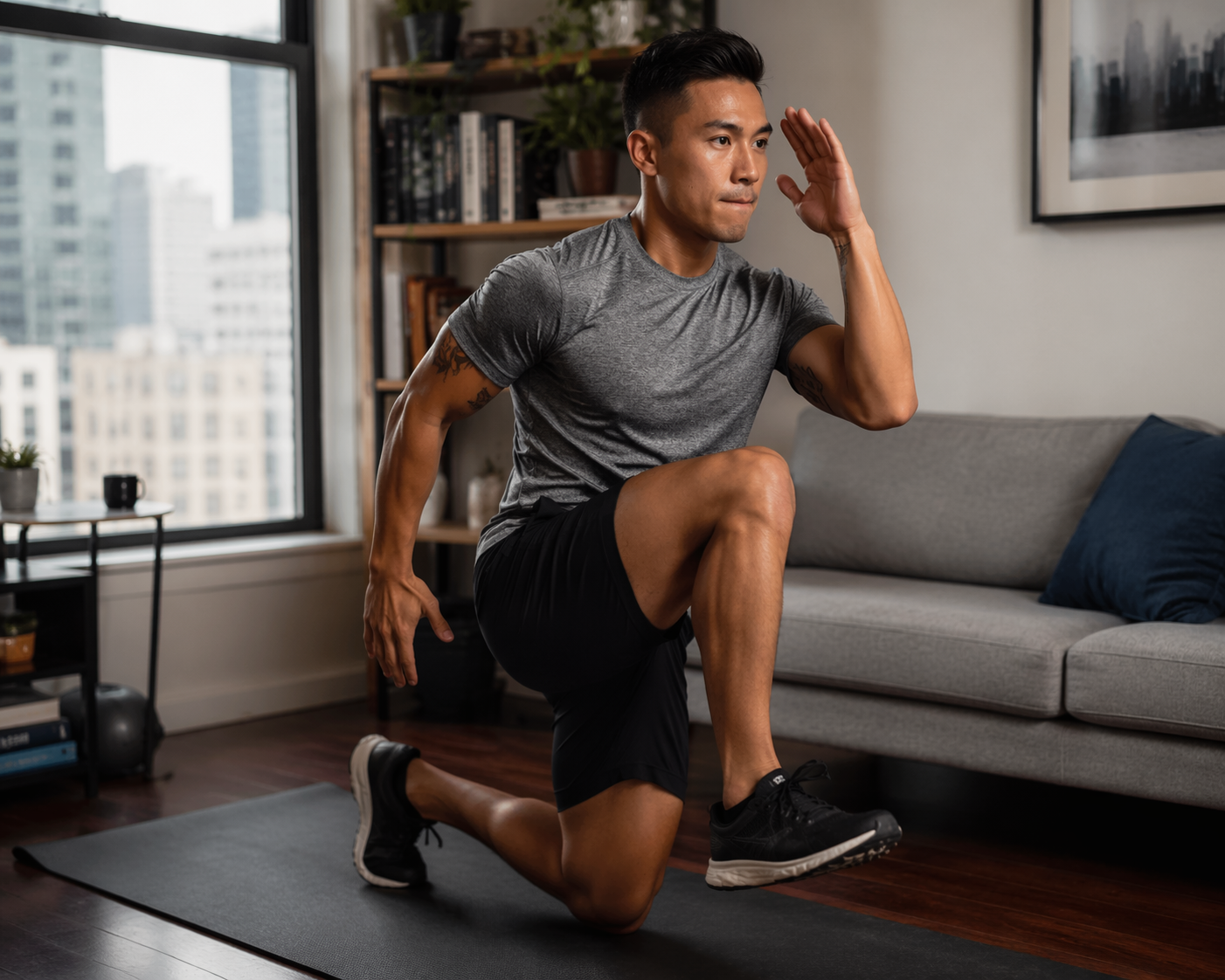
Do the eight moves below for 45 seconds each, resting 15 seconds between moves. Complete two rounds. If your floor creaks during an exercise, slow the transition before you reduce the effort. A quieter rep should still feel like work.
| Exercise | How to Do It | Quiet Cue | Make It Easier | Make It Harder |
|---|---|---|---|---|
| Reverse lunge to knee drive | Step one foot back into a reverse lunge, drive that knee forward as you stand, then repeat on the same side before switching halfway. | Place the back foot down toe-first, then control the front heel as you rise. | Remove the knee drive and alternate reverse lunges. | Stay on one side for the full interval, add a deeper lunge, or hold the knee drive for one beat. |
| Step-back burpee | Hinge down, place both hands on the floor, step one foot back, step the other foot back, return one foot at a time, and stand tall. | Step instead of hopping, and avoid dropping your hips into the floor. | Use a chair or sofa edge for an elevated step-back burpee. | Add a push-up or a fast knee drive before standing. |
| Plank walkout | From standing, fold forward, walk the hands to a high plank, pause, then walk the hands back and stand. | Keep the feet planted and move through the hands instead of jumping the feet back. | Bend the knees more or walk only to a shortened plank. | Add two shoulder taps in the plank before walking back. |
| March jacks | Step one foot out while sweeping the arms overhead, return to center, then alternate sides. | Think step-slide rather than step-stomp. | Keep the arms below shoulder height. | Sink into a mini squat each time the foot steps out. |
| Bear crawl shoulder taps | Start on hands and knees, lift the knees slightly, then tap one hand to the opposite shoulder while keeping the hips steady. | Hover low and shift weight slowly so the hands do not slap the floor. | Keep the knees down and perform quadruped shoulder taps. | Move the feet slightly wider and slow each tap to increase core demand. |
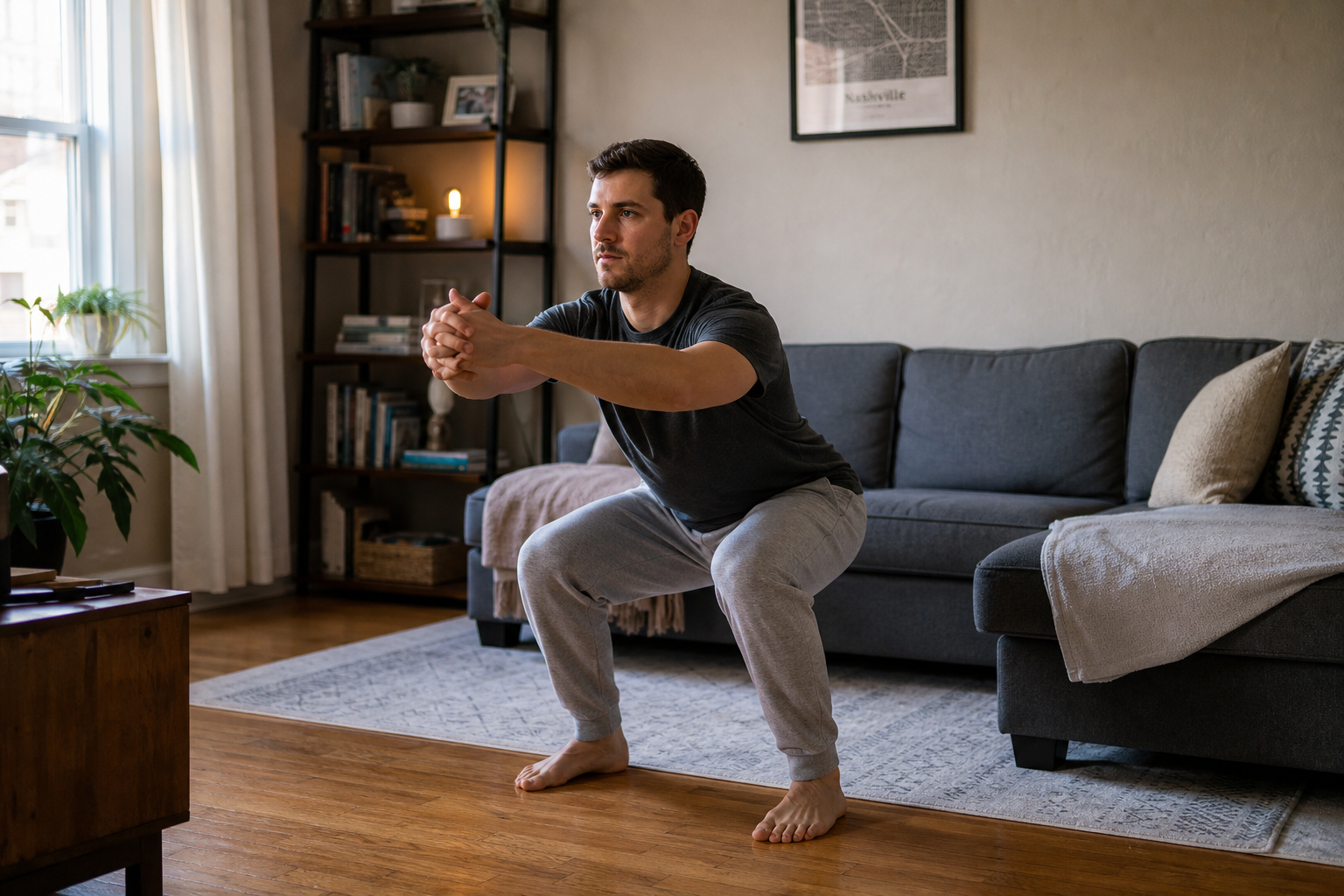
| Squat to overhead reach | Sit into a squat, stand with control, and reach both arms overhead at the top. | Keep the whole foot grounded and avoid snapping the knees locked. | Use a shallower squat or touch a chair lightly. | Add a 2-second pause at the bottom or rise onto the toes without leaving the floor. |
| Controlled mountain climbers | Hold a high plank and drive one knee toward the chest at a time, moving briskly without hopping. | Replace the usual running rhythm with a fast step-in, step-out pattern. | Use an elevated surface or slow the knee drives. | Cross the knee toward the opposite elbow or add a longer plank pause every four reps. |
| Glute bridge pulses | Lie on your back, knees bent, lift the hips, and pulse near the top without fully resting down. | Keep the ribs down and avoid thumping the hips into the floor. | Do full-range glute bridges with a brief rest at the bottom. | Use single-leg bridges or hold the top position for the last 10 seconds. |
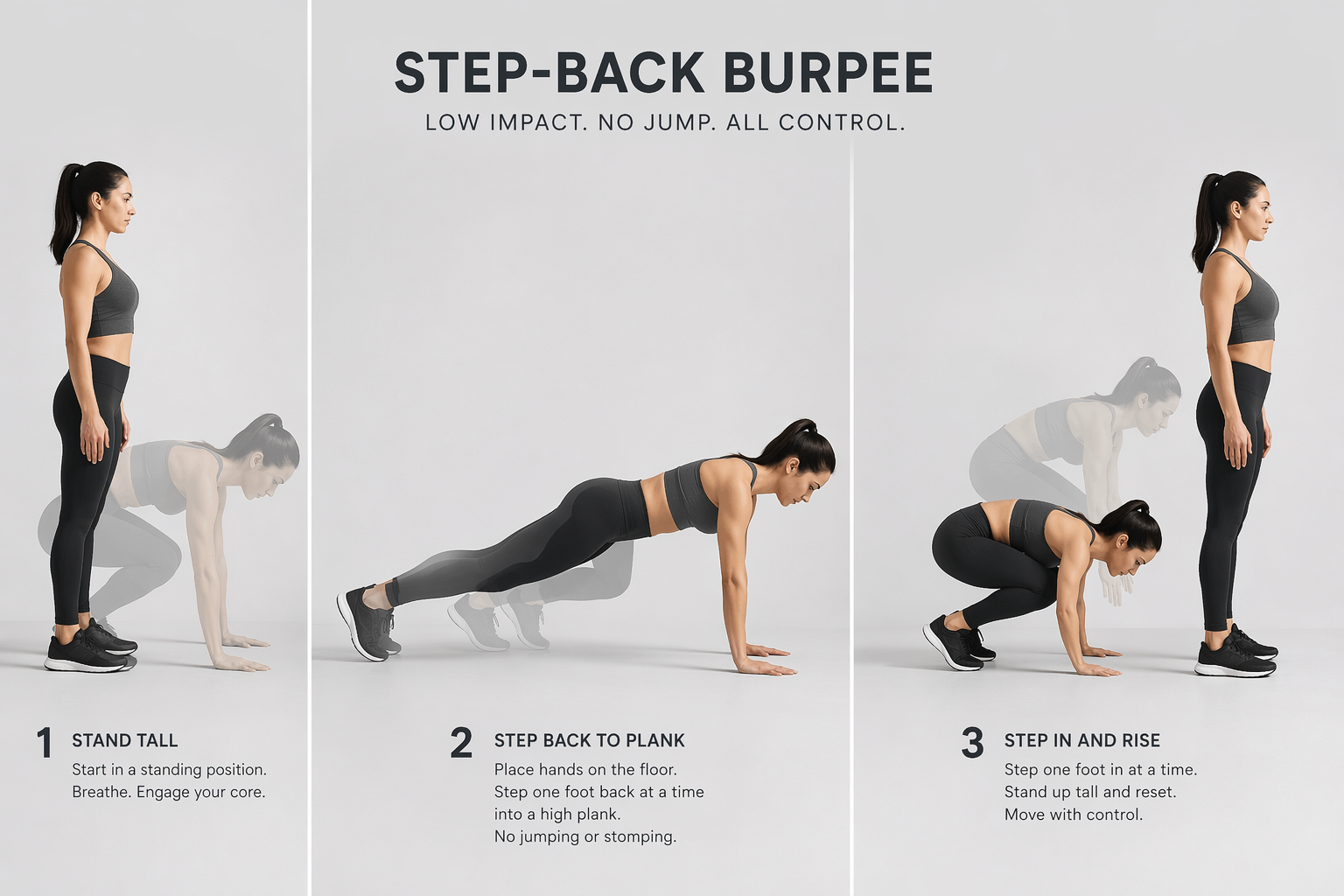
The step-back burpee is where many apartment workouts either become believable or fall apart. If you throw your hands down, kick both feet back, and snap upright, it is just a regular burpee with the jump removed. For this version, the hands lower under control, each foot steps back separately, and the stand-up is fast but not explosive off the floor.
Cool-Down: 2 Minutes
- 30 seconds: Slow nasal breathing while marching gently or standing still.
- 30 seconds: Forward fold with soft knees.
- 30 seconds: Half-kneeling hip flexor stretch, switching sides halfway.
- 30 seconds: Child’s pose, kneeling lat reach, or a comfortable floor stretch.
How This Stays Intense Without Impact
Jumping raises intensity quickly because it recruits large muscles, demands coordination, and gives you less time to coast. This circuit keeps those useful pieces and removes the airborne part. Lunges, walkouts, bear taps, mountain climbers, and burpee steps all ask several muscle groups to work at once. The 15-second rests are short enough that your breathing does not fully reset before the next interval begins.
A practical HIIT target is effort that pushes your heart rate above roughly 70% of max. If you track zones, use that as a reference point; if you do not, use breathing and control. By the second half of each round, you should be breathing hard, sweating, and able to say only short phrases. If you can hold a relaxed conversation, the workout has become low-impact cardio, not HIIT. For more on using zones and perceived effort without guessing, see Home Cardio Intensity Decoded.[1]
That does not mean no-jump HIIT is identical to plyometric HIIT in every outcome. If your goal is explosive power, repeated jumping ability, or the bone-loading stimulus that comes from impact, a quiet apartment circuit is a trade-off. It can be hard conditioning. It is not a secret substitute for every athletic quality that jumping trains.
The impact difference is still meaningful. PureGym notes that running can involve forces of up to four times body weight per stride, while no-jump alternatives remove that landing impact from the session. That matters for cranky knees and backs, and it matters in old buildings where every landing travels through the floorboards.[2]
The Apartment Standard: Quiet Is Part of Good Form
A quiet workout is not just a polite workout. It usually forces better control. The Guardian’s upstairs-flat exercise piece treated noise as a real training constraint, not a joke, with trainer Hollie Grant advising people to avoid jumping and choose controlled movement when exercising above neighbors.[3]
Listen during the first round. If the loudest sounds are your breathing and the timer, you are doing it right. If the floor answers every rep, adjust in this order: shorten the range slightly, slow the landing phase, step wider for balance, then switch to the easier variation. Do not solve noise by standing around during work intervals.
Flooring can help, especially on thin hardwood or older subfloors, but it is not permission to stomp. If you are deciding whether a mat is enough or whether you need denser floor protection, this renter’s guide to home gym flooring is the more useful rabbit hole.
What the Evidence Can—and Cannot—Promise
Home bodyweight intervals are not just filler for people without equipment. In the LJMU Home-HIT study, 32 participants with obesity completed bodyweight home HIIT 3 times per week for 12 weeks and improved aerobic capacity, insulin sensitivity, and arterial function as much as a lab-based cycling HIIT group. That supports the larger idea that structured home intervals can be legitimate training, not just a backup plan.[4]
The narrower point matters: that study does not prove this exact 20-minute no-jumping circuit produces the same heart-rate response, calorie burn, or afterburn as a jump-heavy routine. There is no dedicated comparison in the provided research that tests no-jump apartment HIIT against traditional plyometric HIIT exercise by exercise. So the honest claim is that this format can preserve the main conditioning stimulus when you keep the pace high and the rests short.
The same restraint applies to EPOC, the post-exercise oxygen use people often call afterburn. Hard intervals can raise post-workout energy demand, but it is not a magic calorie loophole, and this article is not going to pretend a quiet burpee variation comes with a precise burn number. The better question is whether the session makes you work hard enough to need recovery. If it does, it is doing its job.
Substitutions If One Move Does Not Fit Your Room or Joints
Use substitutions to preserve the work interval, not to make the circuit random. Replace a move when it causes pain, requires more floor space than you have, or becomes noisy even after you slow the landing phase.
| If This Is the Problem | Swap In | Why It Works |
|---|---|---|
| Lunges bother your knees | Squat pulses | You keep leg tension high without the backward step. |
| Squats feel too repetitive | Cossack squats | You add side-to-side control and hip mobility without jumping. |
| Wrists dislike plank work | March jacks or squat to overhead reach | You keep the heart rate up while taking load off the hands. |
| Step-back burpees are too much | Elevated plank walkouts | You keep the hinge-to-plank pattern with less shoulder and core demand. |
| Mountain climbers get loud | Slow cross-body knee drives from plank | You reduce foot speed while keeping trunk rotation and tension. |
Several of these exercise families appear in low-impact and no-jump workout libraries from PureGym, T3, Asphalt Green, and PopSugar, but the version that matters is the one you can repeat cleanly in your room without turning the floor into a drum.[2][5][6][7]
How Often to Do It
Do this workout 2–3 times per week, leaving rest days or easier training days between sessions. CNN’s article gives the same 2–3-times-per-week frequency guidance from exercise expert Pete McCall, which fits the reality of HIIT: if every session is truly hard, you should not need to repeat it daily.[1]
Signs the intensity is high enough: your breathing climbs by the second or third exercise, the 15-second rests feel short, your coordination takes attention, and the second round is clearly harder than the first. Signs you need to adjust: your feet are slapping the floor, your lower back is taking over during plank moves, or you are moving so slowly that the session feels like mobility work.
If you want to turn this single session into a plan, use a progression instead of adding random harder moves every time. A 4-week progressive home cardio plan can help you build volume without losing control, and this guide to building a home cardio week is useful if you are mixing HIIT with strength work, walking, or recovery days.
No-jump HIIT works when “quiet” does not become code for easy. Keep the pace honest, make every transition deliberate, and finish the 20 minutes with your heart rate up and the floor quiet.
References
- HIIT workouts without jumping, CNN, July 16, 2024.
- 10 Low Impact HIIT Exercises, PureGym.
- Quiet please! How to exercise in an upstairs flat without annoying your neighbours, The Guardian, November 17, 2020.
- 4-Week Progressive Home Cardio Plan: Bodyweight Only, No Equipment.
- 12 best no-jump exercises, T3.
- No-Jumping HIIT Workout, Asphalt Green.
- 10-Minute No-Jumping Cardio Workout, PopSugar.
Comments
Join the discussion with an anonymous comment.