
8-Week No-Equipment Bodyweight Workout Plan for Home
This 8-week progressive bodyweight training plan provides a periodized structure with three phases—neuromuscular, hypertrophic, and metabolic conditioning—using leverage and tempo progression to build strength and muscle at home without any equipment.
If your home workouts stalled, the problem probably was not effort. It was progression. Doing the same three-round circuit every Monday, Wednesday, and Friday can make you tired for a while, but it gives your body very little reason to get stronger after the first adaptation period.
This at home workout plan without equipment is built as an 8-week progression, not a menu of random moves. Weeks 1-2 teach clean reps and control. Weeks 3-5 make the exercises mechanically harder so they can load muscle. Weeks 6-8 keep the strength work but compress rest and organize the same movements into measurable conditioning.
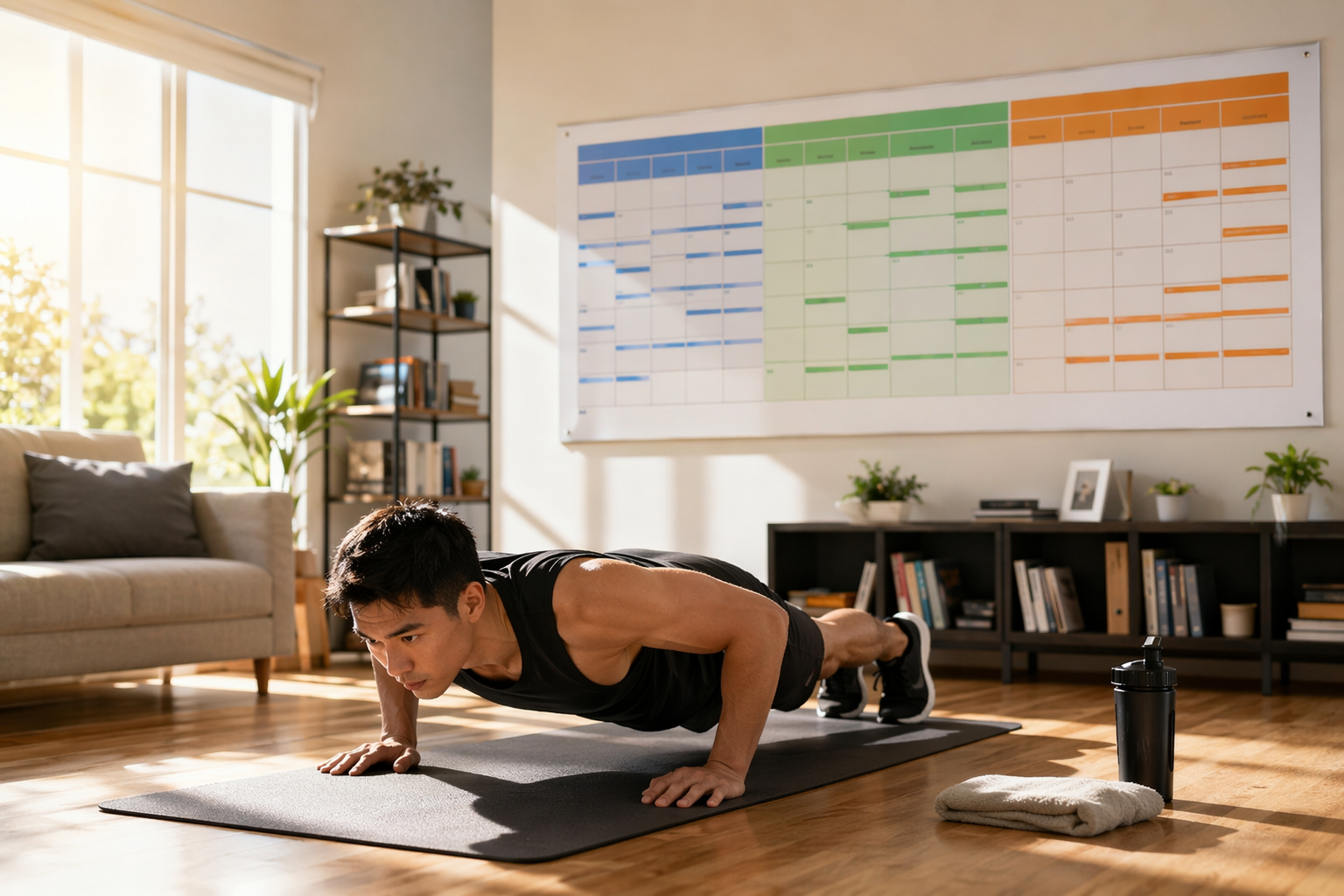
| Weeks | Phase | Sessions per week | Main target | Sets and reps | Tempo | Rest |
|---|---|---|---|---|---|---|
| 1-2 | Neuromuscular foundation | 3 | Clean movement patterns, controlled eccentrics, repeatable range of motion | 3 sets of 15-20 reps or 20-40 second holds | 2-3 seconds down, controlled up | 60-90 seconds |
| 3-5 | Hypertrophic loading | 3-4 | Harder variations in the 8-12 rep range | 4 sets of 8-12 reps or 25-45 second holds | 3 seconds down, brief pause, strong up | 90-120 seconds |
| 6-8 | Metabolic conditioning | 4 | Circuits, supersets, EMOM-style work, reduced rest without losing form | Circuits of 8-15 reps or timed intervals | Controlled but faster transitions | 15-60 seconds depending on format |
The plan uses five movement lanes: push, squat, pull, core, and vertical push. You will not need dumbbells, bands, or machines. You will need a floor, a wall, a sturdy table or doorway for rows if available, and enough honesty to repeat a week when your reps get loose.
The Weekly Schedule
Train on nonconsecutive days when the week has three sessions. In four-session weeks, use two upper/lower pairs or place one easier conditioning day between harder days. The Department of Health and Human Services recommends strength training at least twice per week and 150 minutes of moderate aerobic activity or 75 minutes of vigorous aerobic activity weekly; this plan sits inside that general frequency target while keeping the strength progression visible.[1]
| Week | Session A | Session B | Session C | Optional Session D |
|---|---|---|---|---|
| 1 | Push-up variation, assisted or bodyweight squat, plank: 3 x 15-20 or 20-30 sec; 60-90 sec rest | Doorway/table row if available, split squat practice, side plank: 3 x 12-20 or 20-30 sec; 60-90 sec rest | Incline or knee push-up, squat, pike push-up prep, hollow hold: 3 x 12-20; 60-90 sec rest | None |
| 2 | Repeat Week 1 and add range of motion or 1-2 reps per set where clean | Repeat Week 1 and slow the lowering phase to 3 seconds | Repeat Week 1 and test whether the next variation is clean for 5-8 reps | None |
| 3 | Harder push-up, squat progression, plank or hollow hold: 4 x 8-12; 90-120 sec rest | Row progression, split squat, side plank: 4 x 8-12 or 25-40 sec; 90-120 sec rest | Push-up, squat or split squat, pike push-up, core: 4 x 8-12; 90-120 sec rest | Optional technique day: easy reps only, 2-3 sets |
| 4 | Same pattern; advance one ladder step only if all Week 3 reps were clean | Same pattern; add 1 set only if recovery is solid | Same pattern; keep 3-second eccentrics | Optional technique day or mobility |
| 5 | Hardest clean push and squat variations: 4 x 8-12; 90-120 sec rest | Hardest clean row and unilateral leg variations: 4 x 8-12; 90-120 sec rest | Mixed full-body loading session: 4 x 8-12; 90-120 sec rest | Optional repeat of weakest lane at easy effort |
| 6 | Circuit 1: push, squat, core for 3-4 rounds; 30-45 sec rest between moves | Strength maintenance: 3 x 8-10 on hardest clean push, leg, row, core | Circuit 2: row, split squat, pike push-up, hollow hold for 3-4 rounds | 10-15 minute EMOM using two clean movements |
| 7 | Circuit 1: add 1 round or reduce rest by 10-15 sec | Strength maintenance: keep quality high, no grinding | Circuit 2: add reps only if transitions stay controlled | EMOM: keep reps fixed and compare breathing recovery |
| 8 | Benchmark circuit: repeat Week 6 Circuit 1 and compare total work and rest | Rep-max checks on selected movements, stopping before form breaks | Benchmark circuit: repeat Week 6 Circuit 2 | Short recovery session or optional EMOM retest |
Before Week 1, Pick the Right Starting Variations
Your starting point is not the hardest variation you can survive once. It is the hardest variation you can repeat for the assigned range with the same body position from the first rep to the last. That rule matters more than the name of the exercise.
| Movement lane | Start easier | Progress through | Advanced end |
|---|---|---|---|
| Push | Wall push-up | Incline push-up, knee push-up, full push-up, decline push-up, diamond push-up | Archer push-up, one-arm push-up progression |
| Squat | Assisted squat | Full bodyweight squat, narrow stance squat, split squat, Bulgarian split squat | Pistol progression, shrimp squat |
| Pull | Doorway row | Inverted row under a sturdy table, towel row progression | Slower tempo rows and harder body angle rows |
| Core | Plank | Side plank, hollow hold, leg raise, jackknife | Windshield wiper progression |
| Vertical push | Pike push-up | Decline pike push-up, wall handstand hold | Handstand push-up progression |
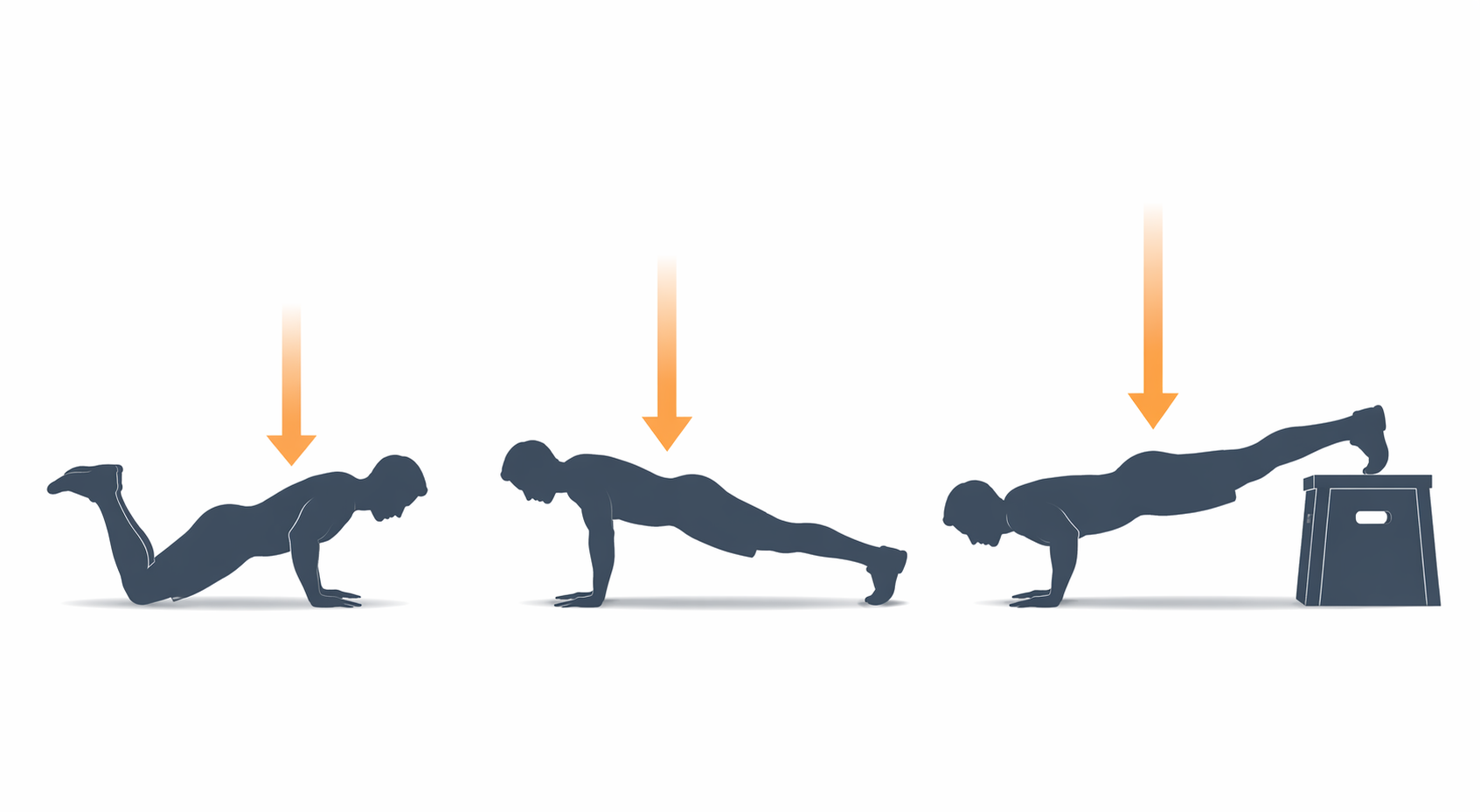
The push-up lane shows why bodyweight progression is not just a motivational trick. A knee push-up has been reported at roughly 42% of bodyweight load, while a decline push-up is reported at roughly 75%, meaning a change in leverage can move the resistance close to double without adding external weight.[2] That does not make every push-up equal to a bench press. It does mean variation choice is a real loading decision.
Weeks 1-2: Build Reps You Can Trust
The first two weeks are deliberately plain. You are teaching the nervous system where the joints go, how deep each rep should be, and what a finished set looks like before fatigue makes the decision for you. If the plan feels too easy, slow the lowering phase before you jump to a harder variation.
Use three full-body sessions per week. Each session should include one push, one squat or split-squat pattern, one pull if your space allows it, one core hold or controlled core movement, and one light vertical push skill. Keep the rest periods long enough that your next set still looks like training, not damage control.
| Exercise slot | Week 1 prescription | Week 2 prescription | What counts as clean |
|---|---|---|---|
| Push | 3 x 15-20 wall, incline, or knee push-ups | 3 x 15-20 with a 3-second lowering phase | Chest and hips move together; elbows track consistently |
| Squat | 3 x 15-20 assisted or full bodyweight squats | 3 x 15-20 with the same depth each rep | Knees track over toes; heels stay down; no collapse at the bottom |
| Pull | 3 x 12-15 doorway rows or table rows if safe | 3 x 12-15 with a pause at the top | Shoulders stay down; body does not jerk toward the anchor |
| Core | 3 x 20-30 sec plank or side plank | 3 x 25-40 sec plank, side plank, or hollow hold | Ribs stay down; low back does not sag |
| Vertical push | 3 x 8-12 pike push-up reps or 20-sec pike hold | 3 x 8-12 controlled pike push-ups | Head travels forward and down; shoulders do the work |
Do not turn these weeks into conditioning circuits. Rest 60-90 seconds. Write down the variation, reps, and one form note. Useful notes are blunt: “hips sagged after rep 14,” “left knee caved on split squats,” “row setup too easy,” or “pike push-up became a shrug.” Those notes decide Week 3 better than your mood does.
Move to Phase 2 Only If
- You completed all prescribed sets and reps for two consecutive sessions in the same movement lane.
- The last two reps slowed down but did not change shape.
- You can describe one clear way to make the exercise harder: lower the incline, use less assistance, increase range of motion, slow the eccentric, or move to the next ladder step.
- Joint discomfort is not increasing from session to session.
If one lane is not ready, keep that lane in Phase 1 while the others advance. A push-up can move from incline to knee or full while the split squat stays assisted for another week. The body does not progress in neat columns.
Weeks 3-5: Make Bodyweight Heavy Enough
This is the main strength and muscle-building block. The reps drop to 8-12, sets rise to four, rest extends to 90-120 seconds, and the exercises should become harder. If you are still doing the same variation for 20 easy reps, you are no longer training the target the phase was built for.
Use a 3-second eccentric on most reps. Lowering slowly does not magically build muscle by itself, but it makes cheating more obvious and increases time under tension. Pause briefly where you normally rush: the bottom of the push-up, the bottom of the split squat, the top of the row, the hollow position before the legs drift up.
| Movement lane | Week 3 | Week 4 | Week 5 |
|---|---|---|---|
| Push | 4 x 8-12 knee, full, or low-incline push-ups | Advance to full, decline, or diamond only after two clean sessions | Use the hardest clean variation for 4 x 8-12 |
| Squat | 4 x 8-12 split squats or narrow stance squats per side where relevant | Advance range of motion or use Bulgarian split squat if stable | Use split squat, Bulgarian split squat, or pistol progression |
| Pull | 4 x 8-12 doorway, table, or towel rows | Make the body angle harder or slow the lowering phase | Hold the top position for 1 second on each rep |
| Core | 4 x 25-40 sec hollow hold, side plank, or controlled leg raise | Add range before adding speed | Use jackknife or harder hollow variation if the low back stays controlled |
| Vertical push | 4 x 6-10 pike push-ups or controlled pike negatives | Advance to decline pike if shoulder position stays clean | Use decline pike or wall handstand hold practice after strength work |
The advancement rule is simple: complete every set at the top of the range for two sessions with clean form, then make the next session harder. For push-ups, that could mean moving from knee to full push-ups. For squats, it could mean moving from full squats to split squats. For rows, it could mean stepping the feet farther forward so more bodyweight has to be pulled.
A controlled month-long study reported by NPR compared a group progressing push-up variations with a group adding weight to the bench press and found no difference in strength improvement between the groups.[3] That is useful evidence for this kind of plan because the push-up group did not merely repeat the same easy version; the variation progressed. The brake stays on the claim, though: the report described a small sample and a one-month window, so it should not be treated as the final word on bodyweight versus weight-room training.
In the same NPR report, exercise scientist James Steele summarized the broader comparison this way: studies comparing bodyweight exercise with free-weight or machine equivalents “all essentially show no difference between the two.”[3] The practical reading is not that equipment never matters. It is that effort, progression, and exercise selection carry a lot of the signal.
What to Do When You Miss the Rep Target
If you get 12, 11, 9, and 7 reps, stay with the same variation next time. If you get 8, 6, 5, and 4, the variation is too hard for this block. Move one step back or use a shorter range of motion until you can own the bottom position. A failed rep is information, not a personality test.
- If reps are too easy: move to the next leverage step before adding more total volume.
- If form breaks late: keep the variation and repeat the week.
- If joints complain: reduce range, slow down, or choose an easier variation with cleaner alignment.
- If conditioning limits the set before the muscle does: rest longer during Phase 2 instead of turning the workout into a circuit.
Commercial summaries of bodyweight research have cited meta-analyses reporting 6-11% lean mass increases over 10-week bodyweight programs, and one 2024 randomized trial in which participants combining bodyweight training with caloric restriction lost 3.9 kg of fat while gaining 1.2 kg of lean mass over 12 weeks.[2] Those figures are encouraging, but they are being reported through a secondary commercial source, so they belong in the “plausible and worth noting” column rather than the “settled for everyone” column.
Move to Phase 3 Only If
- At least three movement lanes reached the assigned 8-12 rep range with clean form.
- You can name your current hardest clean push, squat, row, core, and vertical push variations.
- You are not relying on shorter rest to hide exercises that are too easy.
- Your hardest sets feel challenging but repeatable, roughly 2 reps short of technical failure most of the time.
Weeks 6-8: Condition Without Losing the Strength Thread
Conditioning comes last because now the exercises mean something. A circuit of wall push-ups and half squats can raise your heart rate, but it is hard to measure as strength work. After five weeks of ladder progressions, you can put harder variations into circuits and still know whether you are improving.
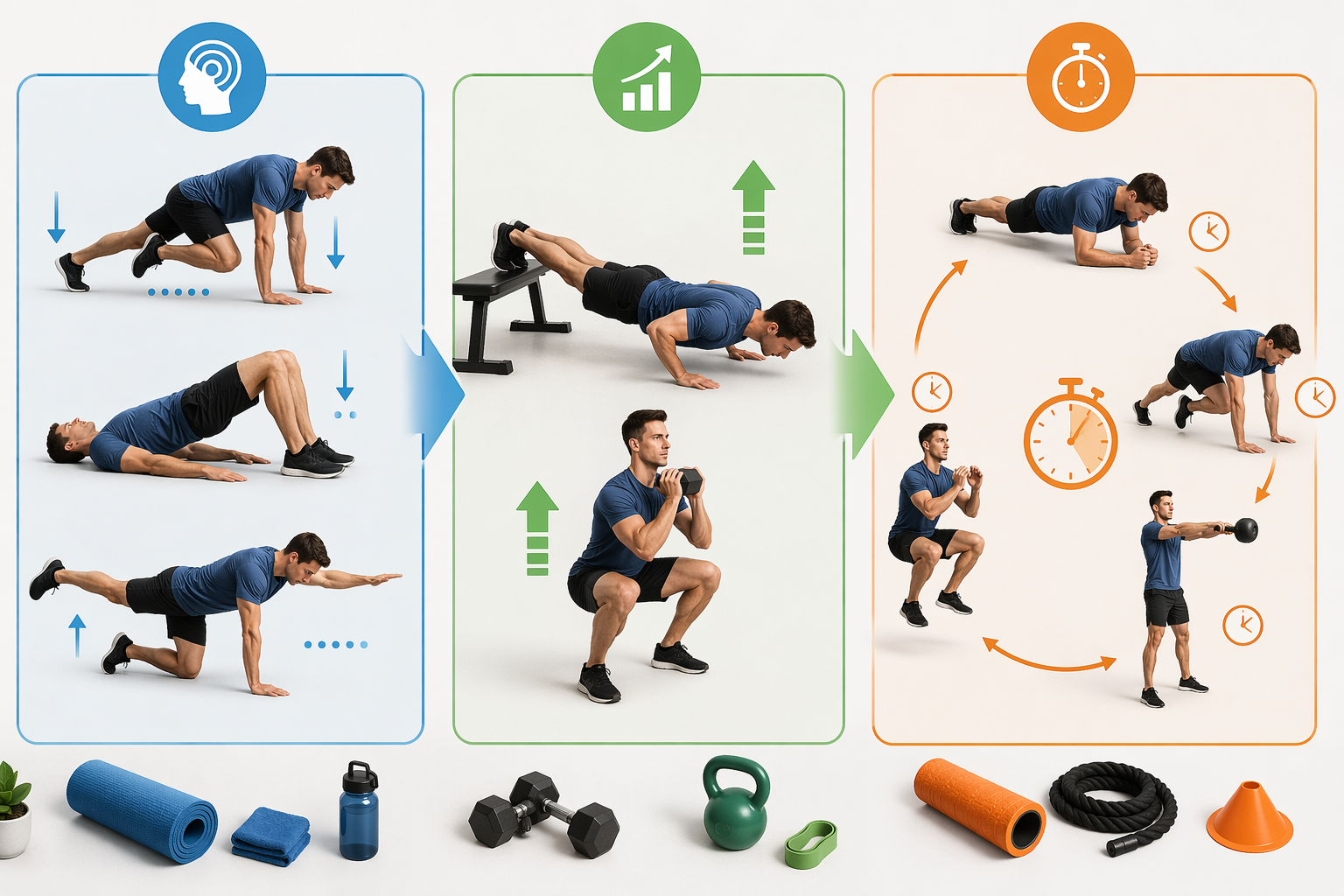
Harvard Health reviewed research in which 10 weeks of bodyweight exercise improved aerobic capacity by 33%, core endurance by 11%, and lower-body power by 6% in young women.[4] That population matters. The result does not promise the same numbers for every reader, but it does support the idea that bodyweight training can train more than local muscular endurance when programmed consistently.
| Session | Format | Work |
|---|---|---|
| Circuit A | 3-4 rounds, 30-45 sec rest between moves | Push-up variation x 8-15, squat or split squat x 10-15, hollow hold x 25-40 sec, pike push-up x 6-10 |
| Strength maintenance | Straight sets, 90 sec rest | Hardest clean push, squat, row, and core variations for 3 x 8-10 |
| Circuit B | 3-4 rounds, 30-45 sec rest between moves | Row variation x 8-12, split squat x 8-12 per side, side plank x 25-40 sec per side, controlled mountain climber x 20-30 total |
| EMOM day | 10-15 minutes | Odd minutes: push or pike push-up reps. Even minutes: squat, split squat, or core reps. Keep reps fixed. |
EMOM means “every minute on the minute.” If the minute starts and you owe 8 push-ups, do the reps, then rest for whatever time remains. The next minute begins whether you feel fully ready or not. Keep the rep number conservative enough that the final round still looks like the first round. A 15-minute collapse is not better training than a 10-minute session you can repeat and beat.
How to Progress the Conditioning Block
In Week 6, learn the formats. In Week 7, change one variable: add a round, reduce rest by 10-15 seconds, or add 1-2 reps per movement. In Week 8, repeat the Week 6 benchmark sessions and compare the numbers. Do not change the exercises and the rest periods and the reps all at once, because then you will not know what improved.
- Better conditioning: same reps and variations with less rest or lower perceived effort.
- Better strength endurance: more clean reps before the first technical breakdown.
- Better pacing: final round is within 1-2 reps of the first round on each movement.
- Poor progression: faster transitions that shorten range of motion or turn rows, squats, and push-ups into partial reps.
The Rules That Keep the Plan Moving
The program works only if the progression rules are more important than the calendar. Eight weeks is the container. Your reps decide the next step.
| Situation | Decision |
|---|---|
| You complete every set at the top of the rep range for two sessions | Move one ladder step harder next time |
| You complete the first sets but form breaks later | Repeat the same week and keep the same variation |
| You cannot reach the bottom of the range | Move one step easier or reduce the range of motion temporarily |
| You feel only cardio fatigue in Phase 2 | Increase rest and choose a harder variation |
| You feel joint irritation that worsens across sessions | Stop advancing that lane and use the cleanest pain-free variation |
| One movement lane is ahead of the others | Advance that lane alone; do not drag the whole plan forward |
Most stalled home plans fail here. They treat progression as enthusiasm: more rounds, less rest, harder-looking moves. This plan treats progression as a change you can write down. A lower incline. A slower eccentric. A deeper split squat. A harder body angle on rows. A shorter rest interval only after the strength work has been earned.
How to Track Gains Without Equipment
You do not need a one-rep max to know whether the plan is working. You need consistent tests. Pick one benchmark from each lane at the start of Week 1, then retest at the end of Week 4 and Week 8.
| What to track | How to measure it | What improvement looks like |
|---|---|---|
| Rep max | One clean set stopped before form breaks | More reps at the same variation or the same reps at a harder variation |
| Form quality | One note per movement after training | Less knee cave, less hip sag, steadier depth, cleaner lockout |
| Variation difficulty | Write the exact ladder step used | Incline to floor, assisted squat to split squat, plank to hollow hold |
| Rest tolerance | Record rest periods on circuits | Same work completed with less rest and no range-of-motion loss |
| Perceived exertion | Rate the hardest set from 1-10 | Same work feels easier or harder work feels similarly challenging |
Use the same testing standard every time. A push-up rep counts when the body moves as one piece and the bottom position matches your training range. A split squat rep counts when the front foot stays planted and the knee tracks cleanly. A hollow hold counts while the low back position stays controlled. These details are not cosmetic; they are how you keep the measurement honest.
After Week 8, you can run the plan again with harder starting variations, or keep the same structure and add equipment if you want more loading options. For a broader comparison of bodyweight, minimal-equipment, and fuller home-gym training weeks, use the home gym workout plan by equipment tier. If the lower-body work is the limiting factor, the no-equipment leg day blueprint gives the squat and unilateral leg progressions more room.
References
- Fitness program: 5 steps to get started, NBC News, https://www.nbcnews.com/better/health/how-start-fitness-program-ncna845091
- Bodyweight Exercises for Strength & Tone: Strategies, Rumen, https://www.rumen.com.au/article/bodyweight-exercises-strength-tone-strategies/
- Building strength without weights, NPR, Jan 14, 2026, https://www.npr.org/2026/01/14/nx-s1-5674895/building-strength-without-weights
- The advantages of body-weight exercise, Harvard Health, reviewed Jan 2026, https://www.health.harvard.edu/exercise-and-fitness/the-advantages-of-body-weight-exercise
What a small equipment investment adds
We don't have a build tagged to this exact tier yet. Browse all builds.
How often should you repeat this?
See our recovery and rest reference for citation-anchored rest-interval guidance.
Spot something off?
Tell us if a movement, tier assumption, or duration didn't match your experience.