
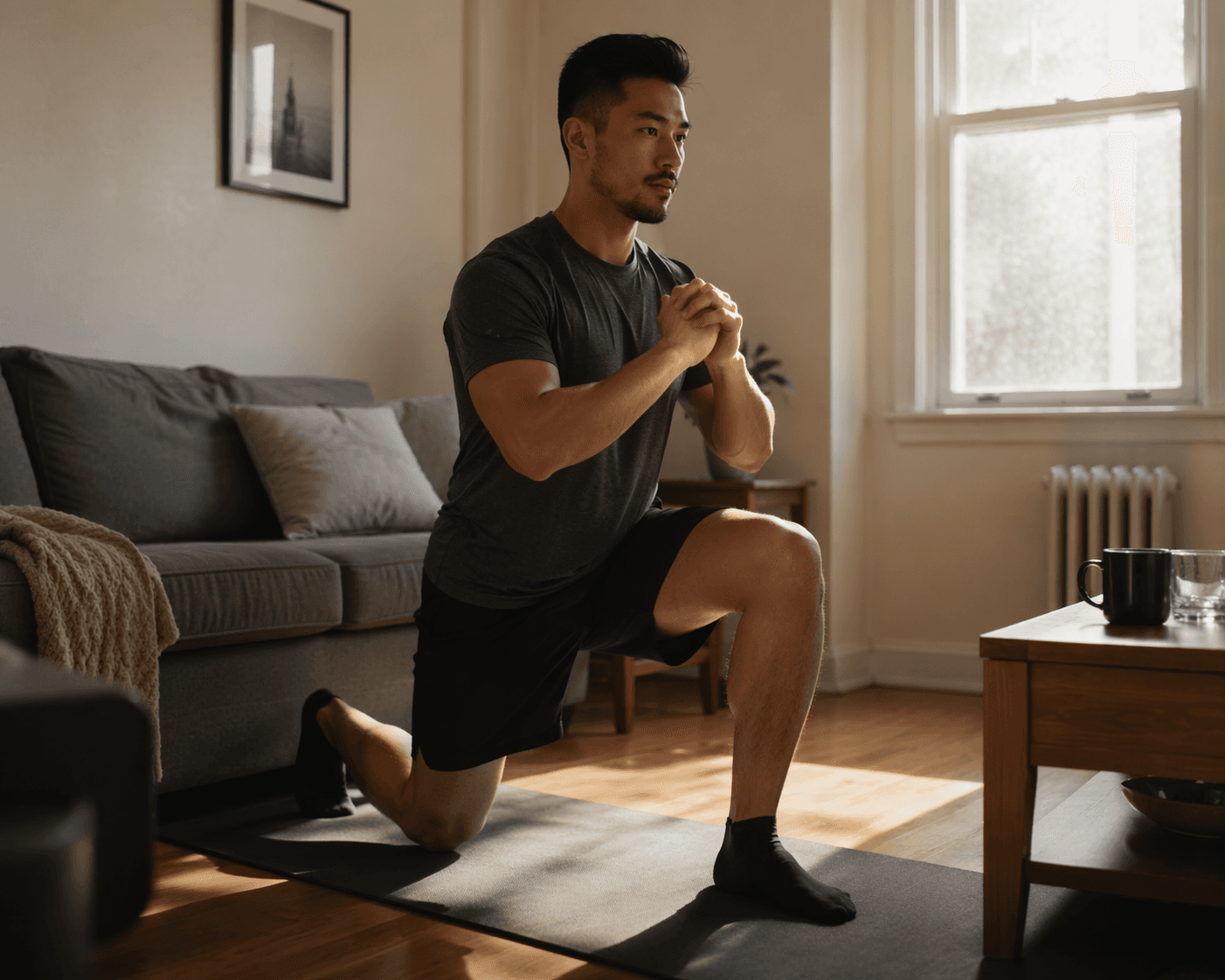
Cardio at home gets irritatingly complicated the second you live above another human being. You want to sweat, breathe hard, and finish feeling like you actually trained, but you cannot jump, stomp, sprint in place, shove the coffee table across the room, or pretend your downstairs neighbor will find burpees charming at 7 a.m.
The usual false choice is noisy plyometrics or half-hearted marching. That is lazy programming. Impact is only one way to raise intensity. A better apartment-friendly lever is to use large compound movements, move them with purpose, and control the rest periods. Trainer-sourced workouts from SELF and Shape make the same useful point: squats, lunges, plank variations, push-ups, and other multi-joint moves ask more from the body than small isolation moves because they recruit multiple large muscle groups at once [1][2].
The workout below needs roughly a 6-by-6-foot patch of floor, no jumping, and no machine. It is quieter, not silent. Your feet still touch the floor, and a sloppy plank walkout can thud just as rudely as a jump. But if you step instead of drop, keep your feet controlled, and use the work-rest structure honestly, this can be real cardio in a small room.
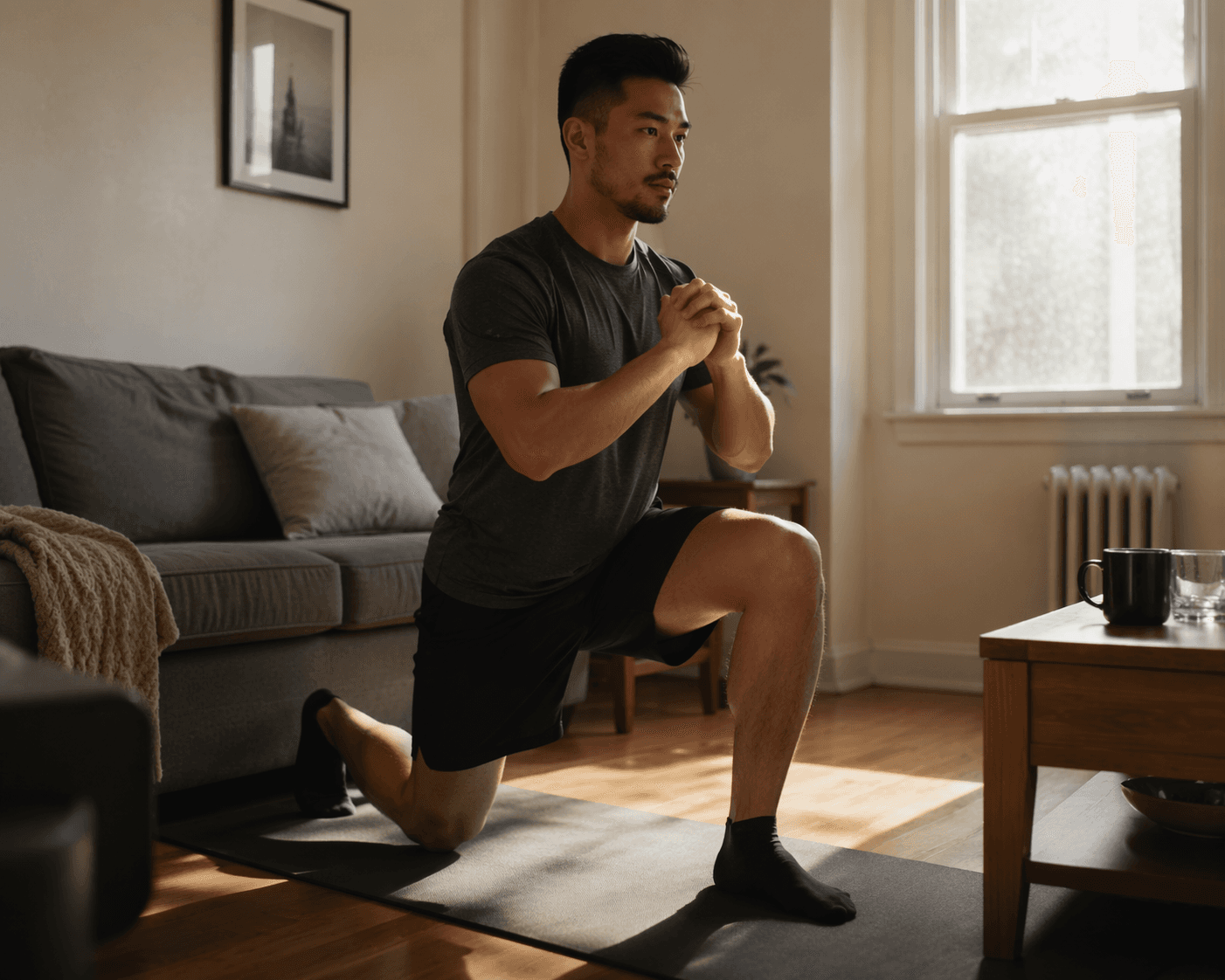
The quiet no-jumping cardio workout
This session uses three formats for different kinds of effort: Tabata for sharp intervals, EMOM for pacing, and AMRAP for sustained density. You can finish in about 24 to 30 minutes depending on how long you rest between blocks.
| Block | Format | Work | Purpose |
|---|---|---|---|
| Warm-up | Continuous | 4 minutes | Raise temperature, rehearse quiet foot placement |
| Block 1 | Tabata | 8 rounds: 20 seconds work, 10 seconds rest | Fast intervals without jumping |
| Block 2 | EMOM | 8 minutes: complete reps at the start of each minute, rest with remaining time | Repeatable pacing and breath control |
| Block 3 | AMRAP | 6 minutes: as many quality rounds as possible | Sustained cardio density |
| Cool-down | Easy movement | 2 to 4 minutes | Bring breathing down and check joints |
Warm-up: 4 minutes
Move continuously, but do not rush. The warm-up is where you teach your feet not to slap the floor.
- 30 seconds: step-out jacks with an easy overhead reach
- 30 seconds: bodyweight good mornings
- 30 seconds: alternating reverse lunges, shallow if needed
- 30 seconds: slow mountain climbers from a high plank
- Repeat once
If your wrists dislike plank work, put your hands on the edge of a sturdy sofa or a countertop. If your knees complain during lunges, shorten the step and keep the back knee higher. Lower range of motion is not failure; uncontrolled movement is the problem.
Block 1: Tabata, 4 minutes
Tabata is simple on paper: 20 seconds of work, 10 seconds of rest, repeated for 8 rounds. In no-jump cardio, it works best when the movement is big enough to matter but controlled enough not to become a floor-rattling mess. Some trainer-led bodyweight Tabata circuits are described as capable of pushing exercisers into roughly 80% to 90% of maximum heart rate, but that should be treated as a possible intensity range, not a promise for every body, fitness level, or execution style [1].
Alternate these two exercises for all 8 rounds:
- Rounds 1, 3, 5, 7: step-back burpee
- Rounds 2, 4, 6, 8: tempo squat to calf raise
For the step-back burpee, place your hands down, step one foot back, step the other foot back, brace in a plank, then step forward and stand tall. Skip the push-up unless you can do it without sagging or rushing. Skip the jump at the top completely. The cardio demand comes from the level change, the plank, and the repeated stand-up—not from launching off the floor.
For the tempo squat to calf raise, lower with control, stand with speed, then rise onto the balls of your feet before lowering your heels softly. This is the apartment swap for a squat jump: legs still work hard, the heart rate still climbs, but the landing disappears. Keep the knees tracking over the toes and use a shallower squat if your hips or knees start bargaining with you.
Block 2: EMOM, 8 minutes
EMOM means “every minute on the minute.” At the start of each minute, you complete the assigned reps. Whatever time remains is your rest. SELF and PopSugar both use no-jumping compound movements in structured home-cardio workouts, and the format is useful because it exposes your pacing: if the first minute takes 25 seconds and the sixth takes 55, you went out too hot [1][3].
| Minute | Exercise | Reps |
|---|---|---|
| 1 | Step-out jack with overhead reach | 24 total step-outs |
| 2 | Alternating reverse lunge to knee drive | 12 total reps |
| 3 | Plank shoulder tap | 20 total taps |
| 4 | Fast bodyweight squat | 15 reps |
| 5 | Step-out jack with overhead reach | 24 total step-outs |
| 6 | Alternating reverse lunge to knee drive | 12 total reps |
| 7 | Plank shoulder tap | 20 total taps |
| 8 | Fast bodyweight squat | 15 reps |
The step-out jack is the quiet replacement for a jumping jack. Step one foot out as both arms reach overhead, bring it back, then switch sides. Make the arms big and the steps quick, but keep the feet light. If your shoulders do not like overhead work, reach forward or place hands on hips and increase the step tempo.
The reverse lunge to knee drive should not become a stomp. Step back, tap the back foot lightly, drive the knee forward, and set it down like you are trying not to wake someone. If balance is the limiting factor, remove the knee drive and do alternating reverse lunges.
For plank shoulder taps, widen your feet, squeeze your glutes, and tap opposite shoulder without rocking your hips side to side. This is not the loud part of the workout, but it is often the part where people lose their brace and start dropping weight through their hands.
Block 3: AMRAP, 6 minutes
AMRAP means “as many rounds as possible.” The important word is quality. You are trying to accumulate work with short transitions, not win a sloppy speed contest. Trainer-sourced no-jump and low-impact cardio routines commonly use moves such as lunges, squats, mountain climbers, and modified burpees because they keep the whole body involved without requiring running or jumping [2][4][5].
- 6 step-back burpees
- 12 tempo squats with calf raise
- 20 slow-to-moderate mountain climbers, total
- 16 step-out jacks with overhead reach, total
Set a timer for 6 minutes and cycle through the list. Rest only when your form needs it. If the plank transition in the step-back burpee starts getting heavy, elevate your hands. If mountain climbers make your feet scrape or bang, slow them down and think of pulling the knee under the body rather than kicking the floor away.
Why these swaps still feel like cardio
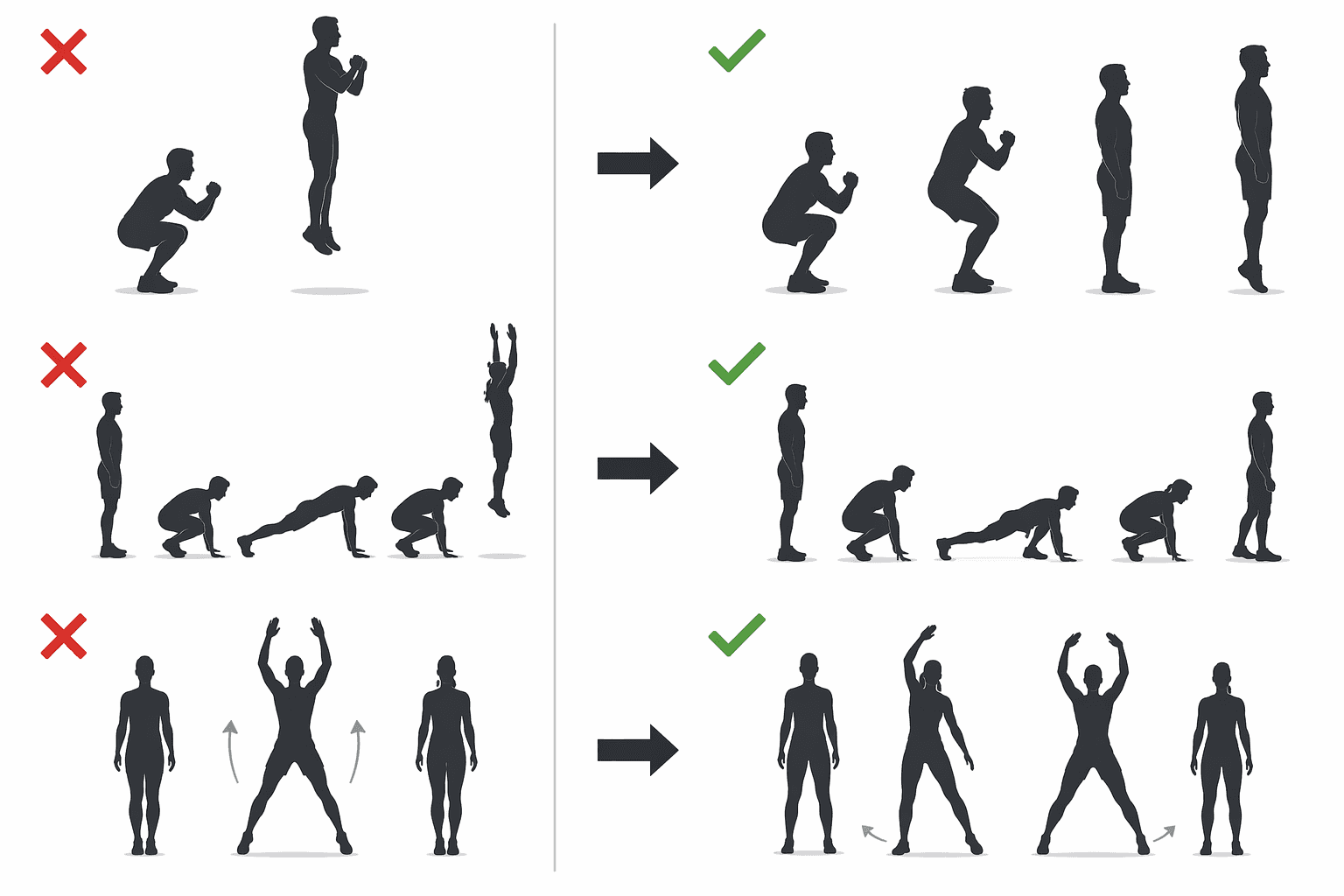
A jump usually adds intensity in two ways: speed and impact. You can keep the speed and remove the impact. That is the whole trick behind a good no-jumping cardio workout.
| Noisy default | Quiet swap | What keeps it hard |
|---|---|---|
| Burpee with jump | Step-back burpee | Level change, plank position, repeated standing |
| Squat jump | Tempo squat with calf raise | Large leg muscles, controlled lowering, fast stand |
| Jumping jack | Step-out jack with overhead reach | Continuous rhythm, arm drive, lateral stepping |
| Running mountain climber | Controlled mountain climber | Core brace, hip drive, upper-body support |
The step-back burpee is the most convincing example because it preserves the part that makes burpees metabolically expensive: getting from standing to the floor and back again. The jump is the loudest part, but it is not the only hard part. When you step back cleanly, hold the plank, and stand up without dawdling, the movement still piles up quickly.
The tempo squat with calf raise works because your legs do not get to disappear between reps. A squat jump gives you a flight phase and a landing. The no-jump version gives you tension, a fast stand, and a calf raise that finishes the line without asking your floorboards to absorb your bodyweight.
The step-out jack looks almost too polite until you do it at a real cadence with full arm reach. Keep the torso tall, step side to side without dragging your feet, and make the arms contribute. If you turn it into a lazy side tap, yes, it becomes easy. That is not a flaw in the exercise; it is a pacing choice.
How to scale the workout without making it useless
If you are newer to training, start by reducing the volume, not by removing all effort. Do one Tabata block, four minutes of EMOM, and four minutes of AMRAP. Keep the same movement patterns so you still train the skill of moving quietly under fatigue.
| If this happens | Change this |
|---|---|
| You cannot finish EMOM reps with at least 10 seconds left | Reduce each exercise by 4 to 6 reps |
| Your knees dislike lunges | Use a shorter reverse lunge or swap for alternating step-back taps |
| Your wrists dislike plank work | Elevate hands on a sturdy surface |
| Your feet are getting loud | Slow the transition and place the whole foot down under control |
| Your breathing never rises | Increase cadence before adding impact |
For a harder version, do not add jumps first. Add one extra AMRAP minute, increase the EMOM reps slightly, or shorten the rest between blocks. If you want strength work that respects the same no-bench, no-jumping, no-neighbor-drama constraints, pair this with a full-body dumbbell workout for apartment dwellers on alternate days.
A few noise rules that matter more than the exercise name
No-jumping does a lot, but it does not fix careless movement. A step-back burpee can still annoy someone downstairs if you throw your feet back, collapse into your hands, and stomp forward. Quiet cardio is partly exercise selection and partly manners under fatigue.
- Land the whole foot softly instead of slapping the forefoot.
- Step back into planks one foot at a time; do not hop both feet back.
- Keep soft knees during squats and step-outs.
- Use a mat for comfort, but do not assume a thin mat is soundproofing.
- Face the long side of your mat if your room is narrow, so transitions stay contained.
If noise is a recurring issue, the workout is only one piece of the setup. Flooring, mat density, and where you place your workout area can change how much vibration travels. For a deeper pass on that side of the problem, see home gym flooring mistakes that affect space, money, and peace with neighbors, or build from the broader apartment dweller’s compact home gym setup.
Do you need a machine for cardio at home?
A treadmill, bike, or rower can be useful if it fits your space, budget, and noise tolerance. It is not required for effective cardio at home. If the question is whether your heart and lungs can be challenged without equipment, the answer is yes: the session above does it by stacking compound patterns, tempo, and limited rest.
If you are deciding whether to buy equipment, use a constraints-first approach instead of chasing the most impressive machine. The right choice depends on floor space, vibration, storage, maintenance, and whether you will actually use it. This cardio-at-home equipment guide is the better next stop for that decision. If this workout feels too intense right now and you need a lower-pressure starting point, try cozy cardio at home first, then come back to intervals when your base is steadier.
The useful test is not whether the workout looks dramatic on video. It is whether you can repeat it, control it, breathe hard, and finish without rattling the floor. If you can move through compound patterns with good foot placement and respect the clock, you can get legitimate cardio at home in a small space without jumping.
References
- Cardio Exercises at Home Workout (No-Jumping, Neighbor-Friendly) — SELF
- No-Running Cardio Workout You Can Do at Home — Shape
- 17 Quiet, At-Home Cardio Exercises That Trainers Recommend — PopSugar
- A Low Impact, No-Jumping Cardio Workout — SELF
- 6 Low Impact Cardio Exercises in 20 Minutes or Less — Healthline
Comments
Join the discussion with an anonymous comment.