
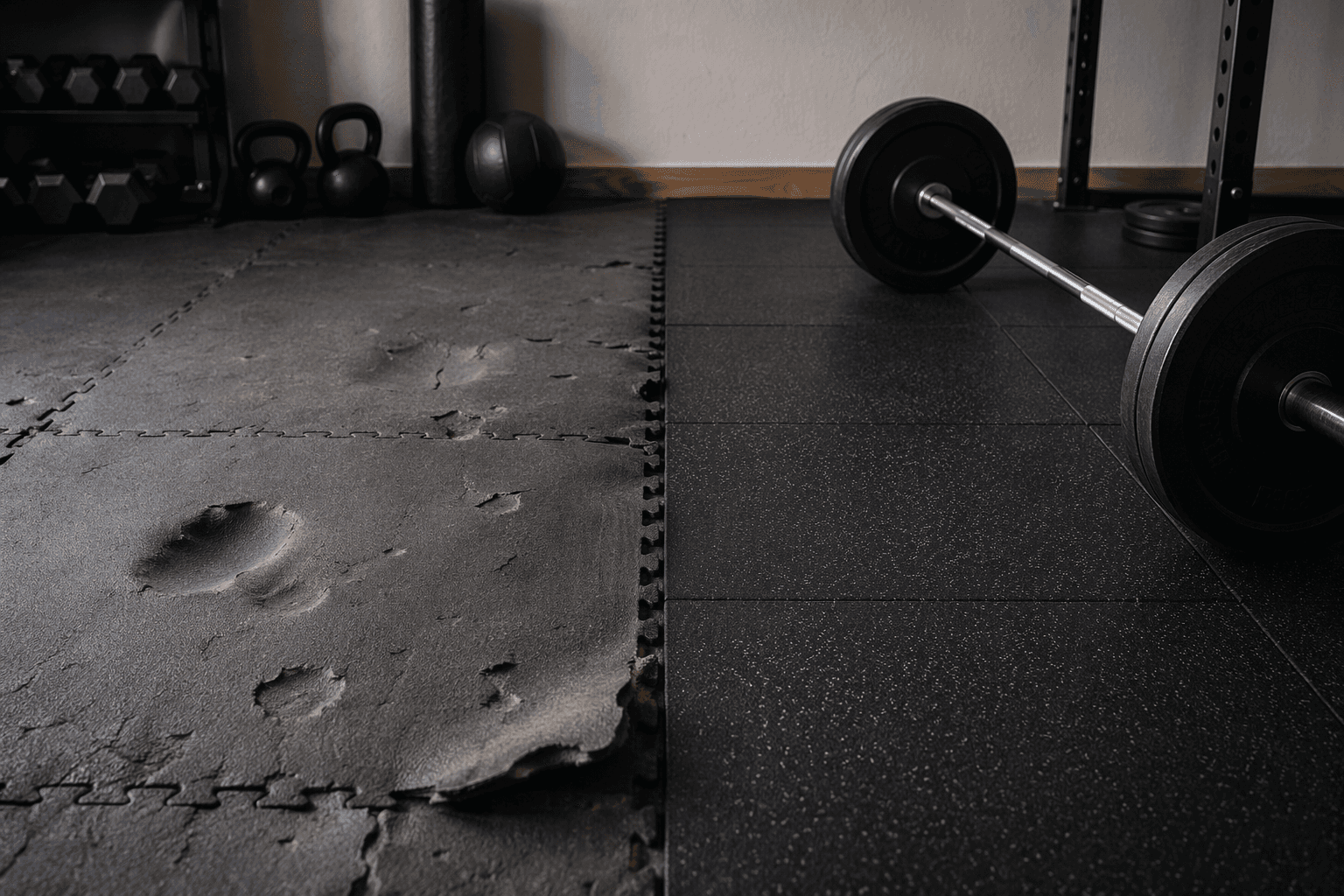
Home gym flooring is easy to treat like an accessory until it arrives. Then it becomes infrastructure: heavy, awkward, often smelly, sometimes impossible to return without paying more in shipping than the mistake is worth. A bad bench can be moved to the corner. Bad flooring sits under everything else and reminds you, every workout, that the room was planned around a product listing instead of the actual space.
The expensive mistakes are usually not exotic. Someone buys soft foam because it looks comfortable, then leaves loaded kettlebells on it and gets permanent dents. Someone buys thick rubber for an apartment and discovers the floor still transmits impact into the ceiling below. Someone orders a roll before measuring the room and ends up cutting around a closet, a baseboard heater, and a strip of unusable waste. The common thread is simple: the floor was chosen for the workout the buyer imagined, not the load, noise, room shape, and lease they actually had.
Mistake 1: Buying for comfort when the real problem is load
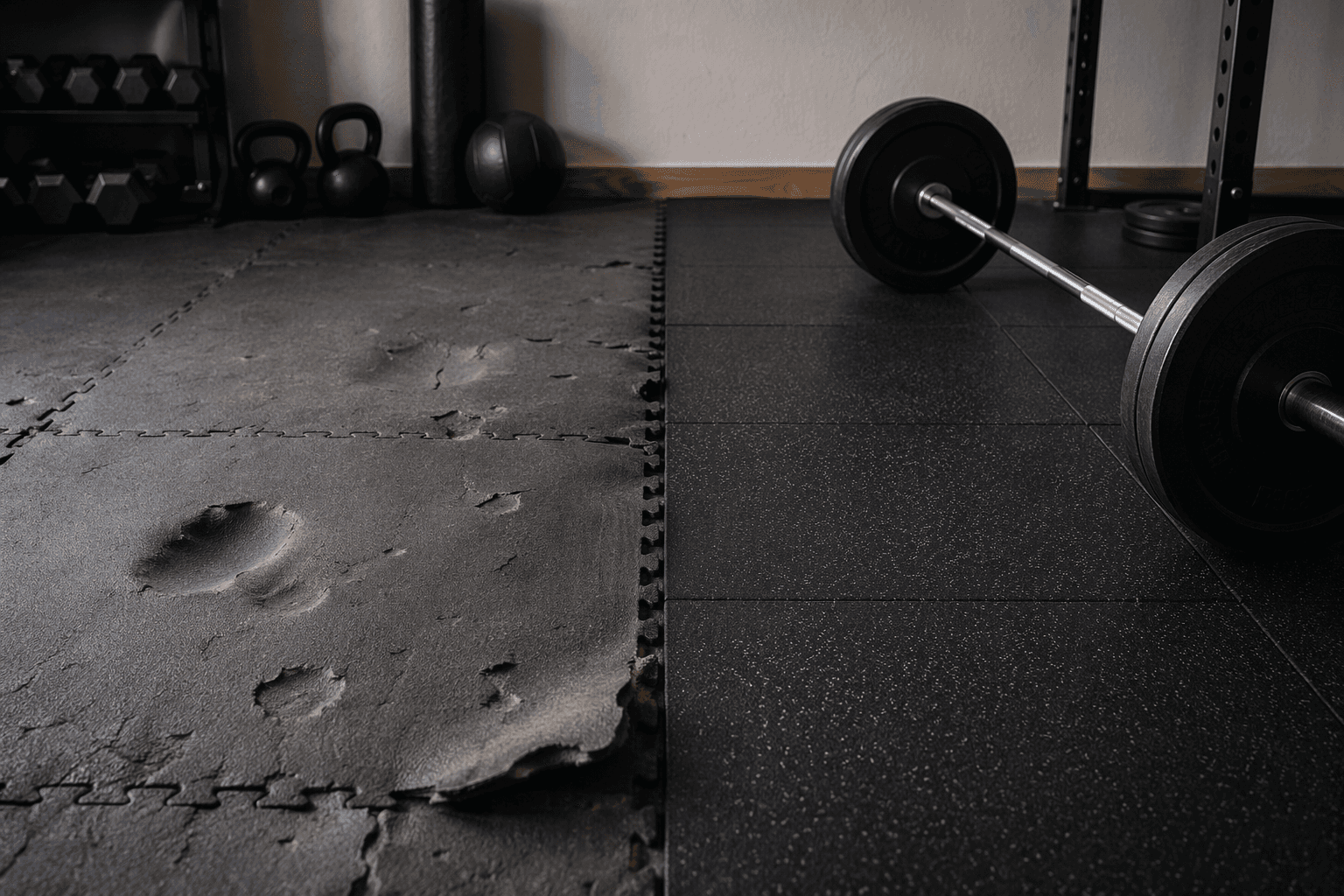
Foam has a place. For yoga, mobility work, stretching, light bodyweight training, and a room that needs to be easy to pack away, interlocking foam can be a reasonable choice. The mistake is asking it to behave like dense rubber under concentrated weight.
Garage Gym Reviews’ 2026 testing found permanent indentations in foam mats after 15 kg and 32 kg kettlebells were left on them for extended periods.[1] That does not make foam useless. It does mean foam is the wrong answer if your floor will live under dumbbell heads, kettlebells, a rack, a treadmill, or a loaded storage tree.

The easy way to avoid this mistake is to judge flooring by the heaviest thing that will sit on it, not the most comfortable exercise you plan to do on it. A floor that feels nice under bare feet can still fail under a single kettlebell left in the same spot. If the room includes free weights, machines, or racks, the surface needs enough density to resist compression, not just enough softness to feel forgiving.
Mistake 2: Treating thickness as a magic number
Thickness matters, but it is not the whole flooring decision. A thicker sheet of lightweight foam is still lightweight foam. A thinner dense rubber surface may protect better under moderate strength training than a puffy tile that collapses under point loads. The question is not “How thick can I afford?” It is “What kind of force is this floor expected to survive?”
| Actual use | Flooring implication |
|---|---|
| Yoga, stretching, bodyweight circuits, light mobility work | Foam can make sense if no heavy equipment is stored on it. |
| General dumbbell and strength training with controlled reps | Dense rubber is usually a safer default than soft foam. |
| Regular heavy Olympic lifting or repeated heavy drops | Plan around heavier-duty rubber, platforms, or a garage-style setup rather than basic multipurpose tiles. |
| Apartment training with neighbors below | Thickness alone is not enough; impact isolation and exercise selection matter. |
Garage Gym Reviews notes that 8 mm, or 5/16 inch, is the most common thickness for general strength training and can handle light drops. For regular heavy Olympic lifting, Olympian Caine Wilkes recommends at least 1/2 inch and prefers 3/4 inch.[2] That distinction matters because many home gyms sit between categories. A few controlled dumbbell sets do not require the same floor as repeated cleans, snatches, and missed lifts.
This is also where “all-purpose” claims get people into trouble. All-purpose for what? A mat can be acceptable for push-ups, annoying under a treadmill, dented under kettlebells, and inadequate for dropped bumper plates. The heaviest realistic use case should set the minimum standard. Everything lighter than that can live with the choice.
Mistake 3: Assuming a soft floor will make an apartment quiet
Noise is where home gym flooring disappoints the fastest, especially in multi-unit housing. The sound you hear in the room is only part of the issue. The neighbor below may be hearing impact transfer through the structure: thuds, vibration, and low-frequency energy that a “cushioned” top layer does not automatically stop.
A 2025 paper presented at the International Congress on Noise Control Engineering found that rubber flooring significantly reduces impact noise compared with bare floors, and its abstract points to density as an important factor in sound dampening rather than thickness alone.[3] Living.Fit’s practical guidance makes the same useful distinction for buyers: lightweight foam lacks the density needed to absorb heavier impacts in the way dense rubber can.[4]
That does not mean rubber makes deadlifts apartment-safe. It means rubber is better understood as one layer in a noise-control decision, not a permission slip. If there is a downstairs neighbor, flooring has to be matched with exercise selection: controlled eccentrics, no dropped weights, no jumping at night, and no pretending a single mat can solve building construction.
For apartment setups, the decision should start with the neighbor problem, not the product category. A quiet-looking mat under a pair of dumbbells may be fine. The same mat under plyometrics, heavy deadlifts, or a treadmill can still create the kind of repeated impact that makes someone downstairs hate your training schedule. If you are building in a rental, pair this flooring decision with the broader constraints in a compact home gym apartment guide before buying the heaviest material you can find.
Mistake 4: Putting rubber mats directly over plush carpet
A room with carpet looks like it already has padding, which is exactly why it tricks people. Plush residential carpet is not a stable base for lifting. Put a rubber mat over it, and the rubber can sink into the carpet and padding underneath. The top surface may feel flat at first, then shift or tilt once weight and movement enter the picture.
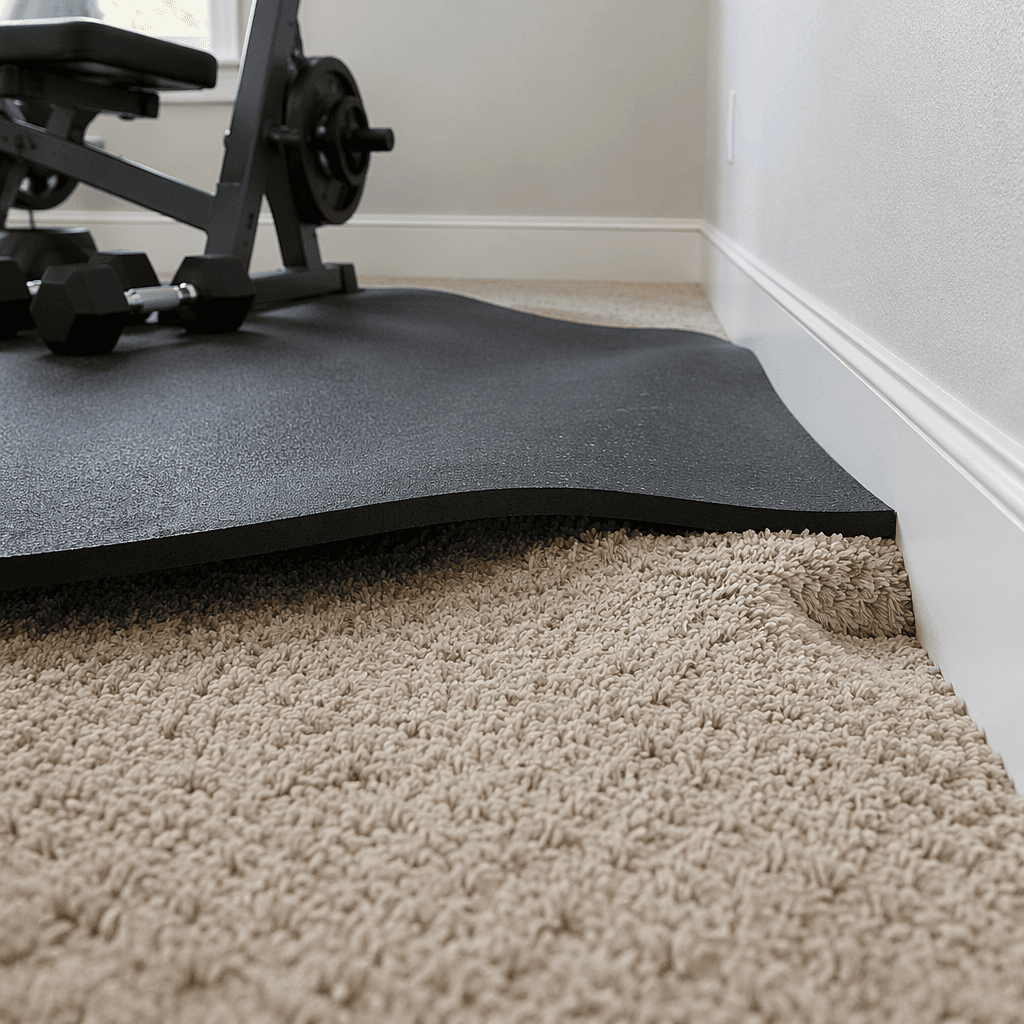
Greatmats specifically warns that placing rubber mats directly over plush carpet creates an unstable surface because the rubber sinks into the carpet padding, causing movement during lifts. For temporary flooring over carpet, it points buyers toward PVC tiles with raised feet, such as StayLock-style products, rather than standard flat rubber mats.[5]
This is a format problem as much as a material problem. The question is not only whether rubber is durable. It is whether the subfloor under it lets the rubber act like a floor. Over hard surfaces, dry-laid rubber tiles or rolls may behave predictably. Over plush carpet, the same material can become a floating, shifting layer.
Renters with carpet need to be especially careful here because the obvious fix — removing carpet or building something more permanent — may not be allowed. If the room has carpet and the setup needs to stay reversible, choose a system designed for that condition instead of hoping heavy rubber will flatten the problem. The same lease-first thinking applies to the rest of an apartment renter’s home gym.
Mistake 5: Choosing rolls because they look cleaner in photos
Rubber rolls can look excellent in a finished room. Fewer seams, a cleaner surface, and a more commercial feel are real advantages. They are also much less forgiving when the room is small, interrupted, or measured casually.
NHC Now notes that rubber rolls commonly come in 4-foot widths with minimum lengths of 15 feet.[6] That format can be efficient in a rectangular garage bay. In a spare bedroom with a closet bump-out, a doorway swing, a radiator, or a partial training zone, it can turn into expensive trimming and leftover material. The mistake happens before checkout: the buyer picks the format before measuring the room.
Tiles solve a different problem. They add seams and may not look as seamless as a roll, but they are easier to move through tight hallways, easier to replace one section at a time, and easier to adapt around odd room shapes. For a garage or basement with a clean rectangle, rolls may be sensible. For apartments and spare rooms, tiles often win because they respect the room’s limitations.
| Room reality | Format that usually makes more sense |
|---|---|
| Large rectangular garage or basement zone | Rolls can work if dimensions match the set width and length. |
| Small spare bedroom with doors, closets, or partial coverage | Tiles are usually easier to fit with less waste. |
| Rental where flooring may need to move later | Dry-laid interlocking tiles are easier to remove than permanent installations. |
| Carpeted room | Use a product designed for over-carpet stability rather than flat rubber dropped on plush pile. |
Measure before comparing formats. Not approximate square footage in your head — actual length, width, doorway clearance, obstructions, and the area where equipment will sit. Flooring is one of the few gym purchases where being off by a few inches can turn a good material into a bad plan.
Mistake 6: Bringing garage solutions into an apartment
Horse stall mats are popular for a reason: they are dense, durable, and often cheaper than premium gym-branded rubber. In the right setting, especially a garage, they can be a practical choice. The right setting is doing a lot of work in that sentence.
Gray Matter Lifting describes 3/4-inch Tractor Supply stall mats as weighing about 100 pounds each, and both Gray Matter Lifting and Garage Gym Reviews note the strong recycled-rubber odor issue, with outdoor airing often needed for weeks.[7][1] That is a manageable annoyance if you have a driveway, a garage, and another person to help carry them. It is a different problem if you live on the third floor, have no outdoor airing space, and need to drag them through a hallway before they have off-gassed.
This is where garage advice becomes bad apartment advice. A product can be durable and still be wrong for the building. Weight affects delivery, carrying, stairwells, elevators, and whether you can reposition the floor alone. Odor affects whether the room is usable. Size affects whether the mat can even make the turn into the space. If you are planning a garage gym, those tradeoffs may be acceptable; if you are planning a spare-bedroom gym, they can become the entire story.
Garage setups deserve their own infrastructure checklist because moisture, concrete, vehicle use, and heavier equipment change the decision. If that is your room, think in terms of the broader garage workout equipment infrastructure, not just the mat price.
Mistake 7: Ignoring permanence until the lease or the move-out date matters
Some flooring choices assume ownership. Glue-down rubber rolls can be appropriate in commercial gyms, dedicated rooms, and permanent home installations. In a rental, they can create a lease problem before they create a training benefit.
Greatmats distinguishes glue-down rubber rolls as a permanent installation that may violate lease terms, while dry-laid interlocking tiles are the more renter-friendly option.[8] That should be a first-round filter, not a detail saved for installation day. If you cannot leave adhesive behind, damage the existing floor, or explain the change during inspection, permanent flooring is not compatible with the room.
The same logic applies to anything that becomes too heavy or too custom to move. A floor cut perfectly around one apartment’s corners may have little value in the next place. A tile system can usually be reconfigured. A glued roll or awkwardly cut sheet may become disposal work.
The price mistake is buying the wrong floor cheaply
Foam, budget rubber, premium rubber, and specialty tiles can differ widely in price, and the ranges move with region, quantity, promotions, and shipping. The useful point is not that the most expensive option is automatically best. It is that flooring is a poor place to save money by ignoring the room’s actual constraints.
A cheap floor that dents, shifts, smells, violates a lease, or keeps a downstairs neighbor awake is not cheap for long. It costs twice: once to buy, and again to replace or work around. If the budget is tight, narrow the workout or the coverage area before buying material that cannot handle the job. A smaller zone of correct flooring beats a wall-to-wall mistake.
For a deeper budget breakdown, use a home gym flooring budget guide after you know whether the room needs foam, rubber, over-carpet tiles, or something more permanent. Price comparison comes after the bad formats have been eliminated.
A better buying order
Do not start with product names. Start with the room and the heaviest honest version of your training. A flooring choice that survives that test has a chance. One chosen around a fantasy version of the gym usually fails in some boring, daily way.
- List the heaviest equipment and whether weight will be dropped, set down under control, or stored in one place.
- Identify the base floor: concrete, hardwood, vinyl, tile, low-pile carpet, or plush carpet.
- Decide whether noise affects only your room or also someone below, beside, or above you.
- Measure the actual training zone before choosing rolls, tiles, or mats.
- Filter out anything your lease, doorway, stairs, elevator, or future move cannot tolerate.
- Compare prices only among flooring formats that still fit those constraints.
The best home gym flooring is not the thickest, softest, cheapest, or most commercial-looking option. It is the one that can live in the actual room, under the actual workout, without creating a new problem for the floor below, the lease, or the person who has to move it later.
References
- Expert-Tested: The Best Home Gym Flooring Options (2026), Garage Gym Reviews, 2026.
- How Thick Should Gym Flooring Be?, Garage Gym Reviews.
- International Congress & Exposition on Noise Control Engineering abstract, Even3, 2025.
- Best Gym Flooring for Noise Reduction: Quiet Training at Home or in Commercial Spaces, Living.Fit.
- Temporary Flooring Over Carpet, Greatmats.
- Best Flooring Options for Home Gyms: Material, Cost & Installation, NHC Now.
- The BEST Home Gym Flooring In 2026, Gray Matter Lifting, 2026.
- Home Gym Flooring Buyer's Guide, Greatmats.
Comments
Join the discussion with an anonymous comment.