
You checked the AQI, saw an unhealthy number, and now the choice is annoyingly practical: run anyway, move the workout inside, lower the intensity, or take the rest day. The answer depends less on willpower than on three things you can actually sort out in order: the AQI tier, whether you are in a sensitive group, and whether your indoor room is set up well enough to be cleaner than the air you are avoiding.
Start With The AQI Tier
Use the U.S. EPA AQI color bands as your first filter. Some health guidance phrases the sensitive-group cutoff as “above 100” while others write it as 101 and up; for a usable daily rule, treat 101 as the start of the orange zone and make the conservative choice if you are right on the edge.
| AQI | Category | If you are not in a sensitive group | If you are in a sensitive group |
|---|---|---|---|
| 0-50 | Good | Exercise normally. | Exercise normally unless your clinician has given stricter limits. |
| 51-100 | Moderate | Exercise normally for most people; pay attention if smoke or irritation is noticeable. | Usually okay, but reduce intensity if symptoms start or if your condition is acting up. |
| 101-150 | Unhealthy for sensitive groups | Shorten or ease outdoor exercise; choose an indoor home workout if you want a lower-exposure option. | Move indoors and reduce intensity. |
| 151-200 | Unhealthy | Move indoors for exercise, or rest if indoor air cannot be controlled. | Move indoors only if the room is well controlled; otherwise choose mobility or rest. |
| 201-300 | Very unhealthy | Use a controlled indoor space and keep the session easy to moderate, or rest. | Rest or do very gentle indoor mobility only if symptoms are absent and indoor air is controlled. |
| 301+ | Hazardous | Rest unless you have a clearly protected indoor environment and a strong reason to move lightly. | Rest and follow medical or public-health guidance. |
The color names matter because they describe health risk, not just how unpleasant the air feels. Green is good, yellow is moderate, orange is unhealthy for sensitive groups, red is unhealthy for everyone, purple is very unhealthy, and maroon is hazardous under the U.S. AQI system described by air-quality and lung-health guidance. [1][2]
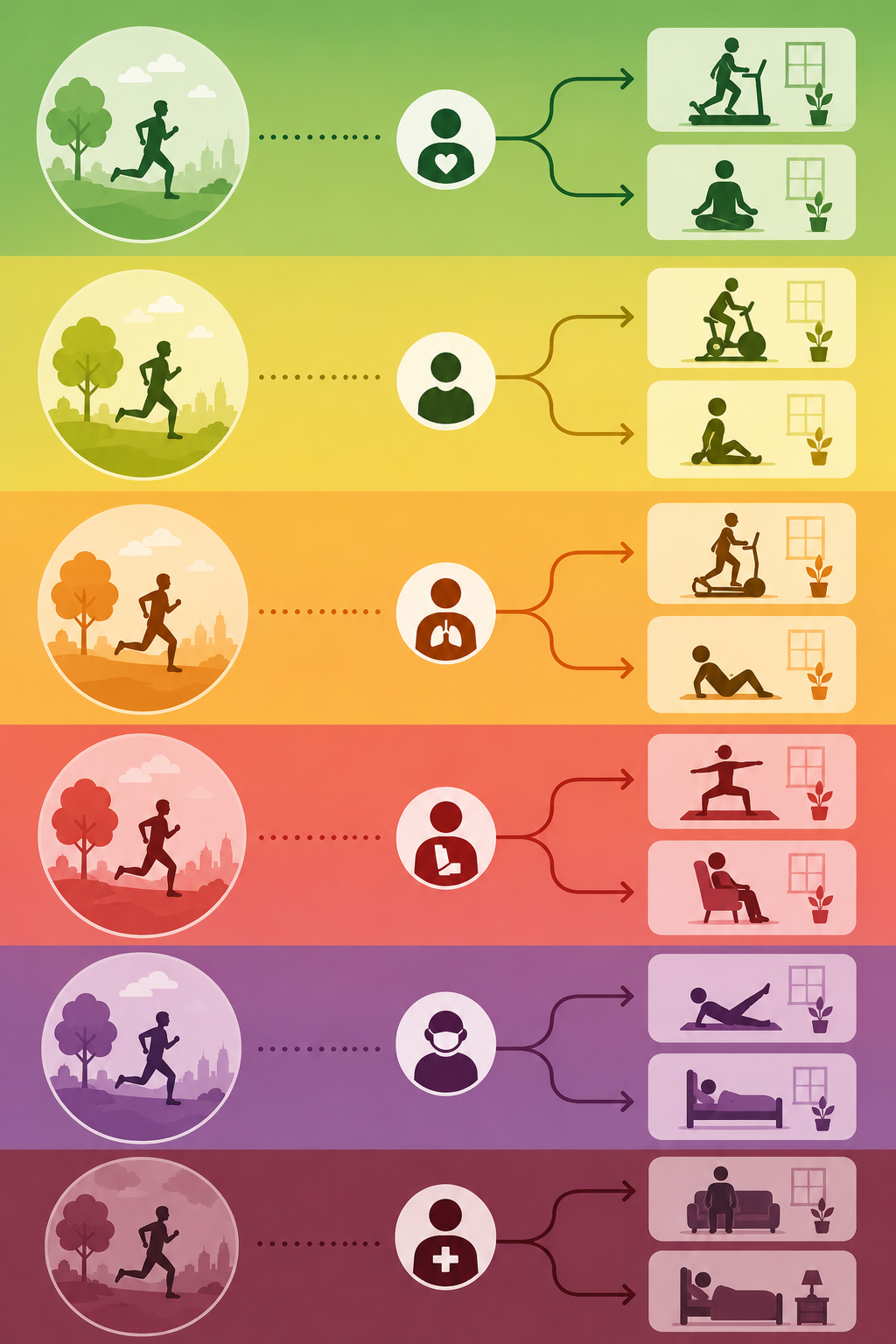
Sensitive groups include people with asthma, COPD or other lung disease, cardiovascular disease or elevated heart risk, older adults, children, and people who are pregnant. If that is you, orange is not a “maybe I can tough it out” signal. It is the point where the plan changes.
Why Exercise Makes The Same Air More Consequential
Sitting in smoky or polluted air is one exposure. Exercising in it is another. At rest, ventilation can be around 12 liters per minute; during exercise, it can rise to about 100 liters per minute, with substantial variation by fitness level and intensity. That means a workout can move far more air, and whatever is in that air, through your respiratory system in the same amount of clock time. [2]
The route changes too. As intensity rises, many people shift from mostly nasal breathing to more mouth breathing. The nose does some filtering and conditioning of inhaled air; mouth breathing bypasses more of that front-end filtration, allowing fine particles such as PM2.5 to travel deeper into the lungs and potentially into the bloodstream. [1][2]
That is why the workout decision is not just “Can I tolerate the smell?” or “Do I feel fine right now?” A steady easy walk, a tempo run, and a jump-squat circuit are not equal exposures when the air is poor. The harder session pulls in more air, encourages more mouth breathing, and leaves less margin if your airways are already irritated.
This is also why moving your workout into the living room is only the beginning. Walls reduce exposure, but they are not a sealed medical-grade filter. Without active filtration, indoor PM2.5 can reach 60-80% of outdoor concentrations, so a room can feel “inside” while still carrying much of the outdoor particle load. [3]
Make The Indoor Room Worth Moving Into
For AQI 151 and above, the useful question is not whether the workout is indoors. It is whether the indoor air has been given a chance to improve before you start breathing hard. A spare bedroom, living room, or small home-gym corner can work, but the setup has to happen before the warm-up.
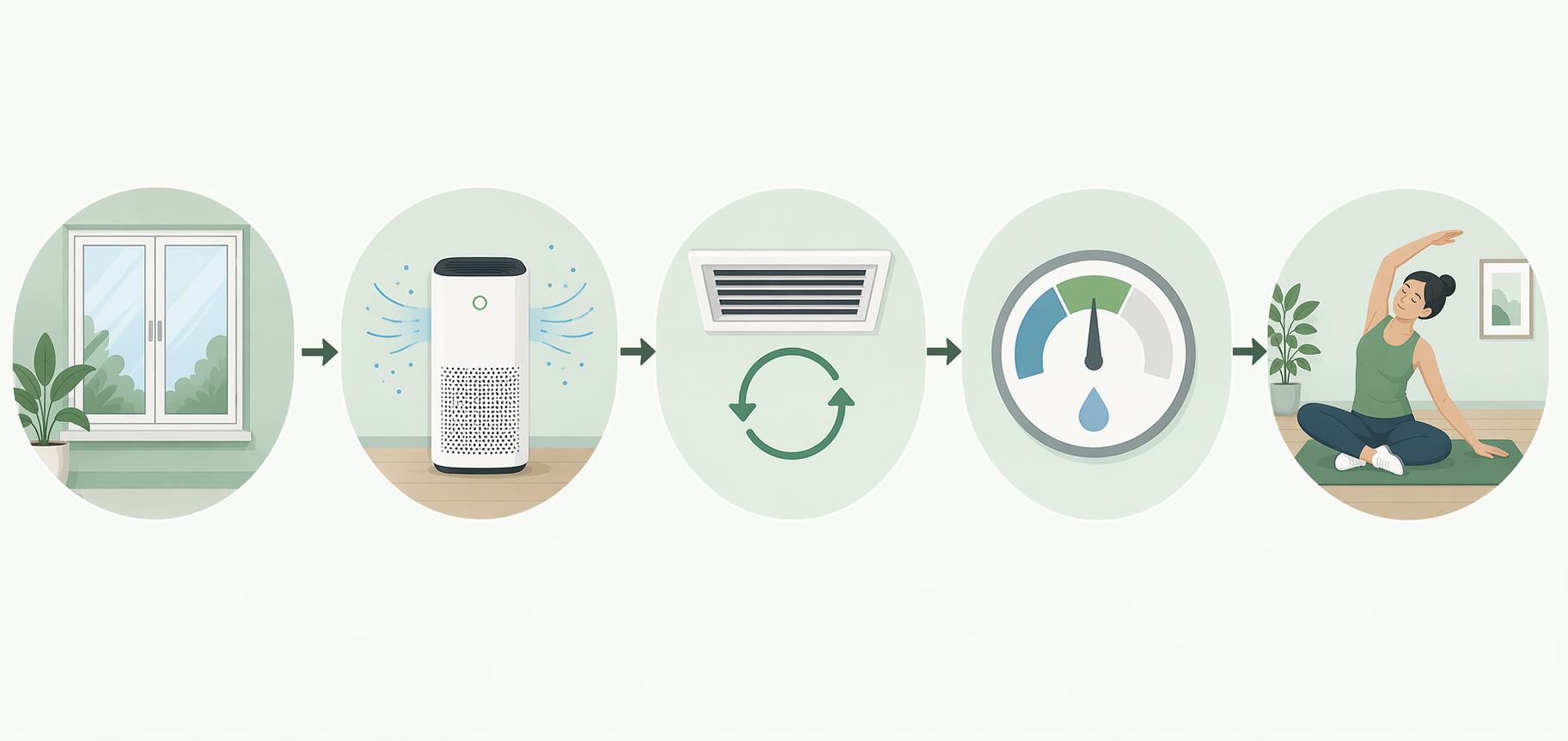
- Close the workout space. Shut windows and exterior doors. Skip the balcony, open garage, carport, or cracked-window room on poor-air days; those spaces often behave more like outdoor air with a roof.
- Filter before you train. If you use a portable HEPA purifier, choose one with a clean air delivery rate, or CADR, at least two-thirds of the room area, and run it for about 30 minutes before exercise when possible. HEPA filtration at that sizing can reduce indoor PM2.5 by 50-70% within 30-60 minutes. [3]
- Use HVAC recirculation if your system allows it. Recirculation reduces the amount of outdoor air pulled in while the system continues moving indoor air through the filter.
- Upgrade filtration if your HVAC system supports it. MERV-13 filters capture at least 75% of 1-3 micron particles and at least 90% of PM10, which is a meaningful step up from typical MERV-8 filtration; check system compatibility before installing a denser filter. [3]
- Keep humidity in the middle range. A relative humidity target of 40-60% supports respiratory mucosal function, while very dry air below 30% can increase airway irritation. [4]
- Watch CO2 if you measure it. Sustained CO2 above 1,500 ppm is a warning sign that ventilation is inadequate, which can compound indoor pollutant buildup during a workout. [4]
There is a tradeoff here: on smoky days you may want to limit outdoor-air intake, but during exercise you still produce heat, moisture, and CO2. That is why the best room is not simply the smallest room with the door shut. It is the room where you can filter air, avoid direct outdoor leakage, manage humidity, and stop if the space starts feeling stale or irritating.
If you do not own a purifier or your HVAC cannot handle better filtration, the decision becomes more conservative as the AQI rises. At orange, a lower-intensity indoor session may still make sense for many people. At red or purple, an uncontrolled indoor room is not automatically a safer training environment, especially for sensitive groups.
Choose The Workout After The Air Decision
Once you know the AQI tier and the room is prepared, match the workout to the risk. This is where many people accidentally overdo it: they move indoors, then try to replace a hard outdoor run with an equally breathless indoor interval session. The location changed, but the ventilation demand may not have.
| Situation today | Best workout choice | What to avoid |
|---|---|---|
| AQI 0-100 and no symptoms | Normal workout, indoors or outdoors | Ignoring new irritation just because the number is under 101 |
| AQI 101-150, sensitive group | Indoor low-impact strength, easy cycling if available, yoga, or mobility | Hard intervals, long outdoor sessions, exercising through wheeze or chest tightness |
| AQI 101-150, not sensitive | Shorter outdoor session or controlled indoor workout | Treating orange as a day for max-effort hill repeats |
| AQI 151-200 | Controlled indoor circuit, low-impact cardio, strength, or mobility | Outdoor exercise; high-breathing indoor workouts in an unfiltered room |
| AQI 201+ | Gentle indoor mobility or rest, depending on symptoms and indoor control | Trying to “make up” for lost outdoor training |
A No-Equipment Session For Red-Air Days
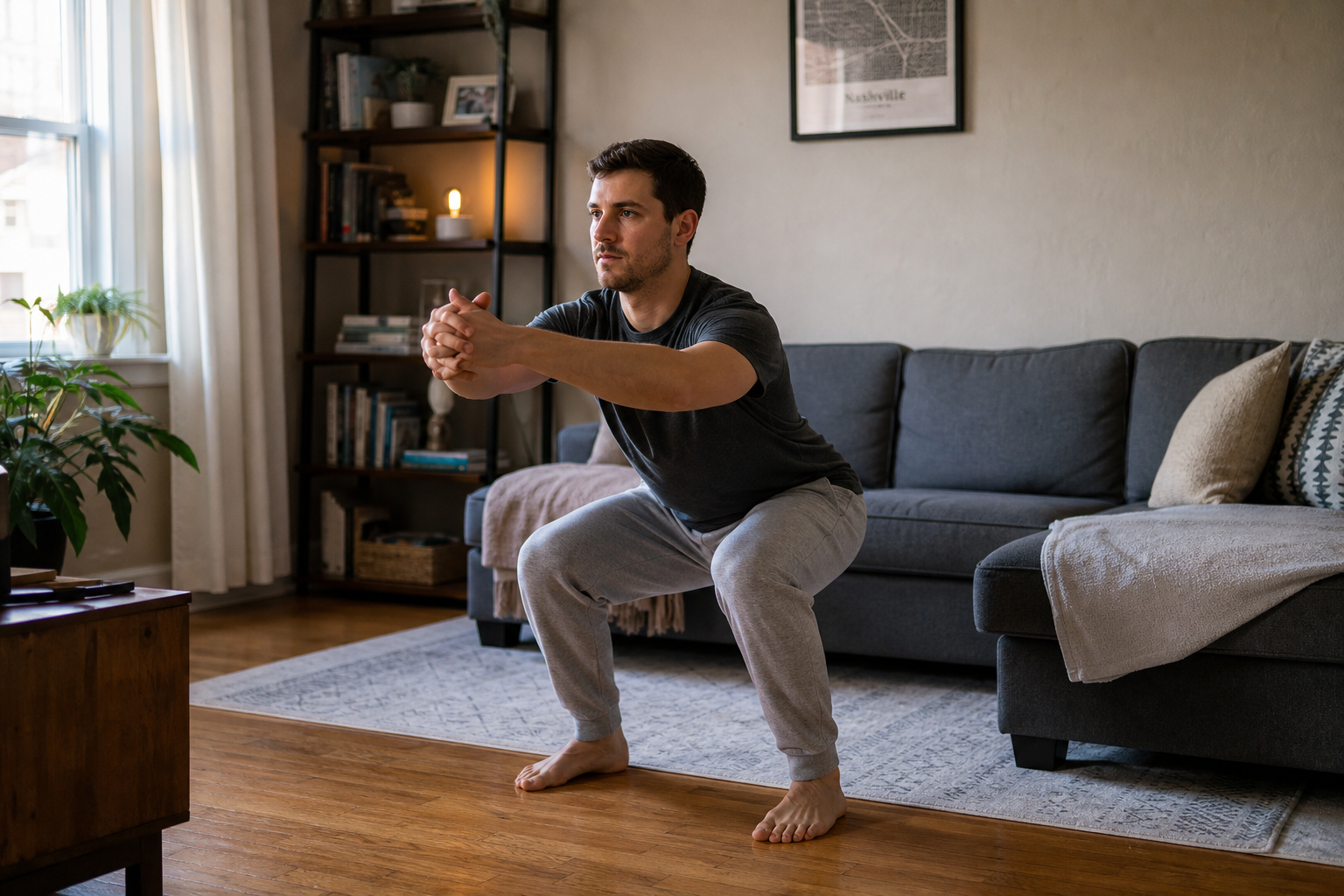
For red AQI days when your indoor space is reasonably controlled and you feel well, aim for a session that keeps breathing steady rather than frantic. Use a talk-test rule: you should be able to speak in short sentences without gasping. If that fails early, reduce the pace or switch to mobility.
- Warm up for 5 minutes with marching in place, shoulder rolls, hip circles, and easy bodyweight hinges.
- Do 2-4 rounds of 8-12 squats to a chair, 6-10 incline push-ups against a counter, 8-12 reverse lunges or step-backs, 20-30 seconds of dead bugs, and 20-30 seconds of side planks.
- Rest 45-90 seconds between moves if your breathing climbs too fast.
- Cool down with 5 minutes of slow walking, calf stretching, chest opening, and nasal breathing if comfortable.
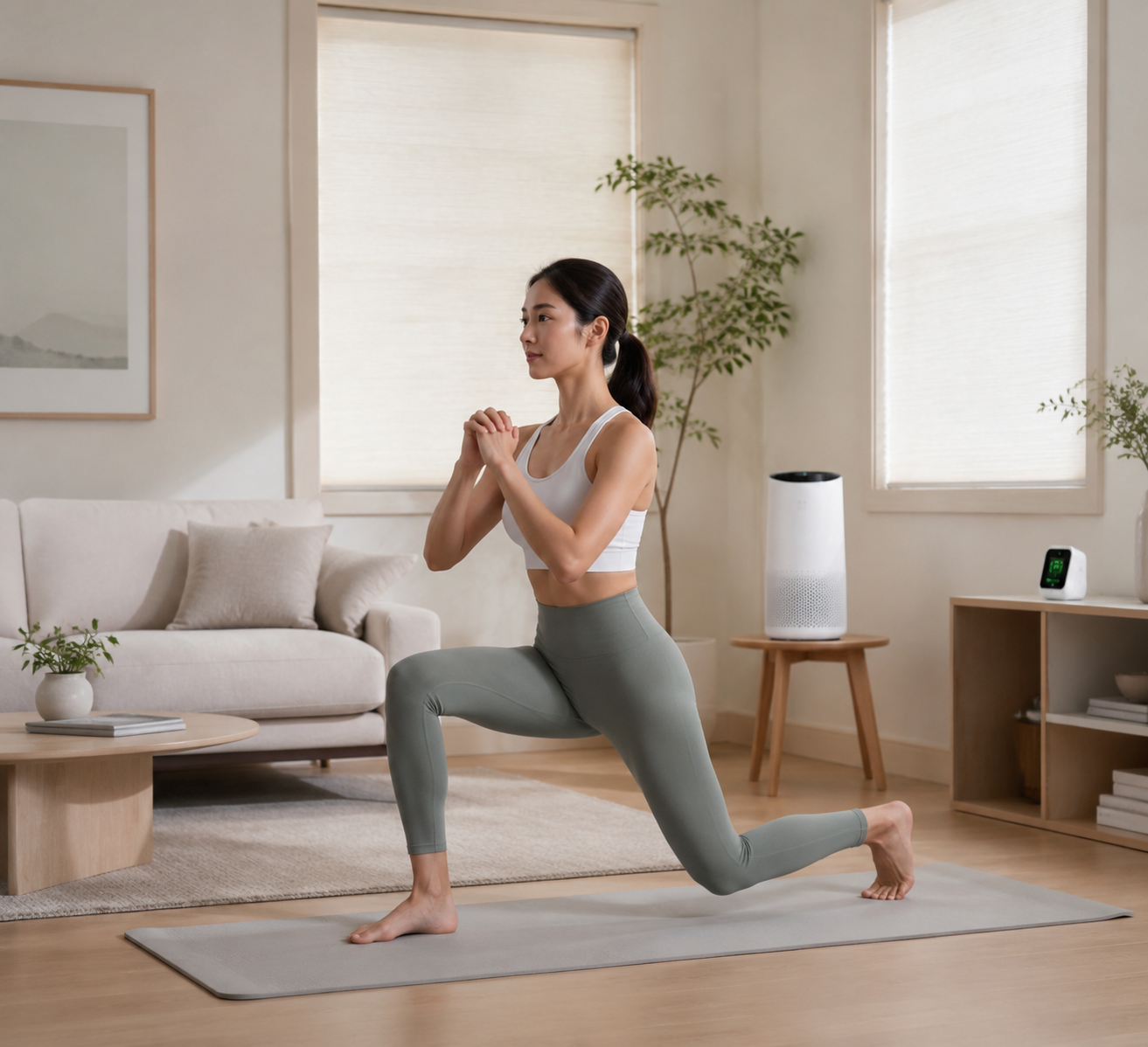
If you were supposed to run, this will not feel identical. That is fine. For a short poor-air stretch, the job is to preserve rhythm, strength, joint range, and enough cardiovascular stimulus to return to your usual routine without feeling like you stopped completely. A well-designed bodyweight plan can reasonably help maintain fitness for a couple of weeks, but that is a practical exercise-physiology judgment, not proof from trials that specifically tested indoor workouts during smoke or pollution events.
When The Better Workout Is Mobility
Mobility is not a consolation prize when the air is bad. It is the right choice when the room is only partly controlled, when you are in a sensitive group during red or purple conditions, or when your body feels irritated before you begin.
- Try 10-20 minutes of slow cat-cow, child’s pose breathing, hip flexor stretches, thoracic rotations, hamstring flossing, ankle mobility, and supported squats.
- Keep the pace low enough that breathing stays comfortable through the nose or through relaxed mixed breathing.
- Skip heated yoga, breathwork that deliberately increases ventilation, and long holds that make you lightheaded.
Symptoms That Override The Plan
AQI charts help you decide before the workout. Symptoms decide during it. Stop exercising and rest if you notice wheezing, chest tightness, persistent coughing, unusual shortness of breath, dizziness, headache, or symptoms that continue after you stop. Exercise physiology guidance during poor-air events emphasizes reducing intensity and monitoring symptoms rather than pushing through irritation. [5][6]
If you have asthma, heart disease, pregnancy-related risk, or another medical condition that makes air quality more consequential, use your clinician’s action plan over any generic workout advice. Rescue inhalers, medication timing, and personal exposure limits are not places for internet-level improvising.
A Simple Order For Today
- Check the AQI where you actually plan to exercise, not just the nearest big-city reading.
- Identify your tier: 0-100, 101-150, 151-200, 201-300, or 301+.
- Decide whether you are in a sensitive group today, including temporary factors such as respiratory illness or pregnancy.
- If moving indoors, close the room, filter before training, use recirculation if available, manage humidity, and avoid semi-outdoor spaces.
- Choose intensity last: normal, shortened, easy indoor strength, mobility, or rest.
- Stop if symptoms show up, even if the AQI app made the plan look acceptable.
Most steady exercisers can keep moving through a poor-air stretch, including a run of days when outdoor training is off the table. The point is not to pretend indoor air erases the problem. It is to make the decision narrow enough to act on: read the AQI, respect your risk category, prepare the room, lower the breathing demand when needed, and take the rest day when the air or your body is giving you a clear no.
References
- Four Things to Know about Air Quality and Exercising Outdoors, American Lung Association
- The AQI Dilemma: Is it Safe to Exercise?, GU Energy Labs
- Is It Safe to Exercise Outside When Air Quality Is Bad?, Filterbuy
- Importance of Air Quality in Gyms, Atmotube
- Tips from an exercise physiologist on how to stay fit safely when air quality is poor, University of Toronto
- Exercising in bad air quality can lead to negative health effects, CBS News
Comments
Join the discussion with an anonymous comment.