
The main trick in how to avoid bears while running outdoors is accepting that a runner does not move through bear country like a hiker. Hikers talk, shuffle, stop, adjust packs, and generally announce themselves. Runners can be softer than they realize: light shoes, steady breathing, quick turns through brush, a watch route on the wrist, maybe one earbud in. That speed and quietness shrink the time a bear has to understand what is coming.
That does not make trail running reckless. It does mean the usual “make noise” advice needs to become more specific. Dr. Tom Smith, a bear-conflict researcher, has said bears tend to ignore jingling bells but respond to the human voice and sharper sounds; in one Katmai experiment reported by Backpacker, 15 bears ignored bells while reacting to a pencil snap.[1][2] For runners, that changes the habit immediately: do not outsource awareness to a bell. Use your voice before the blind corner, the creek crossing, the windy ridge, and the berry-choked stretch where visibility drops.
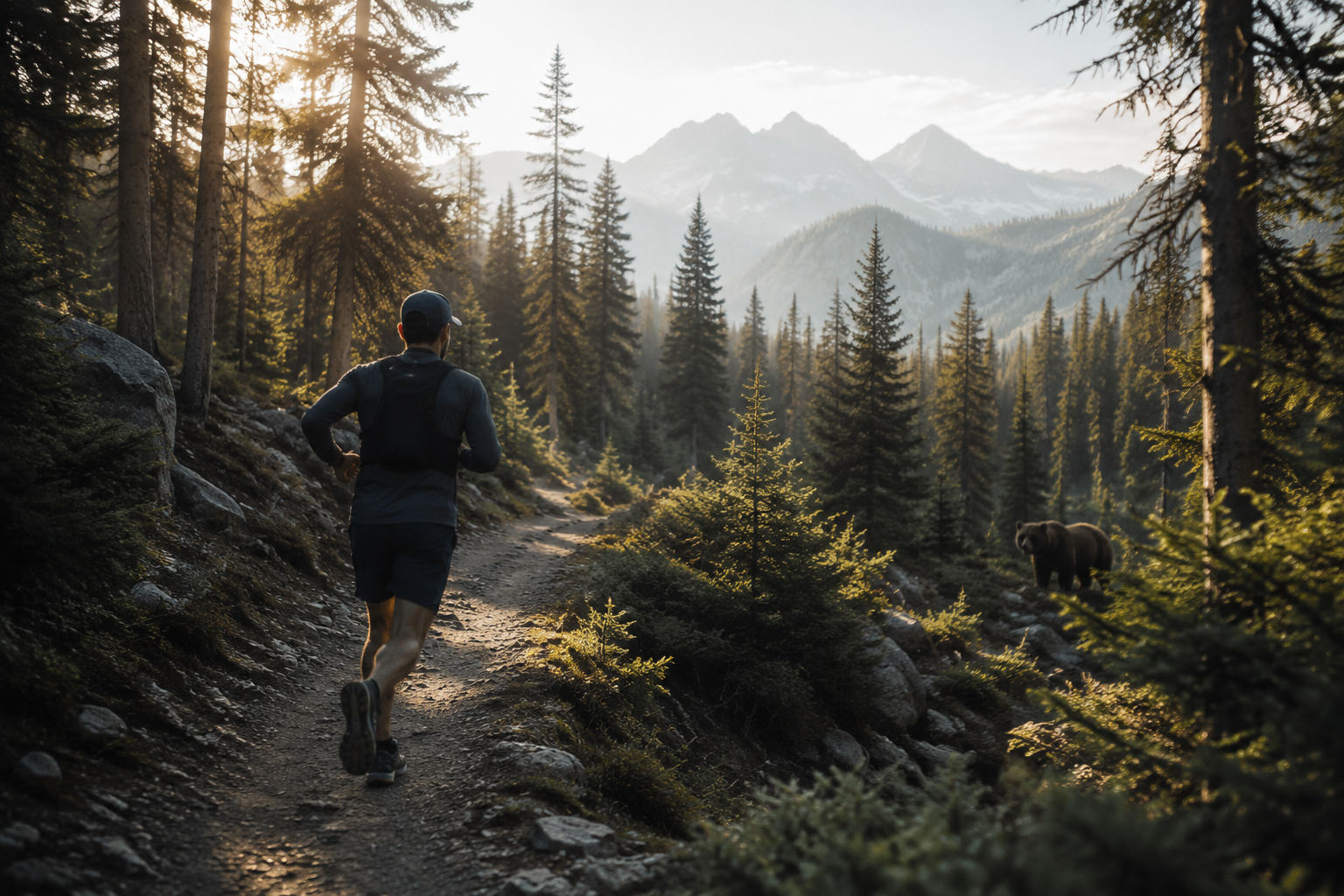
The numbers are worth keeping in proportion. The National Park Service puts the odds of being injured by a bear at about 1 in 2.1 million, and BearVault summarizes global bear attacks at about 40 per year, with roughly 10 fatal.[3][4] The North American Bear Center says black bears kill fewer than one person per year across North America despite an estimated population around 750,000.[5] Those numbers are reassuring, but they are not a permission slip to run the same way everywhere. A dawn solo run in dense grizzly habitat is not the same risk as a midday run through mostly black-bear country.
Before the run, remove the surprise
Most bear avoidance happens before the first mile. The goal is not to turn a run into a backpacking trip. It is to make a few choices that reduce the chance of suddenly appearing inside a bear’s comfort zone.
- Run in daylight when possible, especially in areas with recent bear activity or poor visibility.
- Check local trail notices, park alerts, and recent reports before choosing a route.
- Run with another person or a group when you can; Smith has noted no documented attacks on groups that stood their ground together, as summarized in Runner’s World.[6]
- Skip headphones in high-risk stretches, or at least leave your hearing fully available where water, wind, brush, or curves already reduce awareness.
- If you carry bear spray, place it where your hand can reach it fast, not buried in the rear pocket of a vest.
Runner-specific sources make the same point in practical terms: speed is useful for training, not for surprising wildlife. iRunFar’s trail-runner guide and Trail Runner Magazine’s bear-safety tips both emphasize noise, awareness, group travel where possible, and carrying deterrent accessibly rather than treating bear country like an ordinary fitness route.[7][8]
A GPS watch can help you stay on the intended route, but it does not replace attention to the country around you. If you already use a watch for pacing or navigation, treat it as background support. The important bear-safety signal is still what you can see, hear, and announce in real time. For broader gear planning, FitAtHome’s guides to GPS watch accuracy and smart watch buying are useful for route and tracking features, but the watch is not the thing that keeps a bear from being surprised.
Make noise like a runner, not like a souvenir shop
A bell is easy because it asks nothing from you. That is also the problem. It becomes background sound, and the best evidence in the brief does not support relying on it. A human voice is different. It signals presence, direction, and size more clearly than a faint jingle on a moving vest.
You do not need to yell through an entire run. Use noise where it matters: before blind corners, when entering dense vegetation, near rushing water, when wind covers your footfall, and on trails with fresh scat, carcass signs, berries, or limited sightlines. A simple “hey bear” or “coming through” before the turn is better than appearing silently at running speed.
Slow down when the trail stops giving you information. If you cannot see around the bend, through the alder, or beyond the creek noise, the bear cannot read you much better than you can read it. Taking a few seconds off pace there is not fear. It is just good trail sense.
| Situation | Runner adjustment |
|---|---|
| Blind corner or rolling terrain | Call out before the turn and ease off the pace until sightlines open. |
| Dense brush, berry patches, or loud water | Use your voice more often because your footfall is easy to miss. |
| Wind, rain, or group chatter behind you | Assume sound is distorted and make clearer voice-based noise. |
| Solo run at dawn or dusk | Consider a different time, a partner, or a more open route. |
| Recent bear notice or fresh sign | Change route if practical; if not, increase spacing, voice noise, and readiness. |
The myths can be dealt with quickly. Bells do not solve the runner problem. Running away is a bad plan because bears can sprint about 35 mph, a speed cited by agencies including IGBC, NPS, and Montana Fish, Wildlife & Parks.[3][9] Climbing a tree is not a reliable escape; the National Park Service warns that both black bears and grizzlies can climb trees.[3] And color alone is not species identification, because black bears can be brown, cinnamon, or blonde.[9]
Bear spray helps only if your hand can get to it
Bear spray deserves a place in this conversation, especially in grizzly country, but runners have a different carry problem than hikers. A hiker may keep spray on a belt or pack strap. A runner often has a bouncing vest, soft flasks, poles, snacks, a phone, and not much patience for gear that rubs. If the canister ends up zipped behind your ribs, you are carrying reassurance more than a tool.
The effectiveness data are strong. Outside Online summarizes Smith et al.’s 2008 bear-spray study as finding spray effective in 90% of black bear incidents, 92% of brown bear incidents, and 100% of polar bear incidents, with 98% of people using bear spray escaping injury.[10] That does not mean spray is magic. It means that when a bear is close enough and the person can deploy it correctly, spray has performed very well in documented incidents.
For runners, the carry method is part of the safety system. Runner-specific gear discussions from Counter Assault point toward belt and running-vest configurations meant to keep spray accessible while moving.[11] Whatever brand or setup you choose, test it at jogging pace. Can you reach it with either hand? Does it bounce until you bury it somewhere less useful? Can you remove it without looking? Those questions matter more than whether the product looked tidy on a gear wall.
At first sighting, stop being a runner
Seeing a bear is not the same as being attacked. The first job is to stop feeding the situation with speed. Do not run. Do not turn it into a chase. Speak calmly, make yourself identifiable as human, and back away when you can do so without tripping or moving toward the bear. The National Park Service and IGBC both emphasize staying calm, avoiding sudden flight, and giving the bear space.[3][9]
If the bear has not noticed you, leave quietly and give it room. If it has noticed you but is not approaching, back away while talking in a calm, low voice. If cubs, food, or a carcass may be involved, assume the bear’s tolerance for surprise is lower. The trail, the segment, and the workout are no longer the priority.
This is also where group running pays off. People standing together look and sound different from one startled person moving fast. If you are with others, gather up, speak calmly, and avoid scattering. The moment to sort out everyone’s pace plan has passed.
Identify the bear if you can, but do not pretend it is always easy
The shoulder hump is the field mark runners should know. Grizzlies have a prominent muscular hump above the shoulders; black bears do not. That cue is more useful than color, because black bears are not always black. IGBC, NPS, and iRunFar all point runners and backcountry travelers toward body shape rather than coat color when distinguishing species.[3][7][9]
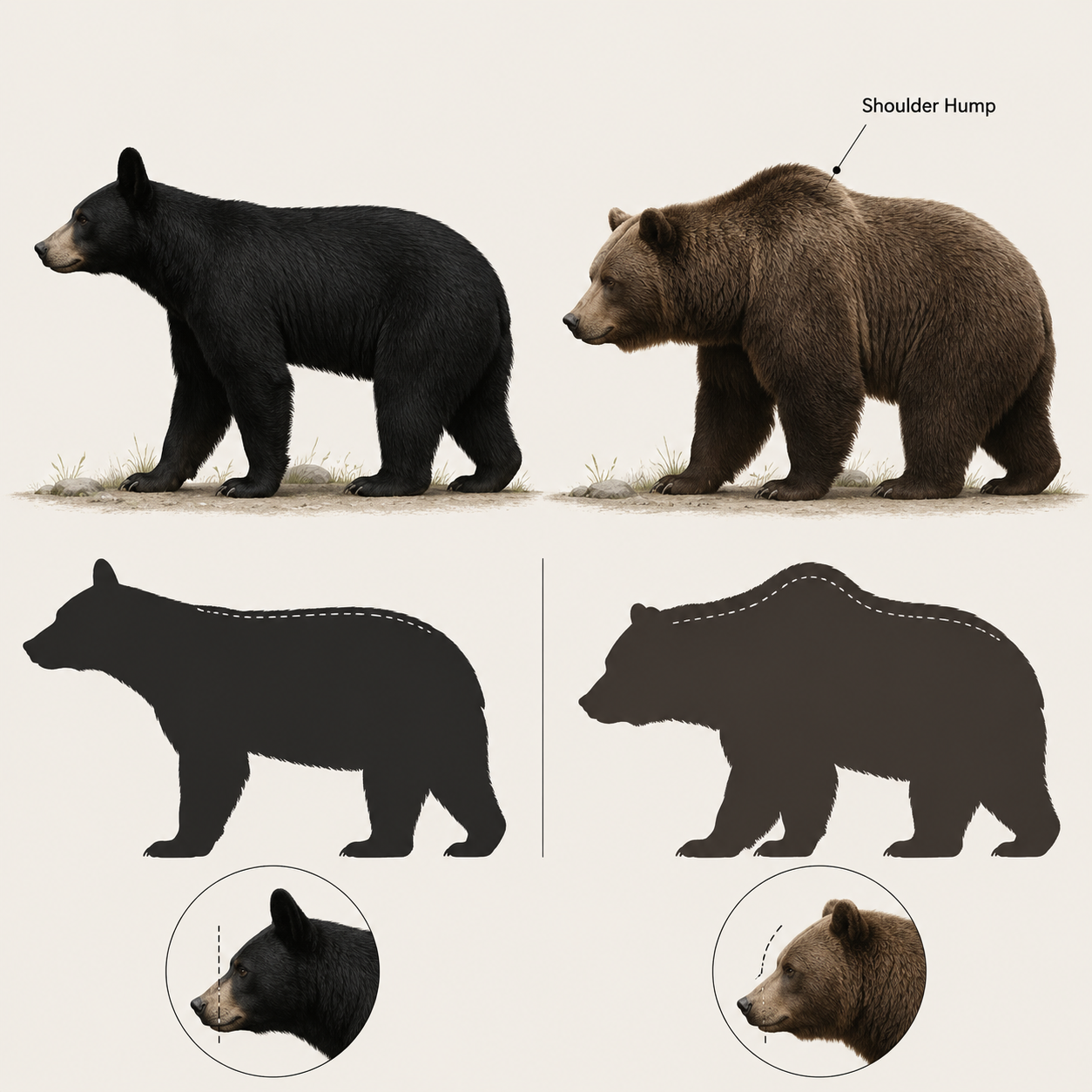
In a clean illustration, this is obvious. On a real trail, it may not be. The bear may be quartering away, partly hidden, backlit, or already too close for a calm biology quiz. Use the hump if you can see it. Notice the face profile and ear shape if you have time. But admit when you are uncertain.
| Field cue | Black bear | Grizzly bear |
|---|---|---|
| Shoulder shape | No prominent shoulder hump | Prominent shoulder hump above front legs |
| Color | Can be black, brown, cinnamon, or blonde | Often brownish, but color alone is not reliable |
| General danger comparison | Usually less dangerous to people | North American Bear Center describes grizzlies as over 20 times more dangerous than black bears |
That last comparison matters for response, not for panic. The point is not to rank bears for drama. It is to know that black bear and grizzly attack protocols are not the same.[5]
The response protocol when distance collapses
A close encounter is where generic advice can become dangerous if it gets too cute. The familiar rhyme — “if it’s brown, lie down; if it’s black, fight back” — points in the right direction for common defensive scenarios, but it is not complete enough to be your only plan. Behavior and context still matter.
- If the bear is present but not attacking: do not run; speak calmly; back away; give it an exit.
- If a bear approaches within spray range and you have spray accessible: deploy it according to the canister instructions and current conditions.
- If a black bear attacks: fight back aggressively, aiming to convince the bear you are not prey.
- If a grizzly attacks defensively: play dead, protect your neck and head, and remain still until the bear leaves.
- If any bear appears to be treating you as prey rather than reacting defensively: fight back rather than remaining passive.
- If you cannot identify the species: use spray if possible, do not run, and make your next choice from the bear’s behavior and the most likely species in that region.
NPS and IGBC guidance supports the core split: fight back during a black bear attack; play dead during a defensive grizzly attack; fight back if the attack becomes predatory.[3][9] The nuance matters because the wrong instinct can be costly. A runner’s strongest instinct may be movement. In this situation, movement is exactly what needs to be controlled.
Playing dead in a defensive grizzly attack means going to the ground on your stomach if possible, clasping your hands behind your neck, spreading your legs to make it harder to roll you, and staying still. Fighting back against a black bear means using whatever you have — poles, rocks, fists, feet, a bottle, a vest buckle — while directing force toward the bear’s face and muzzle. These are ugly instructions to read in a running article, but it is better to decide them here than while scared, winded, and trying to remember a rhyme.
A runner’s practical decision flow
| Moment | Best action |
|---|---|
| Planning the run | Choose daylight, check local bear activity, consider a partner, and decide whether bear spray belongs on this route. |
| Starting the trail | Keep hearing available and place spray where it can be reached quickly. |
| Low visibility | Slow slightly and use voice-based noise before bends, brush, water, and wind. |
| Bear at a distance | Stop running, speak calmly, back away, and give the bear space. |
| Close approach | Prepare spray if carried; do not run; stay grouped if with others. |
| Attack | Fight back against a black bear; play dead in a defensive grizzly attack; fight back in predatory behavior. |
The point is not to make every trail run feel loaded with danger. It is to replace hiker-default habits with runner-specific ones. Voice before blind corners. Daylight when the route is known for bear movement. No headphones where your hearing matters. Spray that your hand can actually reach. A clear mental split between black bear and grizzly response before adrenaline makes the choice for you.
Trail running in bear country asks for more attention than a road loop, but not for paranoia. Keep the run. Change the parts of the run that make you arrive too fast and too quietly.
References
- One of the Foremost Experts in Human-Bear Conflict Explains Bear Safety, The Trek
- Do Bear Bells Really Work?, Backpacker, 2024
- Bear Safety, National Park Service
- Bear Attack Statistics, BearVault
- How Dangerous Are Black Bears?, North American Bear Center
- A Runner’s Guide to Animal Encounters, Runner’s World
- Running With The Bears: A Guide For Trail Runners, iRunFar
- 6 Bear Safety Tips for Trail Runners, Trail Runner Magazine
- Be Bear Aware: Encounter, Interagency Grizzly Bear Committee
- Does Bear Spray Work?, Outside Online
- Runner Safety Gear, Counter Assault


Comments
Join the discussion with an anonymous comment.