The best water sports for fitness are not interchangeable. If your priority is maximum calorie burn, start with rowing, vigorous swimming, water polo, or deep water running. If you need joint-friendly training that still supports weight management, water aerobics deserves a real look. If you want core and balance, stand-up paddleboarding is the clearest match. If you want full-body conditioning that can be adjusted from easy aerobic work to hard intervals, swimming is the most flexible choice.
| Primary fitness goal | Best water sport to consider first | Why it fits |
|---|---|---|
| Highest calorie burn | Rowing, vigorous swimming, water polo, deep water running | These sit at the demanding end of available calorie estimates, though figures come from different methods rather than head-to-head testing. |
| Full-body conditioning | Swimming | Different strokes shift the load across shoulders, chest, back, core, hips, and legs. |
| Low-impact recovery or weight management support | Water aerobics | Chest-deep movement reduces joint loading while still adding resistance. |
| Core and balance | Stand-up paddleboarding | Staying upright on an unstable surface keeps the trunk and hips working. |
| Cardio variety without home equipment | Swimming, deep water running, kayaking, rowing | These give you sustained aerobic work without another treadmill, bike, or compact machine. |
Why Water Training Feels Different From Land Training
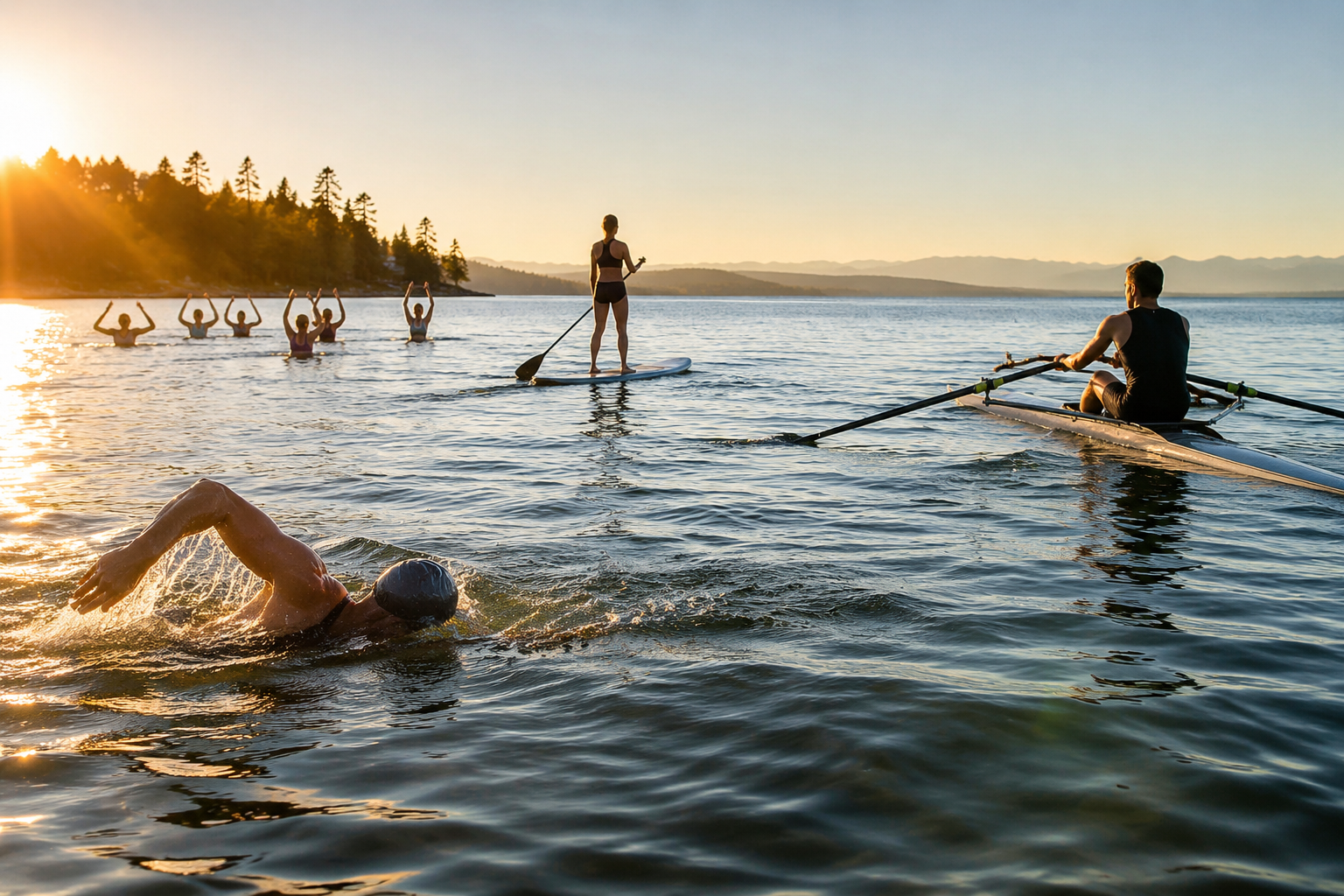
Water changes the training equation before you choose a sport. Harvard Health describes water as providing 12% to 14% more resistance than air, which is why even simple pool movements can feel like a cardio session and a light resistance workout at the same time.[1]
That resistance is not automatically the same as heavy strength training. It depends on how fast you move, how much surface area you push through the water, and whether the activity asks you to stabilize, pull, kick, rotate, or brace. A slow breaststroke, a hard rowing interval, and a chest-deep water aerobics class all use the same medium, but they do not train the same outcome.
The other big difference is loading. In chest-deep water, Harvard Health notes that water can remove about 90% of body weight from the joints; when fully submerged, the unloading can be even greater.[2] That is the reason water workouts keep showing up in recovery conversations. The point is not that water is magically easy. It is that it lets many people work harder than their knees, hips, feet, or back would tolerate on land.
For Calorie Burn and Cardio: Rowing Has the Highest Ceiling, but Technique Matters
If the main goal is energy expenditure, rowing belongs near the top of the list. The available estimates in the research brief put rowing at roughly 981 to 1,117 calories per hour, ahead of vigorous butterfly or freestyle swimming at about 899 to 1,024 calories per hour, water polo at about 660 to 840 calories per hour, and deep water running at about 654 to 745 calories per hour.[3]
Those numbers are useful for sorting activities, not for predicting your exact workout. Calorie databases and sport-specific estimates usually differ in body weight assumptions, intensity definitions, and measurement methods. A clean one-hour comparison between all these water sports does not exist in the material here, so it is better to read the ranges as a hierarchy of demand rather than a guaranteed burn rate.
| Water sport | Estimated calorie range | What drives the demand |
|---|---|---|
| Rowing | About 981-1,117 cal/hr | Large muscle involvement from legs, hips, trunk, back, and arms, especially at hard effort |
| Vigorous butterfly or freestyle swimming | About 899-1,024 cal/hr | Continuous kicking, pulling, breathing control, and high technical demand |
| Water polo | About 660-840 cal/hr | Treading, sprinting, changing direction, and repeated upper-body efforts |
| Deep water running | About 654-745 cal/hr | Running mechanics without ground contact, sustained by hip flexors, glutes, core, and arms |
Rowing earns its high ceiling because it is not just an arm pull. A strong stroke starts with the legs, transfers through the hips and trunk, and finishes through the back and arms. Done well, it is a full-body cardio effort. Done poorly, it can become a low-back tug-of-war. That makes rowing a good choice for fit people who want a hard conditioning tool, but not automatically the first choice for someone who has never learned the stroke or who already knows their back dislikes hinging under fatigue.
Vigorous swimming can be just as serious, especially with butterfly or fast freestyle. The catch is skill. A technically efficient swimmer can hold hard intervals and get a large aerobic return. A beginner may stop because breathing, body position, or shoulder fatigue breaks down before the heart and lungs get the intended stimulus. That does not make swimming worse; it means the first few weeks may be about technique and repeatability rather than chasing the top end of a calorie chart.
Water polo and deep water running are demanding in different ways. Water polo piles on accelerations, treading, contact, and overhead movement, so it is intense but not always easy to access as a routine adult workout. Deep water running is more controlled: you use a flotation belt or deep-water position and mimic running without impact. For runners who need a break from pounding, it is one of the cleaner substitutes because the movement pattern stays familiar while the joints get relief.
For Full-Body Conditioning: Swimming Is the Most Flexible Choice
Swimming is the easiest water sport to recommend when the goal is broad conditioning rather than one narrow metric. It can be aerobic, interval-based, technique-focused, gentle, or brutally hard. It also lets you change the muscular emphasis without changing venues.
- Freestyle tends to emphasize the shoulders, chest, lats, trunk rotation, and flutter kick.
- Butterfly shifts more stress to the back, shoulders, core, hips, and timing of the kick.
- Breaststroke brings in the chest, triceps, inner thighs, hips, and adductors more noticeably.
- Backstroke can be useful for people who want swimming volume without face-down breathing the whole session.
The practical advantage is progression. A beginner can start with easy laps, rest at the wall, use drills, or alternate strokes. A stronger swimmer can use timed intervals, pull buoys, kick sets, or mixed-stroke sessions. The same pool can support recovery work on Monday and a hard conditioning session later in the week.
Swimming does have one important blind spot: it is non-weight-bearing. That is part of why it is kind to joints, but it also means it should not be your only plan if bone-density support is a priority. Harvard Health advises pairing water exercise with weight-bearing exercise such as walking or strength training two to three days per week to help maintain bone strength.[2]
For Low-Impact Recovery and Weight Management: Water Aerobics Is Underrated
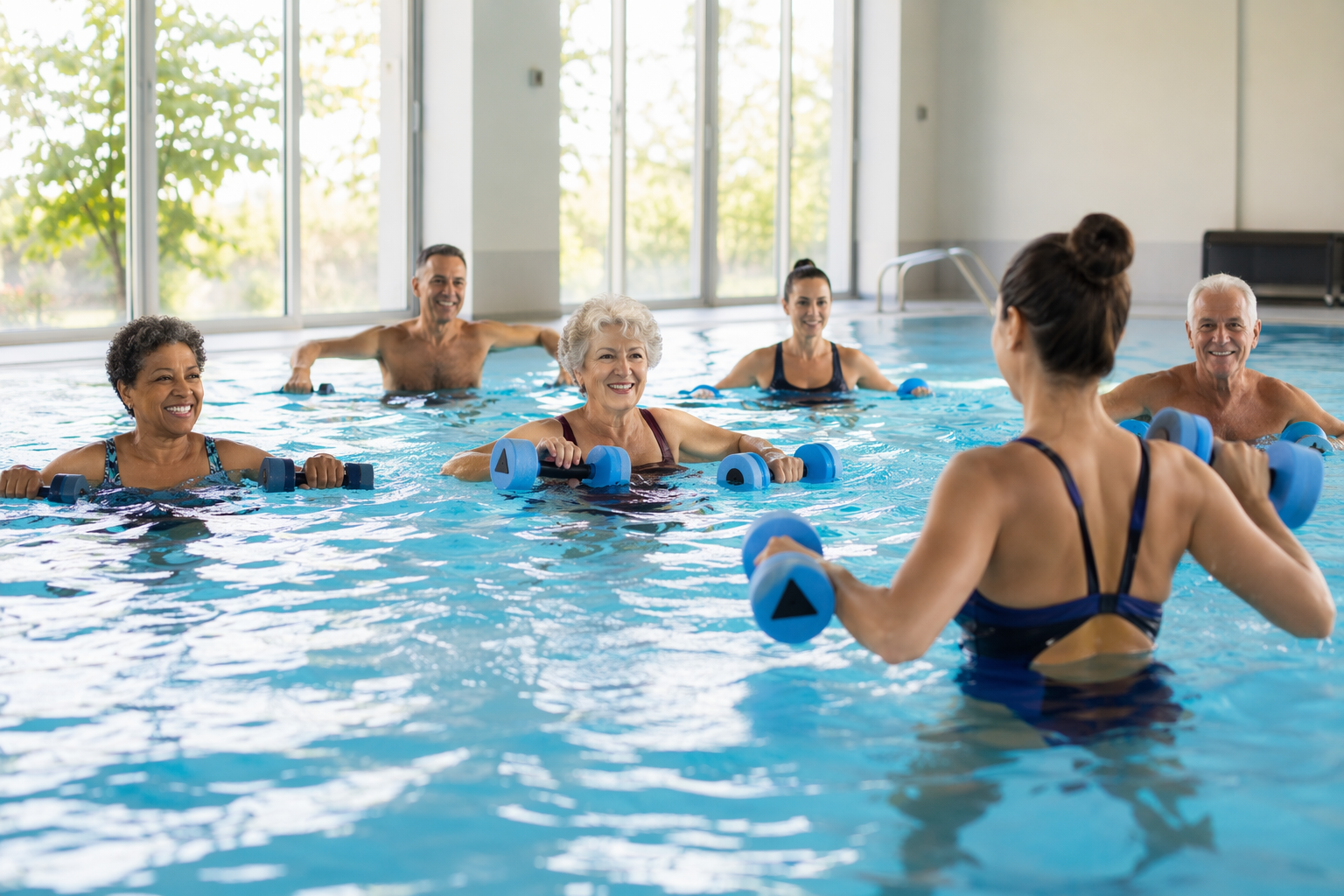
Water aerobics gets dismissed too easily, usually by people who have never had to rebuild fitness around sore knees, a cranky back, or a body that objects to jumping. Chest-deep exercise can remove enough loading to make squats, marching, side steps, kicks, arm work, and intervals possible again. That matters more than whether the workout looks impressive from the pool deck.
The strongest peer-reviewed result in the research brief comes from a BMJ Open analysis reported by BMJ Group in March 2025: water aerobics programs lasting more than 10 weeks were associated with reductions of about 3 kg in body weight and about 3 cm in waist circumference, with the strongest effects seen in women and adults aged 45 and older.[4]
That finding deserves attention because it supports water aerobics as more than a gentle movement class. It can be a legitimate weight-management and conditioning option when repeated long enough. The length matters. A single class may feel good, but the reported changes came from programs running beyond 10 weeks, which is closer to a training habit than a novelty workout.[4]
The caveats matter too. BMJ Group noted that evidence for BMI and body fat percentage changes was lower quality, and most participants in the analysis were women, which limits how confidently the results can be generalized to men.[4] The clean conclusion is narrower but still useful: water aerobics appears especially promising for women and adults over 45 who need a joint-friendly way to train consistently, with moderate-certainty evidence for body weight and waist changes.
For someone coming from home workouts, the real value is not that water aerobics beats every land routine. It is that it can keep training on the calendar when lunges, running, plyometrics, or long treadmill sessions are off the table. If the choice is between a tolerable pool session three times per week and a theoretically superior workout you skip because your joints hate it, the pool session wins in practice.
For Core and Balance: Stand-Up Paddleboarding Has a Clear Job
Stand-up paddleboarding is not the best pick if your only goal is maximum calorie burn, and it should not be sold as a complete strength program. Its best fitness argument is narrower and stronger: it trains balance, core control, hip stability, and postural endurance while still giving you moderate aerobic work.
The board makes the exercise. Every small shift under your feet asks the ankles, hips, trunk, and shoulders to organize the next paddle stroke. Calm water makes SUP approachable. Wind, chop, turns, and longer paddles make it more demanding. That progression is useful because the sport can stay interesting without requiring a heavier weight, a steeper hill, or another piece of home equipment.
SUP is a good match if your usual workouts are strong in straight-line cardio but weak in balance. It pairs well with strength training, walking, or cycling because it fills a different gap. It is less ideal as the only workout for someone chasing high-intensity conditioning or measurable strength progression.
Where Kayaking Fits
Kayaking sits in the middle of the fitness conversation. It can be excellent aerobic work if you paddle continuously, and it gives the shoulders, upper back, arms, trunk, and grip a lot to do. It is also seated, which lowers the balance demand compared with SUP and changes the muscular emphasis away from the legs.
That makes kayaking a good choice for outdoor variety and upper-body endurance, especially for someone bored with indoor cardio machines. It is not the first choice for full-body strength, lower-body conditioning, or the highest calorie ceiling. It works best when you want sustained movement, scenery, and a reason to keep going longer than you would on a machine at home.
How to Choose Without Overthinking It
Start with the result you need most, not the sport that sounds most complete. If you need a hard calorie-burning session and have access to coaching or good technique, rowing and vigorous swimming should be high on the list. If you need cardio without land impact, deep water running or swimming is easier to justify than another sore-knee jog. If you need consistency while managing joint discomfort, water aerobics is not a compromise; it may be the activity that lets the training happen.
- Choose rowing if you want the highest conditioning ceiling and can learn the stroke well enough to protect your back.
- Choose swimming if you want the most adjustable full-body water workout and are willing to build technique.
- Choose water aerobics if joint tolerance, recovery, or repeatable weight-management support is the main problem to solve.
- Choose stand-up paddleboarding if core control, balance, and outdoor variety matter more than maximal intensity.
- Choose kayaking if you want steady outdoor cardio with an upper-body endurance bias.
A water-resistant fitness tracker can help with heart-rate trends and session consistency, but treat calorie readouts as estimates. The same caution applies to published calorie ranges: useful for comparison, too rough for exact accounting. The better test is whether the activity gives you the training effect you wanted and whether you can repeat it without paying for it in joint pain.
The final rule is simple enough: match the sport to the constraint. Use rowing, hard swimming, water polo, or deep water running when intensity is the priority. Use water aerobics when joint-friendly consistency matters most. Use SUP when balance and core control are the missing pieces. Use swimming when you want the broadest conditioning option, then add walking or strength training if you need weight-bearing work for bones.
References
- Advantages of water-based exercise, Harvard Health
- Exercising in water: Big heart benefits and little downside, Harvard Health
- Calories burned in 30 minutes for people of three different weights, Harvard Health
- Water aerobics for more than 10 weeks can trim waist size and aid weight loss, BMJ Group, March 2025
Comments
Join the discussion with an anonymous comment.