If you are searching for a no-equipment strength workout, the real question is probably not whether you can get sweaty in your living room. That part is easy. The harder question is whether the work counts as strength training in the measurable sense: stronger legs, stronger pressing, better control, more muscle doing the job.
For beginners, the answer is yes—with one important condition. Bodyweight training has to progress. Repeating the same easy squats and push-ups forever is not a hidden shortcut. But if the exercises become gradually harder, the first several weeks of no-equipment training can produce real strength gains, not just a feeling of having moved around.
The cleanest comparison: bodyweight squats vs. barbell squats
A useful study has to do more than say bodyweight exercise is “good for you.” The more useful question is what happens when bodyweight training is put beside loaded training and both are taken seriously.
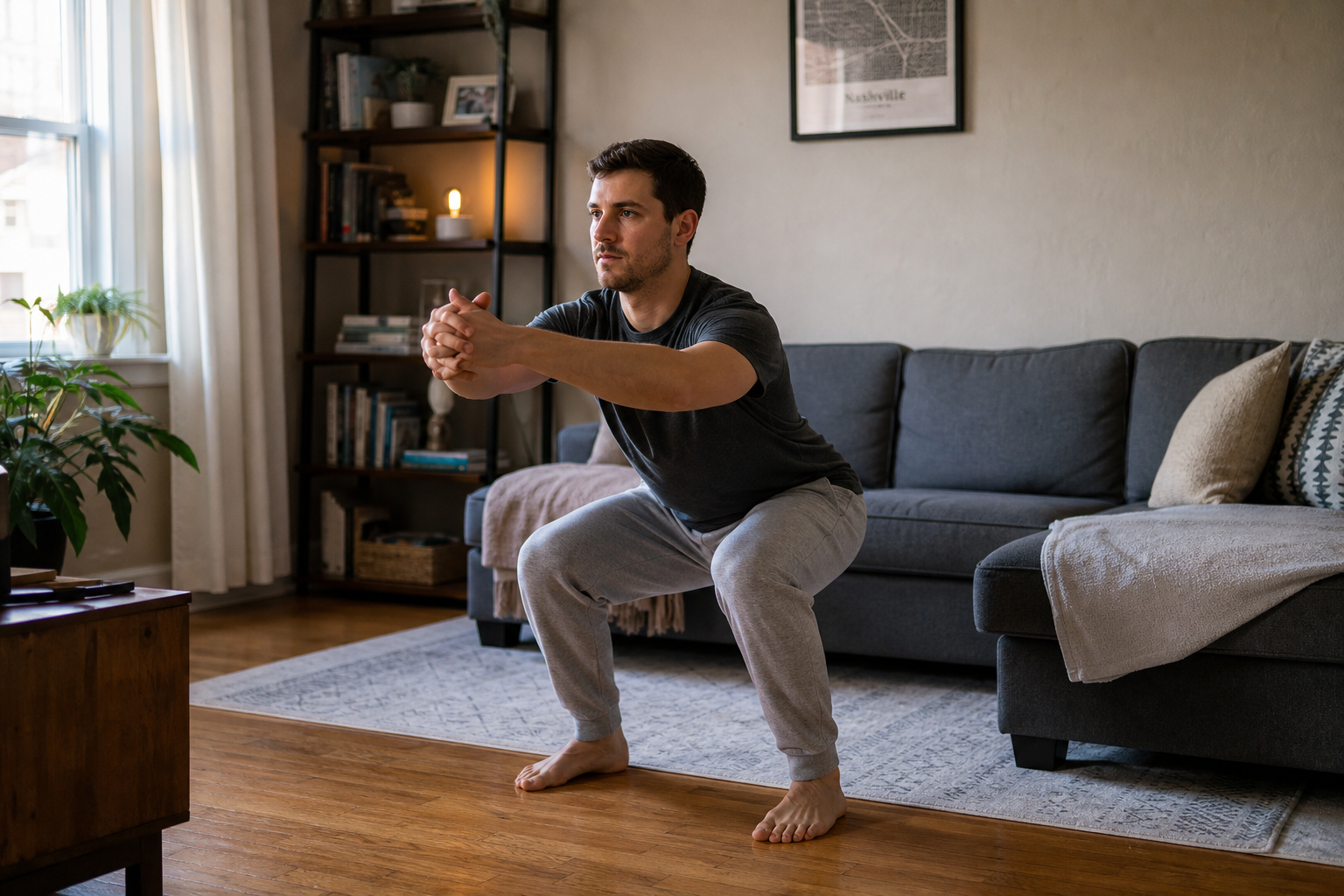
In a 2023 randomized trial published in Scientific Reports, sedentary women trained for six weeks with either progressive bodyweight squats or barbell back squats. The researchers found statistically similar improvements in strength, muscle hypertrophy, and the hamstring-to-quadriceps strength ratio between the two groups over that six-week period.[1]
That is the kind of evidence beginners deserve. It does not ask you to believe that a living-room squat is magically the same thing as a heavy barbell squat for every lifter. It says something narrower and more useful: in sedentary beginners, over six weeks, progressive bodyweight squat training produced strength and muscle changes that were statistically similar to barbell back squat training.
The limits matter. The participants were sedentary women, not trained lifters. The trial lasted six weeks, not a year. And the barbell group had a larger reduction in body-fat percentage than the bodyweight group: -3.7% compared with -0.16%.[1] If your goal is long-term maximal strength or if you already squat heavy loads, this study does not erase the usefulness of barbells.
But if you are returning after years away, training in a small apartment, or starting from modified push-ups and shaky squats, the study is enough to remove the worst excuse: the absence of plates does not make the first phase of strength training fake.
Why beginners get stronger before they look different
Early strength gains are not only about adding visible muscle. In the first 4 to 8 weeks of resistance training, a large share of improvement comes from neural adaptation: the nervous system gets better at recruiting existing muscle fibers, coordinating the movement, and producing force efficiently.[2]
That explains a common beginner experience. In week one, a squat may feel awkward and unstable. By week four, the same person may stand up from the bottom more smoothly, keep the knees tracking better, and perform more controlled reps, even if their legs do not look dramatically different yet. Something real changed. The body learned the task.
This is also why no-equipment strength training can work quickly for new trainees. A wall push-up, incline push-up, split squat, glute bridge, or controlled squat gives the nervous system a repeated force-production problem to solve. If that problem becomes progressively harder, strength can rise without a dumbbell ever entering the room.
That does not mean muscle growth is irrelevant. A 2021 calisthenics study cited in Men’s Health UK reported significant hypertrophy in the chest, arms, and thighs after 12 weeks of structured calisthenics using exercises such as push-ups, squats, dips, and pull-ups.[3] The sensible takeaway is not that bodyweight training is effortless muscle-building. It is that bodyweight training can create enough tension and volume to matter when the program is structured.
“No equipment” still needs overload
The most common failed bodyweight plan is not too simple. It is too static. Someone does three sets of ten squats, three sets of ten knee push-ups, and a plank, then repeats the same workout until it feels like a warm-up. When nothing changes, they blame the lack of equipment.
Loaded training makes progression obvious: add weight to the bar. Bodyweight training makes progression less obvious, but not less real. Progressive overload can come from increasing repetitions, changing tempo, reducing rest, increasing range of motion, altering leverage, or moving toward harder unilateral variations.[4][5][6]
| Progression method | What changes | Example |
|---|---|---|
| Add reps | More total work at the same difficulty | Move from 6 controlled push-ups to 10 controlled push-ups |
| Slow the lowering phase | More time under tension | Take 3 seconds to lower into each squat |
| Change leverage | More bodyweight shifts onto the working muscles | Move from incline push-ups to floor push-ups |
| Use one side more | Each limb handles a larger share of the work | Move from squats to split squats, then toward assisted single-leg work |
| Shorten rest carefully | Same work with less recovery | Reduce rest only after form stays consistent |
The order matters less than the honesty of the difficulty. A harder variation with sloppy movement is not progress. A slower rep that turns into collapsing is not progress. The body adapts to the work it can actually perform, not the version written optimistically in a notes app.
A push-up shows how bodyweight load can be scaled
Push-ups are where many beginners decide, too early, that they are either “strong enough” or “not ready.” The better view is that push-ups are a ladder. You do not need to start on the floor, and you do not need to stay with the same version once it becomes easy.
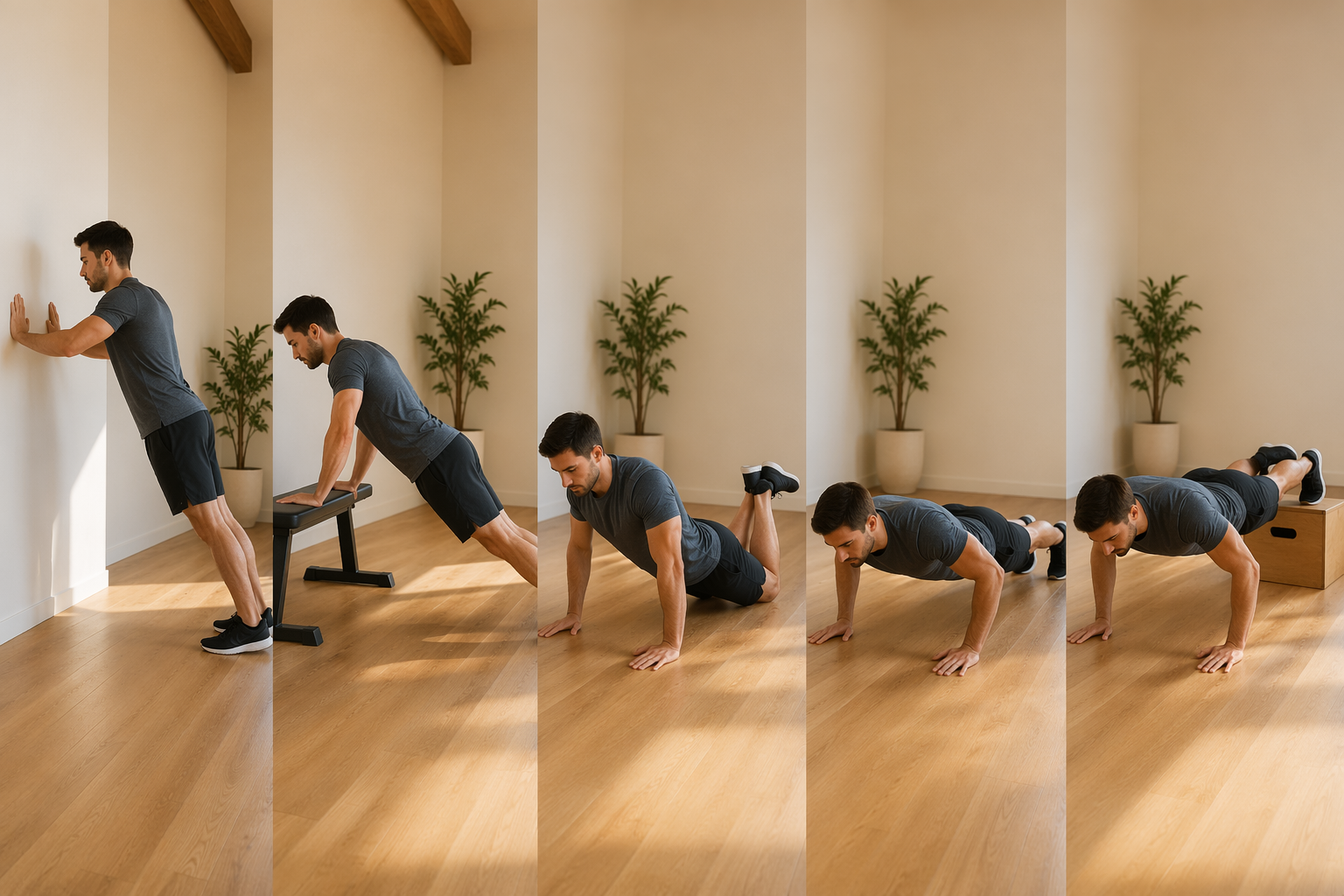
A practical progression is wall push-up, incline push-up, kneeling push-up, full push-up, then feet-elevated push-up. One analysis estimates that kneeling push-ups load roughly 49% of bodyweight and standard push-ups roughly 65%, though those figures should be treated as estimates rather than universal lab values.[7]
The exact percentage is less important than the principle. Raising the hands makes the movement easier. Lowering the hands toward the floor makes it harder. Elevating the feet generally makes it harder again. The same person can train the same pattern for months without buying equipment, as long as the version keeps matching their current strength.
- If wall push-ups feel easy, move to a counter or sturdy table.
- If incline push-ups feel solid, lower the incline before rushing to the floor.
- If full push-ups break down after two reps, use a higher-quality easier variation for most of your work.
- If full push-ups become comfortable, slow the lowering phase or begin using feet-elevated reps.
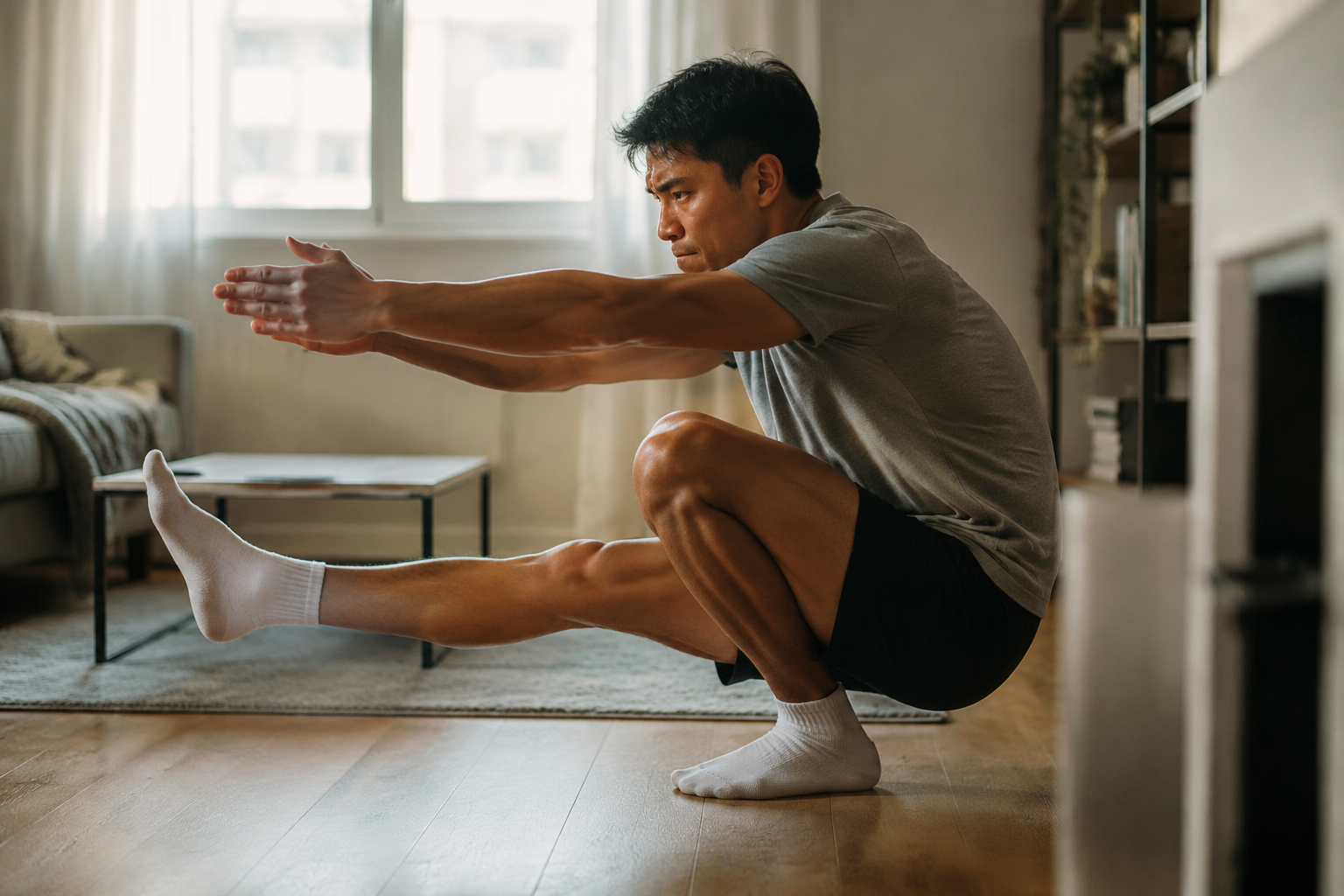
The same thinking applies to lower-body work. A beginner might move from box squats to full squats, then split squats, reverse lunges, step-back lunges, assisted single-leg squats, and eventually more demanding single-leg variations. Not every person needs a pistol squat. Everyone needs a next step that is difficult enough to require adaptation.
What the supporting evidence adds
The squat trial is the centerpiece because it compares bodyweight and barbell training directly. Other evidence rounds out the picture. Harvard Health describes 10-week data in young women where bodyweight exercise improved aerobic capacity by 33%, muscle endurance by 11%, and lower-body power by 6%.[8]
Those numbers do not prove that bodyweight training is always equal to weights for strength. They show something different: a structured bodyweight program can improve several fitness qualities at once. For a beginner who wants to feel stronger climbing stairs, lowering into a chair, getting off the floor, or holding a plank without shaking immediately, that combination is not trivial.
The calisthenics hypertrophy data points in a similar direction. When bodyweight exercises are organized and progressed, they can provide enough stimulus for measurable muscle growth.[3] The word “organized” is doing work there. Random hard reps are not the same thing as training.
How to start without overcomplicating it
A beginner no-equipment strength session does not need twenty exercises. It needs a squat or lunge pattern, a push pattern, a hip-extension pattern, a trunk-control drill, and—when possible—a pulling pattern. Pulling is the one place where “no equipment” gets genuinely harder, because rows and pull-ups usually need a bar, table edge, towel setup, or bands. If you want a practical follow-up for upper-body balance, the site’s no-equipment upper body workout covers that problem more directly.
For the first phase, choose versions that allow clean reps with effort left to concentrate. A set that ends because the target muscles are challenged is useful. A set that ends because the lower back, wrists, or knees are complaining needs adjustment.
- Squat pattern: chair squat, bodyweight squat, split squat, or assisted single-leg variation.
- Push pattern: wall, incline, kneeling, full, or feet-elevated push-up.
- Hip extension: glute bridge, single-leg glute bridge, or hip hinge drill.
- Trunk control: dead bug, side plank, front plank, or slow mountain climber.
Progress one variable at a time. Add reps before changing the exercise. Slow the lowering phase before jumping to a harder leverage position. Move to single-limb work only when the two-limb version is controlled. Reduce rest last, and only if the next set still looks like training rather than survival.
Simple form rules worth keeping
- Stop a set when technique changes more than the target muscle effort.
- Use a range of motion you can control, then expand it gradually.
- Keep joints tracking comfortably; pain is not proof that the exercise is working.
- Make the easy version cleaner before making the hard version messier.
This is where bodyweight training becomes honest. It is not a loophole around effort. It simply changes the way effort is loaded. Instead of adding five pounds to a bar, you may lower more slowly, use a deeper range, shift leverage, or ask one leg to do more of the work.
Where bodyweight training fits—and where it does not
Barbells remain excellent because they make loading clean, measurable, and almost endlessly adjustable. For maximal strength, advanced lower-body training, and precise load tracking, external weights are hard to beat. Respecting that does not require pretending a beginner needs a rack before they are allowed to train.
The fair conclusion is narrower and stronger: for beginners, a progressive no-equipment strength workout can build measurable strength in the first several weeks, supported by head-to-head trial evidence and by what we know about neural adaptation. It keeps working only if it keeps progressing. The moment the exercises become automatic and stay automatic, the training stimulus fades.
So the starting line is not a gym membership, a barbell, or the perfect home setup. It is a version of the movement you can do well today, followed by a slightly harder version when your body earns it.
References
- Effects of barbell back squat versus bodyweight squat training on strength, hypertrophy and H/Q ratio in sedentary women, Scientific Reports, 2023
- The Science of Getting Stronger Without Weights, Human Kinetics
- Can You Build Muscle With Bodyweight Exercises?, Men’s Health UK
- Progressive Overload: What It Is and How To Do It, Cleveland Clinic
- Progressive Overload Training: The 4 Keys to Getting Stronger, Men’s Health
- Progressing With Bodyweight Exercises, The Movement Athlete
- Bodyweight Workout for Muscle Mass, Bony to Beastly
- The advantages of body-weight exercise, Harvard Health
Comments
Join the discussion with an anonymous comment.