
Outdoor exercise equipment fails in ways indoor gear never has to think about. The paint gets cooked before the frame is stressed. Water sits inside an upright instead of on top of it. Vinyl cracks from UV exposure. Bar sleeves rust before the knurling wears down. A bench that feels solid in a garage can become a sponge on a patio if the underside of the pad and the seams are always damp.
That changes the first buying question. For outdoor exercise equipment, the first decision is not whether you prefer strength training, calisthenics, or conditioning. It is where the gear will live and what the weather can reach. Corrosion protection, UV resistance, drainage, the surface under the equipment, and your willingness to maintain it decide more than the feature list on the product page.
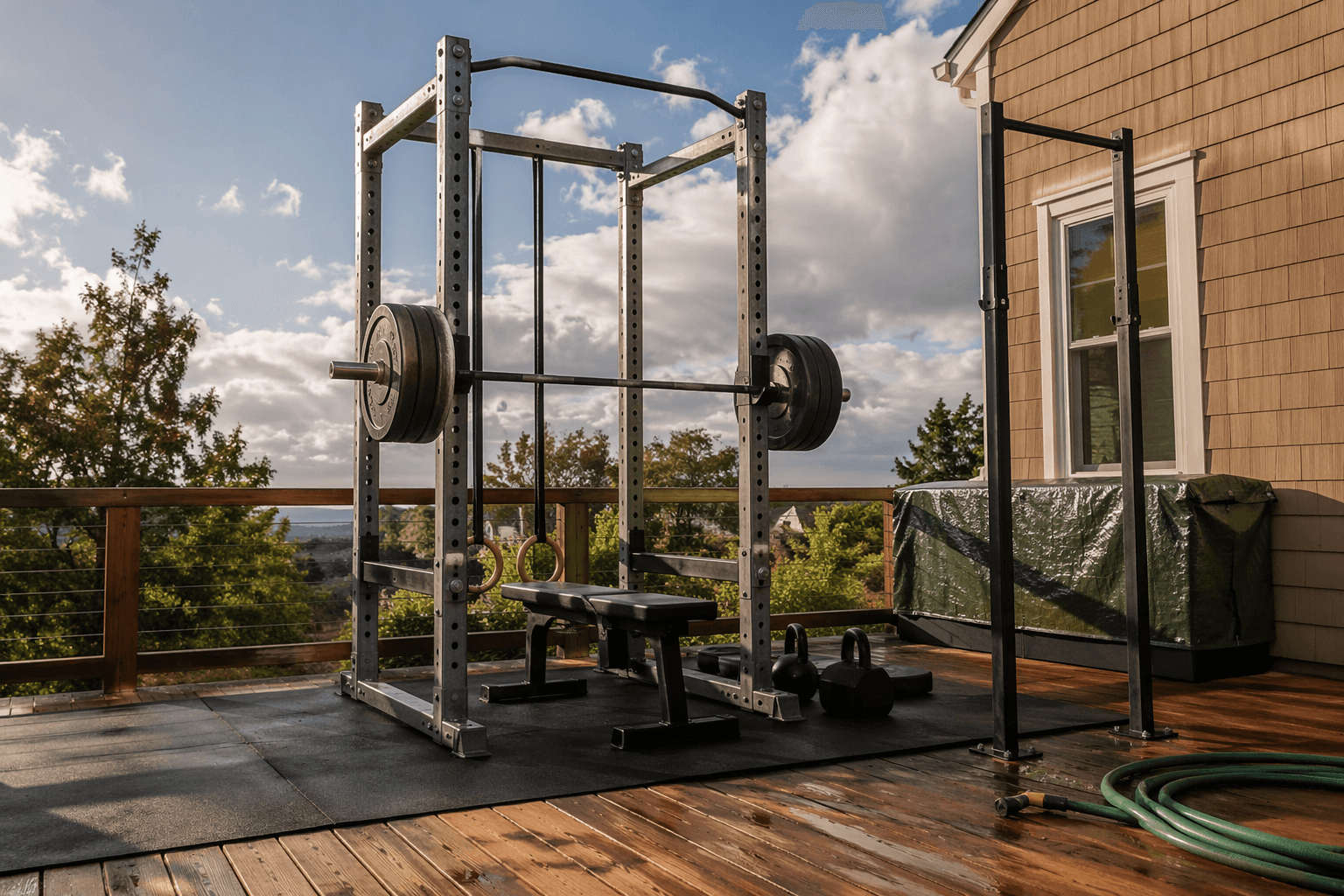
Start with exposure, not equipment type
A backyard gym under open sky and a rack tucked under a roof overhang are not the same project. The same pull-up bar, bench, or barbell can be a reasonable purchase in one spot and a short-lived annoyance in another.
| Where the gear will live | What matters most | What usually makes sense |
|---|---|---|
| Uncovered yard | Galvanized or stainless steel, drainage, simple shapes, minimal upholstery | Pull-up bar, rings, dip station, kettlebells you can inspect and clean, bands stored indoors |
| Partially covered patio | Splash protection, UV exposure, covers, airflow, rust-prone joints | Bodyweight station, adjustable bench if protected, limited barbell setup with maintenance |
| Deck | Load distribution, matting, water trapped under feet, rust staining, anchoring limits | Freestanding rack or tower, rubber mats that can drain and dry, portable implements |
| Shed, pergola, carport, or enclosed structure | Ventilation, condensation, roof leaks, floor moisture | Rack, bench, barbell, plates, and possibly protected cardio equipment |
The open-yard version should be the simplest. Every hinge, sleeve, cable, pad, strap, and hollow tube is another place for weather to collect or UV to chew on. A more protected structure gives you more freedom, but it does not turn outdoor gear into indoor gear. Condensation, wind-driven rain, wet flooring, and trapped moisture still count.
Balconies are a separate problem. The useful public guidance is thin, and the real constraints are often building rules, structural load limits, noise, neighbors, drainage, and access. For most apartment setups, portable gear stored indoors is the safer assumption unless the building and lease clearly allow more.
The material hierarchy is where the purchase is won or lost
For outdoor steel, the rough hierarchy is simple: galvanized or stainless steel sits at the top, powder-coated steel can work with caveats, and bare steel should be treated as a maintenance commitment. TwoRepCave’s outdoor home gym guidance is blunt about the weak point many buyers miss: powder coating by itself can degrade after 2–3 years in direct sun and rain exposure, while galvanized or stainless construction is the better long-term outdoor choice.[1]
Powder coating is not useless. It is just not magic. Once it chips, cracks, fades, or wears through at bolt holes and contact points, the underlying steel becomes the real story. Outdoors, that story often starts at the bottom of a rack foot, the inside of a hollow upright, the underside of a bench frame, or the sleeve of a barbell that was left wet after rain.
If you want a deeper side-by-side explanation of coatings and metals, see outdoor exercise equipment materials. The short version for buying is this: do not pay for attachments, adjustment holes, or glossy accessories before you know what metal is underneath and how water leaves the frame.
Galvanized steel
Galvanized steel is often the most practical outdoor choice for large structures such as pull-up rigs, simple racks, posts, and fixed stations. It is not always pretty, and it may not match the blacked-out garage-gym look, but outdoor equipment is one place where the less glamorous finish can be the better buy.
Stainless steel
Stainless steel is appealing where hands, sleeves, and moving contact matter: pull-up bars, handles, hardware, and barbells. It costs more, so it is not always the sensible choice for every inch of a backyard setup. But if you are buying a barbell that may see humidity or occasional outdoor storage, stainless becomes much easier to justify.
Powder-coated steel
Powder-coated equipment can survive outside when the design is simple, the coating is intact, water does not sit inside the tubes, and the owner actually inspects chips and scratches. It is a riskier buy when the equipment is full of adjustment tracks, welded seams, moving parts, or padded pieces that hide moisture.
Upholstery, rubber, webbing, and bands
Steel gets most of the attention because rust is visible. The softer parts often fail just as annoyingly. Bench vinyl, rubber bumper plates, strap safeties, suspension straps, and resistance bands all need UV protection and dry storage habits. TwoRepCave specifically recommends 303 Aerospace Protectant for vinyl bench upholstery, rubber bumper plates, and safety strap webbing in outdoor gym setups.[1]
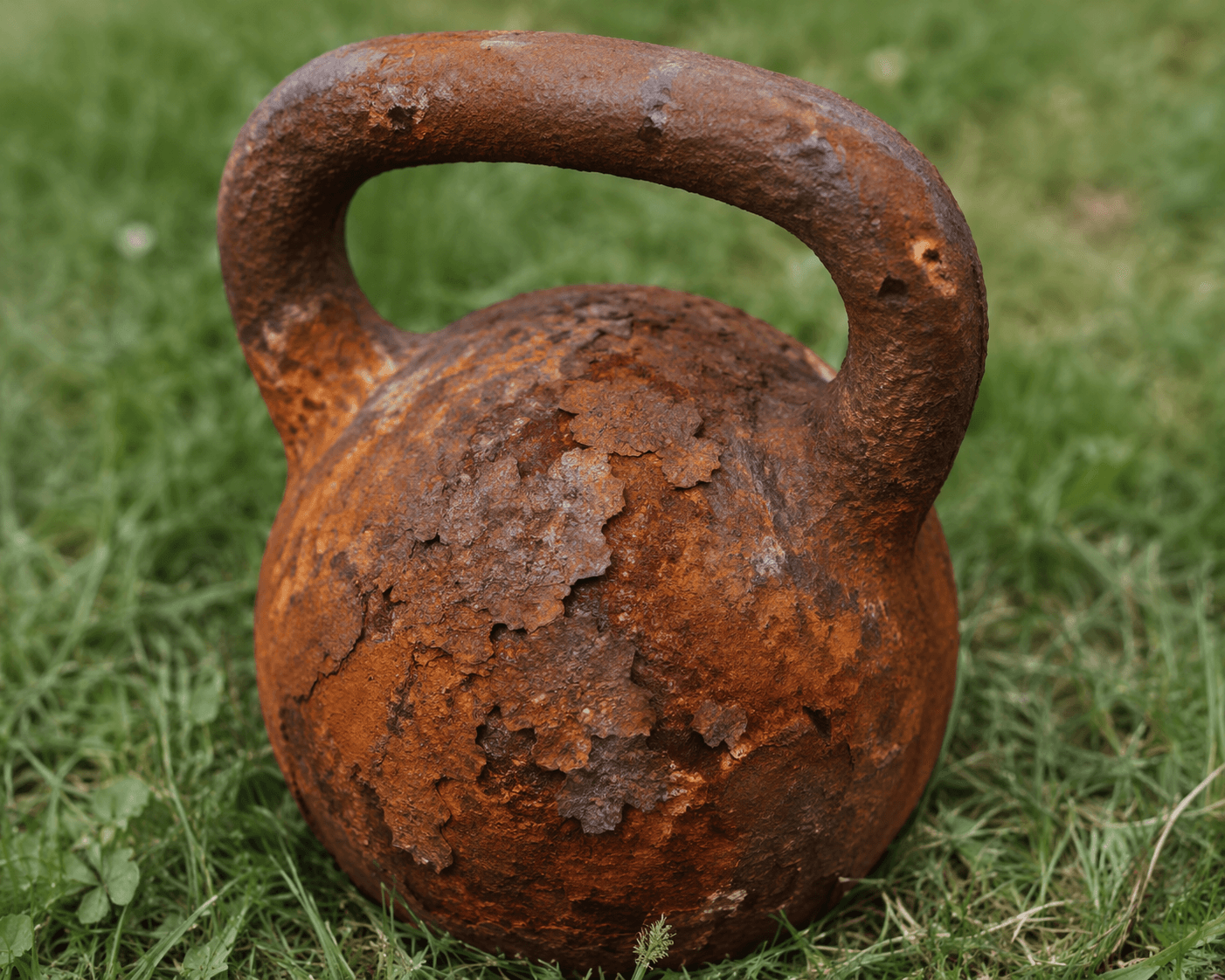
A little surface rust on a kettlebell is not the end of the world. Rust inside a rack upright, under a bench pad, or on a barbell sleeve is more irritating because it can spread quietly before the owner notices. That is why outdoor buying rewards boring inspection points: open tube ends, drain paths, replaceable pads, accessible hardware, and finishes you can touch up.
Match the equipment to how permanent the setup can be
Outdoor home gyms tend to work best when the most exposed items are the least complicated. That does not mean everyone has to train only with rings and kettlebells. It does mean a rack, bench, barbell, or cardio machine needs a higher standard than it would in a garage.
Pull-up bars, rings, and dip stations
For an uncovered yard, this is the cleanest starting point. A fixed pull-up bar, a dip station, gymnastics rings, and a place for push-ups or step-ups can cover a lot of training without upholstery, bar sleeves, electronics, or cable systems. If the frame is galvanized or otherwise built for exposure, there are fewer parts asking to become a maintenance project.
Rings and straps still should not be treated as weatherproof forever. Webbing and buckles live longer when they are brought inside or stored in a dry bin after training. The permanent part can be the bar or station; the soft goods do not need to prove anything in a thunderstorm.
If your decision is mainly between a tower, a calisthenics station, and a DIY rig, the useful comparison is not just exercise variety. It is anchoring, drainage, replacement hardware, and whether the station can dry underneath. A separate guide to power towers versus calisthenics stations can help narrow that choice.
Power racks and squat stands
A rack can live outside, but it needs outdoor logic from the beginning. TwoRepCave notes that powder-coated or galvanized power racks can survive outdoors for years when owners add two practical protections: drilling drain holes in the uprights and spraying interior frame coating.[1]
The drain holes matter because hollow steel tubing can hold water. If water gets in through the top, a bolt hole, or a seam and cannot get out, the rack may be rusting from the inside while the outside still looks acceptable. That is the kind of failure an indoor buyer never has to price into the decision.
Rack feet also deserve more attention than they get. Feet sitting directly on wet soil, grass, or a mat that traps water underneath are asking for trouble. On a deck or slab, leave a path for water to escape, check for rust staining, and avoid pretending a rubber mat is automatically protective if it keeps the underside damp. For more detail on the ground layer, see common home gym flooring mistakes.
Benches
Benches are sneakier than racks. The frame can look fine while the pad is taking the abuse. Outdoor bench buying should start with the underside of the pad, the stitching, the staples or fasteners, and whether the pad can dry after rain. A flat utility bench with fewer moving parts is usually a better outdoor candidate than a heavily adjustable bench with more hinges, gaps, and padding seams.
If the bench is going to live outside, a cover helps, but only if it does not trap moisture for days. A covered bench on a damp patio can still grow mildew or rust under the pad. The habit that matters is boring: uncover it, let it dry, inspect the hardware, and protect the vinyl periodically.
Barbells and plates
Barbells are one of the easiest places to overspend in the wrong direction. A beautiful bare-steel bar is pleasant in a controlled indoor gym and needy outdoors. TwoRepCave’s barbell maintenance guidance treats stainless steel as the ideal outdoor-resistant choice, while bare steel needs regular oiling; its outdoor gym guidance also points to monthly oiling for bare steel.[1][2]
The sleeves matter as much as the shaft. If a bar is left where rain can reach it, water can get into the sleeve area and sit where cleaning is more annoying. If you want an outdoor barbell setup, keep the bar under real cover or store it indoors and carry it out for sessions. That one inconvenience may save more regret than buying another attachment for the rack.
Bumper plates and iron plates have different annoyances. Rubber needs UV protection and can degrade in the sun. Iron can rust, especially where paint chips. Plates are usually simple enough to maintain, but they still prefer a dry storage bin, covered rack, or shed over a permanent life in wet grass.
Kettlebells, dumbbells, and bands
Kettlebells are outdoor-friendly in the sense that they are simple. They are not outdoor-proof. A cast-iron bell can handle a lot of abuse, but chips become rust spots, and wet grass accelerates the mess. Store them off the ground, wipe them down after wet sessions, and accept that a pristine finish is probably not the goal outdoors.
Dumbbells are more complicated because handles, heads, rubber coatings, and adjustment mechanisms vary. Fixed iron or urethane dumbbells may be manageable with storage. Adjustable dumbbells with selector mechanisms should be treated like indoor equipment unless they are used outside and brought back in.
Bands should be portable, not permanent. Sun and heat are not kind to latex. Use them outside, then bring them in. There is no upside to leaving a $20 band on a hot fence until it becomes a cracked $0 band.
Cardio machines
Cardio machines are where outdoor-gym optimism does the most damage. TwoRepCave’s guidance is direct: cardio machines, as a rule, do badly outside and need covered structures.[1] Electronics, bearings, belts, consoles, rails, cables, and screens are not improved by sideways rain and summer heat.
A manual sled, battle rope, sandbag, jump rope, hill, or loaded carry lane is often a better outdoor conditioning choice than trying to turn a treadmill into patio furniture. If you already own a rower, bike, or treadmill, the safer plan is to train near an open door or under a real roof, then store it where weather cannot reach it.
Space and surface checks before you buy
Marcy Pro suggests 100–200 square feet as a baseline for an outdoor home gym, and at least 7 feet of overhead clearance for pressing movements.[3] Those numbers are useful as a planning check, not a law. A pull-up bar and kettlebells may need less footprint. A rack with a barbell, plates, bench, and walking room can need more. Taller users, overhead lifts, rings, and muscle-up work can quickly make 7 feet feel optimistic.
The surface is not just about comfort. It decides whether equipment sits level, whether rack feet sink, whether water drains, and whether you can clean mud and grit before they get into moving parts. Grass feels inviting until equipment starts leaning, rusting, or disappearing into soft ground. A concrete slab, pavers, compacted base, or deck can work better, but each has its own load, drainage, and anchoring questions.
Rubber stall mats can be useful outside, especially on a hard surface, but they should not become a wet blanket under steel feet. If a mat traps water against metal, it is solving one problem by creating another. Leave drainage paths, lift mats occasionally, and check the contact points where metal meets floor.
Budget after weather, not before
It is tempting to start with a number and then fill the yard until the money runs out. Outdoors, that can backfire. A cheap rack, cheap bench, cheap bar, and cheap plates may look like a complete gym for one season and a pile of compromises after two summers. The better question is what level of exposure your budget can actually support.
| Budget range | Best use of the money | What to avoid |
|---|---|---|
| Under $500 | Minimalist bodyweight setup: rings, bands stored indoors, a simple pull-up option, one or two kettlebells or a sandbag | Trying to build a full barbell gym with low-grade coated steel and no protection |
| $500–$1,500 | Stronger bodyweight station, better surface prep, selected kettlebells, possibly a rack or bench if exposure is controlled | Spending the whole budget on a rack while ignoring flooring, covers, storage, and corrosion protection |
| $1,500+ | More complete setup with rack, bench, barbell, plates, protected storage, surface work, and weatherproofing infrastructure | Assuming a higher price automatically means the equipment can live uncovered |
Garage Gym Reviews documented a DIY backyard bodyweight gym that cost about $1,400 including landscaping and took 3 weeks of part-time work.[4] That is a useful reality check because the money did not go only into bars and attachments. Outdoor gyms often spend a surprising amount on the unexciting parts: posts, concrete, drainage, mats, storage, and site prep.
Under $500, a bodyweight-first setup is usually the least regretful path. A doorway-style indoor mindset will push you toward more “features.” Outdoor logic pushes you toward fewer exposed parts. A freestanding dip station, rings, a kettlebell, a jump rope, and bands stored indoors can train a lot without asking a bargain bench to survive weather it was never built for.
In the $500–$1,500 range, the fork in the road is whether you are buying better simple equipment or trying to introduce barbell training. If the space is exposed, better simple equipment usually wins. If you have a covered patio or shed, this range can support a modest rack, bench, and bar only if you leave money for covers, oil, storage, and the ground surface.
Above $1,500, the mistake is assuming the budget has solved the weather. It has only given you room to solve it properly. Spend on galvanized or stainless components where they matter, a surface that drains, a cover that breathes, a storage box that keeps soft goods dry, and maintenance supplies. Product-specific lists can help once that framework is set; this outdoor home gym equipment buyer’s guide is a better next step after you know your exposure level.
For budget allocation, the usual home-gym question of where to buy premium and where to economize still applies, but outdoors it changes shape. Saving on a finish, cover, or storage method can cost more than saving on a handle style or attachment. A separate spend-versus-save guide for affordable home gym equipment can help if the budget is tight.
Maintenance is part of the purchase
Some commercial outdoor fitness suppliers describe 10–20 years of service life for outdoor fitness equipment with proper maintenance.[5] That can be a useful expectation for well-built, properly installed, maintained equipment, but it should not be read as a guarantee for every consumer rack, bench, or barbell left in a yard. The sources making those lifespan claims are commercial suppliers, and the available material does not include independent home-user failure-rate data.
For a home buyer, the more useful question is whether you will tolerate the maintenance the setup needs. Outdoor ownership means wiping bars, checking chips, oiling bare steel, protecting upholstery and rubber, inspecting fasteners, lifting mats, draining water, and occasionally touching up finishes. If that sounds annoying, buy fewer exposed pieces.
- After rain: check rack feet, bar sleeves, bench pads, and any place water can pool.
- Monthly in humid or exposed conditions: inspect coating chips, hardware, straps, bands, and bare steel.
- Seasonally: remove or lift mats, clean under equipment, check drainage, and reapply protectants where needed.
- Before storms or long gaps in training: bring in bands, rings, bars, pads, electronics, and anything with fabric or bearings if practical.
If you want a more detailed maintenance plan, use a dedicated weatherproofing and maintenance guide. The key buying point here is simpler: do not choose equipment whose maintenance you already know you will ignore.
What to buy for the setup you actually have
If the gym will be uncovered, start with a bodyweight-oriented setup: a galvanized or weather-appropriate pull-up station, rings that come inside after use, a dip option, kettlebells or a sandbag stored off the ground, and bands kept indoors. Add surface work before you add complexity.
If the gym is partially covered, you can consider a bench, squat stand, or rack, but the purchase should include drainage, covers, frame inspection, and a plan for the barbell. This is where “indoor rack plus tarp” is usually not enough. The frame interior, the feet, the pad, and the bar sleeves all need to be accounted for.
If you have a shed, carport, pergola, or more protected structure, a rack-and-barbell setup becomes much more reasonable. Even then, buy for humidity and splash, not just for max weight capacity. Stainless or better-protected bars, sealed storage, airflow, and dry flooring still matter.
Keep cardio machines under real cover or indoors. Treat manufacturer lifespan claims as possible outcomes under good conditions, not promises. Spend less energy trying to recreate a full commercial gym outside and more energy choosing a few durable pieces that match the weather, drain properly, and can be maintained without becoming a second hobby.
References
- Outdoor Home Gyms: How to Avoid Rust or UV Damage — TwoRepCave
- Olympic Barbell Maintenance: Cleaning off Rust — TwoRepCave
- How to Build an Outdoor Home Gym — Marcy Pro
- DIY Outdoor Bodyweight Gym — Garage Gym Reviews
- Can I Leave My Gym Equipment Outside? (Detailed) — TriActive USA
Comments
Join the discussion with an anonymous comment.