UFC fight training at home gets silly when it pretends your living room is an octagon. It becomes useful when the goal is narrower: build conditioning, rehearse fighting movement, and organize hard work into rounds without needing a heavy bag, a garage, or a downstairs-neighbor complaint.
For this version, clear roughly an 8x4 ft rectangle. That is enough room for stance switches, shadowboxing, sprawls modified for quiet floors, push-ups, squats, bridges, hip escapes, and technical stand-ups. It is not enough room for live grappling, pad work, wall wrestling, or anything that needs a partner resisting you. That distinction matters.
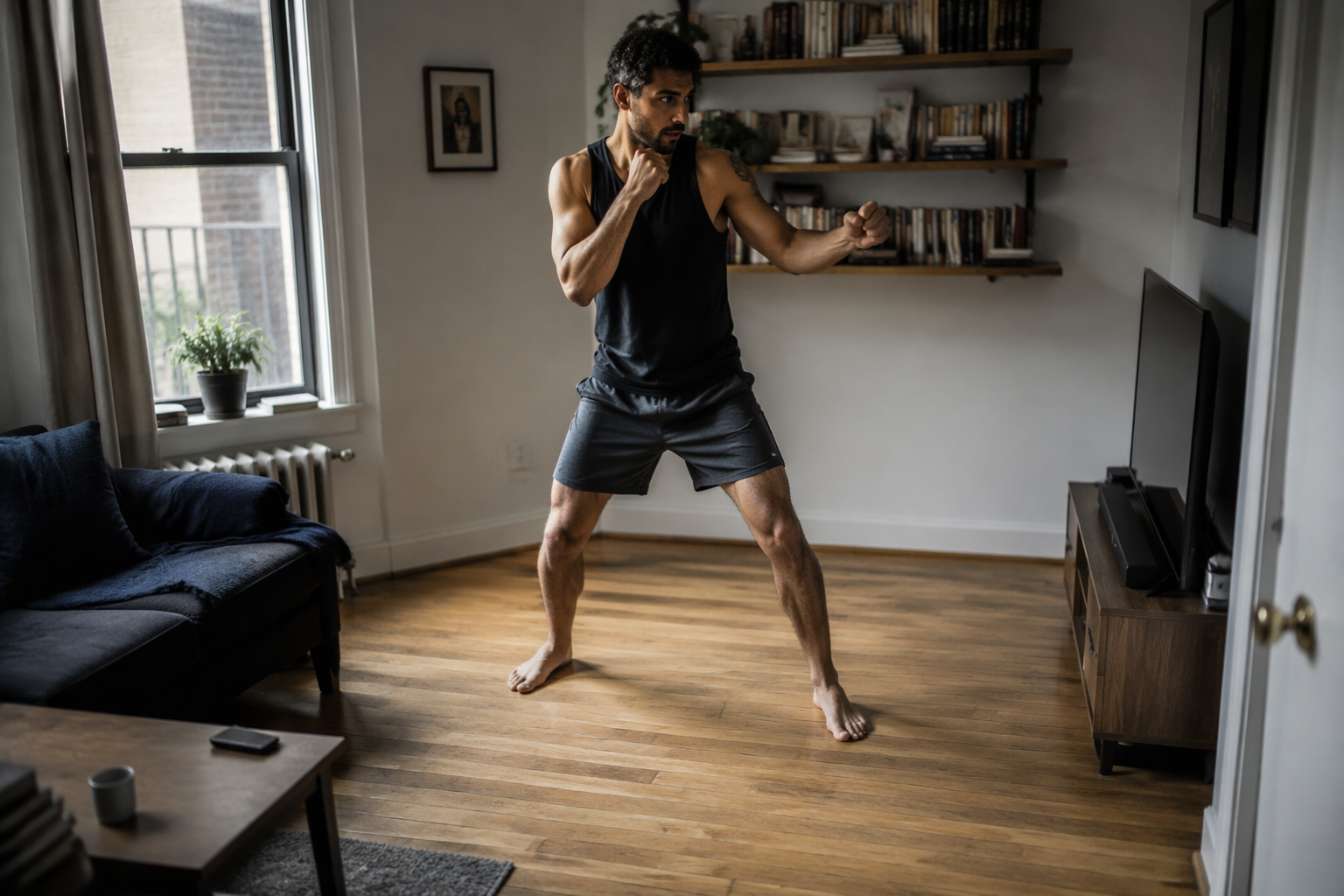
Bodyweight-only training is not automatically light training. UFC.com profiled Mike Swick using bodyweight-only conditioning, reporting that he reached 4% body fat and later earned Knockout of the Night; the same UFC.com feature also cites UFC strength coach Andy Hennebelle’s 4-2-1 tempo method for making push-ups and squats demanding without machines or heavy loads.[1] The useful lesson is not that an apartment makes you fight-ready. It is that tempo, density, and round structure can make simple movements feel like real work.
The 30-Minute Apartment Session
Run this as a conditioning and skill-practice session. You need a timer, bare floor or a thin mat, and enough discipline not to turn every movement into a noisy max-effort scramble.
| Time | Block | What You Do |
|---|---|---|
| 0:00-4:00 | Warm-up | Joint circles, light stance movement, slow squats, inchworms, hip switches |
| 4:00-13:00 | Shadowboxing | Three 2-minute rounds with 1 minute of deliberate recovery between rounds |
| 13:00-22:00 | Bodyweight tempo circuit | Three rounds of push-ups, squats, plank shoulder taps, and reverse lunges |
| 22:00-27:00 | Solo grappling block | Shrimps, bridges, technical stand-ups, and quiet sprawl-to-stand practice |
| 27:00-30:00 | Cool-down | Nasal breathing, hip flexor stretch, thoracic rotation, calf and shoulder reset |
The shadowboxing block borrows the basic no-equipment logic from FightCamp’s 15-minute shadowboxing format: use rounds, footwork, punches, and defensive movement instead of waiting for a bag to make the session feel legitimate.[2] The bodyweight block follows the same general equipment-free MMA conditioning idea used in a Verywell Fit workout designed by UFC veteran Chris Camozzi, but scaled to a tighter apartment space.[3]
Warm Up Without Wasting the First Round
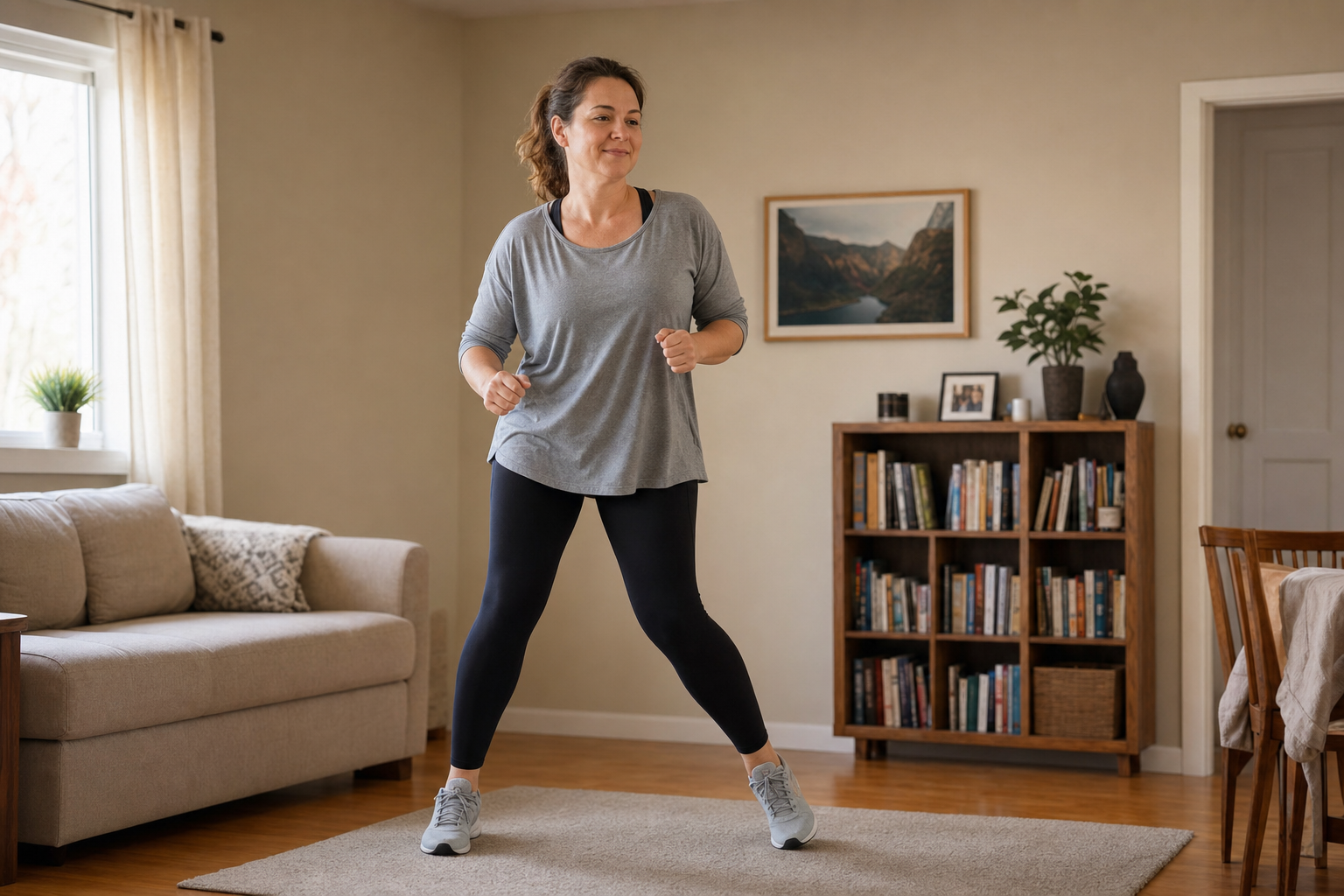
Four minutes is enough if you do not spend it wandering. Start with neck, shoulder, wrist, hip, knee, and ankle circles. Then move into a fighting stance and take small steps forward, back, left, and right. Keep the feet under you; an apartment is the wrong place for dramatic bounce-step footwork.
- Minute 1: joint circles from neck to ankles
- Minute 2: stance steps, pivots, and light hip turns
- Minute 3: slow squats, alternating reverse lunges, and inchworms
- Minute 4: easy shadowboxing at half speed with slips and guard returns
The warm-up should make your ankles and hips feel available. It should not spike your breathing before the actual work begins.
Shadowboxing in a Room That Does Not Forgive Sloppy Feet
Shadowboxing is where most home “MMA workouts” start looking fake. The fix is not to punch harder. It is to give each round a job. In a small apartment, your feet have to stay honest because there is no open floor to rescue bad balance.
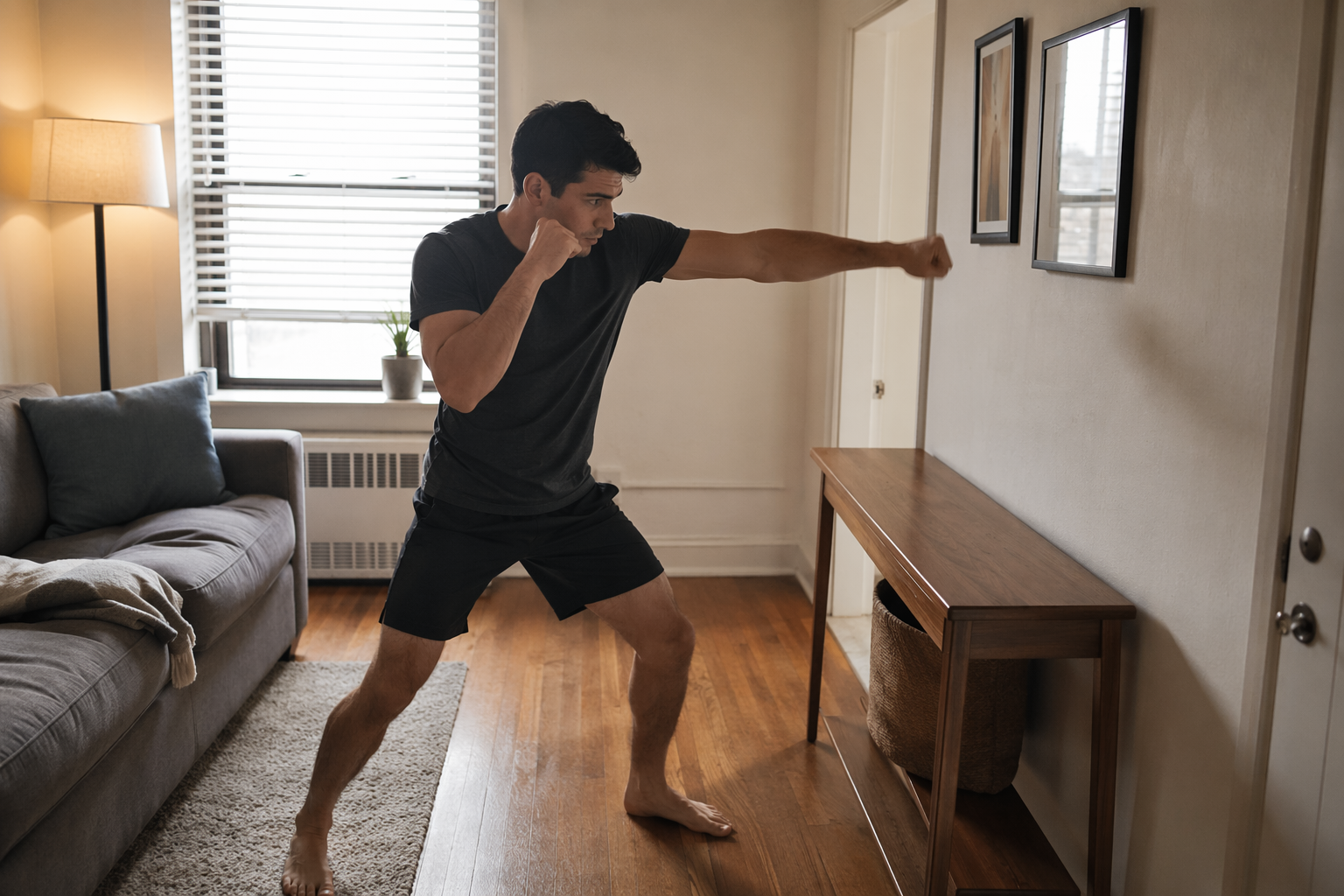
Use three 2-minute rounds. Rest 1 minute between rounds. During rest, do not check your phone or drift around the room. Walk slowly, breathe through the nose if possible, shake out the shoulders, and decide the first combination of the next round before the timer starts.
Round 1: Stance, Range, and Straight Punches
Work mostly jab-cross. Step in, step out, pivot, reset. Throw at 60-70% speed and pull each hand back to your face. If your rear heel never turns, your cross is just an arm swing. If your front foot keeps slapping the floor, shorten the step.
- 20 seconds: jab only, moving in a small square
- 20 seconds: jab-cross, rear hip turning cleanly
- 20 seconds: jab-cross, pivot out
- 20 seconds: double jab, cross, reset
- 40 seconds: freestyle using only those pieces
Round 2: Defense After Every Entry
This is the round that stops shadowboxing from becoming air-punch cardio. Every combination earns a defensive exit: slip, roll, pull, frame, or pivot. Keep the movements compact. A slip in a living room should move your head off line, not fold your whole body toward the coffee table.
- Jab-cross-slip right
- Jab-cross-roll under
- Jab-cross-lead hook-pivot
- Cross-lead hook-cross, then step out
Quiet modification: remove bounce. Stay on the balls of the feet, but think “slide and turn” instead of “hop and spring.” Your calves still work; your floorboards do less complaining.
Round 3: Pace Changes
Fight conditioning is not one steady speed. For the final shadowboxing round, alternate smooth movement with short bursts. Do not make the burst longer just because you feel good in the first minute. The point is to recover inside the round and still have shape.
| Interval | Action |
|---|---|
| 0:00-0:30 | Easy movement, jab, feints, guard returns |
| 0:30-0:40 | Fast straight punches with small steps |
| 0:40-1:10 | Easy movement with slips and pivots |
| 1:10-1:20 | Fast 3-4 punch combinations |
| 1:20-1:50 | Easy movement, reset breathing |
| 1:50-2:00 | Final controlled burst, then stop cleanly |
The Bodyweight Circuit: Make Simple Movements Heavy
The circuit is not complicated because it does not need to be. Hennebelle’s 4-2-1 tempo method is the useful apartment trick here: take 4 seconds to lower, hold 2 seconds near the bottom, then come up in 1 second.[1] That turns a regular push-up or squat into a bracing, breathing, and control problem.
Do three rounds. Work for quality before speed. Rest 45-60 seconds between rounds, longer if your form turns into survival.
| Movement | Reps or Time | Apartment Standard |
|---|---|---|
| Tempo push-up | 6-10 reps | 4 seconds down, 2-second hover, 1 second up; knees down if needed |
| Tempo squat | 8-12 reps | Quiet feet, full-foot pressure, hips under control |
| Plank shoulder tap | 20-30 taps | Hips stay mostly still; widen feet to reduce rocking |
| Reverse lunge | 6-8 each side | Step back softly; front foot stays planted |
Push-ups are the first place ego ruins the session. If the 4-second descent collapses after three reps, elevate your hands on a couch or sturdy chair instead of doing ugly floor reps. The slow lower should make the shoulders, ribs, and trunk coordinate. The pause should feel like you are holding position under pressure, not resting on the floor.
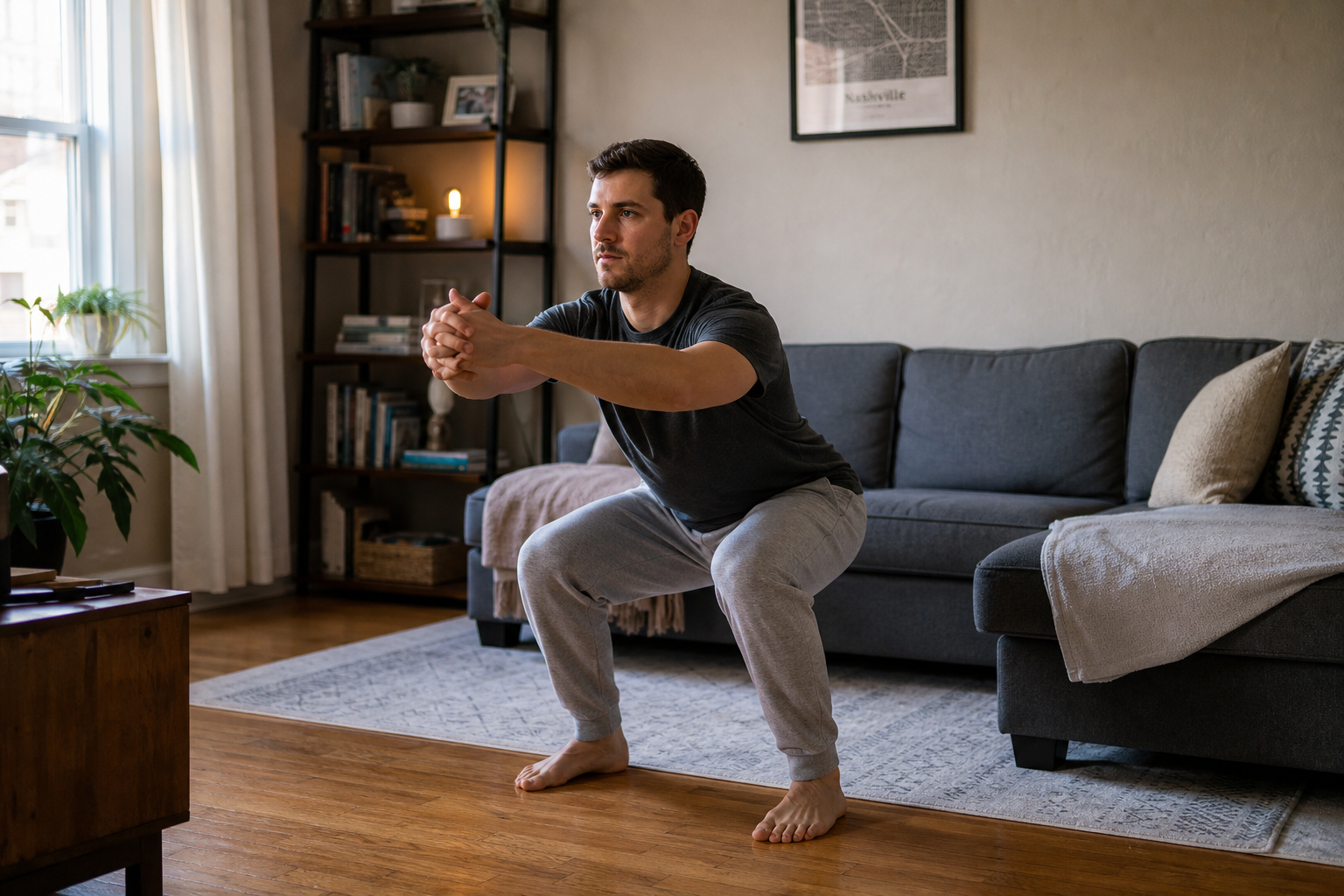
For squats, keep them quiet and vertical enough for your space. No jump squats. No stomping out of the bottom. The difficulty comes from tempo and tension. If you want more bite, add a 2-second pause just above parallel and keep your hands high in a guard position.
Plank shoulder taps are there because fighting posture asks the trunk to resist rotation while the limbs move. Make them boring. A flashy version with hips swinging side to side does less for you than a slower version where the torso barely shifts.
Reverse lunges beat forward lunges in a small apartment because the landing is easier to control. Step back like you are trying not to wake someone up. Drive through the front foot to stand, then reset before the next rep.
Solo Grappling Without Pretending You Have a Partner
Solo grappling drills are movement practice. They can sharpen hip movement, floor transitions, posting, and getting up safely. They cannot teach timing against resistance or replace live rounds. That is not a flaw; it is the boundary.
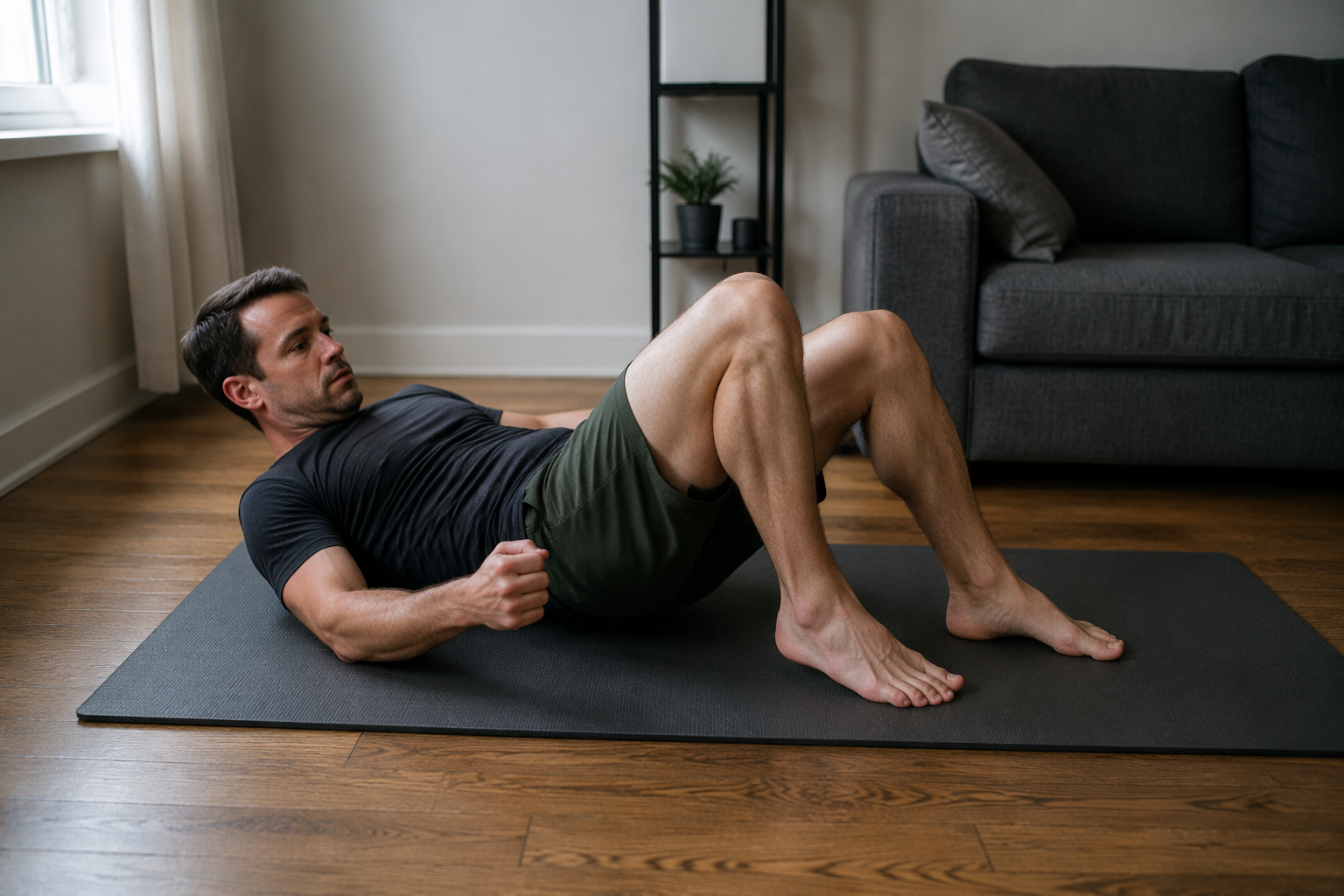
Etobicoke Martial Arts includes shrimps, bridges, and technical stand-ups among beginner solo grappling movements, which makes them a good fit for a tight no-partner block.[4] Run this section for 5 minutes as a continuous practice, not as a race.
| Time | Drill | Focus |
|---|---|---|
| 0:00-1:15 | Shrimp escape | Push through the foot, move hips away, recover position |
| 1:15-2:30 | Bridge and shoulder turn | Drive hips up, turn to one shoulder, keep movement controlled |
| 2:30-4:00 | Technical stand-up | Post hand, opposite foot planted, hips back, stand without crossing feet |
| 4:00-5:00 | Quiet sprawl-to-stand | Step back instead of jumping, chest lowers under control, stand to stance |
For shrimps, do not just slide across the floor. Start on your back or side, plant one foot, lift the hips slightly, and push your hips away as if making space between your belt line and an opponent. In a small room, alternate sides instead of traveling across the floor.
For bridges, the useful part is the hip drive and shoulder turn. Lift the hips, turn toward one shoulder, and come back down with control. If the floor is hard, use a thin mat or folded towel under the upper back, but avoid a soft surface that makes the neck unstable.
The technical stand-up is the most transferable drill in the block for apartment training. Sit with one hand posted behind you, the opposite foot planted, and the free leg ready to retract. Lift the hips, pull the lower leg back, and stand into a guarded stance. The standard is balance, not speed.
For the quiet sprawl, remove the jump. Step one leg back, then the other, lower the hips under control, briefly brace through the hands, and step back up to stance. It will not feel exactly like reacting to a shot, because it is not reacting to a shot. It still trains the down-up rhythm without shaking the ceiling below you.
Rest Like It Is Part of the Round
The UFC/EXOS strength program emphasizes structured work and rest rather than random effort, including planned rest periods inside training sessions.[5] That is the difference between a fighter-style session and a pile of exercises done until you get bored.
Use the rest periods to lower your breathing, check your posture, and prepare the next task. If you finish a shadowboxing round bent over with your hands on your knees, stand up before the next round begins. If the tempo circuit makes your push-ups fall apart, extend the rest by 15-30 seconds and keep the next set clean.
- Between shadowboxing rounds: 60 seconds of walking, nasal breathing, and shoulder shakeouts
- Between circuit rounds: 45-60 seconds, extended only when form needs it
- Between grappling drills: transition smoothly instead of fully stopping
- During cool-down: slow the breathing before stretching harder
How to Progress Without Adding Noise
Do this session two or three times per week before making it harder. The first progression is cleaner rounds, not more chaos. Your jab returns faster. Your feet land softer. Your technical stand-up stops wobbling. Your push-up tempo stays honest for all three rounds.
| If This Feels Too Easy | Progression |
|---|---|
| Shadowboxing stays smooth for all rounds | Add one 2-minute round or make the final 10-second bursts sharper |
| Tempo push-ups are clean | Add 1-2 reps per round before choosing a harder variation |
| Squats no longer challenge your legs | Add a longer bottom pause or switch some reps to split squats |
| Grappling block feels automatic | Link shrimp, bridge, technical stand-up, and stance reset into a continuous flow |
Avoid the apartment traps: burpees for noise, jump squats for drama, and frantic sprawls that turn into floor slams. If you want compact equipment later, a light jump rope may still be too loud for some buildings, while bands, a slip line, or a small mat are easier to justify. For buying priorities, see the Garage Gym Equipment Tier System or the home gym on a budget guide.
What This Can and Cannot Do
This setup can build serious conditioning in a small apartment. It can improve stance discipline, hip movement, trunk control, pushing endurance, floor-to-feet transitions, and recovery between rounds. It can also make training feel purposeful when you do not have a bag, pads, or mat space.
It cannot give you sparring timing, clinch pressure, takedown resistance, pad feedback, live grappling reactions, or coaching corrections. If your goal is actual fight readiness, you still need a real training room, partners, and qualified instruction. If your goal is UFC-style conditioning and solo technical habits in the corner of an apartment, this is enough space to start working.
References
- UFC Gym Training: No Machines, Just Muscle. UFC.com.
- 15-Minute No-Equipment Shadowboxing Workout. FightCamp.
- The MMA Workout You Can Do at Home. Verywell Fit.
- Beginner Guide. Etobicoke Martial Arts.
- Elite UFC Training Made Simple. UFC.com.
Comments
Join the discussion with an anonymous comment.