Before you start this GLP-1 strength training plan at home, get cleared by your prescribing physician, especially if you have dizziness, nausea, dehydration, very low calorie intake, blood pressure issues, diabetes medications, joint pain, or any condition that changes what safe exercise looks like for you.
Once you are cleared, the weekly job is simple: lift at home 2–3 times per week for 20–30 minutes, repeat six basic movement patterns, eat enough protein to support the tissue you want to keep, and adjust the dose on low-energy days instead of disappearing from the plan.
| Plan element | What you will do |
|---|---|
| Length | 8 weeks |
| Frequency | 2 strength sessions per week to start; optional third short session when recovery is good |
| Session time | 20–30 minutes; 15 minutes on low-energy days |
| Equipment | Dumbbells, resistance band, chair, mat; bodyweight options included |
| Movement patterns | Squat, hinge, push, pull, carry, core |
| Progression | Start with 1 set of 12–15 controlled reps, build to 2 sets, add load, then reach 2–3 sets |
The reason this matters is not that everyone on a GLP-1 is doomed to lose muscle. It is that a meaningful share of weight loss can come from lean mass. Reviews have reported wide ranges, with roughly 20–40% of weight lost coming from lean mass in some analyses, though estimates vary by study design, medication, dose, population, and duration. [1][2]
Strength training gives your body a repeated mechanical reason to keep muscle while body weight is coming down. Medical and fitness guidance for people taking GLP-1 medications commonly points toward regular resistance training, compound movements, and a realistic weekly dose rather than a complicated bodybuilding routine. [3]
The Six Movements You Will Repeat
You do not need a gym split. You need enough good repetitions of the movements that cover daily life: sitting and standing, picking things up, pushing, pulling, carrying, and bracing. Beginner GLP-1 strength routines from fitness and clinical sources tend to return to these same practical patterns because they train large muscle groups without requiring machines. [4][5]
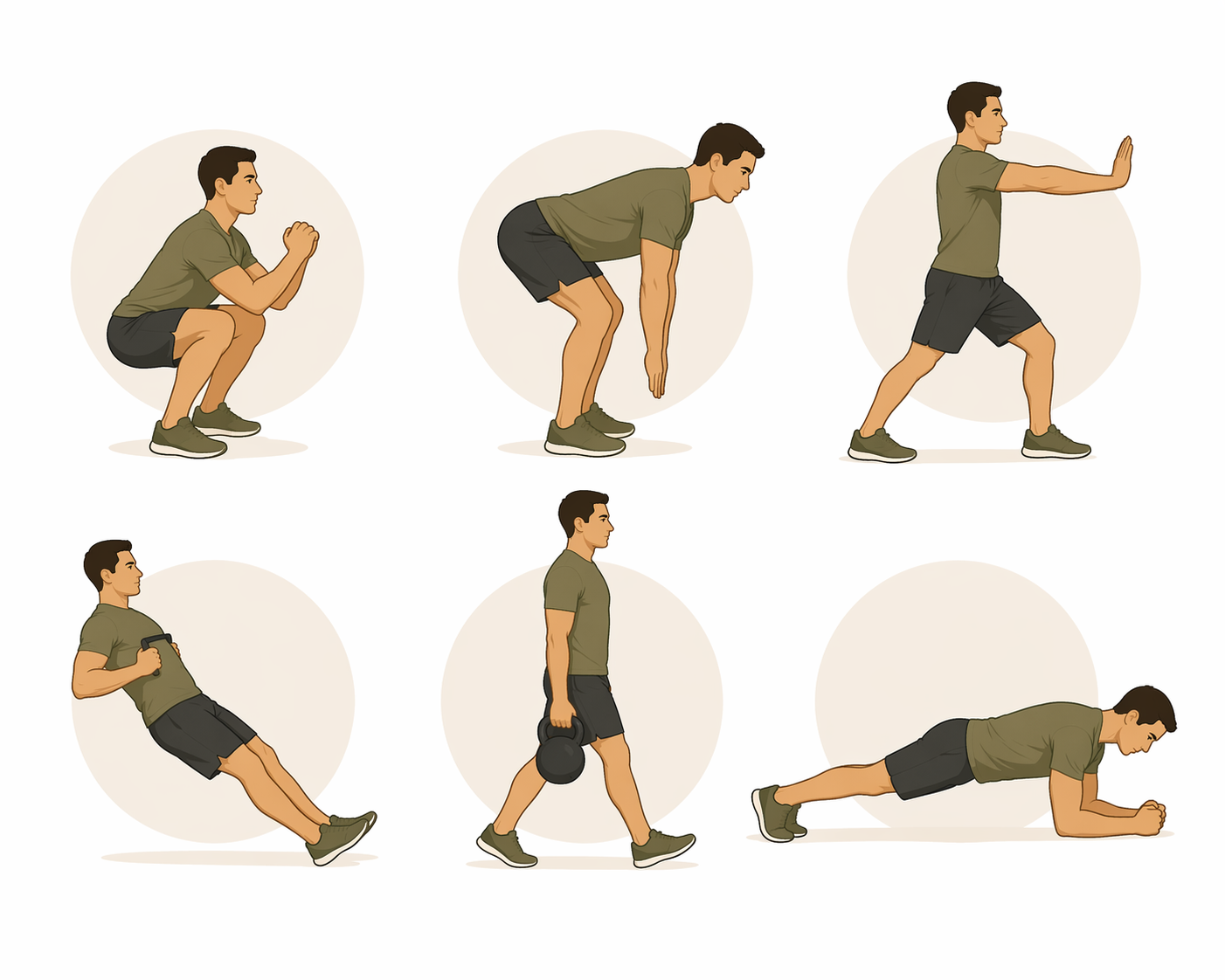
| Pattern | Main exercise | No-equipment option |
|---|---|---|
| Squat | Goblet squat to a chair | Sit-to-stand from a chair |
| Hinge | Dumbbell Romanian deadlift | Glute bridge |
| Push | Incline push-up or dumbbell floor press | Wall push-up or counter push-up |
| Pull | Band row or one-arm dumbbell row | Towel isometric row against your own resistance |
| Carry | Suitcase carry with one dumbbell | Slow marching carry with a backpack or bodyweight march |
| Core | Dead bug, plank, or side plank | Dead bug with shorter range of motion |
For the first 4–6 weeks, bodyweight versions can be enough if you are new, detrained, or dealing with appetite-related fatigue. The point is not to make every exercise hard on day one. The point is to practice the pattern, finish with a little capacity left, and create room to progress.
How Hard Each Set Should Feel
Use a simple effort rule: stop each set when you could still do about 2–3 more clean reps. If your form changes, the set is over. If you feel lightheaded, unusually weak, or nauseated, stop the session and follow the medical guidance you were given for side effects.
A controlled rep means you are not dropping into the squat, bouncing through the bridge, yanking the band, or holding your breath through the push. Move with enough control that the muscle, not momentum, is doing the work.
- Rest 45–90 seconds between sets.
- Use a chair, wall, countertop, or sofa arm for balance when needed.
- Keep the first week almost too easy; you are testing recovery as much as strength.
- Do not chase soreness. Mild soreness is fine; joint pain or symptoms are not the goal.
Your Weekly Schedule
Start with two full-body sessions per week. Put at least one day between them. If recovery is good by week 3 or 4, you can add a third shorter session, but it is optional. The 2–3 day weekly strength dose is consistent with common beginner strength guidance for people using GLP-1 medications and with practical fitness programming built around gradual progression. [3][6]
| If you train 2 days | If you train 3 days |
|---|---|
| Monday: Session A | Monday: Session A |
| Thursday: Session B | Wednesday: Session B |
| Optional weekend walk or mobility | Saturday: Session C, shorter or lighter |
Session A and Session B are enough. Session C is for weeks when food, sleep, hydration, and symptoms are cooperating. If adding a third day makes you dread the other two, remove it.
The Base Sessions
Session A
| Pattern | Exercise | Reps or time |
|---|---|---|
| Squat | Goblet squat to chair or sit-to-stand | 12–15 reps |
| Push | Incline push-up or dumbbell floor press | 12–15 reps |
| Hinge | Dumbbell Romanian deadlift or glute bridge | 12–15 reps |
| Pull | Band row or one-arm dumbbell row | 12–15 reps per side |
| Core | Dead bug | 6–10 reps per side |
| Carry | Suitcase carry | 20–40 seconds per side |
Session B
| Pattern | Exercise | Reps or time |
|---|---|---|
| Hinge | Glute bridge or dumbbell hip hinge | 12–15 reps |
| Squat | Split squat to a chair, supported reverse lunge, or sit-to-stand | 8–12 reps per side |
| Push | Dumbbell floor press or counter push-up | 12–15 reps |
| Pull | Band pull-apart or band row | 12–15 reps |
| Core | Forearm plank or elevated plank | 15–30 seconds |
| Carry | Farmer carry with two weights or backpack carry | 20–40 seconds |
Optional Session C
Use Session C as a lighter repeat, not a test. Pick four moves: sit-to-stand, band row, glute bridge, dead bug. Do 1–2 sets. Keep the whole thing around 15–20 minutes. This is useful when you want another muscle signal without turning your week into recovery math.
The 8-Week Progression
This 8-week structure is a practical synthesis of beginner strength guidance, GLP-1 fitness programming, and standard progression logic. It is not a trial-proven home protocol tested specifically in people taking semaglutide or tirzepatide. That distinction matters: the plan is built from the best available practical rails, not from a single study showing a guaranteed body-composition result. [3][6]
| Week | Sessions | Sets | Reps | Progression focus |
|---|---|---|---|---|
| 1 | 2 | 1 set per exercise | 12–15 controlled reps | Learn the movements; finish feeling like you could do more |
| 2 | 2 | 1 set per exercise | 12–15 controlled reps | Repeat week 1 with smoother form and steadier breathing |
| 3 | 2, optional light third | 2 sets for squat, push, hinge, pull; 1 set carry and core | 10–15 reps | Add a second set to the main lifts if week 2 recovery was good |
| 4 | 2–3 | 2 sets per exercise | 10–15 reps | Keep the same load and make all reps cleaner |
| 5 | 2–3 | 2 sets per exercise | 8–12 reps on weighted moves; 10–15 on bodyweight moves | Add a small amount of weight when you can complete the top of the range |
| 6 | 2–3 | 2 sets per exercise | 8–12 reps | Use slightly heavier dumbbells or a stronger band on 1–2 movements |
| 7 | 2–3 | 2–3 sets for main moves; 2 sets for carry and core | 8–12 reps | Add a third set only to exercises that still feel controlled |
| 8 | 2–3 | 2–3 sets | 8–12 reps | Hold, refine, or add small load; do not force every exercise to progress |
Weeks 1 and 2 are supposed to feel modest. If you have been eating much less than usual, your first win is completing two sessions without feeling flattened the next day. One set per exercise is not a failure version of training; single-set beginner strength work is often enough to start building the habit and tolerance for resistance training.
Weeks 3 and 4 add volume before load. That means you do more total work, but you do not need to buy heavier dumbbells yet. Add the second set only if the first set is controlled and your energy is predictable enough to recover.
Weeks 5 and 6 are where load begins to matter. If you can perform 15 goblet squats with steady form and still have several reps left, choose the next heavier dumbbell and work in the 8–12 rep range. If you only own one pair of dumbbells, slow the lowering phase, pause briefly at the bottom, or add reps before you buy anything else.
Weeks 7 and 8 give you the option of 2–3 sets. The third set belongs to the exercises that feel stable: often squats, bridges, rows, or carries. It does not belong to a movement that makes your knee, back, shoulder, or stomach complain.
How to Progress Without Guessing
Progressive overload just means gradually asking a little more of the muscle. You can do that by adding reps, adding a set, adding weight, using a stronger band, slowing the movement, or choosing a harder variation. You do not need to change all of those at once.
| What happened last session? | What to do next time |
|---|---|
| You finished every set with clean form and 2–3 reps left | Add 1–2 reps per set until you reach the top of the range |
| You reached the top of the rep range for two sessions | Add a small amount of weight or use a stronger band |
| The last reps were sloppy | Keep the same load and reps next time |
| You were sore for more than a couple of days | Repeat the previous week or reduce one set |
| You felt lightheaded, nauseated, or unusually weak | Stop, recover, and discuss symptoms with your clinician if they persist |
| You missed a session | Do the next scheduled session; do not double up |
For dumbbells, small jumps are friendlier than heroic jumps. A weight that lets you do 8 controlled reps is more useful than a heavier one that turns the exercise into a balance emergency. For bands, step farther away or use a thicker band only when the row or press still looks like the same exercise.
Low-Energy Days Are Already in the Plan
GLP-1 appetite suppression can make some days feel under-fueled. Fatigue, nausea, and lower intake can change what a normal workout feels like, and practical exercise guidance for GLP-1 users often emphasizes adjusting training around symptoms instead of forcing the same workload every day. [7]
Use this rule: reduce the dose before you skip the habit. A 15-minute session with one good set of each pattern still tells your muscles they are needed.
| If today feels like... | Do this version |
|---|---|
| Low appetite but otherwise okay | Do the planned session, but keep 3 reps in reserve and take longer rests |
| Tired or under-fueled | Do 1 set per exercise instead of 2–3 |
| Heavy legs or poor sleep | Lighten the load by about 30–50% |
| Mild nausea | Choose slower bodyweight work, skip carries, and stop if symptoms rise |
| Dizzy, shaky, or unwell | Do not train; follow your medical plan and contact your clinician if needed |
A low-energy Session A might be five moves: sit-to-stand, wall push-up, glute bridge, band row, dead bug. One set each. Done. That is not a motivational trick; it is how the plan survives the weeks when your appetite and schedule are not cooperating.
Protein Makes the Training Easier to Use
Strength training provides the signal. Protein provides the building material. During weight loss, protein recommendations vary, but a common practical range used in sports medicine and lean-mass preservation discussions is about 1.2–2.0 grams of protein per kilogram of body weight per day, adjusted for medical conditions and clinician guidance. [8]
If appetite is low, large meals may be the wrong battle. Smaller protein anchors often work better: a shake, Greek yogurt, eggs, cottage cheese, tofu, tuna, chicken, or a protein-forward soup. People with kidney disease or other conditions that affect protein targets should follow their clinician’s number, not an internet range.
| Body weight | 1.2 g/kg/day | 2.0 g/kg/day |
|---|---|---|
| 150 lb / 68 kg | About 82 g/day | About 136 g/day |
| 180 lb / 82 kg | About 98 g/day | About 164 g/day |
| 220 lb / 100 kg | About 120 g/day | About 200 g/day |
Those numbers are not a command to force food when you feel sick. They are a planning range. If you are far below it, start by adding one reliable protein serving earlier in the day, because waiting until dinner can be rough when the medication has flattened your appetite.
Form Notes for the Main Exercises
Goblet Squat to Chair
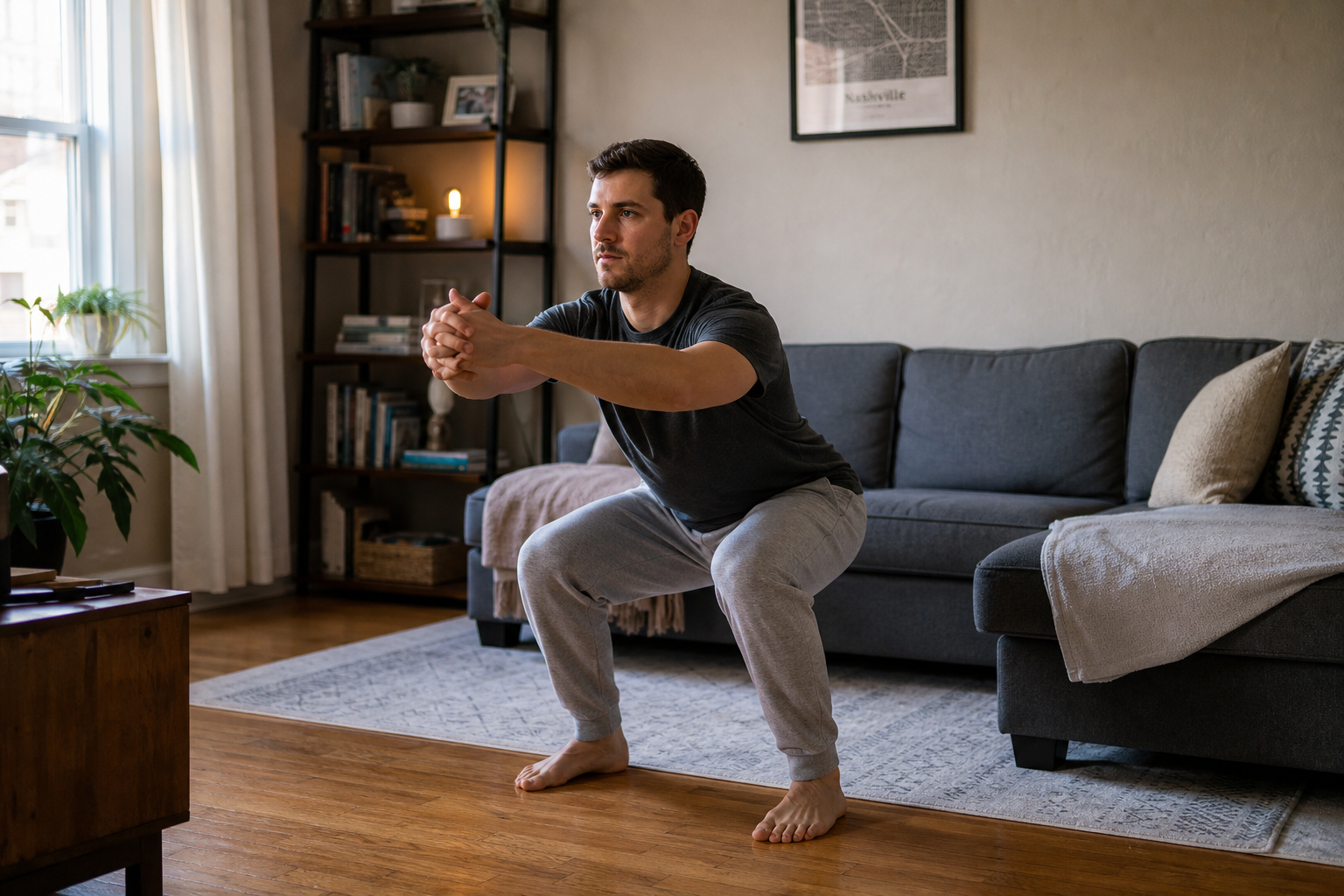
Stand in front of a chair with feet about hip-width to shoulder-width apart. Hold one dumbbell at your chest, or use no weight. Sit your hips back, tap the chair lightly, then stand. If your knees feel better with a higher chair or a pillow on the seat, use it.
Dumbbell Romanian Deadlift
Hold dumbbells in front of your thighs. Soften your knees, push your hips back, and let the weights travel close to your legs. Stop when you feel your hamstrings working or your back wants to round. Stand tall by pressing the floor away.
Incline Push-Up
Place your hands on a wall, countertop, sturdy table, or sofa arm. Keep your body in one line, bend your elbows, and press back up. The higher your hands are, the easier the exercise becomes.
Band Row
Anchor the band securely or loop it around your feet while seated. Pull your elbows back, pause briefly, and return with control. If the band snaps you forward, it is too heavy or you are too far from the anchor.
Suitcase Carry
Hold one dumbbell at your side and walk slowly across the room. Keep your ribs stacked over your hips. Switch sides. If walking space is limited, march in place.
Dead Bug
Lie on your back with knees bent over hips and arms reaching up. Slowly lower one heel or one leg while keeping your low back heavy on the mat. Make the range smaller if your back arches.
When to Hold Steady
Holding steady is progress when your body is adapting to a lower intake, a new medication dose, or a busier week. Repeat the same week if your sleep was poor, your protein intake dropped, you had lingering soreness, your form got worse, or you increased your GLP-1 dose and side effects changed.
The plan works best when you treat it as a dial, not a pass-fail test. Turn the dial up when reps are clean and recovery is normal. Turn it down when symptoms, food intake, or life make the full version a bad bargain.
After Week 8
At the end of week 8, keep the same structure and choose one progression: slightly heavier dumbbells, a stronger band, a third set on two main exercises, or a harder variation such as a lower incline push-up. Do not upgrade everything in the same week.
Preserving muscle at home does not require a barbell, a gym membership, or a perfect appetite. It does require repeated mechanical work, gradual overload, enough protein to support recovery, and a minimum version of the workout that still happens when the full version is too much.
References
- Changes in lean body mass with glucagon-like peptide-1-based therapies and cessation, PubMed
- Systematic review on muscle mass and GLP-1 receptor agonists, AHA Circulation
- Fitness for People Taking GLP-1 Agonists, Mass General
- A Beginner Strength Training Workout for People on GLP-1s, SELF
- Six of the best exercises to preserve strength for GLP-1 users, according to an expert, Fit&Well
- Strength Training While on GLP-1: A 6-Week Plan, iFIT
- Ozempic and Exercise: How to Maintain Muscle on a GLP-1, Hinge Health
- Preserving Lean Body Mass in Patients Taking GLP-1 for Weight Loss, Mass General Advances
Comments
Join the discussion with an anonymous comment.