
The number one reason people give for not exercising is time. Not motivation, not equipment, not knowledge. Time. And when you look at who actually quits an exercise program, the same pattern shows up: a single 30-minute block is too hard to protect from the rest of the day. The meeting runs long. The kid wakes up. The energy tank is empty after work.
Now try a different structure: five minutes. Not a warm-up plus a finisher, but five deliberate minutes of moderate-to-vigorous movement, repeated two or three times during the day. That is the exercise snack model. It is not a shorter version of traditional cardio — it is a structural reframe of how exercise fits into a life. And the evidence from 2025–2026 is strong enough that I think we should stop assuming one continuous session is the only way.
What the 2026 meta-analysis actually found
The core of the exercise snack argument is a systematic review and meta-analysis published in the British Journal of Sports Medicine in 2026. It pooled 11 randomised controlled trials covering 414 physically inactive adults (69.1% women, age range 18–74). The headline number: a large effect size of Hedge's g = 1.37 for improvement in cardiorespiratory fitness (CRF), with a 95% confidence interval of 0.58 to 2.17. That is a real, clinically meaningful gain — not a subtle blip.
But here is what the meta-analysis does not say. It found no significant effects on lower limb strength, body composition (body fat percentage, BMI), blood pressure, or blood lipids. The CRF improvement is moderate certainty evidence; everything else is very low certainty or simply absent. If someone tells you exercise snacks will fix your cholesterol or melt belly fat, they are reading the wrong study.
The other striking number is adherence. In unsupervised home-based settings, 82.8% of participants stuck with the snack protocols. The meta-analysis cites comparative data from Santos et al. 2023 showing that traditional moderate-intensity continuous training (MICT) averaged 68.2% adherence and high-intensity interval training (HIIT) averaged 63% in similar unsupervised contexts. I want to be clear: that 82.8% figure is not from a direct head-to-head within the same trial — it is a cross-study comparison. But the gap is large enough to take seriously. When people can fit exercise into their day in small chunks, they actually keep doing it.
What counts as a snack — and what does not
The meta-analysis used a clear definition: structured bouts lasting ≤5 minutes, performed at least twice per day, at least three days per week, for a minimum of two weeks. The exercise modes in the included studies varied — stair climbing for younger adults, resistance or tai chi for older adults — so the specific movement matters less than the structure.
This is where the distinction from other short-duration workouts matters. Unlike traditional HIIT sessions that require a single 10-to-20-minute block, or the 7-minute workout which is a single condensed circuit, exercise snacks are spread across the day. You are not doing one bigger block; you are doing multiple smaller blocks. That structural difference is what makes the adherence rates possible.
Three protocols you can start tomorrow
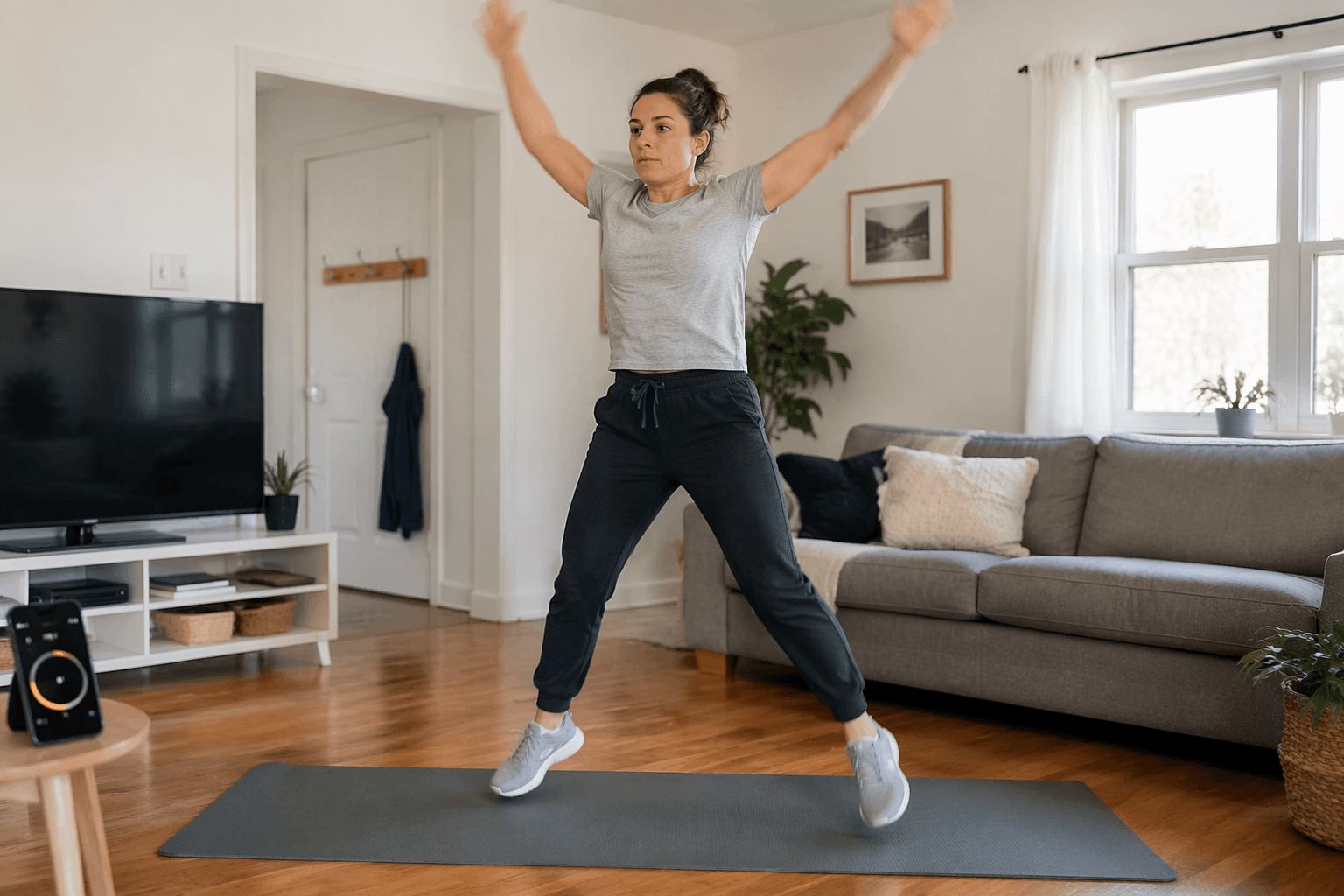
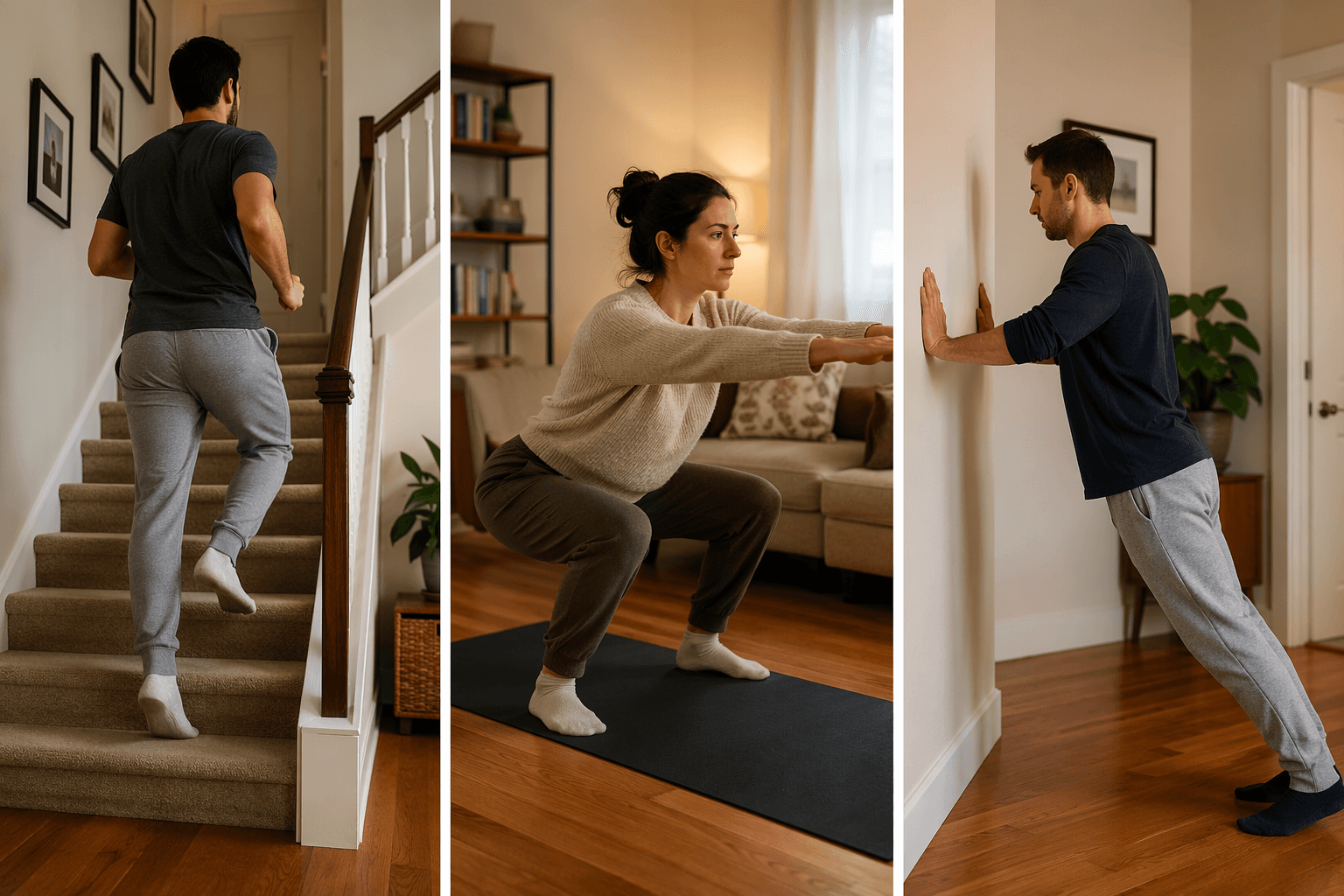
The meta-analysis did not prescribe exact workouts, but the included studies point to practical options. Combined with a recent controlled trial of a home-based eccentric program, here are three concrete protocols that require no equipment and fit any home.
| Protocol | Duration | Intensity | Key outcomes | Caveats |
|---|---|---|---|---|
| Stair climbing circuit | 5 min | Brisk ascent/descent, RPE 6–8/10 | Improved CRF (meta-analysis primary outcome) | Best for homes with stairs; younger adults in studies |
| Bodyweight mini-circuit | 5 min (squat jumps, push-ups, mountain climbers – low-impact versions available) | Moderate-to-vigorous, keep moving | Matches meta-analysis definition; scalable intensity | Needs a few square feet of floor space |
| Eccentric 5-min program (Kirk et al. 2025) | 5 min daily, 4 weeks | Controlled eccentric movements (slow lowering phase) | 66% push-up improvement, 51% sit-up improvement, 13% strength gain, 16% mental health improvement, 4.8% lower heart rate in step test | n=22, no control group, predominantly women; results may not generalize |
The eccentric protocol comes from a 2025 study by Kirk et al. in the European Journal of Applied Physiology. Twenty-two sedentary adults did a daily 5-minute home-based eccentric program for four weeks. The results are impressive on paper: push-up endurance up 66%, sit-up endurance up 51%, isometric strength up 13%, and mental health scores up 16%. Adherence averaged 91%. But I have to point out the limitations: the sample is tiny (n=22), there was no separate control group (they used a control period design), and 18 of the 22 participants were women. The study also found no changes in body composition, resting heart rate, or blood markers. I would treat these results as promising but not settled.
Building the habit
The meta-analysis showed benefits with at least two bouts per day, at least three days per week. That is the minimum bar. If you are starting from zero, pick one snack per day for the first week. Morning and afternoon breaks are natural slots for desk workers. Once you are consistent at two snacks daily, you can increase frequency (add a third), then increase intensity (choose a harder variant), then consider progressing to longer sessions.
When you do decide to move to structured, longer workouts, the 4-Week Progressive Home Cardio Plan (bodyweight only) is a natural next step. It builds on the same principles — short, manageable sessions that gradually increase duration — but in a single daily block rather than multiple snacks. Most people benefit from at least a month of snack consistency before stepping up.
- Week 1–2: One 5-min snack per day. Any protocol above. Focus on hitting moderate intensity.
- Week 3–4: Two snacks per day. Space them at least four hours apart.
- Week 5+: Three snacks per day or try the first snack at a higher intensity (e.g., faster stair climbing, more explosive movements).
- When ready: transition to a 20-minute structured workout using the 4-Week Plan.
What snacks still cannot do
I do not want you to misunderstand the evidence. Exercise snacks are not a total fitness solution. The meta-analysis found no significant effects on blood pressure, blood lipids, body composition, or lower limb strength. The Kirk et al. study also reported no changes in body composition, resting heart rate, or blood markers. If your primary goal is muscle growth, fat loss, or blood pressure control, you need additional modalities — longer strength sessions, steady-state cardio, or dietary intervention. Exercise snacks are fantastic for cardiorespiratory fitness and adherence, but they are a single tool in a broader home fitness practice.
Start with one snack
The data supports using exercise snacks specifically for improving cardiorespiratory fitness, with adherence rates that beat traditional programs by a wide margin. Even modest CRF gains reduce mortality risk. For time-constrained adults — people who know they need to move but cannot find a 30-minute window — this is the most practical, evidence-backed approach I have seen in years.
Start tomorrow. One snack. Five minutes. Do it twice if you can. If you have never exercised at home before, read the beginner's guide to starting and sticking with home workouts for the full context. The evidence is not perfect, but it is good enough to act on.
Comments
Join the discussion with an anonymous comment.