
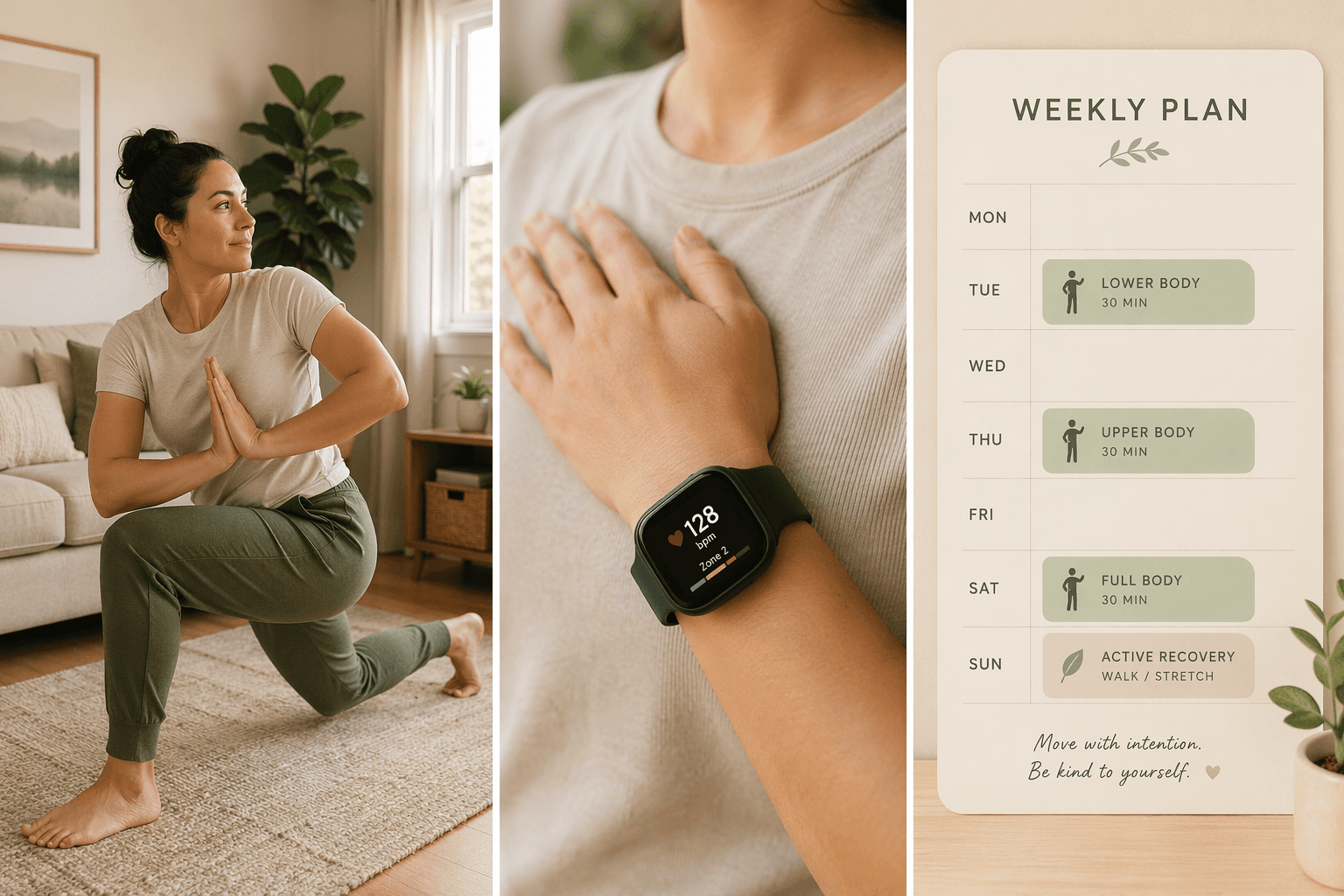
Can you really get a meaningful cardio workout at home with no equipment?
That’s the question. Most people assume you need a treadmill or a bike to push your heart rate. A 2019 study from Liverpool John Moores University tested that assumption. Thirty-two participants with obesity did a bodyweight home HIIT routine three times a week for 12 weeks. The home group improved aerobic capacity, insulin sensitivity, and arterial function as much as a lab-based cycling HIIT group and as much as the government-recommended 150 minutes of moderate exercise per week. The results were published in The Journal of Physiology. That is a strong claim. But it is also a single study with 32 people, all with obesity. I am not going to tell you this settles the question. I am going to use it as a starting point for a plan that, with the right structure, actually works.
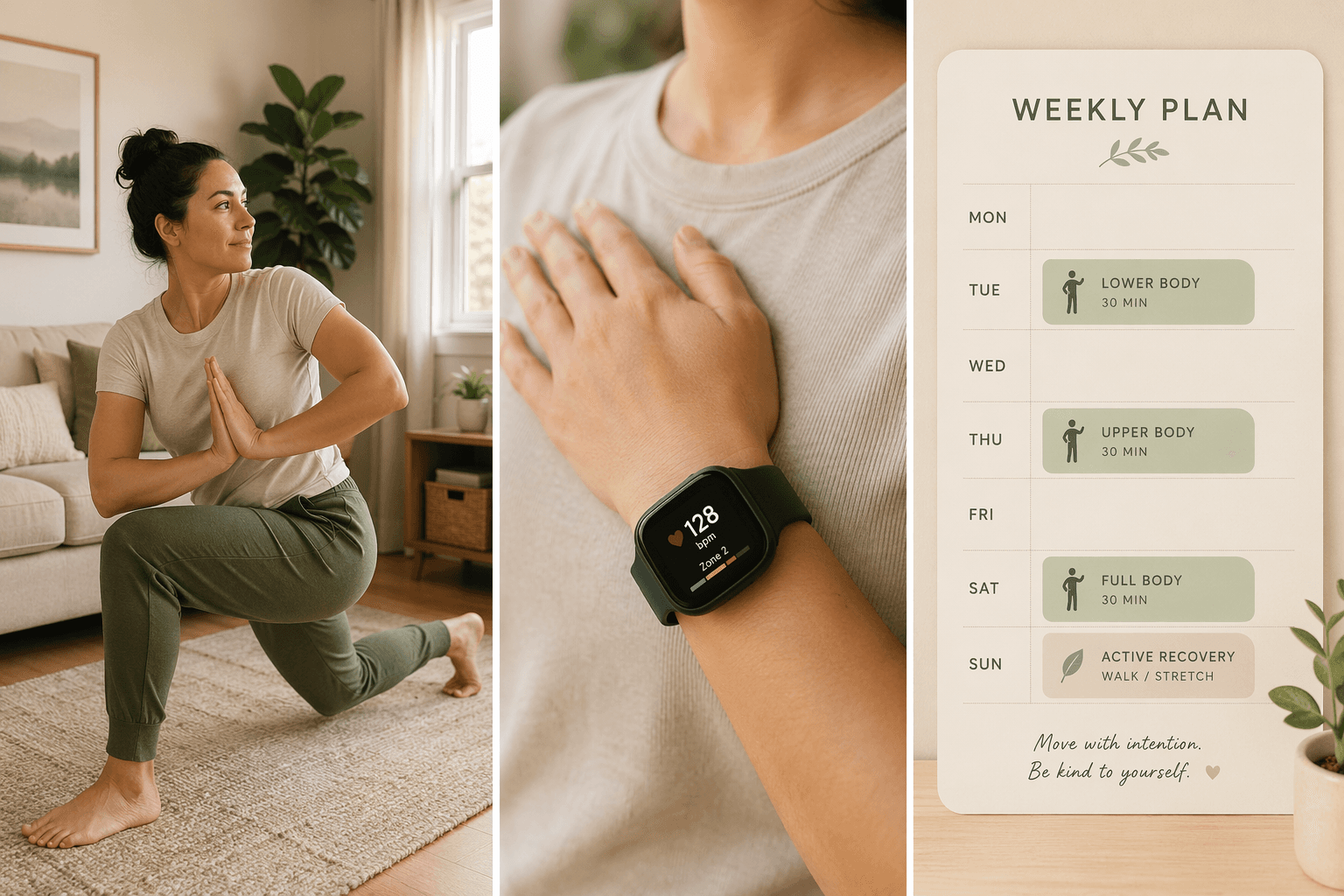
Why most home cardio plans stop working after two weeks
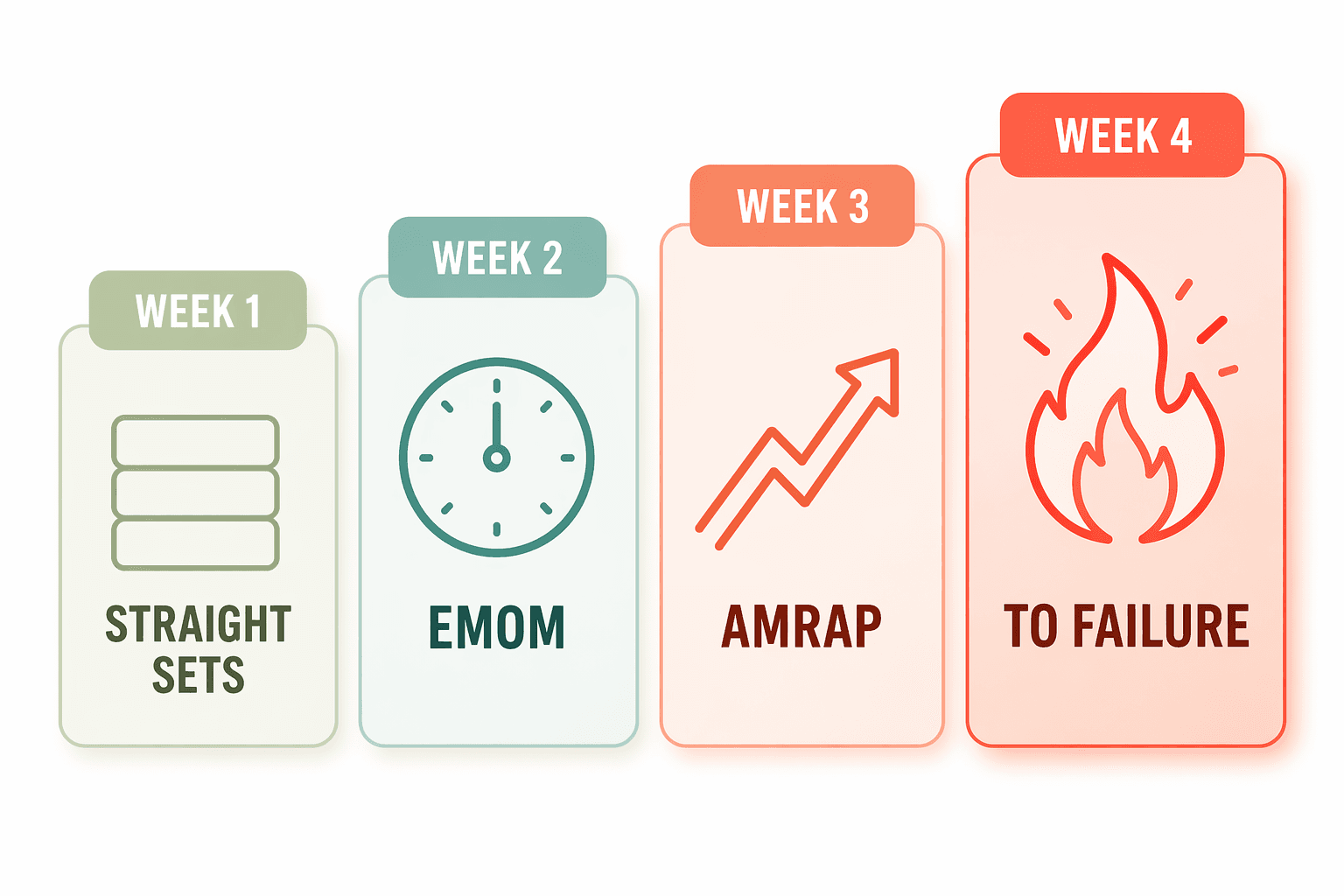
The problem is simple: your cardiovascular system adapts. Without a systematic increase in demand, the stimulus plateaus. In the gym you add weight. At home, you have to change the format. Shorten rest, increase work density, or shift the session goal. That is what this plan does. Each week uses a different structure — Straight Sets, EMOM, AMRAP, and To Failure — to keep intensity rising. As Noam Tamir, CSCS, told SELF, compound bodyweight movements can match the heart rate elevation of jumping moves when performed at a higher tempo with shortened rest. The plan leans on that principle.
What the LJMU study actually showed (and what it did not)
The Liverpool study measured VO₂ peak, insulin sensitivity, and brachial artery function. The home group showed significant improvements. But here is what the study did not do: it did not compare home HIIT to typical gym resistance training. It compared it to cycling HIIT and to moderate activity. The conclusion is narrower than many articles suggest. Also, the sample size is small. I find the results promising enough to build a plan around, but I would not tell you this replaces a gym membership.
The 4-week progression: how it forces adaptation without equipment
The key is changing the demand on your heart and lungs by altering how you structure each session. Here is a quick comparison of the four formats:
| Week | Format | What it does | Example structure |
|---|---|---|---|
| 1 | Straight Sets | Constant work-to-rest ratio; good for building baseline work capacity. | 40s work / 20s rest, 3 rounds, 6 exercises |
| 2 | EMOM (Every Minute on the Minute) | Teaches pacing; you must finish reps in ≤60s, then rest the remainder. | 15 reps per minute for 8 minutes, 4 exercises |
| 3 | AMRAP (As Many Rounds As Possible) | Increases total volume under a fixed time cap; pushes endurance. | 12 minutes, complete as many rounds of 5 exercises as possible |
| 4 | To Failure | Maximal fatigue per set; advanced overload with extended rest. | 3 exercises, 2 sets to failure each, 90s rest between sets |
You measure intensity with the Rate of Perceived Exertion (RPE) scale (1–10) — 1 is lying on the couch, 10 is all-out sprint. For vigorous cardio, you want to be in the 7–8 range for work intervals. The talk test is simpler: during work, you should be able to say a few words but not a full sentence. If you can sing, you are not working hard enough. If you have a heart rate monitor, use the AHA target heart rate chart. But remember, 220 minus age is an average. You may be a few beats above or below.
Adherence: the numbers from the lab do not always translate to your living room
The Roberts et al. NIH study reported session attendance of 94% and 92.6% over 12 weeks. Those numbers came from supervised group settings with controlled meals provided. At home, managing your own schedule and kitchen, adherence is likely lower. I mention this not to discourage, but to set realistic expectations. Aim for three sessions per week. If you miss one, do not panic. Even three sessions per week over 4 weeks (12 sessions) still moves the needle. The AMA/Circulation study of 116,000 adults found that meeting the minimum recommended levels (75–150 min vigorous per week) reduced cardiovascular disease mortality by 22–31%. That means even a few sessions a week that genuinely get your heart rate up are doing real work.
The plan in detail
Do each session after a 5-minute warm-up (jogging in place, arm circles, leg swings) and finish with a 3-minute cool-down (walking, deep breathing). Choose 6–8 exercises from the library below. Rotate them between sessions to avoid boredom. Aim for 3–4 sessions per week, spacing them out so you have at least one rest day between sessions.
Week 1: Straight Sets
Perform each exercise for 40 seconds, then rest 20 seconds. Complete all exercises to finish one round. Rest 60 seconds between rounds. Do 3 rounds total. RPE target: 7–8. Talk test: should be able to say three words but not a full sentence.
Week 2: EMOM
Set a timer for 8 minutes. At the start of each minute, begin your set of 15 reps of the first exercise. Finish the reps, then rest the remainder of the minute. Start the next minute with the next exercise. Cycle through 4 exercises twice. RPE target: 8. If 15 reps is too easy, increase to 18–20.
Week 3: AMRAP
Set a timer for 12 minutes. Perform 5 exercises in sequence without rest between exercises. Rest 60 seconds after finishing all 5. Repeat as many rounds as possible. Count your rounds each session and try to beat that number next time. RPE target: 8–9.
Week 4: To Failure
Pick 3 exercises. Perform the first exercise until you cannot do another rep with good form (failure). Rest 90 seconds. Do a second set to failure. Move to the next exercise. That is two rounds of 3 exercises. RPE target: 9–10. This week is demanding. If you feel excessive fatigue, scale to 2 exercises or reduce sets to one per exercise.
Exercise library (with modifications)
- Bodyweight squat – Modification: sit-to-stand from a chair. To increase intensity, add a jump.
- Mountain climber – Modification: step feet back one at a time instead of jumping. Increase speed for intensity.
- Push-up – Modification: knee push-ups or incline on a counter. To increase, add a shoulder tap at the top.
- Reverse lunge – Modification: stationary lunge. Increase tempo: hold the low position for 2 seconds.
- Plank jack – Modification: step feet out and in instead of jumping. Increase tempo for intensity.
- Bicycle crunch – Modification: slower, controlled movement. Increase speed for intensity.
- Speed squat – Modification: squat with a 3-second descent. Increase speed to explosive.
All of these moves come from the SELF low-impact Tabata workout and the POPSUGAR list of 17 quiet cardio exercises. They are effective without equipment and quiet enough for apartment living.
Does this plan meet the AHA guidelines?
Let me do the math. Suppose you do three sessions per week, each 22–30 minutes of work (excluding warm-up and cool-down). That gives about 66–90 minutes of vigorous activity per week. The AHA recommends at least 75 minutes per week of vigorous activity. The plan meets or exceeds that threshold. For more benefit, the AHA suggests 300 minutes of moderate or 150 minutes of vigorous per week. The plan at four sessions per week (120 minutes vigorous) comes close. The AMA study found that doing two to four times the minimum (150–299 minutes vigorous per week) reduced all-cause mortality by 21–23% and CVD mortality by 27–33%. That is a strong incentive to work up to four sessions if you can.
Week 4 requires caution
I designed week 4 to be the hardest, and it is. Training to failure accumulates a lot of fatigue, especially for your central nervous system. If you are a beginner, do not attempt true failure on every set. Use RPE 9 instead — stop one rep short of failure. You can also drop to two exercises or do only one set per exercise. The AMA study found no harmful effects of high vigorous activity at the population level, but individuals vary. If you feel joint pain, extreme soreness, or a drop in performance, back off. The plan is meant to challenge you, not break you.
What comes after week 4? How to keep progressing
Four weeks is a starter, not a ceiling. To continue progressing, you have several options:
- Repeat the 4-week cycle but increase volume: add one more round (Straight Sets), increase reps per minute (EMOM), extend the time cap (AMRAP), add a third set (To Failure).
- Introduce new formats: descending rest (e.g., 90s, then 75s, then 60s between sets), ladder sets (1 rep, rest, 2 reps, rest, 3 reps...), or combine EMOM into AMRAP (10 minutes EMOM then 5 minutes AMRAP).
- Add light resistance: a weighted vest, resistance bands, or a filled backpack for squats and lunges.
- Increase session frequency to 4–5 times per week, but keep at least one full rest day.
This plan differs from existing same-site content (such as the low-impact habit-building 4-week plan) because it focuses on progressive intensity overload and backs it with evidence. If you have followed a beginner plan before, this one will take you further.
The bottom line: what this plan can and cannot do for you
This plan can improve your aerobic fitness, help you meet the AHA guidelines for vigorous activity, and reduce your risk of cardiovascular disease — backed by one small but well-designed study and supported by exercise physiology principles. It can be done in a small apartment, costs nothing, and takes less than 30 minutes per session.
It cannot claim to be a proven replacement for supervised gym training in every population. The LJMU study is promising, not definitive. The adherence data came from highly controlled settings. Your results will depend on your consistency and willingness to push yourself. But here is what I know: doing this plan is far better than doing nothing. The evidence that even minimal vigorous activity cuts mortality by 22–31% is strong. So start week 1. Listen to your body. Adjust as needed. And when you finish week 4, keep going.
Comments
Join the discussion with an anonymous comment.