If wildfire smoke just canceled your run, race, practice, or outdoor class, the move is not to sneak in an “easy” version outside. Check the outdoor AQI, check what your indoor air is doing, close the room down as best you can, then train inside for 15 to 30 minutes if the indoor conditions and your body both say yes.
That can feel unsatisfying when you were already dressed, fueled, and mentally committed. It is still the right pivot. During exercise, ventilation can rise from roughly 12 liters per minute at rest to around 100 liters per minute, increasing PM2.5 intake by 10 to 20 times during smoky conditions.[1] A 30-minute jog through heavy smoke is not just a shorter version of the workout you planned. It is 30 minutes of hard breathing in air your event organizers, coach, or local health officials have already decided is not fit for the original plan.
First, decide whether this is an indoor workout day
Use the AQI as a decision tool, not as a vibe check. When smoke pushes the AQI to 151 or higher, AirNow guidance says everyone should avoid prolonged outdoor exertion.[2] Sensitive groups, including people with asthma, heart disease, older adults, children, and pregnant people, should move exercise indoors earlier, around the 100 AQI range.[3]
Indoors can be meaningfully better, but only if the indoor air is actually protected. A well-sealed home with windows closed, air conditioning set to recirculate, and HEPA filtration can reduce indoor PM2.5 to less than half the outdoor level.[4] That is the opening you are using for today’s workout: not “inside is automatically safe,” but “a controlled indoor room may be safer than training outside.”
- Do the normal 15-30 minute circuit if outdoor AQI is poor but your indoor space is closed up, filtered or reasonably sealed, and you have no smoke-related symptoms.
- Reduce intensity if the room smells smoky, feels stale, lacks filtration, or you are unsure whether outdoor air is leaking in.
- Switch to mobility, easy core, or light strength if you notice throat irritation, coughing, unusual chest tightness, wheezing, dizziness, headache, or heavier-than-normal breathing.
- Skip exertion and focus on cleaner air if symptoms continue indoors or if your indoor AQI is also poor.
If you own an indoor air monitor, use it. If you do not, be conservative with smell, visible haze, symptoms, and whether you can create one cleaner room. Close windows and exterior doors, avoid cooking or vacuuming right before the workout, set HVAC to recirculate if available, and place a HEPA purifier in the workout room if you have one. The better the room, the more reasonable the workout.
Why the replacement workout is short
The point of shortening the session is not to make the day easy. It is to reduce the time you spend breathing hard while still giving your legs, trunk, and nervous system a training signal. Coaching guidance for smoky conditions commonly favors shorter sessions over long outdoor endurance work because particle exposure is strongly tied to how long you are breathing elevated volumes of air.[5]
This is where a bodyweight circuit earns its place. Squats, lunges, hinges, push-ups, planks, and controlled intervals can keep the habit intact and maintain useful fitness without pretending to replace a long run, marathon workout, or sport-specific practice. If your long run was canceled, this is not the same stimulus. It is the best available training compromise for a day when the air changed the rules.
Fit people are not exempt from this tradeoff. A Brown University marathon analysis cited by GU Energy Labs found that for every 1 µg/m³ increase in PM2.5, men ran 32 seconds slower and women ran 25 seconds slower, with the strongest effects seen among the fittest runners.[6] Training-week exposure matters too: a 2023 collegiate distance runner study reported that PM2.5 exposure during the 21 days before a 5K championship predicted slower race times, even when the question was not simply race-day air.[7]
The 15-30 minute indoor bodyweight workout
Set up in the cleanest room you can make: windows closed, fan or HVAC not pulling smoky air from outside, purifier running if you have one, enough floor space for a mat or towel. Keep water nearby. The effort should feel controlled, not like a test of how much air you can move through your lungs.
| Part | Time | What to do |
|---|---|---|
| Warm-up | 3-5 minutes | Easy marching, joint circles, gentle squats, hip hinges, and light mobility |
| Main circuit | 10-20 minutes | Bodyweight strength moves with controlled breathing and short rests |
| Cool-down | 2-5 minutes | Slow walking, floor breathing, calf and hip flexor stretches |
Warm-up: 3 to 5 minutes
Start easier than you think you need to. You are trying to raise tissue temperature and check how your breathing feels indoors, not prove the cancellation annoyed you.
- March in place or step side to side for 60 seconds.
- Do 8 slow bodyweight squats, stopping above any painful range.
- Do 8 hip hinges with hands on hips, reaching your hips back without rounding hard through the spine.
- Do 6 reverse lunges per side, or step-back toe taps if lunges feel too much.
- Do 20 to 30 seconds of shoulder rolls, arm circles, and easy nasal breathing if that feels comfortable.
Main circuit: choose 15, 20, or 30 minutes
Pick the version that matches your indoor air and your training background. If this was supposed to be a routine easy run, 15 to 20 minutes is enough. If you are trained, the room is well controlled, and you feel normal, go up to 30 minutes. Stop early if smoke symptoms show up.
| Version | Best for | Format |
|---|---|---|
| 15 minutes | Uncertain indoor air, beginner fitness, or sensitive-group caution | 2 rounds, 40 seconds work / 40 seconds rest |
| 20 minutes | Most canceled-run days in a decent indoor setup | 3 rounds, 40 seconds work / 20 seconds rest |
| 30 minutes | Experienced exercisers in a cleaner, filtered room | 4 rounds, 45 seconds work / 15-30 seconds rest |
For each round, move through these exercises in order:
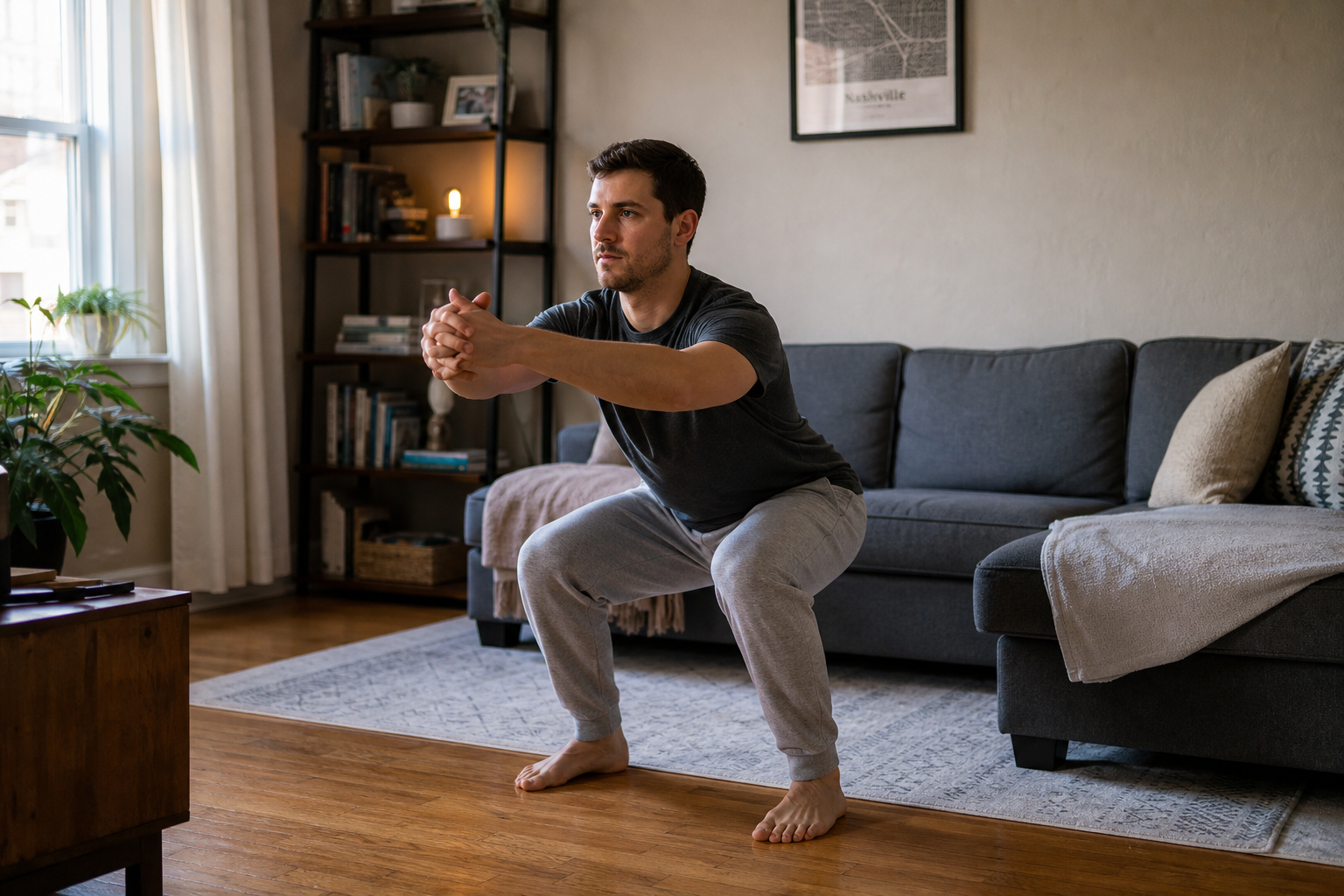
- Bodyweight squat: Sit hips back, keep the whole foot down, and stand tall without jumping.
- Incline or floor push-up: Use a counter, couch, bench, or wall if the floor version turns sloppy.
- Reverse lunge: Step back, lower under control, and alternate sides; use split squats if stepping bothers balance.
- Glute bridge: Drive through heels, squeeze glutes at the top, and lower slowly.
- Plank shoulder tap or dead bug: Choose the option that lets you keep your ribs down and breathing steady.
- Low-impact cardio finisher: March fast, do step jacks, shadow box lightly, or perform slow mountain climbers.
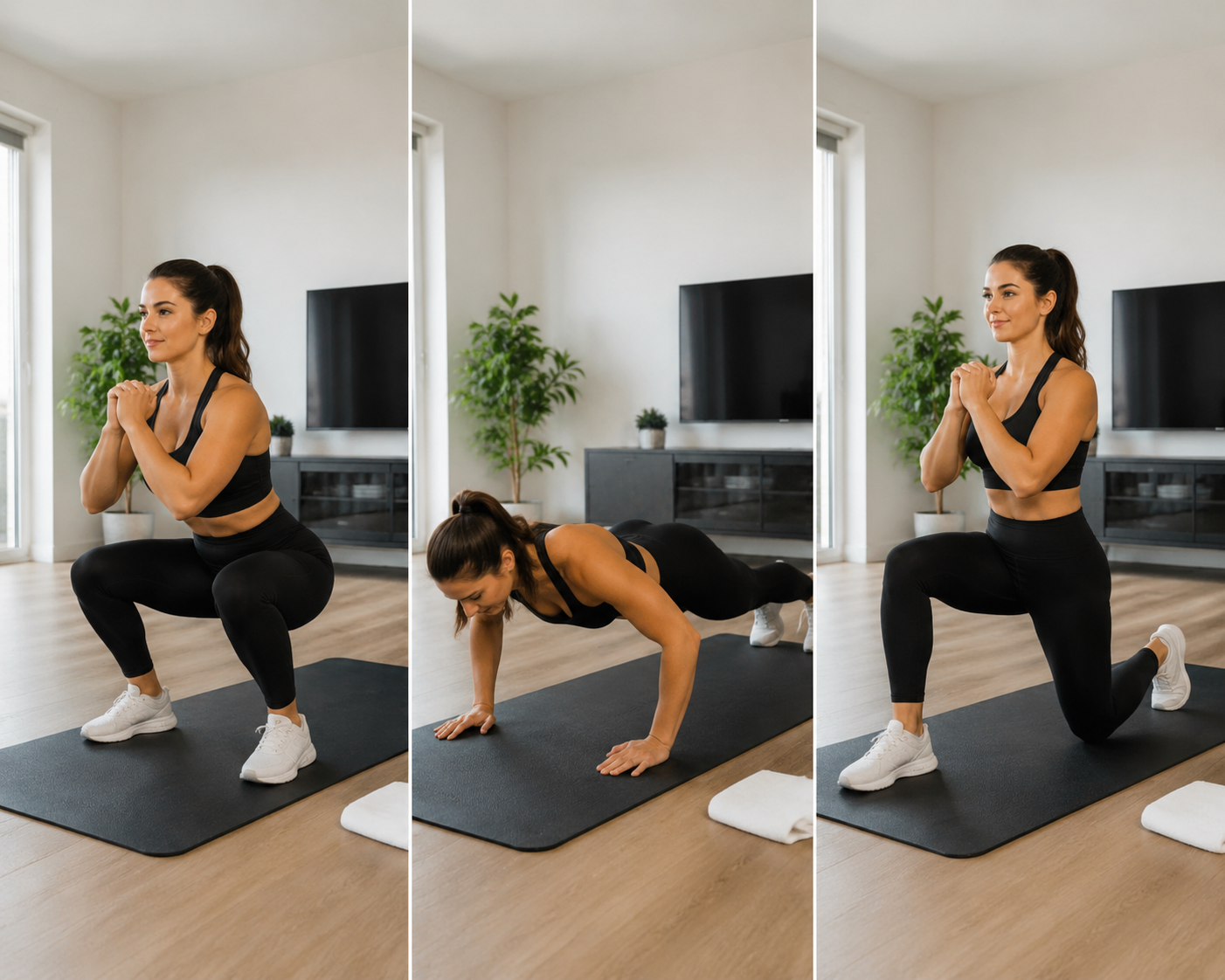
Keep the first round deliberately manageable. If you finish the cardio move gasping, reduce the next round. This is not the day for burpees, jump squats, or all-out intervals unless your indoor air is excellent and those moves already belong in your training.
Low-impact swaps
| If the exercise spikes breathing or bothers joints | Use this instead |
|---|---|
| Jumping jacks | Step jacks or side steps |
| Mountain climbers | Standing knee drives or dead bugs |
| Reverse lunges | Supported split squats or sit-to-stand squats |
| Floor push-ups | Wall, counter, or couch push-ups |
| Plank shoulder taps | Forearm plank hold or bird dog |
Beginner version
Do two rounds only. Work for 30 seconds, rest for 45 to 60 seconds, and leave out the cardio finisher if breathing feels rough. Your exercise list becomes squat to a chair, wall push-up, supported reverse lunge or step-back tap, glute bridge, dead bug, then one minute of easy walking around the room.
If bodyweight training still feels like filler compared with running, that skepticism is understandable. Strength work will not mimic a long run, but it does train positions, tendon loading, trunk control, and muscular endurance that runners and field-sport athletes can use. For a deeper look at why no-equipment training is legitimate on its own terms, use Bodyweight Training Actually Works: What the 2026 Science Says after today’s session, not in the middle of deciding whether to train.
Cool-down: 2 to 5 minutes
End by bringing breathing down, not by collapsing on the floor. Walk slowly for one minute. Then do a calf stretch, hip flexor stretch, and child’s pose or lying knees-to-chest breathing. If lying down makes breathing feel worse, sit upright instead. The finish line is normal breathing in a cleaner room.
If indoor air is only partly controlled
Many homes are not sealed like labs. Some apartments pull smoky hallway air under the door. Some houses do not have air conditioning. Some people have a purifier in one bedroom and nowhere else. That does not make the day useless; it changes the session.
| Indoor condition | Training choice |
|---|---|
| Room smells clean, windows are closed, HVAC is on recirculate, purifier is running if available | Use the normal 15-30 minute circuit |
| Room is probably better than outside, but you smell faint smoke or lack filtration | Use the 15-minute version, avoid the cardio finisher, and extend rests |
| Indoor air feels irritating or you develop symptoms | Stop the circuit and switch to gentle mobility or rest |
| Indoor AQI is poor or symptoms continue after stopping | Skip exercise and prioritize cleaner air |
An N95 may reduce inhaled particles outdoors, but it is a backup consideration rather than the main plan for exercise. Hard training through a tight respirator is uncomfortable for many people, and it does not solve the problem of spending a long time breathing heavily in smoky air. If your event was canceled because conditions are bad, a cleaner indoor room is the better target.
If smoke lasts more than one day
Do not repeat the hardest version of the same circuit every day just because the forecast keeps disappointing you. Rotate the stress. One smoke day can be the full circuit. The next can be mobility, core, and light strength with much less heavy breathing. A third can return to the circuit if indoor air and symptoms are still acceptable.
- For two smoke days: do the circuit once, then do an easier mobility and core day.
- For three to five smoke days: alternate strength circuits with lower-breathing sessions and short walks inside if your indoor air is good.
- For a canceled long run: keep one moderate circuit, but do not try to “make up” the full duration indoors unless you have a clean indoor facility and the workout already fits your plan.
- For symptoms: treat coughing, wheezing, chest tightness, dizziness, or unusual fatigue as a reason to back off, not as a pacing problem.
If you want progression while smoke disrupts the week, use a real home-training plan instead of improvising a new punishment circuit each day. A simple next step is a 4-Week No-Equipment Home Workout Plan for Beginners. If bodyweight training becomes more than an emergency substitute, move to a 12-Week At-Home Bodyweight Workout Plan after the smoke clears.
For variety during a multi-day smoke event, swap in an upper-body no-equipment routine on a day after lunges and squats, or use a quiet small-space workout if neighbors, sleeping kids, or apartment floors rule out impact.
When outdoor AQI improves, return gradually. The first clear-air day does not have to carry every mile, drill, or interval you missed. Resume with an easier run or practice, then rebuild toward the original plan if symptoms are gone and the air remains acceptable. The useful win here is narrow and real: protect your lungs, preserve the training rhythm, and avoid the false choice between unsafe outdoor exercise and doing nothing.
References
- Is it safe to exercise outside when there is wildfire smoke in the air? — Colorado State University
- When Smoke is in the Air — AirNow.gov
- Four Things to Know About Air Quality and Exercise — American Lung Association
- Protecting indoor air from wildfire smoke — OSU Extension Service
- Adjust Training in Response to Air Pollution and Forest Fire Smoke — CTS TrainRight
- The AQI Dilemma: Is It Safe to Exercise? — GU Energy Labs
- High AQI: Is it Safe to Exercise Outside? — TrainingPeaks
Comments
Join the discussion with an anonymous comment.