
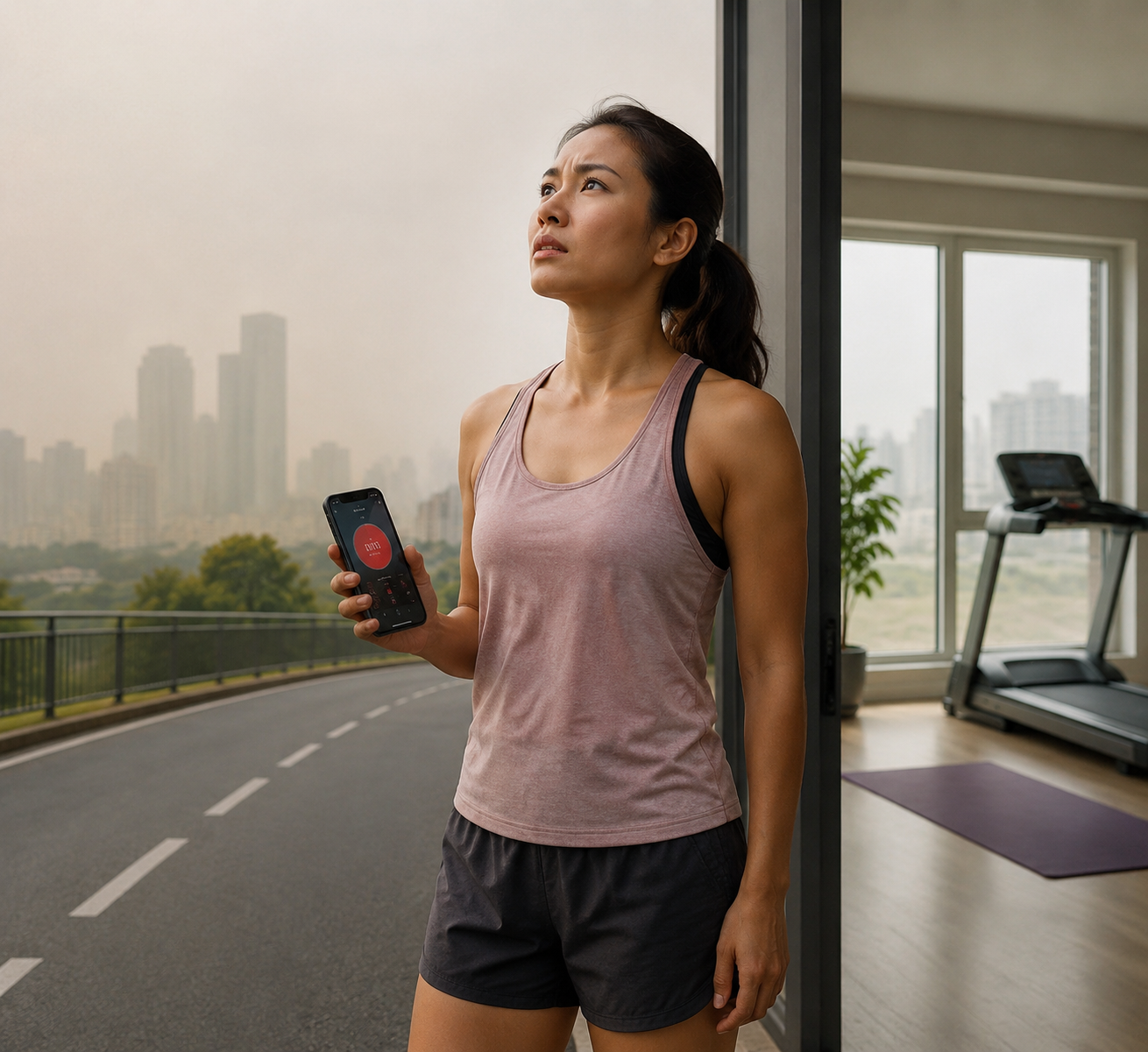
You checked the AQI before today’s workout. The useful question is not whether air pollution is bad in general; it is whether today’s run, ride, walk, or outdoor circuit should stay outside, get easier, move earlier, or move indoors.
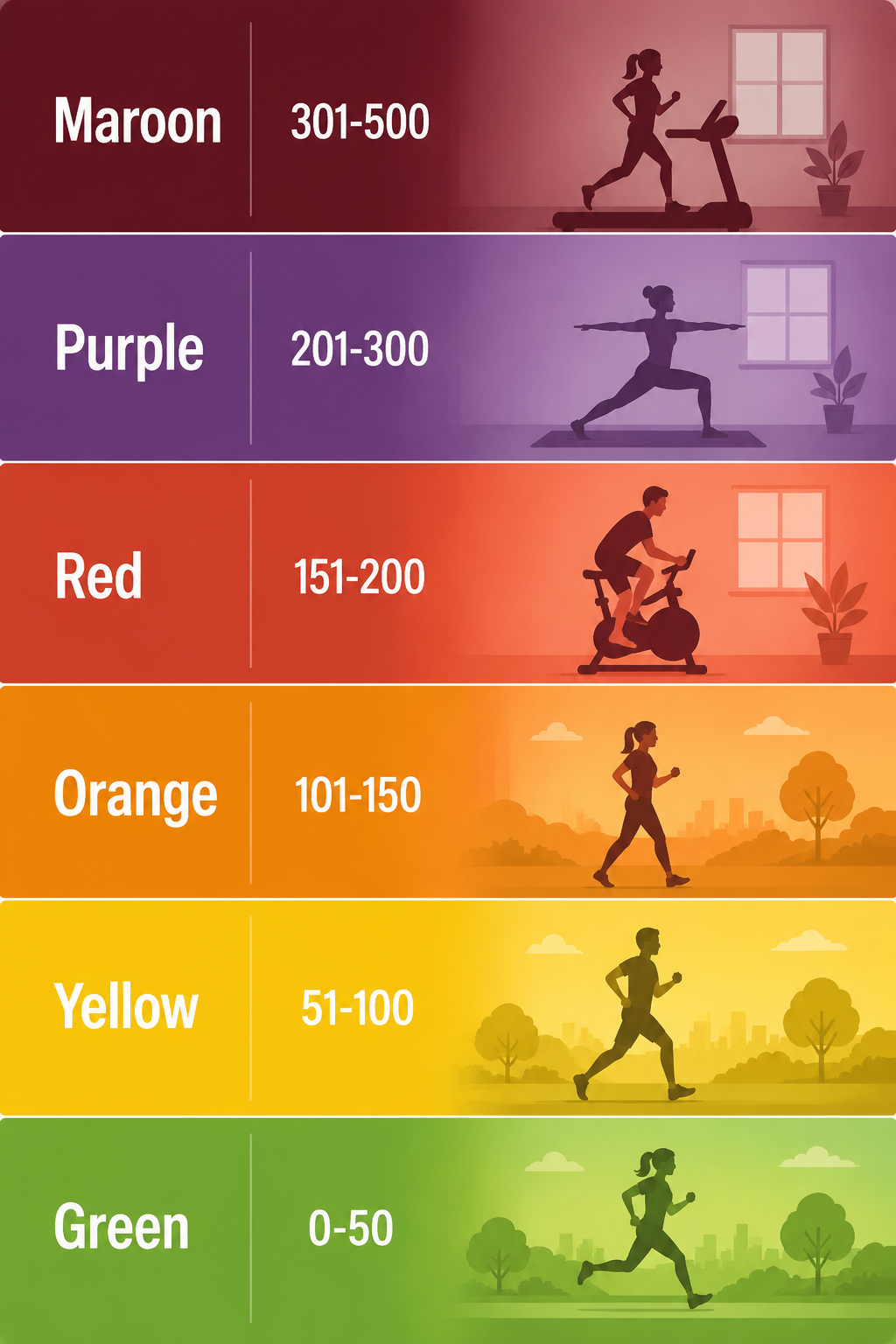
A practical rule of thumb: healthy adults can generally keep outdoor exercise on the plan through AQI 100, sensitive groups should start modifying at AQI 101, and everyone should move the workout indoors at AQI 151 or higher. Those cutoffs use the EPA’s AQI color bands as a decision framework, while recognizing that the EPA does not publish separate exercise-specific sub-guidelines for every training situation.[1]
Medical note: This guide is for general information, not individual medical advice. If you have asthma, COPD, heart disease, are pregnant, are 65 or older, are recovering from a respiratory infection, or have been told you are sensitive to air pollution, use the more conservative side of the chart and follow your clinician’s guidance.
The AQI Workout Decision Guide
| AQI band | What it means for healthy adults | What sensitive groups should do | Best workout choice |
|---|---|---|---|
| Green: 0–50 | Outdoor exercise is generally a good choice. | Outdoor exercise is usually acceptable unless personal symptoms say otherwise. | Run, walk, ride, hike, intervals, or outdoor strength work as planned. |
| Yellow: 51–100 | Outdoor exercise is generally acceptable, but pay attention if the workout is long or hard. | Most can still be outside, but people who are unusually sensitive should reduce duration or intensity. | Keep easy and moderate workouts outside; consider moving very hard intervals indoors if symptoms appear. |
| Orange: 101–150 | Many healthy adults can still do light or moderate outdoor exercise, but hard efforts are less attractive. | People with asthma, COPD, heart disease, children, adults 65+, and pregnant individuals should limit prolonged or heavy exertion outdoors.[2] | Choose an easy walk, short relaxed run, mobility session, or indoor cardio instead of tempo work, hill repeats, or long rides. |
| Red: 151–200 | Move vigorous exercise indoors. Outdoor exertion carries more risk, especially if it is long or intense. | Move indoors and avoid outdoor exertion.[2] | Use treadmill walking, indoor cycling, bodyweight circuits, mobility, strength training, or a recovery session. |
| Purple: 201–300 | Avoid outdoor exercise. | Avoid outdoor exercise. | Train indoors only if indoor air is reasonably protected; otherwise keep it very light or rest. |
| Maroon: 301–500 | Do not exercise outdoors. | Do not exercise outdoors. | Stay indoors, reduce exertion if indoor air is affected, and prioritize exposure reduction. |
The most common gray area is Yellow and Orange. At Yellow, a healthy adult’s easy five-mile run and a sensitive runner’s all-out track session are not the same decision. At Orange, the split matters more: a healthy adult may choose a short conversational run, while someone with asthma or a recent respiratory flare should treat the same reading as a reason to move indoors or keep outdoor movement brief and easy.
At Red, the decision gets simpler. This is where training consistency should mean changing location, not pushing through. If the planned workout was intervals, make it indoor intervals. If it was a long run, swap to a treadmill, bike, elliptical, step-up circuit, or strength session. If your indoor air is also smoky or irritating, reduce intensity rather than forcing a hard session in a bad environment.
Why Intensity Changes the Air Quality Decision
The reason a hard workout gets treated differently from an easy walk is ventilation. During exercise, minute ventilation can rise 10 to 20 times above resting levels, which means you are pulling much more air into your lungs during the same amount of clock time. Exercise also increases mouth breathing, which bypasses some of the filtering that normally happens in the nose.[3]
That does not make every outdoor workout unsafe when AQI is elevated. It does mean “I’ll only be out for 30 minutes” is not the whole exposure story. A relaxed walk, an easy jog, and a threshold workout create different breathing demands. The air reading is the same, but the dose your body has to handle can change with intensity.
Use intensity as the first adjustment knob. If AQI is Yellow, the planned workout may still be fine, but you can shorten the hard portion or keep the effort conversational. If AQI is Orange, take speedwork, hills, long sustained tempo, and high-rep outdoor circuits off the outdoor menu, especially if you are in a sensitive group. If AQI is Red or worse, stop negotiating with the outdoor version and choose the indoor one.
| Planned workout | Lower-risk substitution when AQI is elevated |
|---|---|
| Outdoor intervals | Indoor bike, treadmill, rowing, or low-impact cardio intervals |
| Tempo run or hard group ride | Easy indoor cardio plus short strength work |
| Long run or long hike | Short easy walk if AQI allows, or indoor endurance session |
| Outdoor bootcamp | Bodyweight circuit indoors with controlled ventilation |
| Easy recovery day | Indoor mobility, stretching, light strength, or rest if symptoms are present |
Who Should Modify Earlier
Sensitive groups should not wait for Red AQI to make changes. The American Lung Association identifies people with asthma, COPD, heart disease, children, older adults, and pregnant individuals as groups that need extra caution when air quality worsens.[2]
For these groups, Orange is not a “maybe do the same workout” signal. It is the point to limit prolonged or heavy outdoor exertion. That may mean walking instead of running, shortening the route, skipping the hill section, moving the main workout indoors, or choosing a recovery day if symptoms are already present.
Symptoms also matter, but they should not be the only safety system. Chest tightness, wheezing, unusual shortness of breath, dizziness, coughing that worsens during exertion, or a flare in allergy or asthma symptoms are reasons to stop the outdoor workout and get into cleaner air. Waiting until symptoms appear is a weaker plan than adjusting before the workout starts.
Timing Matters: Ozone, Smoke, and Fast-Changing AQI
The AQI number you use should be current and local. Yesterday’s forecast can be useful for planning, but it should not override the reading when you are actually tying your shoes. Wildfire smoke can shift with wind direction, and conditions can change over the course of a day.[4]
Ozone has a different pattern. On hot days, ozone often peaks in the afternoon, so a morning workout may be a safer choice than the same workout later in the day when ozone is higher.[4]
- If the problem is ozone on a hot summer day, check whether an earlier outdoor session keeps you in a safer AQI band.
- If the problem is wildfire smoke, check the current AQI close to workout time and be ready to change plans quickly.
- If AQI is rising, do not start a long out-and-back route that leaves you committed far from home.
- If visibility, odor, or throat irritation seems worse than the app suggests, choose the more conservative workout.
This is also where long-term research becomes hard to turn into a simple slogan. Some studies find that exercise remains beneficial across pollution levels, while other findings raise concern about very high activity in high-pollution settings. A 2025 simulated wildfire-smoke study in 20 healthy participants in their mid-20s found acute vascular effects that reversed within one hour in clean air, but that small, young, healthy sample cannot settle the question for older adults or people with cardiovascular or respiratory conditions.[5]
That uncertainty is one reason the Red-and-above rule should be firm. Above AQI 150, the cleaner training decision is usually not to debate whether exercise is still “worth it.” It is to preserve the workout by changing where and how you do it.
Make the Indoor Pivot Safer, Too
Moving indoors helps most when the indoor air is actually better. On poor-air days, close windows and doors before the workout, especially if smoke or outdoor pollution is drifting in. If your HVAC system can support it, a MERV 13 filter can reduce fine particles, and a standalone HEPA purifier can help in the room where you train.[6]
Do not add avoidable indoor pollutants right before a workout. Skip candles and incense, and avoid using a gas stove close to training time when possible. A hard indoor session already raises ventilation; there is no reason to pair that with fresh irritants in a small room.[6]
A compact indoor setup does not need to mimic the outdoors perfectly. The goal is to keep the training stimulus without the outdoor exposure. A treadmill walk, stationary bike ride, step-up session, resistance-band circuit, yoga flow, or dumbbell strength workout can keep the habit intact until the air clears.
A Repeatable Pre-Workout Routine
- Check the current AQI where you will actually exercise, not only the citywide forecast.
- Identify whether you are in a sensitive group or are temporarily more vulnerable because of illness, pregnancy, asthma symptoms, or recovery.
- Match the AQI color band to the workout: Green and Yellow usually allow outdoor exercise, Orange calls for modification for sensitive groups, and Red or higher moves the workout indoors.
- Adjust intensity before duration: make hard workouts easy, make long workouts shorter, and move intervals indoors first.
- Account for timing: consider morning exercise for ozone days and use current readings for wildfire smoke.
- Set up the indoor option before you need it, so the decision is a swap rather than a skipped workout.
Poor air quality does not have to break training consistency. It does change the job of the day. At AQI 151 and above, the consistent choice is to move the workout indoors.
References
- AQI Basics, AirNow, U.S. Environmental Protection Agency.
- 4 Things to Know About Air Quality and Exercise, American Lung Association.
- Tips from an exercise physiologist on how to stay fit safely when air quality is poor, University of Toronto.
- How to Adjust Your Training in Response to Air Pollution and Wildfire Smoke, CTS Coaching.
- Wildfire smoke can make your outdoor workout hazardous to your health − an exercise scientist explains how to gauge the risk, The Conversation.
- Is It Safe to Exercise Outside When Air Quality Is Bad?, Filterbuy.
Comments
Join the discussion with an anonymous comment.