The run is canceled, the pickup game is off, or the community walk has moved from “see you there” to “we’ll update tomorrow.” When wildfire smoke does that for one day, you can improvise. When it does it for a week, you need a plan that keeps the habit alive without pretending the living room is automatically a safe training space.
Use this as a 7-day plan to exercise indoors when wildfire smoke cancels outdoor events. It needs no equipment, no jumping if you need to stay quiet, and no fantasy that you are building a perfect home gym overnight. The only non-negotiable is the air you are breathing while you train.
Before You Work Out: Make the Indoor Air Worth Training In
Outdoor air guidance is not one universal red line. Public health experts commonly advise moving exercise indoors when air quality reaches unhealthy levels, while sensitive groups may need to act sooner; U.S. AQI and Canada’s AQHI also use different scales, so compare your local reading with the system used where you live rather than borrowing someone else’s cutoff from another country.[1]
Once you decide to move inside, do the boring setup first: close windows and exterior doors, avoid bringing smoky air in, run recirculating air conditioning if you have it, and use the best filtration available. EPA guidance recommends MERV-13 or higher filters in central HVAC systems when compatible and running the system fan continuously in “on” mode during smoke events.[2]
That setup can matter a lot. Colorado State University reports that indoor AQI can be less than half the outdoor value when windows are closed and air conditioning or a purifier is running, but that does not mean every indoor room is clean by default.[3] If the room smells smoky, your eyes or throat burn, or the indoor air reading is also poor, treat that as a rest-or-relocate signal, not a challenge.
- Pick the cleanest room you can close off, ideally away from frequently opened exterior doors.
- Use recirculating AC, a HEPA purifier, or compatible HVAC filtration if available.
- Keep the workout moderate if you cannot confidently improve the indoor air.
- Stop if you develop chest tightness, wheezing, unusual shortness of breath, dizziness, or symptoms that feel different from normal workout effort.
The reason for being strict here is simple: strenuous exercise changes the dose. During hard effort, an adult can breathe roughly 10 times more air than at rest, increasing the amount of smoke particles inhaled if the workout happens in smoky conditions.[4] A 2025 University of Montana lab study discussed by exercise scientist Christopher T. Migliaccio found temporary declines in blood vessel and nervous system function after 20 healthy young adults cycled for 2 hours at about 50% maximum effort in simulated wildfire smoke.[4] That study was small, controlled, and not a perfect stand-in for every outdoor run, but it is enough to make “just go easy outside” feel like a poor default when a workable indoor option exists.
The 7-Day Plan at a Glance
The week alternates stress and recovery on purpose. You get short HIIT sessions to replace some of the lost cardio stimulus, bodyweight strength circuits to maintain muscular endurance, mobility to keep you from turning a smoke week into a couch week, and one true rest day so the plan can be repeated if the smoke lingers.
| Day | Focus | Time | Main Work |
|---|---|---|---|
| Day 1 | Cardio HIIT | 22-30 minutes | Low-space intervals with squat, plank, and step patterns |
| Day 2 | Lower-body endurance | 25-35 minutes | Lunges, squats, hinges, glute bridges, calf raises |
| Day 3 | Mobility and easy cardio | 20-30 minutes | Joint mobility, marching, balance, breathing cooldown |
| Day 4 | Full-body strength circuit | 30-40 minutes | Push-ups, split squats, dead bugs, wall sits, plank work |
| Day 5 | Cardio ladder | 18-28 minutes | Progressive intervals with quiet or higher-impact options |
| Day 6 | Core, posture, and hips | 25-35 minutes | Core control, hip stability, upper-back work |
| Day 7 | Rest or recovery reset | 10-25 minutes | Rest, gentle mobility, or an easy walk indoors |
If you only need a single workout for today, use this shorter indoor smoke-day session instead. The plan here is for the more annoying version of the problem: several days of canceled outdoor movement and no clear end date.

How Hard Should These Workouts Feel?
For HIIT days, aim for a hard but controlled effort: about 7 to 8 out of 10 during work intervals, with enough recovery that the next interval is still crisp. Bodyweight HIIT circuits can push many exercisers into roughly 80-90% of maximum heart rate, a meaningful cardiovascular stimulus when outdoor running is off the table.[5] You do not need to prove anything by turning every round into a collapse.
For strength and mobility days, use a steadier pace. You should finish most sets with a little control left. The goal is to preserve rhythm, range of motion, and muscular endurance, not to create soreness that makes the next smoke day harder.
This matters because stopping completely is not the only safe choice. Northern Health in British Columbia notes that physical activity can have a protective effect during periods of lower air quality, so the practical target is not zero movement; it is safer movement in better-managed air.[6]
Day 1: Cardio HIIT Without Leaving the Room
Purpose: replace the canceled run, walk, class, or game with a short cardiovascular session that raises your heart rate without requiring equipment or much floor space.
- Warm up for 5 minutes: march in place, shoulder rolls, hip circles, easy bodyweight squats, and slow alternating reverse lunges.
- Do 4 rounds: 40 seconds of work, 20 seconds of rest for each move.
- Move 1: squat to calf raise.
- Move 2: mountain climber or slow plank knee drive.
- Move 3: reverse lunge, alternating sides.
- Move 4: high knees, low-impact fast march, or step jacks.
- Cool down for 4-6 minutes: easy marching, hamstring stretch, chest opener, and slow nasal breathing if comfortable.
Beginner option: do 30 seconds of work and 30 seconds of rest for 3 rounds. Apartment option: choose calf raises instead of jumps, step jacks instead of jumping jacks, and plank knee drives instead of fast mountain climbers.
Day 2: Lower-Body Endurance for Walkers, Runners, and Court-Sport Legs
Purpose: give your legs useful work without stacking another high-intensity cardio day. This is the day that keeps stairs, strides, and casual sports from feeling rusty when the air clears.
- Warm up for 6 minutes: ankle circles, leg swings, glute bridges, easy squats, and slow lunges.
- Circuit A, 3 rounds: 12 squats, 10 reverse lunges per side, 15 glute bridges, 20 standing calf raises.
- Rest 60-90 seconds between rounds.
- Circuit B, 2 rounds: 30-second wall sit, 8 slow single-leg hinges per side, 20-second side plank per side.
- Cool down: quad stretch, figure-four stretch, calf stretch, and 1 minute of easy walking around the room.
Make it easier by holding a wall during lunges and hinges. Make it harder by slowing the lowering phase of each squat and lunge to 3 seconds. Do not add jumping just because you miss running; Day 5 will bring the next cardio push.
Day 3: Mobility and Easy Cardio
Purpose: keep moving while letting your breathing, joints, and legs recover. This day should feel almost too easy if you are used to outdoor training, which is exactly why it belongs in the week.
- 5 minutes: easy marching or walking laps inside.
- 6 minutes: neck turns, shoulder circles, cat-cow, thoracic rotations, and wrist circles.
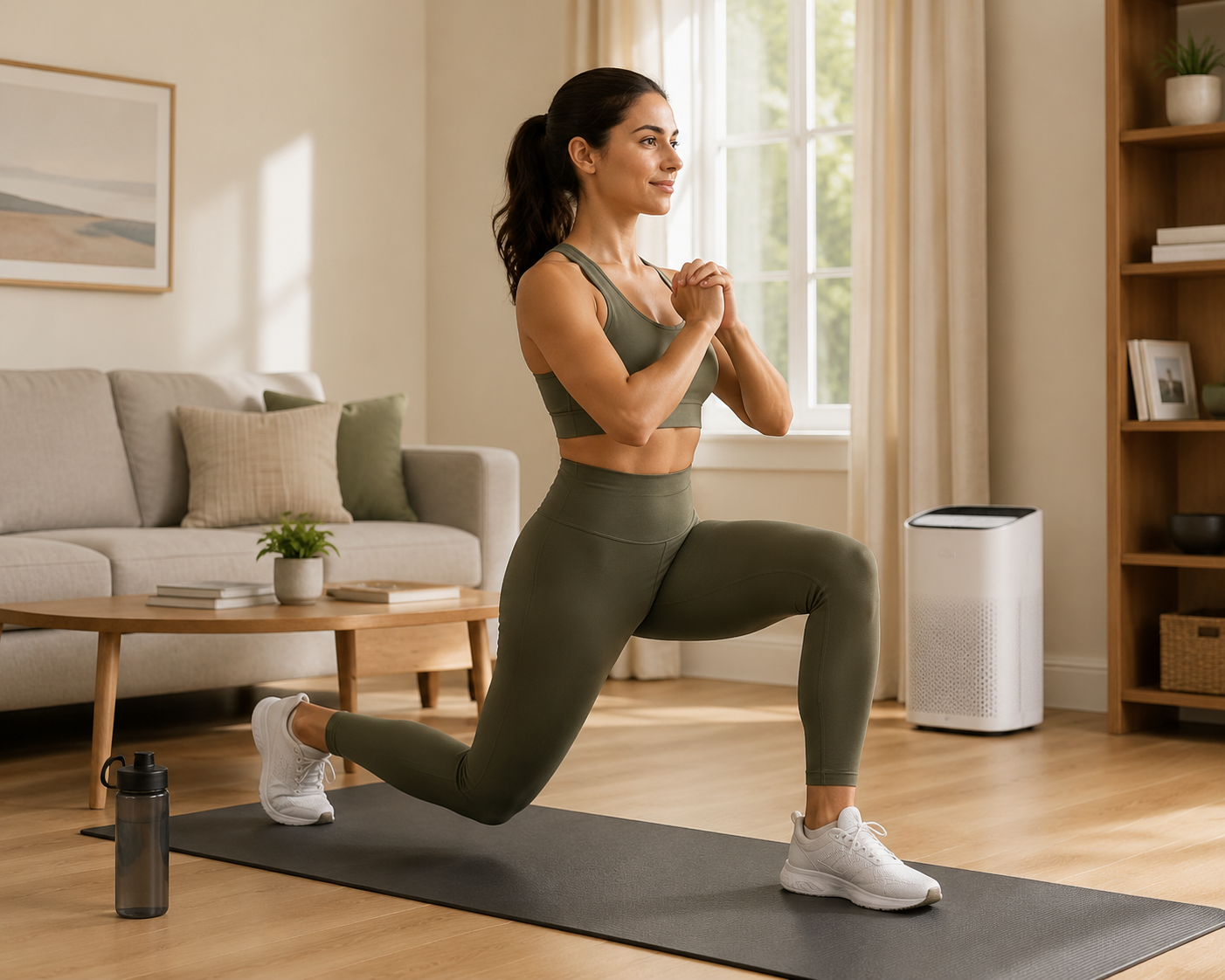
- 8 minutes: alternating reverse lunges, hip flexor stretch, hamstring sweep, and deep squat hold using a wall or counter if needed.
- 4 minutes: dead bug, bird dog, and side-lying hip abduction at an easy pace.
- 2-5 minutes: slow walking and relaxed breathing.
If your indoor air is only marginally improved, this is the right kind of session to keep. Skip the harder days until the room is better managed.
Day 4: Full-Body Strength Circuit
Purpose: maintain upper-body, lower-body, and core endurance in one session. Outdoor exercise often hides strength gaps because forward motion does most of the organizing. Indoors, you can be more deliberate.
- Warm up for 5-7 minutes: arm circles, inchworm walkouts or wall walkouts, glute bridges, squats, and plank shoulder taps.
- Do 3-5 rounds depending on time and experience.
- 8-15 push-ups, using a wall, counter, knees, or floor.
- 10 split squats per side.
- 20-30 seconds hollow hold, dead bug, or forearm plank.
- 30-45 seconds wall sit.
- 10 prone Y-T raises or reverse snow angels.
- Rest 60-90 seconds between rounds.
Keep the first round conservative. If push-ups are the limiting move, do not let them ruin the whole circuit; choose an incline variation and keep the session moving. After this week, if you want a more deliberate push-up and upper-body path, use this no-equipment upper-body progression.
Day 5: Cardio Ladder With Quiet Options
Purpose: create the second hard cardio touch of the week without repeating Day 1. The ladder format makes the middle of the workout demanding, then brings you back down before form falls apart.
- Warm up for 5 minutes with marching, step jacks, squats, and shoulder mobility.
- Round 1: 20 seconds fast work, 40 seconds easy movement.
- Round 2: 30 seconds fast work, 30 seconds easy movement.
- Round 3: 40 seconds fast work, 20 seconds easy movement.
- Round 4: 30 seconds fast work, 30 seconds easy movement.
- Round 5: 20 seconds fast work, 40 seconds easy movement.
- Repeat the full ladder 2-4 times, resting 1 minute between ladders.
Choose one fast move for each ladder: skater steps, squat thrusts without the push-up, high knees, fast step jacks, or invisible jump rope. If you own a rope and have room, jump rope can be a strong substitute; one study commonly cited in fitness guidance found a 10-minute daily jump rope program comparable to a 30-minute jogging regimen for cardiovascular conditioning.[7] If you do not own one, mimic the rhythm without pounding the floor.
For noise-sensitive apartments, use fast marching, skater steps without hopping, and shadow rope with soft knees. For a more detailed quiet setup, use this small-space strength plan and keep the same work-rest timing from this day.
Day 6: Core, Posture, and Hips
Purpose: support the parts that outdoor movement often depends on but does not always train well: trunk control, hip stability, and upper-back endurance. This session should feel focused, not frantic.
- Warm up for 5 minutes: cat-cow, hip circles, glute bridges, bird dogs, and easy squats.
- Core block, 3 rounds: 8 dead bugs per side, 20-40 second forearm plank, 8 bird dogs per side, 20-second side plank per side.
- Hip block, 2-3 rounds: 12 glute bridges, 10 side-lying leg raises per side, 8 slow reverse lunges per side, 20-second single-leg balance per side.
- Posture block, 2 rounds: 12 prone Y-T raises, 10 scapular push-ups from wall or floor, 30-second chest opener.
- Cool down with hip flexor stretch, child’s pose, and easy walking.
If you feel restless because this is not a sweat-heavy day, add 10 minutes of easy indoor walking after the cooldown. Keep it easy enough that you could talk in full sentences.
Day 7: Rest, Recovery, or a Gentle Reset
Purpose: absorb the week. If you trained all six days, take a true rest day. If you missed sessions or have been sitting more than usual, do a gentle reset instead of trying to cram in the hardest workout.
- Option A: full rest, especially if sleep, stress, or smoke symptoms have been rough.
- Option B: 10-15 minutes of mobility from Day 3.
- Option C: 20-25 minutes of easy indoor walking, marching, or household movement.
- Option D: repeat the Day 6 core block only, keeping every set comfortable.
Rest is not a failed workout. It is what makes the next smoke week manageable if the forecast does not improve.
How to Modify the Plan Without Losing the Point
The plan works because it gives each day a job. Modify the movements freely, but keep the job intact: hard days hard enough to stimulate fitness, easy days easy enough to recover, strength days controlled enough to build endurance rather than just fatigue.
| If this is you | Change this | Keep this |
|---|---|---|
| Beginner | Use fewer rounds, longer rests, and incline push-ups | The same day order |
| Apartment or shared floor | Replace jumps with step jacks, fast marches, calf raises, and skater steps | The interval timing |
| Knee-sensitive | Use smaller lunge ranges, more glute bridges, and wall sits only if comfortable | Lower-body work that stays pain-free |
| Wrist-sensitive | Use wall planks, forearm planks, or dead bugs instead of floor push-up positions | Core control |
| Low indoor-air confidence | Choose Day 3, Day 6, or Day 7-style work | Gentle movement without heavy breathing |
A useful smoke-week rule: if the air management is uncertain, reduce breathing demand before you reduce movement to zero. Mobility, easy walking, and controlled strength work are often better choices than all-out intervals in a questionable room.
If the Smoke Lasts Longer Than a Week
Repeat the same 7-day structure rather than inventing a harder plan out of frustration. If you felt good, add one round to Day 2 or Day 4, or add one ladder to Day 5. If you felt worn down, keep the same workouts but cap the hard days at 3 rounds and extend the cooldowns.
Do not turn every week indoors into a punishment for losing outdoor time. The goal is continuity: enough cardio to maintain the habit, enough strength to avoid feeling stale, enough recovery to keep going until the air improves.
When to Choose Rest or Medical Advice
Skip the workout and rest if smoke has entered your indoor space, if you cannot reduce exposure, or if normal warm-up effort feels unusually difficult. People with asthma, COPD, heart disease, pregnancy, recent respiratory illness, or other health concerns should use stricter thresholds and follow medical guidance rather than a generic workout plan.
During any session, stop for chest pain, wheezing, faintness, confusion, severe headache, or shortness of breath that does not settle with rest. A bodyweight circuit is replaceable. Your lungs are not the place to negotiate.
Returning Outdoors
When the air clears, return gradually. Make the first outdoor session shorter and easier than the one that was canceled, especially if you spent several days indoors or still feel throat, sinus, or chest irritation. Keep the indoor plan available for the next bad-air stretch; wildfire smoke has a way of turning “one missed workout” into a week unless you already know what comes next.
References
- Experts Offer Advice on Working Out During Wildfire Smoke Events. Public Health Institute.
- When Smoke is in the Air. AirNow.gov / EPA.
- Is it safe to exercise outside when there is wildfire smoke in the air?. Colorado State University.
- Wildfire smoke can make your outdoor workout hazardous to your health - an exercise scientist explains how to gauge the risk. The Conversation.
- How to Tell If the Air Is Safe Enough to Exercise Outside. Healthline.
- Physical activity and wildfire season: The good, the bad, and the ugly. Northern Health.
- The Best Cardio Exercises You Can Do at Home. Healthline.
Comments
Join the discussion with an anonymous comment.