
Train Tennis Coordination, Strength, and Endurance at Home
Training tennis at home works even in an upstairs apartment: coordination and strength drills are naturally quiet, and endurance can come from tempo-driven, no-impact circuits instead of jumps or sprints. You get a sample 20-minute quiet session plus floor-protection and neighbor-noise guidance for renters.
- Equipment tier required
- none
- Duration
- 20 min
- Difficulty
- beginner
- Target area
- full body
- Space footprint needed
- small clear floor area
- Noise level
- low
The upstairs-room objection is real: the obvious tennis-conditioning choices are exactly the ones that make an apartment feel unusable. Jump rope hits the floor over and over. Split jumps thump. Short sprints need space, traction, and forgiving neighbors. On a hard floor, “just do footwork” can sound less like training advice and more like a lease violation waiting to happen.
The useful answer is narrower and better: training tennis coordination, strength, and endurance at home does not depend on jumping or sprinting. Coordination work is naturally quiet because it lives in the hands, eyes, racquet face, balance, and timing. Strength work can be loaded with slow tempo, pauses, single-leg control, and trunk tension. Endurance is the part that needs the most redesign, but it can come from short repeated efforts and faster step-based patterns rather than impact.
That is where high-intensity low-impact training, often shortened to HILIT, is a useful idea: the goal is to raise effort without bouncing or pounding the floor [1]. ACE-certified trainer Sean Alexander gives the same practical lever for quiet cardio indoors: when weights and impact are limited, intensity can come from a faster pace or from slow holds [2]. For the session structure below, the cleanest starting point is a published low-impact circuit format: six moves, one minute each, three rounds, with one to two minutes of rest between rounds [3]. This article adapts that format to tennis; it is not a universal law of conditioning.
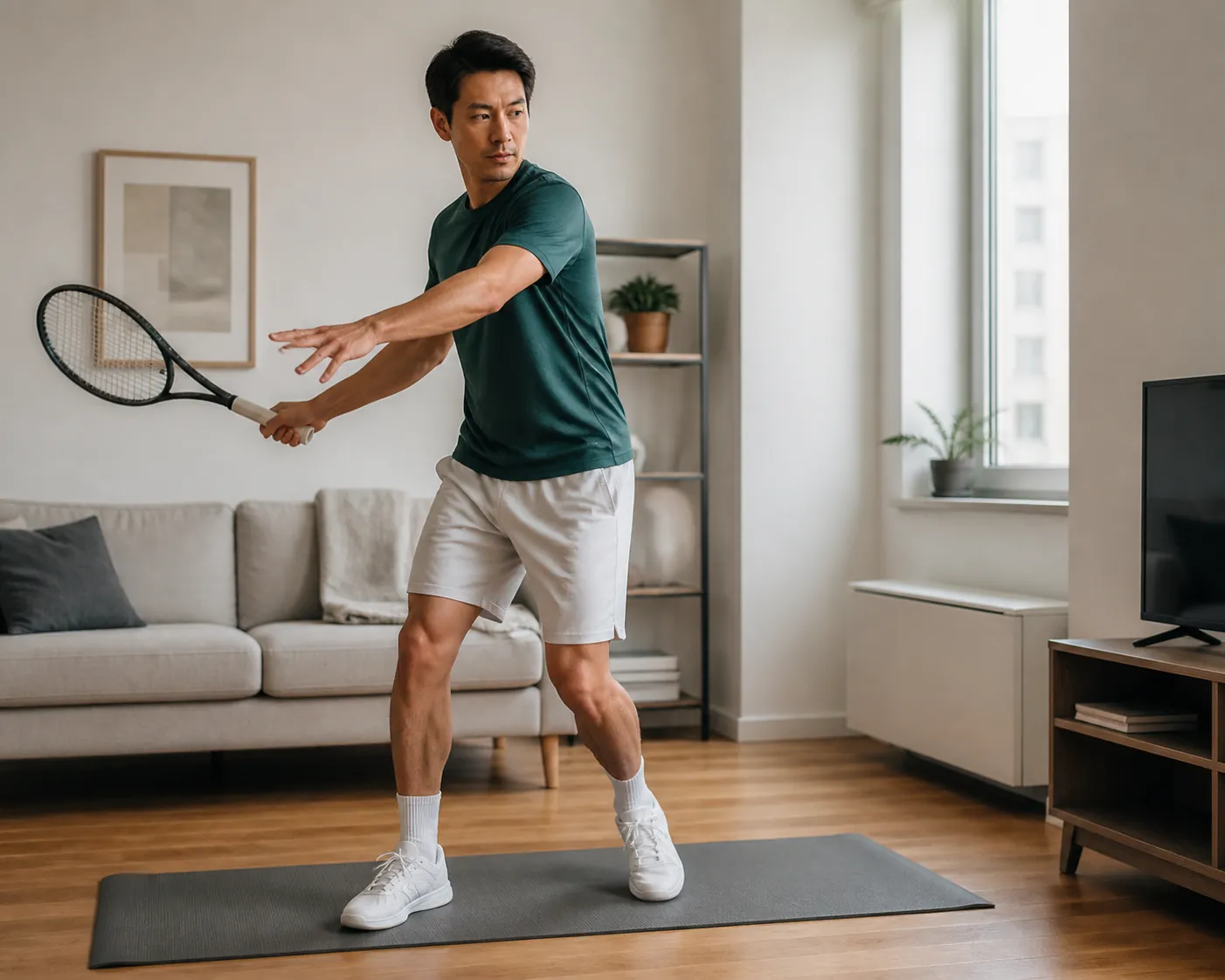
A 20-minute quiet tennis-conditioning session
Use a clear patch of floor, a racquet, two to four soft markers, and a mat if your floor is hard. Round one is your rehearsal round. Rounds two and three are the working rounds. Rest for one minute after round one and one minute after round two. That gives you 18 minutes of work and two minutes of rest, which keeps the whole session at 20 minutes while staying close to the six-move, three-round low-impact circuit model [3].
| Station | One-minute block | What it trains | How to raise effort without impact |
|---|---|---|---|
| 1 | Mirror shadow swings with quiet recovery steps | Stroke rhythm, spacing, balance, racquet path awareness | Move through the swing a little faster, then freeze the finish for two seconds |
| 2 | Racquet-control work: bounce-on-strings, racquet juggling, or serve-toss catch | Hand-eye coordination, racquet-face control, toss consistency | Reduce the margin for error: lower bounces, fewer resets, or a stiller tossing arm |
| 3 | Slow split squat, reverse lunge to balance, or lateral squat reach | Leg strength for wide balls, braking, and recovery | Use a three-count lowering phase or hold the bottom position quietly |
| 4 | Dead bug, plank shoulder tap, wall sit, or band-resisted shadow swing if your setup is safe | Trunk control, shoulder stability, posture under fatigue | Slow the movement down, pause each rep, or reduce rest before the next station |
| 5 | Marker footspeed: step to forehand marker, recover, step to backhand marker, recover | First-step quickness and repeated court-like repositioning | Use 10 seconds quick steps, 10 seconds easy steps, repeated through the minute [7] |
| 6 | No-jump repeated-effort pattern: two markers side to side, then one forward-and-back recovery pattern | Match-relevant endurance without sprinting | Use 20 seconds work, 20 seconds easy recovery, 20 seconds work as the apartment version |
The tennis pieces in that flow are not random fitness decorations. Mirror shadow swings and ground-up stroke rehearsal are common at-home tennis practice choices [4]. Wall volleys, marker-based movement patterns, and band-resisted shadow swings are also used in at-home tennis drill collections [5]. Racquet juggling, bounce-on-strings work, and serve-toss consistency drills give the hands and eyes something recognizably tennis-specific to solve [6]. The apartment edit is simple: keep the contacts soft, keep the feet under control, and make the clock do some of the loading.
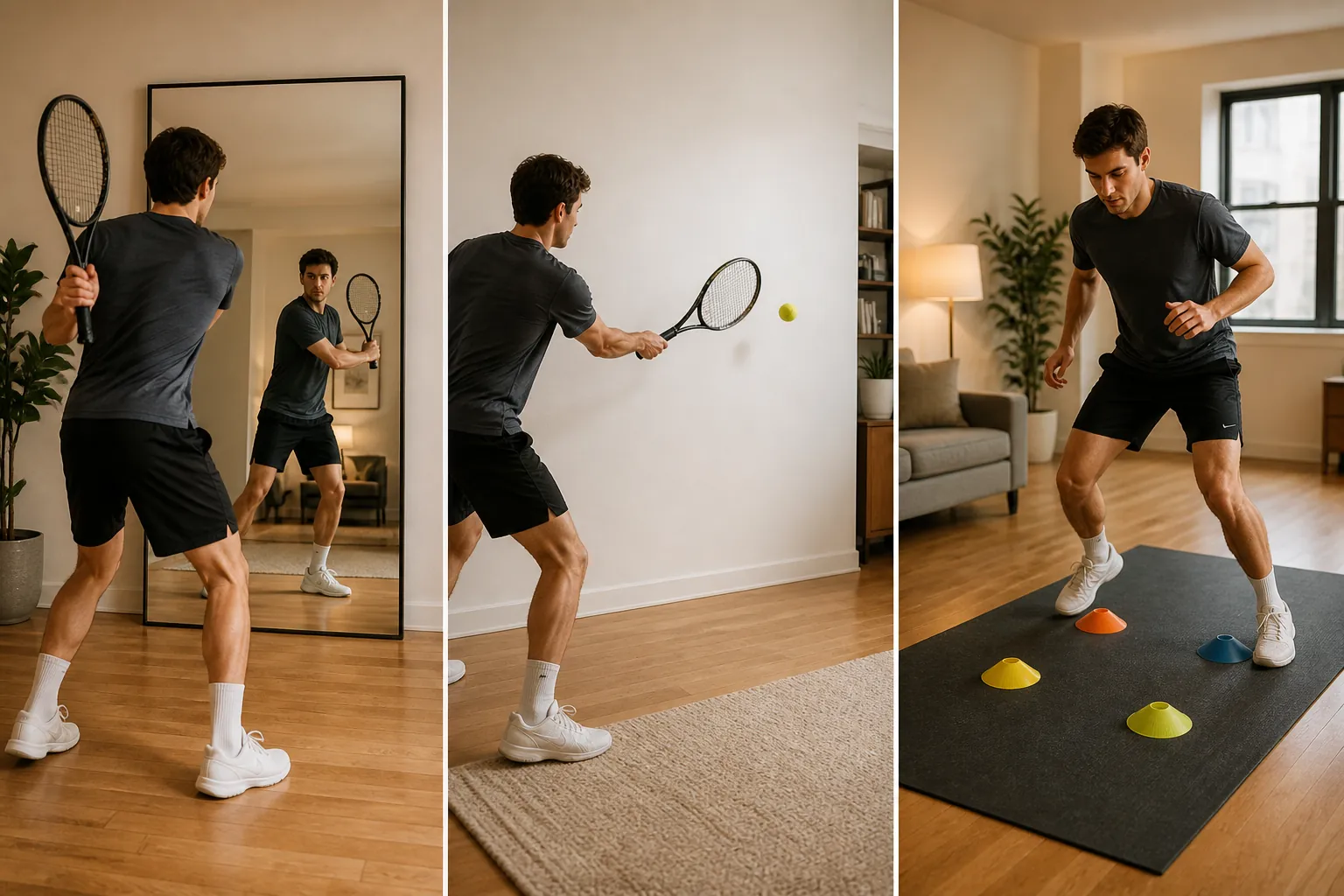
Coordination: keep the racquet in the session
A quiet apartment session gets worse when the racquet disappears too early. General balance and agility work can help, but a tennis player should still spend part of the session solving tennis-shaped problems: controlling the racquet face, timing the toss, recovering after a shadow swing, or making small adjustment steps before contact.
For mirror shadow swings, stand far enough from furniture that the racquet has a safe path. Hit no ball. Watch whether your finish, balance, and recovery step are repeatable. This is conditioning, not a stroke lesson, so the useful apartment rule is to make each swing recoverable. If a forehand shadow swing leaves you falling into the coffee table, the next rep should be smaller or slower.
Racquet-control work can be almost silent if the ball stays on the strings or is caught by hand. Bounce-on-strings work asks for a steady racquet face. Racquet juggling adds touch. Serve-toss catch work asks whether the ball can rise and return to the same hand path without you chasing it across the room. For serve mechanics beyond toss consistency, use the existing guide to improve your tennis serve at home; this session only needs enough toss discipline to train coordination without turning the living room into a full technical lesson.
Wall volleys are the one coordination drill that deserves extra caution upstairs. The sound is not only foot noise; a ball hitting a wall can transmit through the structure. If you use them, choose a low-force volley, a forgiving target area, and a wall that you have already tested at easy speed. If that still carries through the apartment, replace wall volleys with racquet bounces, toss-and-catch work, or shadow volleys with a freeze at contact.
Strength: make slow work honest
Strength is the easiest quality to keep quiet because the best apartment options do not need floor impact. A slow split squat, a lateral squat reach, a wall sit, a calf raise with a pause, a dead bug, or a plank shoulder tap can all become demanding without leaving the floor. The mistake is treating “no jump” as “easy.” Slow reps expose balance and leg endurance quickly.
For the lower-body station, pick one movement that matches your joints and space. A reverse lunge to balance works if you can step back without sliding. A split squat works if you want fewer moving parts. A lateral squat reach feels more tennis-specific because you shift into a wider stance, but it must stay controlled; the foot should not slap the floor on the way out or back.
For trunk and shoulder work, the racquet can stay nearby without turning every exercise into a trick. Dead bugs and planks teach the torso to stay organized while the limbs move. Band-resisted shadow swings can fit here if the band is anchored safely to a door, as used in at-home tennis drill guidance [5]. If the anchor is questionable, skip the band. Quiet training does not need a doorframe experiment.
The cleanest progression is tempo: lower for three counts, hold for one, stand smoothly. Then progress density: keep the same exercise but take fewer wasted seconds between reps. Load can come later. In an apartment, control earns the right to speed up.
Endurance: step fast, recover short, do it again
Endurance is where quiet tennis conditioning usually gets doubted, because people picture only two choices: jogging in place or jumping. Neither is necessary. Tennis endurance at home can be trained with repeated step-based efforts: a quick burst to a marker, a controlled recovery, then another burst before you feel fully fresh.
One useful footspeed option is the 10-seconds-work, 10-seconds-rest format published in a Tennis Fitness home workout [7]. In an apartment, the “rest” does not need to mean standing still. It can be easy walking in place, a quiet racquet reset, or two slow breaths while you stay in a ready position. The important part is that the hard 10 seconds stay crisp without turning into stomping.
For a more conditioning-focused block, Tennis Fitness also describes repeated-effort intervals of 20 to 30 seconds of work, 20 to 30 seconds of recovery, six to eight repetitions, and two to three minutes between drills [8]. Treat that as a published recommendation, not a measured standard that every recreational player must copy. In a 20-minute apartment session, you can borrow the idea in smaller doses. If you want a dedicated endurance add-on, use the full interval shape on one or two marker patterns and keep the total volume modest enough that your steps stay quiet.
- Side-to-side marker pattern: step to the forehand-side marker, return to center, step to the backhand-side marker, return to center. No hop is required.
- Forward-and-back pattern: step forward to a short-ball marker, recover backward under control, then reset the racquet before the next rep.
- Four-marker box: step around the box in one direction for the work interval, then reverse direction on the next work interval.
- Shadow point pattern: one quiet recovery step, one shadow forehand or backhand, one reset step, then repeat at a pace you can sustain.
If your heart rate is not rising, do not add a jump first. Tighten the transition. Make the recovery shorter. Increase step frequency while keeping the foot contacts soft. Hold the ready position during recovery instead of standing upright. Those changes raise effort while keeping the floor in the problem.
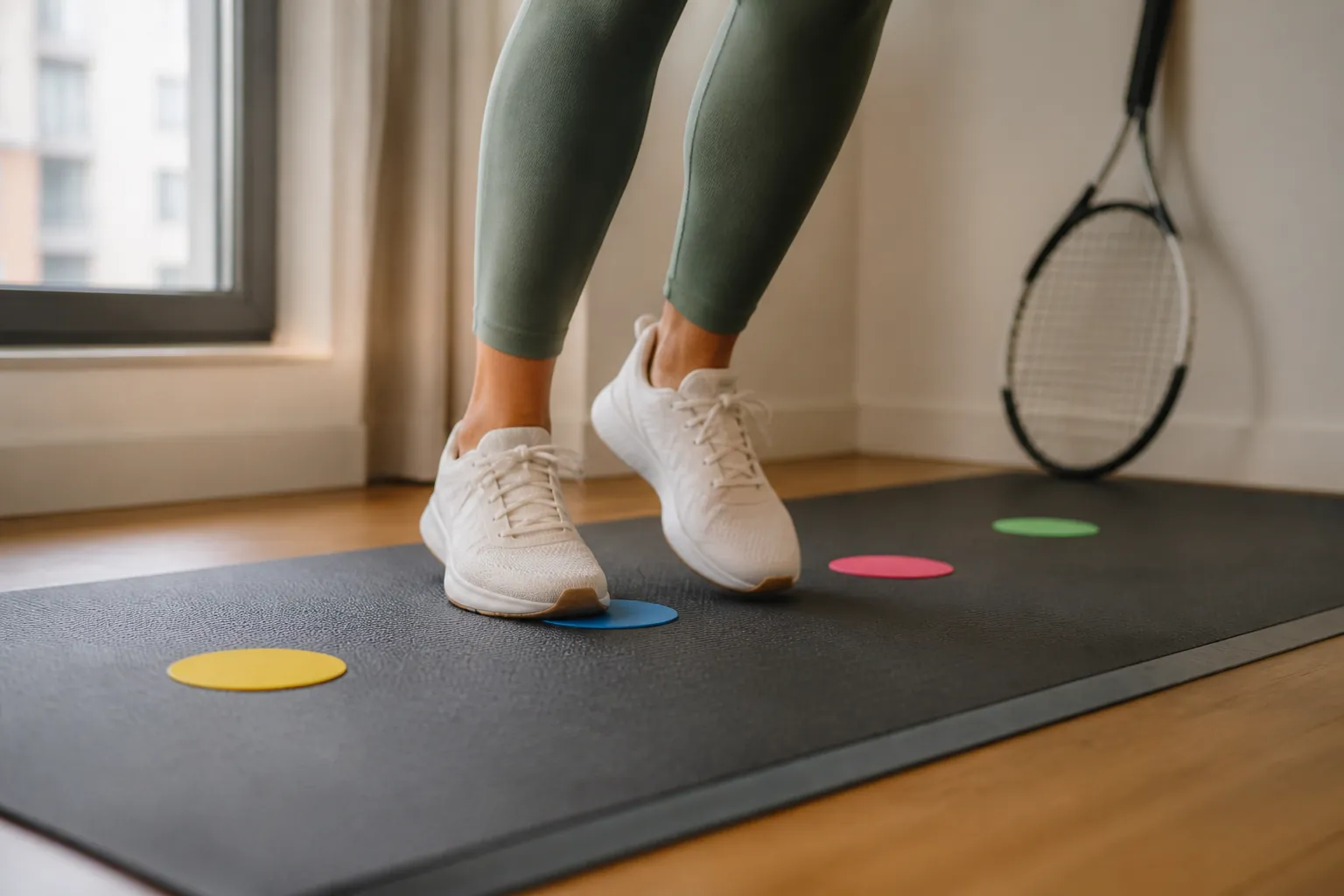
The apartment edits matter as much as the exercises
Quiet is not a magic label. A movement can be low-impact and still be annoying on a particular floor. A tennis ball can be light and still sound sharp against a wall. A mat can soften contact without making an old building silent. The honest approach is to choose low-impact movements first, then test how they behave in your room.
| Upstairs problem move | Apartment replacement | What to monitor |
|---|---|---|
| Jump rope | Fast step-rope pattern, marching rope rhythm, or 10:10 marker footspeed | Repeated heel strikes and rope taps on hard floor |
| Split jumps | Step-based ready reset: widen stance by stepping out, sink, recover | Feet slapping during the reset |
| Jump squats | Slow squat, wall sit, squat to calf raise with a pause | Hard heel contact when standing tall |
| 180-degree jumps or turn jumps | Step-turn shadow swing with a controlled pivot | Twisting on sticky flooring or scraping shoes |
| Short sprints | Two- to four-marker step pattern with short work intervals | Braking noise at the marker |
| Hard wall volleys | Soft wall volleys, shadow volleys, or racquet-control drills | Ball impact through shared walls |
Soft markers are better than cones if you are training indoors. Painter’s tape, flat rubber dots, socks, or folded towels are less likely to become trip hazards or hard contact points. Keep the pattern small enough that your last step is a placement, not a skid. Tennis players like to talk about exploding to the ball; upstairs, the useful skill is arriving quickly without needing a loud brake.
The mat helps most when it sits under the actual contact zone. If your footwork pattern takes you off the mat, the mat is decoration. For a narrow living room, place the markers on the mat and make the pattern denser rather than larger. For a hallway, use forward-and-back steps with a strict turnaround point. For a bedroom, racquet-control and serve-toss work may be the better choice than wall contact.
Do not borrow confident decibel claims from generic quiet-workout lists and assume they apply to your floor. The site’s Small-Space Testing apartment-noise methodology is the better reference point for how to think about floor contact, shared walls, and renter consequences. The same practical mindset shows up in the quiet sport patterns for quiet pickleball practice at home and first-step reaction drills: make the drill small, rate the contact honestly, and protect the surface before adding speed.
How to progress without becoming the noisy neighbor
Progress the session by changing one variable at a time. If you make the footwork faster, keep the same number of rounds. If you add a fourth round, keep the same pace. If you shorten recovery, do not also make the pattern bigger. Quiet training fails when fatigue makes the feet heavy and the player keeps chasing the workout anyway.
- Start with three rounds of the six-station session and one-minute rests.
- Make round two and round three cleaner before making them faster.
- Add 10:10 footspeed only to one marker pattern at first.
- Use the 20-to-30-second repeated-effort format as a separate endurance emphasis, not as something you must force into every session.
- Stop a drill when braking gets loud, balance disappears, or you start reaching for furniture.
This also keeps the session useful for social players. A 3.0-to-4.5-style recreational player does not need an apartment version of a pro plyometric day to get value. More often, the win is repeatable footwork, stronger legs in low positions, a steadier trunk, and enough repeated-effort tolerance that the third set does not feel like a different sport.
If you want a broader week plan, pair this quiet apartment session with the full at-home tennis fitness routine on days when you have more room or access to a court. If you want a non-tennis conditioning day that still respects downstairs neighbors, the site’s quiet workouts for workday energy can fill that role without pretending every general circuit is automatically tennis conditioning.
An upstairs apartment changes the exercise menu. It asks you to replace split jumps with step-based resets, sprints with marker patterns, jump rope with fast low-impact footwork, and vague “quiet” claims with actual floor checks. It does not remove the possibility of training tennis coordination, strength, and match-relevant endurance at home.
References
- Shh! Quiet Exercises for an Apartment-Friendly Workout — Centr
- Best Quiet At-Home Cardio Exercises — POPSUGAR
- Low Impact Cardio — Healthline
- Practice Tennis At Home — Feel Tennis
- 5 Tennis Drills to Practice at Home — TeachMe.To
- 4 At-Home Tennis Drills — Tennis Camper
- Tennis Fitness Workout for Home — Tennis Fitness
- Conditioning for Tennis — Tennis Fitness
What a small equipment investment adds
We don't have a build tagged to this exact tier yet. Browse all builds.
How often should you repeat this?
See our recovery and rest reference for citation-anchored rest-interval guidance.
Spot something off?
Tell us if a movement, tier assumption, or duration didn't match your experience.