
Correct Golf Half Swing Form You Can Practice at Home
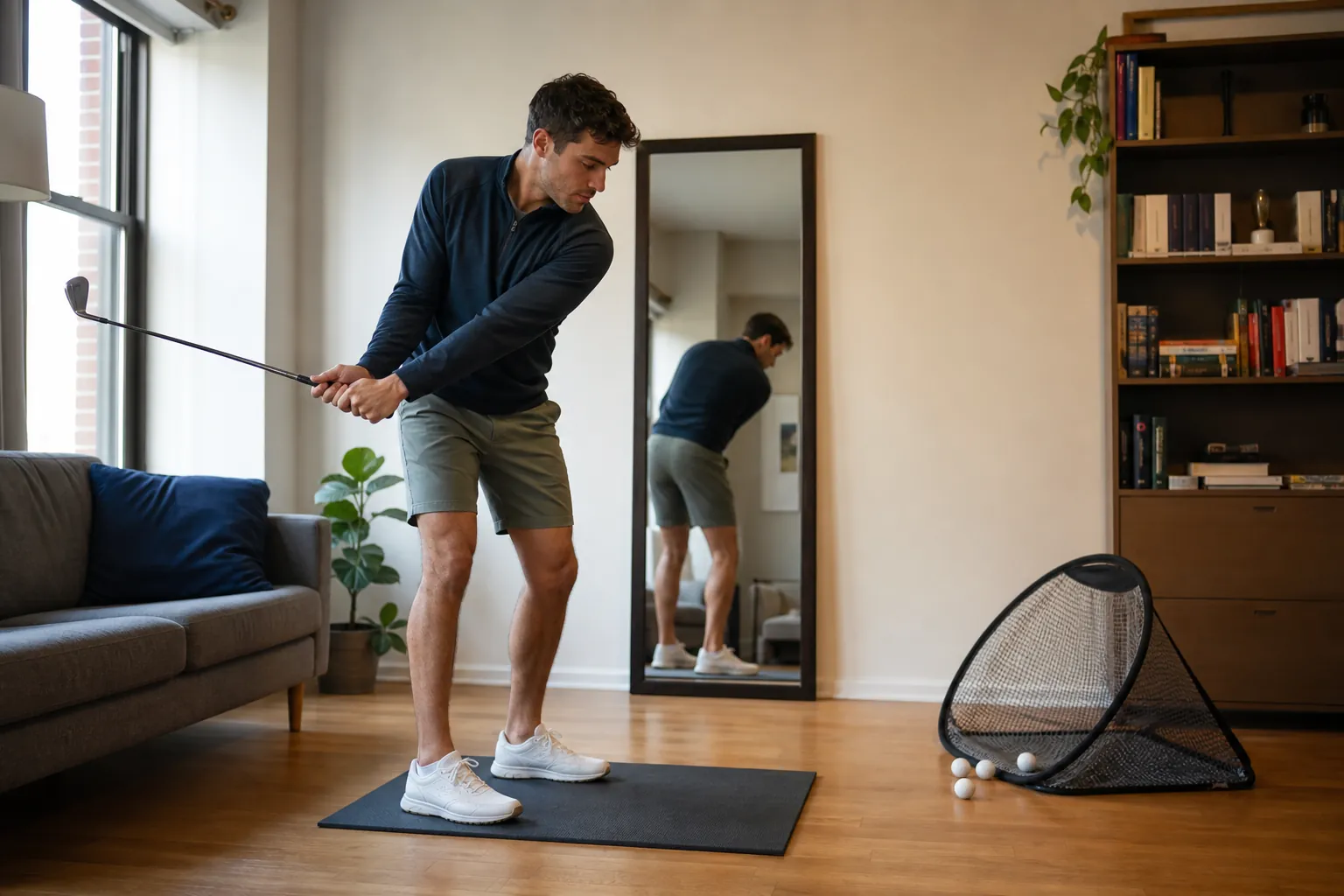
A half swing at home improves real golf only when it is a body-rotation move — club stopping at 9:00 and 3:00, waist-high — not a shortened arm swing. This guide lays out the correct form as five impact checkpoints and a 15-minute daily routine that progresses from mirror work to foam-ball strikes into a net.
- Equipment tier required
- none
- Duration
- 15 min
- Difficulty
- beginner
- Target area
- full body
- Noise level
- low
A correct golf half swing for home practice is not a smaller arm swing. It is a rotation-driven motion where the club travels from roughly waist-high at 9:00 in the backswing to waist-high at 3:00 in the follow-through, with the hips and shoulders moving the system and the arms staying quiet enough that they cannot fake the motion. Tonal frames the half swing as a building block for the full swing, and RotarySwing’s 9-to-3 drill uses the same clock-position idea to train consistency through the strike zone.[1][2]
That distinction matters more in an apartment than it does on a range. In a tight room, a golfer can easily make the club shorter by folding the elbows, yanking the handle across the body, and calling it control. Golf Distillery identifies the “all arms” swing as a common error where the body stays too passive and the hands and arms take over the motion.[3] For indoor half-swing practice, that is the rep to avoid. It feels safe because the club moves less. It teaches the wrong thing because the body has stopped organizing the swing.
The half swing is a 9:00-to-3:00 rotation drill
Use the clock image literally enough to make the drill checkable. At address, imagine the golfer standing in the middle of a clock face. For a right-handed golfer looking down the target line, the backswing stops when the lead arm and club structure reach about 9:00. The follow-through stops when the club reaches about 3:00. The club is roughly belt-high or waist-high on both sides, not above the shoulder and not trapped beside the thigh.
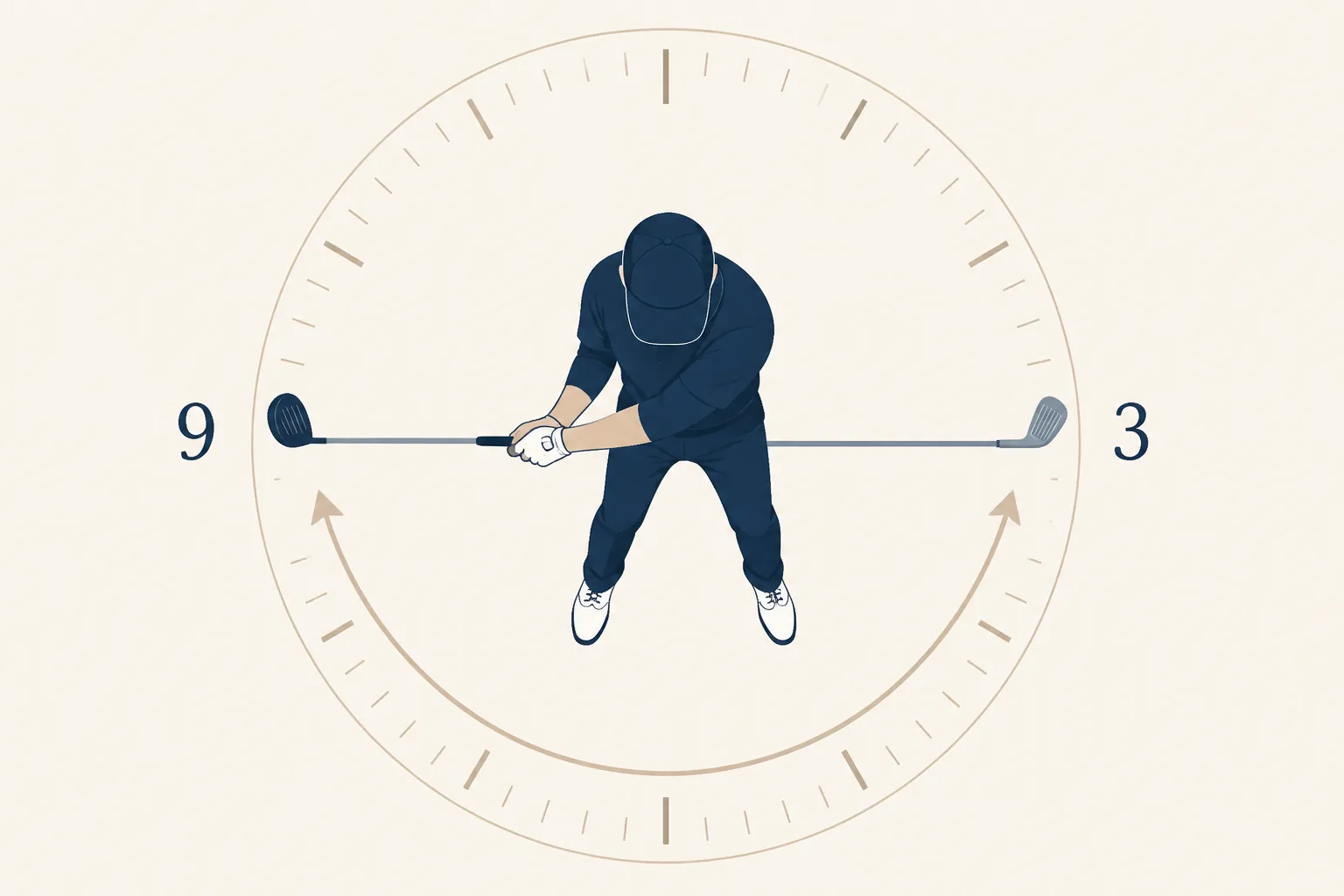
The useful part of the 9:00-to-3:00 idea is not that every golfer will match a drawing perfectly. It is that the room now has a visible stopping point. If the club is drifting high because the wrists keep lifting after the chest stops turning, the mirror will show it. If the club barely reaches waist height because the golfer is steering with bent elbows, the mirror will show that too.
A good home half swing has three simple movement rules:
- The chest turns the club back to 9:00; the hands do not snatch it there.
- The lower body begins the return; the arms do not throw the clubhead from the top.
- The finish reaches 3:00 because the body has rotated through, not because the wrists have flipped the club past the ball.
A small room actually helps with this part. There is not enough space to hide behind a long, pretty finish. The club stops early, the body positions are exposed, and the golfer has to decide whether the rep was rotation or rehearsal theater.
The five impact checkpoints you can pause and inspect
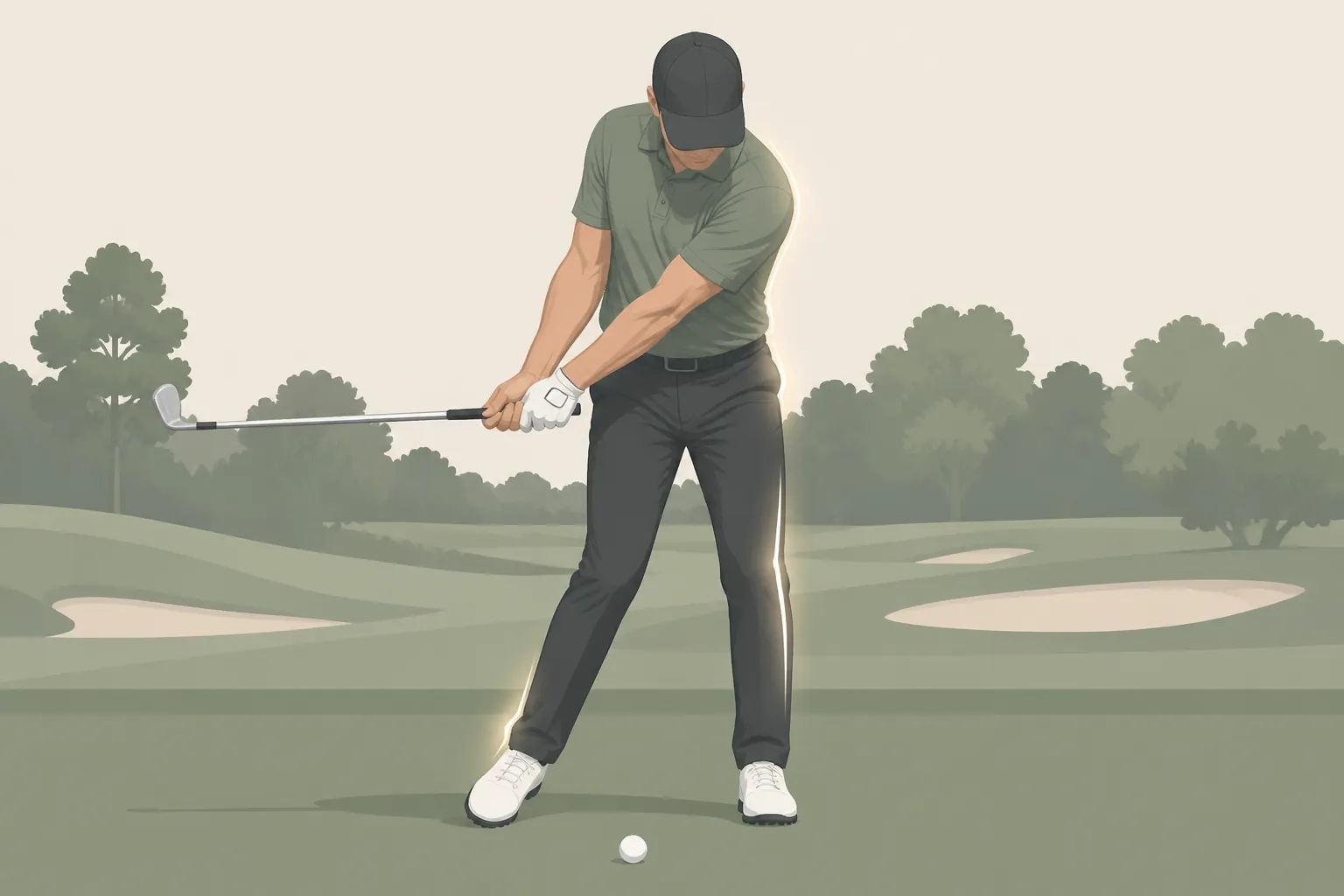
The 9:00 and 3:00 positions are the outer edges. The center of the drill is impact. RotarySwing’s half-swing material gives five checkpoints for the impact position: trail heel down and rolled inward, lead knee straight, weight through the lead ankle, hips open roughly 30–45 degrees, and spine angle preserved.[4] Treat the 30–45-degree hip position as RotarySwing’s teaching checkpoint, not as a universal biomechanics law. The value for home practice is that each checkpoint is visible or feelable without a launch monitor.
Trail heel down and rolled inward
At half-swing impact, the trail foot should not be spinning onto the toe as if the golfer is trying to manufacture speed. Keep the trail heel down or only gently releasing, with pressure rolling toward the inside of the foot. This gives the lower body time to transfer pressure instead of jumping out of the shot.
Lead knee straight enough to brace
The lead knee does not need to lock aggressively, but it should be firming. In a mirror, the lead side should look like it can accept force. If the lead knee stays soft and drifting, the body has not posted up; the hands will usually compensate by scooping or steering.
Weight through the lead ankle
This is the checkpoint that catches many home swings. At the strike, pressure should be clearly moving into the lead side, felt through the lead ankle and foot. If the golfer can pause impact and still feels stacked over the trail leg, the swing has become a hand delivery. The ball may still move into a net, but the movement pattern is not the one worth keeping.
Hips open, within the drill’s teaching range
RotarySwing’s checkpoint of roughly 30–45 degrees open at impact is useful as a mirror cue because it prevents the hips from freezing square while the arms slap through.[4] Do not turn it into a geometry contest. The practical question is whether the belt buckle and lead hip have started clearing before the club reaches the ball. If they have not, the golfer is usually just dragging the club with the upper body or flipping the wrists at the bottom.
Spine angle preserved
The spine does not have to look frozen. It does have to keep its address tilt well enough that the chest is still covering the strike area. In a small room, early extension is easy to spot: the hips move toward the ball line, the chest rises, and the club needs a last-second hand save. A foam ball can disguise that. A mirror usually will not.
A 15-minute home routine that makes form visible before contact
Performance Golf’s beginner indoor-practice guidance presents 10–15 minutes of daily drills and mirror work as enough time to create noticeable gains when the work is consistent.[5] For half swings, the important word is not “daily.” It is “visible.” A short session only helps if the golfer can tell which reps matched the form and which reps merely moved a club through the air.
| Time | Work | What must be checked |
|---|---|---|
| 0:00–2:00 | Set the room and rehearse the address position | Enough clearance, safe mat or carpet, no ball yet |
| 2:00–6:00 | No-club mirror turns | Chest turns to 9:00 and through to 3:00 without arm snatching |
| 6:00–10:00 | Slow half swings with a club, pausing at 9:00, impact, and 3:00 | Five impact checkpoints can be held without posture collapsing |
| 10:00–12:00 | Add a light tempo count or metronome | Back and through stay sequenced; speed does not erase the checkpoints |
| 12:00–15:00 | Foam-ball strikes into a net | Contact does not pull the motion back into an arms-only swing |
Start with mirror turns, not a ball
For the first working block, put the club down. Cross the arms over the chest or hold a short object across the shoulders. Turn to the backswing side until the chest has made the amount of rotation that would carry the club to 9:00. Then turn through until the chest has carried the imaginary club to 3:00. The point is to feel the body moving the arc before the hands are allowed to participate.
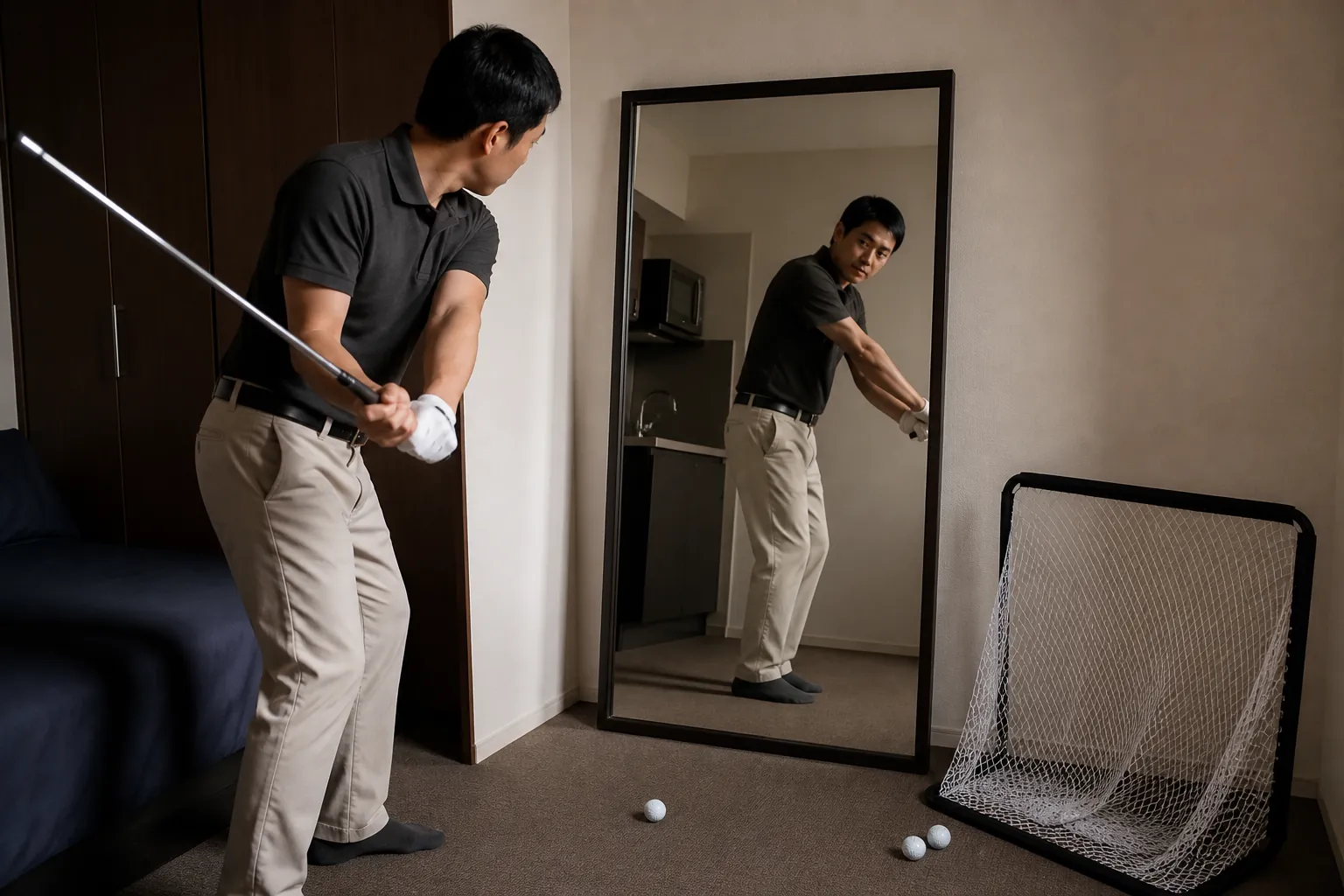
Use the mirror from two angles if the room allows it. Face-on, check pressure shift and lead-side bracing. Down-the-line, check whether the spine angle stays close to its address shape. If you only have one mirror angle, choose the one that catches your usual miss. A golfer who rises out of posture should prioritize down-the-line. A golfer who hangs back should prioritize face-on.
Then pick up the club and grip down if ceiling or wall clearance is close. Make slow half swings with three deliberate pauses: 9:00, impact, 3:00. The pauses are not decorative. They are where the body gets caught. If the club reaches 9:00 but the hips never loaded, restart. If impact cannot be paused with pressure on the lead side, restart. If 3:00 happens only because the hands rolled over, restart.
Add tempo lightly, then leave it alone
Tempo helps, but it should not take over the session. Practical Golf summarizes the commonly taught 3:1 backswing-to-downswing tempo idea associated with Tour Tempo and also notes instructor observations that many amateurs are too slow rather than too fast.[6] TPI’s timing article gives full-swing driver context from its tour-player 3D database, including an average backswing around 847 milliseconds, downswing timing in the 233–296 millisecond range, and a ratio around 3.2.[7] Those are full-swing tour-driver numbers, not half-swing apartment targets.
For this drill, use tempo as a guardrail. Count “one-two-three” back and “one” through, or use a quiet metronome if it helps. GOLF.com published a metronome warmup from Top 100 Teacher John Tillery using 65 beats per minute as a starting point.[8] If you want the deeper metronome progression, use our dedicated guide to golf swing tempo drills for home practice. Here, the rule is simpler: if the tempo makes the checkpoints disappear, the tempo is too fast for today.
Only then hit foam balls into a net
Contact should enter the session late. Foam balls and a compact net are useful because they let the golfer test strike without turning an apartment into a range bay. They are also dangerous in a quieter way: the moment a ball appears, many golfers stop checking the motion and start judging whether the ball flew straight for six feet.
Keep the first foam-ball set boring. Make three slow rehearsals with pauses, then hit one ball. After contact, hold the 3:00 finish long enough to ask whether the finish came from body rotation. If the ball strike was decent but the body stalled, do not count the rep. If the contact was imperfect but the checkpoints survived, the rep may still be useful.
MyGolfSpy’s at-home drill guidance includes pause-at-first-parallel work and strike-location practice as no-simulator options.[10] Those ideas fit best after the mirror phase, not before it. A paused club position and a strike mark are feedback tools. They cannot rescue a motion that was never organized by rotation.
Small-room rules that keep the drill honest
The home setup does not need to be impressive. It does need to be safe and repeatable. Chiputt’s small-apartment practice guidance suggests half-swing work can fit under standard 7–8-foot ceilings, while full swings may need roughly 9–10 feet of clearance; it also recommends workarounds such as gripping down, using yoga mats or carpet remnants, and choosing foam balls to reduce noise and protect floors.[9] Treat those as practical setup guidelines, not building-code truths.
- Check ceiling and wall clearance with the club moving slowly before any ball appears.
- Grip down if the club feels close to furniture, a light fixture, or the ceiling.
- Use a mat, yoga mat, or carpet remnant so the stance and floor contact feel consistent.
- Use foam balls indoors unless the net, room, and neighbors can safely handle something firmer.
- Keep quiet hours in mind; Chiputt cites typical quiet-hour windows around 10 PM to 8 AM.[9]
If you do not have a net, stay with the no-ball and mirror version or use the no-equipment progressions in our apartment golf drills guide. If you are deciding whether a net belongs in a small-space setup at all, compare it against the broader tradeoffs in our home gym cost breakdown rather than buying one just because a drill list mentioned it.
When the half swing is ready to progress
Do not progress because the drill feels easy. Progress because the checkpoints are repeatable. The club should arrive at 9:00 without the hands lifting independently. Impact should be pauseable with pressure through the lead ankle, the lead side braced, the trail foot behaving, the hips clearing, and the spine angle still recognizable. The club should reach 3:00 because the body rotated through, not because the wrists threw the club past the ball.
Foam-ball contact is the final test inside the 15-minute session. If adding a ball pulls the golfer back into an arms-only chop, remove the ball and return to the mirror. If contact stays quiet, tempo stays controlled, and the five impact checkpoints survive several sessions in a row, the home half swing is doing its job. Small-space practice works when it makes correct form more visible, not when it merely makes the swing smaller.
References
- How Mastering the Half Swing Can Transform Your Golf Game — Tonal
- 9 to 3 Golf Consistency Drill — RotarySwing
- Golf Swing Error: All Arms Swing — Golf Distillery
- Half Swing Drill in Golf: Definition, Biomechanics & Drill — RotarySwing
- Golf for Beginners: How to Practice Your Golf Swing Indoors — Performance Golf
- Swing Tempo: The Cornerstone of a Successful Golfer — Practical Golf
- Measuring the Timing of the Golf Swing from Video — TPI
- Try this metronome warmup routine — GOLF.com
- Perfect Home Golf Practice Space (Even in Small Apartments) — Chiputt Golf
- 5 Golf Drills You Can Do at Home (No Simulator Required) — MyGolfSpy
What a small equipment investment adds
We don't have a build tagged to this exact tier yet. Browse all builds.
How often should you repeat this?
See our recovery and rest reference for citation-anchored rest-interval guidance.
Spot something off?
Tell us if a movement, tier assumption, or duration didn't match your experience.