
Can HIIT at home really help older adults' cognition?
HIIT brain-health headlines rarely name the dose behind the claim. Here's that dose — the University of Queensland 4x4 protocol — and a no-equipment, chair-supported home version for older adults with RPE pacing and fall-safety rules.
- Equipment tier required
- none
- Duration
- 40 min
- Difficulty
- beginner
- Target area
- full body
- Space footprint needed
- 6 x 6 feet
- Noise level
- low
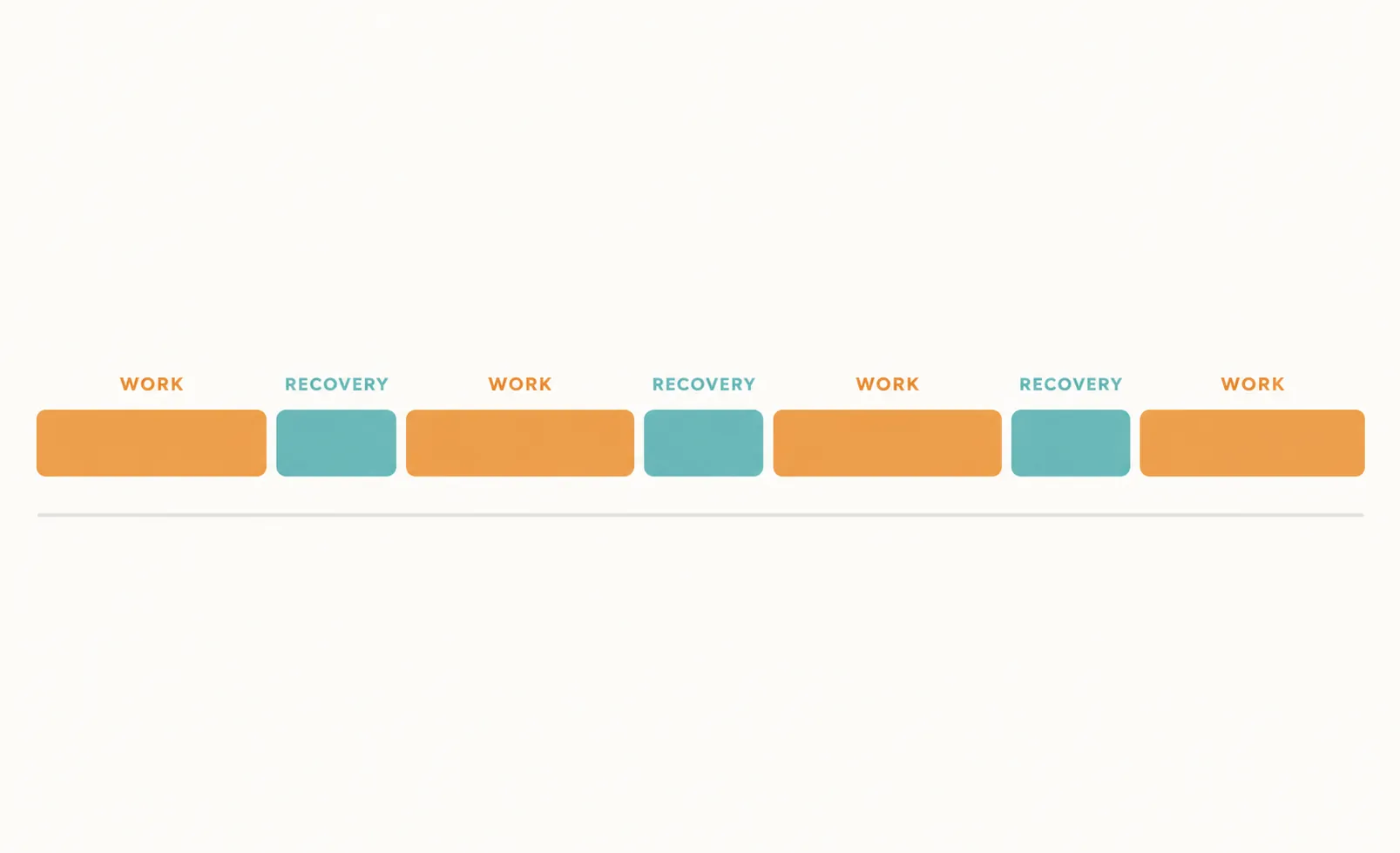
The most useful answer to whether HIIT at home can help older adults' cognition begins with a number: four. In the University of Queensland trial that generated much of the recent attention, participants completed four 4-minute hard intervals, each followed by 3 minutes of active recovery. They did this three times a week for six months, under supervision, on a treadmill. That is a much more specific claim than “HIIT is good for the brain,” and it also sets a limit on what can be promised from an improvised living-room workout.
What the UQ study actually tested
The study recruited 194 healthy adults between 65 and 85 years old; 151 completed the trial. Participants were assigned to low-intensity training, moderate-intensity training, or HIIT. The HIIT sessions lasted about 40 minutes: a 10-minute warm-up, four 4-minute intervals at 85-95% of each person's measured peak heart rate, 3-minute active recoveries at 60-70%, and a 5-minute cool-down. The program called for three supervised sessions per week for six months, or 72 sessions in total. [1]
The cognitive result was narrower than the headline. Only the HIIT group improved on a hippocampal-dependent paired-associate learning task. The improvement was retained for up to five years, and right-hippocampus volume was preserved in the HIIT group while it declined in the low- and moderate-intensity groups. The researchers did not find improvements in the other listed outcomes, including working memory, visual memory, and emotion recognition. [1]
That makes the finding interesting, but it does not establish that four intervals at home prevent cognitive decline. The participants trained on treadmills with supervision, and their intensity was set from an individually measured peak heart rate. A chair-supported, no-jumping routine can preserve the study's work-recovery logic and provide a practical approximation of the intensity principle. It cannot reproduce the trial conditions exactly.
The wider evidence is less tidy. A meta-analysis found that HIIT outperformed moderate continuous training on some tasks, including the Stroop test and digit span, and outperformed control conditions on measures such as Trail Making and task-switching. The authors also noted substantial heterogeneity and that the samples were mostly young. [7] In the five-year Generation 100 randomized trial, structured exercise did not produce a cognitive benefit over guideline advice, although higher fitness was associated with better cognition. [8] A systematic review of randomized trials likewise found no consistent benefit for overall cognition. [9]
The home version: keep the pattern, change the delivery
For a small living room, the session below keeps the central pattern but scales the movements and the starting dose. You need a clear area of roughly 6 by 6 feet, a sturdy chair that does not slide, and enough room to step without catching a rug or furniture. A mat is optional. Jumping, rapid floor transitions, and equipment are unnecessary.
- Warm up for 10 minutes with easy marching, side steps, shoulder movements, ankle pumps, and gradually larger versions of the exercise you plan to use.
- Perform a hard interval for up to 4 minutes. Choose a low-impact movement such as brisk marching, alternating toe taps, step-outs, seated marching with arm drives, or supported side steps.
- Recover actively for 3 minutes by walking slowly, marching gently, or sitting and moving the feet and arms if standing is tiring.
- Repeat the work-recovery pair up to four times, but only when the shorter version feels controlled and repeatable.
- Cool down for 5 minutes with progressively slower walking or seated movement, followed by comfortable breathing and gentle range-of-motion work.
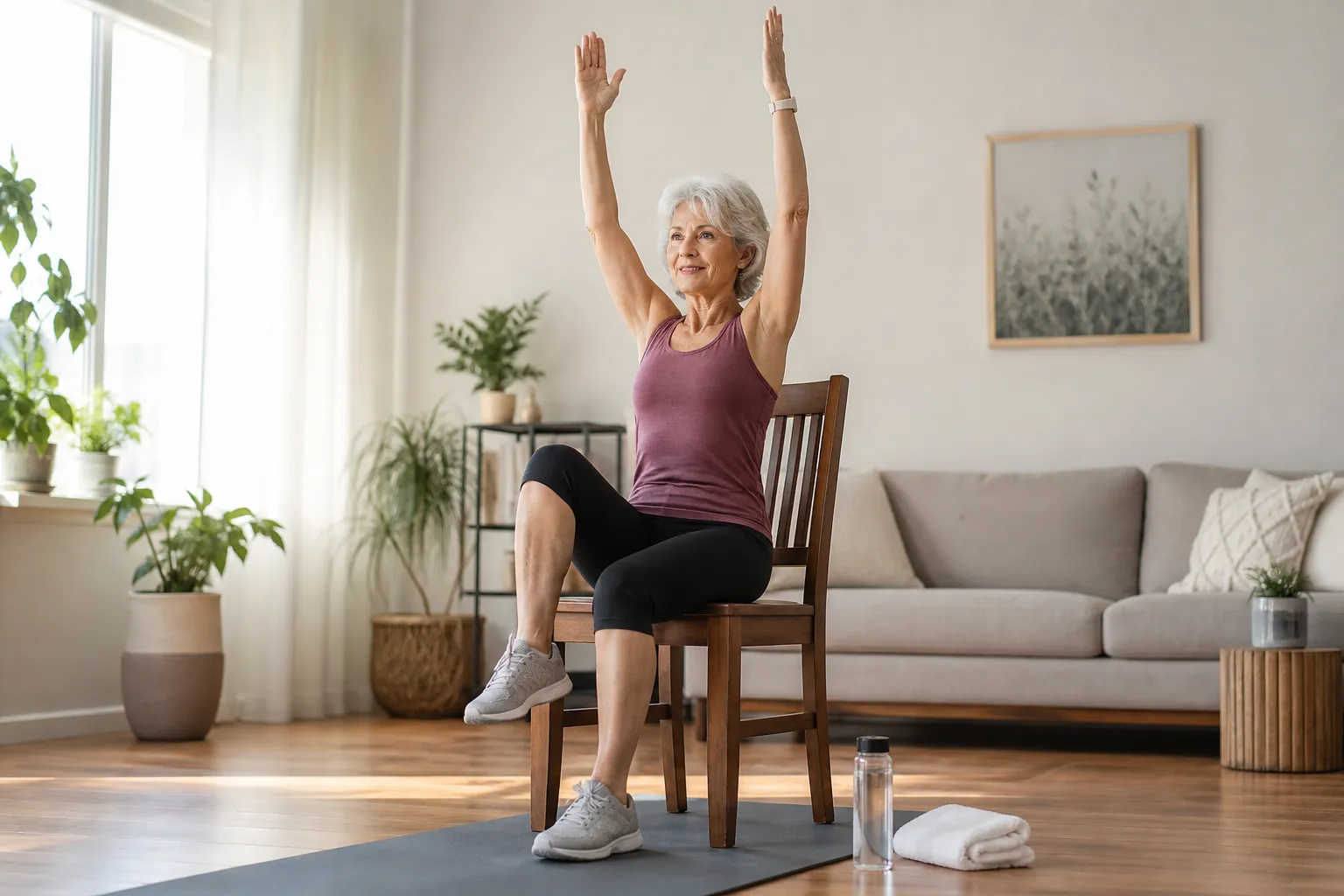
The chair is not a decoration or a sign that the session has failed. It is a way to control balance demands. A seated interval can use fast but comfortable marching, alternating knee lifts, heel taps, and arm drives. A standing interval can keep one or both hands near the chair back. The movement should remain quiet enough for an apartment and stable enough that attention can stay on effort rather than on catching yourself.
The full UQ-style structure is a destination, not a first-session requirement. A conservative progression is one session in the first week, with one or two 10- to 30-second harder efforts separated by 1 to 3 minutes of easy recovery. Add only one variable at a time: a longer effort, an additional effort, or a slightly quicker movement. Do not schedule sessions on back-to-back days. Guidance for older adults new to HIIT supports this gradual entry, particularly when recovery and movement control are still unfamiliar. [4]
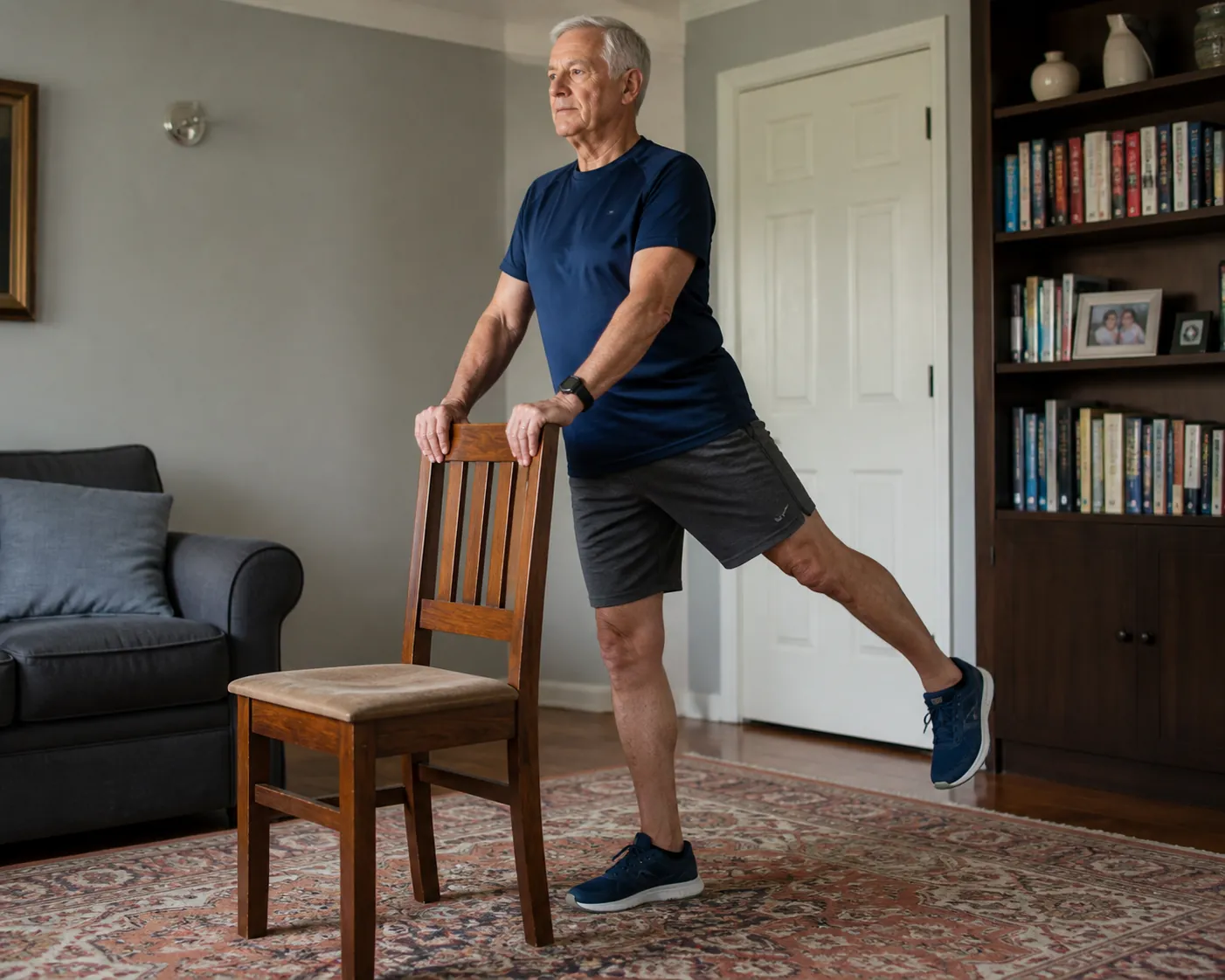
Once one or two short efforts feel predictable, progress to two 1-minute efforts, then three or four 2-minute efforts, with the same 3-minute recovery if that recovery is comfortable. Only after those sessions are well tolerated should you work toward four 4-minute intervals. One session per week is a reasonable starting point; two sessions may follow as recovery allows, and three sessions is the upper frequency used in the UQ trial rather than a requirement for everyone.
How hard is hard enough without a monitor?
The study used heart-rate percentages, but many people training at home will not have a reliable peak-heart-rate value or a monitor. Use two controls together: perceived exertion and speech.
- For the hard portion, aim for roughly 7 to 8 on a 0-to-10 effort scale: demanding, but controlled. You should be able to say a few words, not carry on a sentence.
- For active recovery, drop to an easy-to-moderate effort that lets breathing settle while you continue moving.
- If the chair, stepping pattern, or breathing becomes disorganized, reduce speed or sit. The target is not to prove that you can endure a particular number.
Harvard Health describes the same practical approach: during a high-intensity interval, a person should be able to say a few words but not a full sentence. It also advises limiting high-intensity days and consulting a doctor before HIIT when heart disease, diabetes, or high blood pressure is present. [2] Beta blockers and some health conditions can make heart-rate formulas less useful, which is another reason not to chase a calculated number at home. [4]
Stop the session for chest discomfort, faintness, or unusual shortness of breath. New or unexplained symptoms deserve medical attention rather than a lower interval setting. A clinician can also help determine whether this kind of exercise is appropriate when balance problems, joint limitations, medication changes, or significant cardiovascular risk are part of the picture.
The 30 minutes after the workout count
A safe home session is not finished when the timer ends. In a systematic review, seven of nine studies reported no adverse effects during HIIT, but one study found that a single 4x4 treadmill session increased postural sway immediately afterward and for up to about 30 minutes. [3] That does not mean every older adult will become unsteady, but it changes the sensible end of the routine.

Keep the chair nearby during the workout and move slowly into the cool-down. Afterward, sit or walk gently, drink water, and avoid stairs, a shower, carrying laundry, or other balance-demanding tasks for roughly 30 minutes, especially during the first few sessions. If someone is supervising an older adult, this is the time to remain available rather than leaving immediately after the last interval.
Recovery may also take longer than the calendar suggests. Evidence summarized in the same review found that peak leg power took about five days to recover after one HIIT session in men around age 60, compared with about three days in 25-year-olds. A low-frequency schedule of one session every five days still improved muscle power in that research. [3] Those findings do not create a universal timetable, but they support spacing sessions and judging readiness by how the legs and balance feel, not by eagerness to complete a weekly quota.
What home delivery can and cannot claim
A coached home program is feasible. One study of video-based instruction with coaching reported 98% retention, but its participants were low-active adults aged 18 and older with a mean age of 34. That result supports the practicality of structured remote delivery; it does not show that unsupervised home HIIT produces the UQ cognitive result or has the same safety profile for older adults. [6]
The 4x4 structure itself is a recognized interval format used and recommended by the Norwegian University of Science and Technology's Cardiac Exercise Research Group. [5] Its legitimacy as a training format does not remove the difference between a measured treadmill protocol and a person exercising alone beside a chair. Movement choice, balance, medication, recovery, and the ability to stop all affect the home version.
For related practical planning, the site's workout-routines category includes other older-adult-oriented routines, while recovery and injury content can help with the layer that begins after exercise rather than during it.
So, can HIIT at home really help older adults' cognition? A carefully scaled routine can retain the study's interval logic: hard work, active recovery, gradual progression, and a controlled finish. The UQ trial offers a promising and specific cognitive signal, centered on hippocampal-dependent learning, but it does not prove that an unsupervised living-room adaptation prevents decline or produces the same result. The honest version of the claim is therefore narrower: home HIIT may be a useful, structured exercise option, provided the dose is built gradually and the safety conditions are treated as part of the workout.
References
- High-intensity interval training increases hippocampal volume and improves memory in older adults — Aging and Disease, 2024
- An easy HIIT home workout for older adults — Harvard Health Publishing, March 2026
- Effects of high-intensity interval training on physical and cognitive function in older adults: a systematic review — 2021
- How to Safely Use High-Intensity Interval Training With Older Adult Clients — ACE Certified, June 2026
- 4x4 Interval Training — NTNU Cardiac Exercise Research Group
- Effectiveness and feasibility of a remotely delivered high-intensity interval training intervention — PLOS ONE, 2023
- The effects of high-intensity interval training on cognitive function: a meta-analysis — Frontiers in Physiology, 2025
- Effects of exercise training on cognition and brain volume in older adults: the Generation 100 study — Frontiers in Aging Neuroscience, 2021
- Effects of High-Intensity Interval Training on Cognitive Function in Older Adults: A Systematic Review of Randomized Controlled Trials — Cureus
What a small equipment investment adds
We don't have a build tagged to this exact tier yet. Browse all builds.
How often should you repeat this?
See our recovery and rest reference for citation-anchored rest-interval guidance.
Spot something off?
Tell us if a movement, tier assumption, or duration didn't match your experience.