Christie Brinkley's Anti-Aging At-Home Workout, Explained
Christie Brinkley's real at-home routine is unglamorous consistency, not the Total Gym's marketing pitch. This dated, source-by-source breakdown separates evidence-backed habits from celebrity anecdote and rebuilds the defensible core as a 20-30 minute home workout without the machine.
- Equipment tier required
- none
- Duration
- 20-30 min
- Difficulty
- beginner
- Target area
- full body
- Space footprint needed
- Small; corner of a room
- Noise level
- Low (no jumping)
The useful correction for anyone searching Christie Brinkley’s anti-aging workout routine at home is this: the part worth copying is not a secret machine or an age-defying trick. Across the dated interviews, Brinkley’s defensible pattern is short resistance work, 20- to 30-minute cardio several days a week, floor/arm/core work on alternate days, and little bits of movement folded into ordinary life. If we are going to use the phrase “anti-aging,” it needs to stay that narrow: strength, aerobic capacity, balance, and the habit of not becoming still.
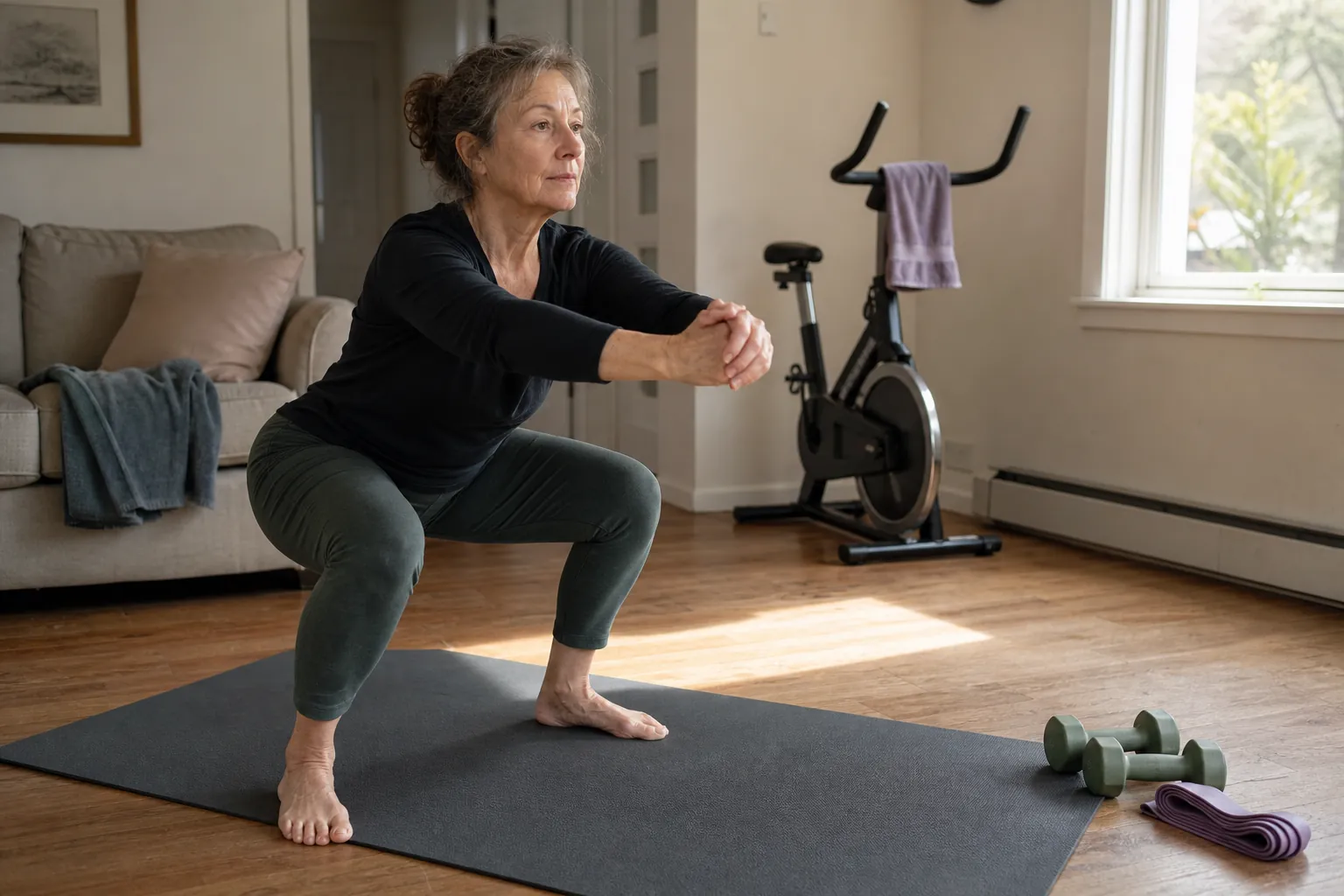
Everything below should be read with one important label attached: Brinkley’s workout details are self-reported celebrity-interview material, not a measured training log. That does not make them useless. It just means they are clues, not a protocol.
What Brinkley has actually described, by date
The older interviews matter because they keep repeating the same unglamorous habits. Brinkley turned 72 on Feb. 2, 2026; PEOPLE’s January 2024 interview caught the same question just before she turned 70, and the exercise details there are not wildly different from what she had been saying years earlier.[4]
2016: sun salutations, Total Gym language, and the first caution flag
In Coveteur’s 2016 beauty-routine interview, Brinkley said she liked to start with sun salutations, then moved into her familiar Total Gym discussion. She also used the “eccentric and concentric” phrasing, describing it as a reason she considered the machine effective.[1] That is the kind of sentence that sounds scientific enough to travel well online. It should travel with a warning label.
The useful piece from 2016 is not that a particular machine owns both phases of muscle contraction. The useful piece is that she had a home setup she would actually use. Brinkley’s commercial relationship with Total Gym is part of the context; later coverage describes her as a spokesperson for the brand, so the machine language belongs in the marketing container, not the evidence container.[2]
2018: the most believable consistency details
The Cut’s 2018 interview is probably the most useful one for a home exerciser because it gives the small, almost silly details that make routines survive bad moods. Brinkley said that on low-motivation days, even seven minutes on the Total Gym counted. She described doing leg lifts while brushing her teeth and squats while drying her hair. After a labrum tear, she summed up the lesson this way: “once you’re over 50, don’t stop moving because you’ll rust.”[3]
That line is not a medical rule, but it does sound like the practical truth of many home routines: the shorter the path between intention and movement, the better. A bike wedged near the wall still works if you can get on it. A mat on a not-perfect floor still works if it is not buried under laundry.
2020: about 15 minutes a day, with a secondary-source caveat
In 2020, Women’s Health, citing Shape, reported that Brinkley did about 15 minutes a day on the Total Gym, including bodyweight squats, twists, and pull-up-style movements; the story also noted that she used the machine outdoors during quarantine.[2] Because the original Shape page is not retrievable from the materials here, that 15-minute detail is best treated as secondary attribution, not a fresh primary interview.
Still, it fits the pattern: short, frequent resistance work at home. The machine is visible in the story because the brand relationship is visible. The training idea underneath is simpler than the product: push, pull, squat, rotate, repeat.
2024: 20- or 30-minute spin classes several days a week
The January 2024 PEOPLE interview is the clearest cardio checkpoint. Brinkley said she did a 20- or 30-minute spin or Peloton-style class several days a week, then floor, arm, and core work on other days. She also said she liked the Total Gym because “if it’s in my home, I’m going to do it.”[4]
That last sentence is more useful than the brand pitch. It is the difference between buying equipment as an identity and placing equipment where your future tired self can use it. If the bike is already there, the decision gets smaller.
2024: “mix it up” is a philosophy, not a prescription
In NewBeauty’s 2024 piece, Brinkley described her view as “the best exercise routine is not to have a routine, to mix it up.”[5] That is a fine personal philosophy. It does not mean randomness is better than progressive training, and it does not replace weekly minimums. It does explain why her interviews move among cycling, Total Gym work, floor work, gardening, yoga-like movement, and everyday movement snacks.
| Claim from the interviews | How to treat it at home |
|---|---|
| Short daily resistance work, often described as 7 to 15 minutes | Useful pattern; rebuildable with bodyweight, bands, light dumbbells, or a mat |
| 20- or 30-minute spin/Peloton-style classes several days a week | Useful cardio pattern; bike optional if walking, marching, stairs, or low-impact intervals fit better |
| Floor, arm, and core work on other days | Useful as variety, especially if it helps you meet strength work at least twice weekly |
| Calf raises while brushing teeth, squats while drying hair, gardening | Useful movement-snack habit; not a full substitute for strength and cardio minimums |
| “Eccentric and concentric” as a reason the Total Gym is best | Brand-adjacent claim; do not treat it as a scientific verdict |
What the exercise-aging evidence actually backs
The evidence does not prove that Brinkley’s face, body, career, or longevity came from one product. It does support the duller, sturdier parts of the routine: regular aerobic work, regular strength work, enough total weekly movement, and balance attention as we get older.
The ACSM baseline for adults is at least 150 minutes of moderate-intensity aerobic activity per week, or 75 minutes vigorous, plus muscle-strengthening activity at least two days a week.[6] The CDC gives the same broad minimums for older adults and adds balance activities for adults 65 and older.[7] Brinkley’s reported pattern can fit that frame if the “several days a week” cardio sessions and the floor/strength work are actually repeated consistently. The interviews do not prove that they are, but the structure is plausible.
A 2015 review in Rejuvenation Research describes exercise as something that can attenuate major hallmarks of aging, not abolish them. It notes that resistance exercise improves muscle mass and strength in older adults, with common protocols using two to three nonconsecutive sessions per week and one to three sets of 10 to 15 repetitions. The same review gives the less cheerful reason this matters: VO2max declines at least 4 to 5 mL/kg/min per decade, muscle mass begins declining around ages 25 to 30 with roughly 40% lost by age 80, and sarcopenia affects roughly 5% to 13% of people ages 60 to 70.[8]
That is where the real anti-aging case sits. Not in looking frozen in time. In keeping enough leg strength to get off the floor, enough pulling strength to carry groceries, enough aerobic capacity to climb stairs without bargaining with yourself, and enough balance to avoid unnecessary falls.
The Dallas Bed Rest and Training Study is striking, but it should stay small in our minds because it was small in design. Harvard Health describes five men who returned at age 50 and trained for six months, reversing 100% of their 30-year age-related decline in aerobic power. The same Harvard article also reports that previously sedentary men who started exercising after age 45 had a 24% lower death rate than inactive classmates, while plainly stating that “exercise can’t do it all.”[9]
So yes, exercise can make a large difference to capacity, risk, and independence. No, that does not turn one celebrity routine into proof of biological reversal. It especially does not prove skincare outcomes, supplement claims, procedure choices, or the value of a specific machine.
The “eccentric and concentric” claim is where marketing gets too comfortable
Most ordinary strength exercises already have concentric and eccentric phases. Stand up from a squat and your muscles shorten under load; lower back down with control and they lengthen under load. Curl a dumbbell up, then lower it slowly. Pull a band toward you, then resist it on the way back. You do not need a branded machine for that basic training reality.
A Total Gym may be convenient for someone who owns it, likes it, and has room for it. Convenience is not a small thing. But the ACSM and CDC guidelines do not name a machine; they name activity categories and weekly work.[6][7] That is the line to keep: the machine may be Brinkley’s tool, but it is not the evidence-backed requirement.
Rebuild the defensible routine without the Total Gym
This is not Christie Brinkley’s exact workout. It is the home version of the pattern that survives the source check and the evidence check: short resistance work, cardio several days a week, some floor/core work, frequent easy movement, and balance work if you are 65 or older.
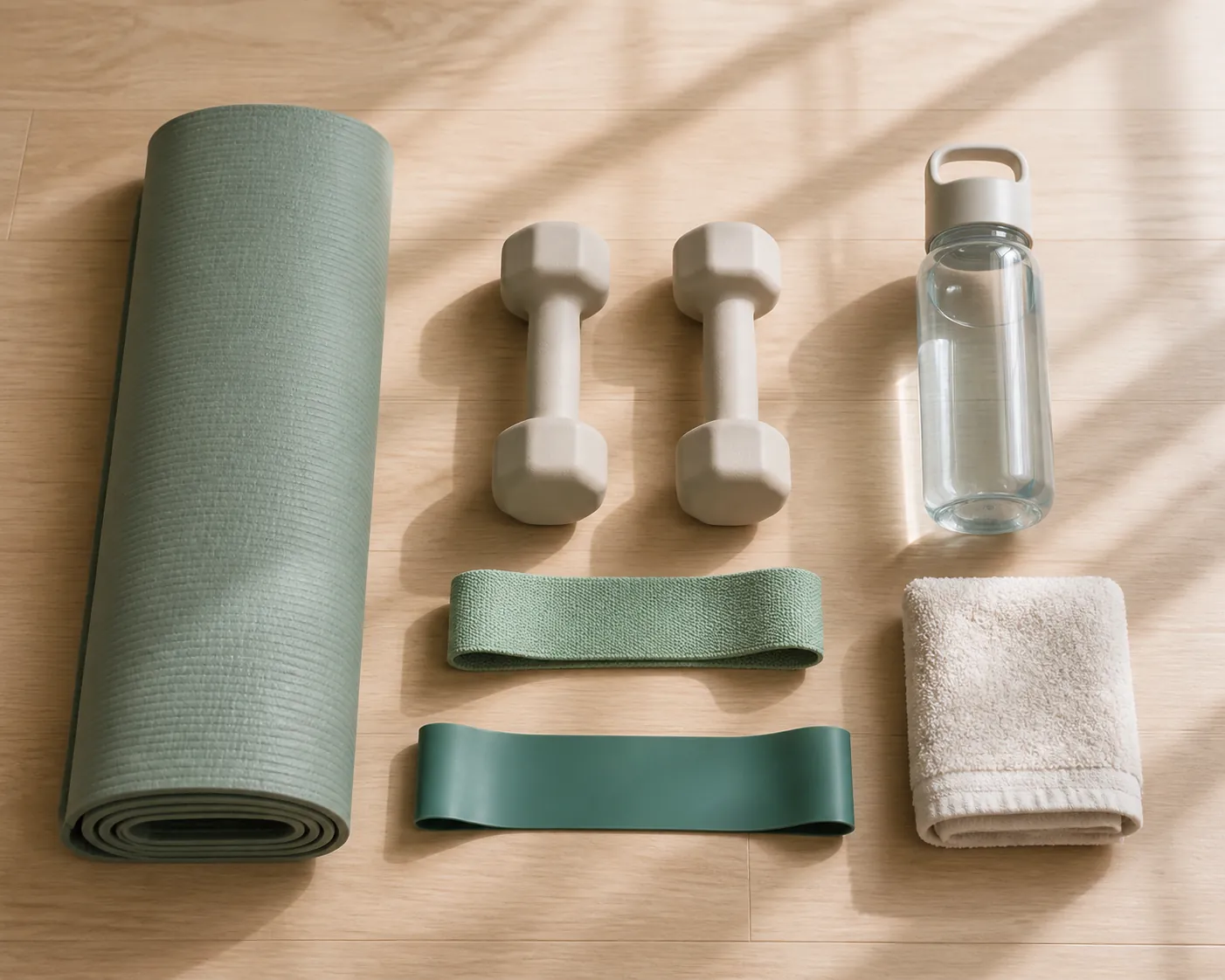
Use what you already have: bodyweight, a chair, a wall, a mat, a resistance band, light dumbbells, a stationary bike if one is already in the house, or low-impact cardio if it is not. If you are trying to manage weekly effort without a coach, it helps to keep a simple log; our guide to home workout load and recovery is a better companion for that job than any celebrity interview.
| Day type | 20- to 30-minute home version |
|---|---|
| Cardio day, 3 or more days weekly | 20 to 30 minutes on a bike, brisk walk, low-impact dance, marching intervals, step-ups, or an easy-to-follow online class |
| Strength day, at least 2 days weekly | 10 to 20 minutes of squats or sit-to-stands, rows, wall or incline push-ups, hip hinges or glute bridges, and carries or marches |
| Floor/core day | Dead bugs, bird dogs, side planks from knees, gentle twists, mobility work, or mat-based arm/core circuits |
| Low-motivation day | 7 minutes still counts: one easy circuit, one short walk, or one song of movement instead of skipping completely |
| Daily movement snacks | Calf raises, counter push-ups, light squats, stair trips, gardening, or walking during phone calls |
A 20-minute resistance session
Warm up for three minutes: march in place, shoulder rolls, easy step-touches, hip circles, and a few slow sit-to-stands from a chair. Then do one or two rounds of the following, resting as needed:
- Chair squat or bodyweight squat: 8 to 12 repetitions
- Band row, towel row, or dumbbell row: 8 to 12 repetitions
- Wall push-up, counter push-up, or incline push-up: 6 to 12 repetitions
- Glute bridge or hip hinge: 8 to 12 repetitions
- Dead bug, bird dog, or slow standing march: 6 to 10 per side
- Optional carry: hold two light weights or household objects and walk slowly for 30 to 60 seconds
Lower each rep with control and lift with control. That gives you the ordinary eccentric and concentric work without turning the words into a sales pitch. If the room is small, stay with chair squats, rows, wall push-ups, bridges, and marching. A routine you can perform in a corner has a better chance than one that requires clearing the whole room every time.
A 20- to 30-minute cardio session
If you own a bike and like classes, Brinkley’s reported 20- or 30-minute spin/Peloton-style format is easy to understand: get on, warm up, spend most of the session at a pace where talking takes effort, cool down. If you do not own a bike, do not buy one just to imitate the shape of her routine. The training target is sustained aerobic work.
- No bike: brisk walking, indoor marching, low-impact dance, stair walking, or step-ups.
- Sensitive joints: choose flatter walking routes, cycling, water exercise if available, or low-impact intervals.
- Low energy: do 10 minutes now and 10 minutes later. It is not glamorous, but it counts toward the habit.
Several 20- to 30-minute cardio sessions can get you close to the 150-minute weekly minimum, depending on frequency and intensity. Strength sessions and ordinary walking around the day help, but they should not hide the math. If the week keeps coming up short, do not keep shortening the sessions; reduce the setup friction instead.
Movement snacks are not childish; they are infrastructure
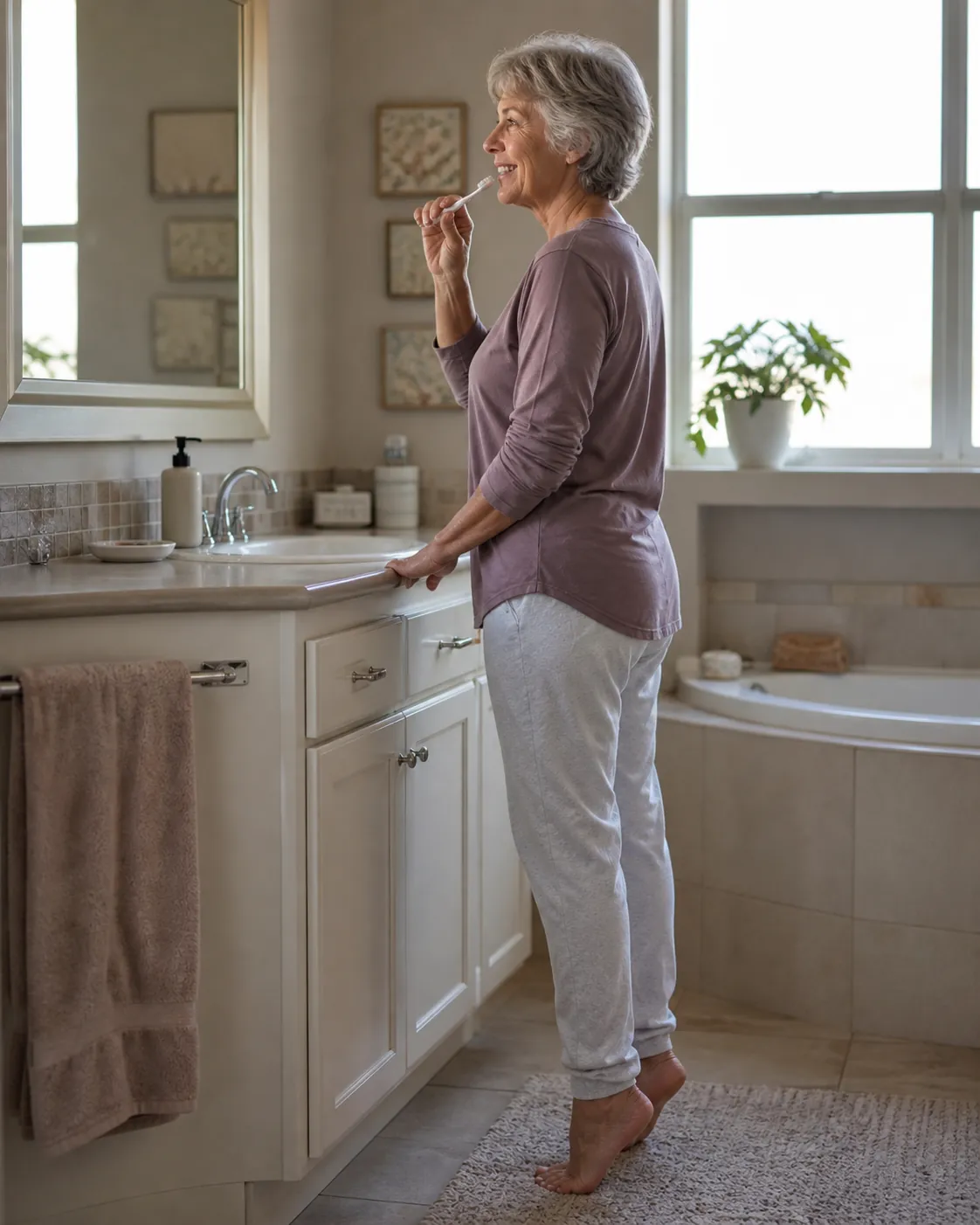
Brinkley’s calf raises while brushing teeth and squats while drying hair are not a complete program.[3] They are a way of keeping the door open on days when the formal workout is not going to happen. A few calf raises at the sink, five counter push-ups while the kettle heats, one slow set of sit-to-stands before a shower — those are not magic. They are reminders to the body that the day still includes movement.
This is also where setup matters more than willpower. Shoes by the door, a band hanging where you can see it, dumbbells that are not shoved behind a basket, a mat that is easy to unroll: these small choices do more for consistency than another promise to be disciplined tomorrow. If that is the part of home exercise that keeps breaking down, start with home workout motivation and setup before changing the workout itself.
For readers 65 and older, add balance on purpose
The celebrity interviews make balance sound incidental, but the CDC recommendation for adults 65 and older is explicit: include balance activities along with aerobic and strengthening work.[7] That can be as simple as heel-to-toe walking near a wall, tandem stance beside a counter, slow weight shifts, or single-leg stands with fingertips available for support.
If you have had a recent fall, dizziness, surgery, neurological symptoms, or a new pain that changes how you move, this is where a clinician or physical therapist matters. For a gentle, rehab-adjacent starting point, see our home exercises after a fall guide rather than copying any celebrity circuit.
What to leave out
Leave out the idea that the Total Gym is necessary. Leave out the idea that “eccentric and concentric” makes one branded setup uniquely anti-aging. Leave out diet, supplement, mushroom-coffee, skincare, and procedure anecdotes when judging the workout, because the materials here do not support those as exercise claims.
I would also leave out the circulated “100 pushups” and “10-lb dumbbells” style details unless you can trace them to a reliable primary source. They may be tempting because they sound specific, but specificity is not the same as provenance.
If you like celebrity rebuilds because they make the routine feel less abstract, the same rule applies elsewhere: keep the useful pattern and discard the fantasy. That is the approach in our John Goodman weight-loss workout plan and Asplund weight-loss home plan as well.
The machine is optional. The marketing is optional. The beauty and diet anecdotes are outside the workout evidence. The boring pattern — strength, cardio, variety, and daily movement — is the part worth copying.
References
- Christie Brinkley’s Beauty and Hair Routine, Coveteur, 2016
- Christie Brinkley Shared a Home Workout Video Using Her Total Gym In Her Backyard, Women’s Health, April 2020
- Christie Brinkley’s Anti-Aging Diet and Workout Routine, The Cut, January 2018
- Christie Brinkley Talks Accepting Wrinkles and Clapping Back at Online Haters (Exclusive), PEOPLE, January 2024
- 7 Things Christie Brinkley Does to Look This Great at 70, NewBeauty, 2024
- Physical Activity Guidelines, ACSM
- Older Adult Activity: An Overview, CDC
- Exercise Attenuates the Major Hallmarks of Aging, Rejuvenation Research, 2015
- Exercise and aging: Can you walk away from Father Time?, Harvard Health Publishing, 2014
What a small equipment investment adds
We don't have a build tagged to this exact tier yet. Browse all builds.
How often should you repeat this?
See our recovery and rest reference for citation-anchored rest-interval guidance.
Spot something off?
Tell us if a movement, tier assumption, or duration didn't match your experience.