
Follow John Goodman's Weight Loss Workout Plan at Home
John Goodman's reported weight-loss routine is deliberately ordinary: near-daily moderate movement, a 10,000–12,000 step target, boxing-style conditioning, and portion control. Those pieces transfer to a home setup, and this plan arranges them into three budget tiers — from no-equipment walking to an incline treadmill or elliptical — checked against ACSM and CDC guidance.
- Equipment tier required
- none
- Duration
- 30 min
- Difficulty
- beginner
- Target area
- full body
- Space footprint needed
- small (rug-sized)
- Noise level
- quiet-friendly
The useful version of a “John Goodman weight loss workout plan at home” is not a secret celebrity session. The parts that have actually been reported are plain: frequent moderate movement, treadmill or elliptical work, a 10,000–12,000 daily step target, boxing-style conditioning, portion control, less sugar, and sobriety. Goodman trained with Mackie Shilstone, and Shilstone reportedly set up equipment at Goodman’s California home, but public sources do not document every workout length, exact machine model, or full equipment list. That is enough to adapt the pattern without pretending to copy the man’s private calendar. [1][2]
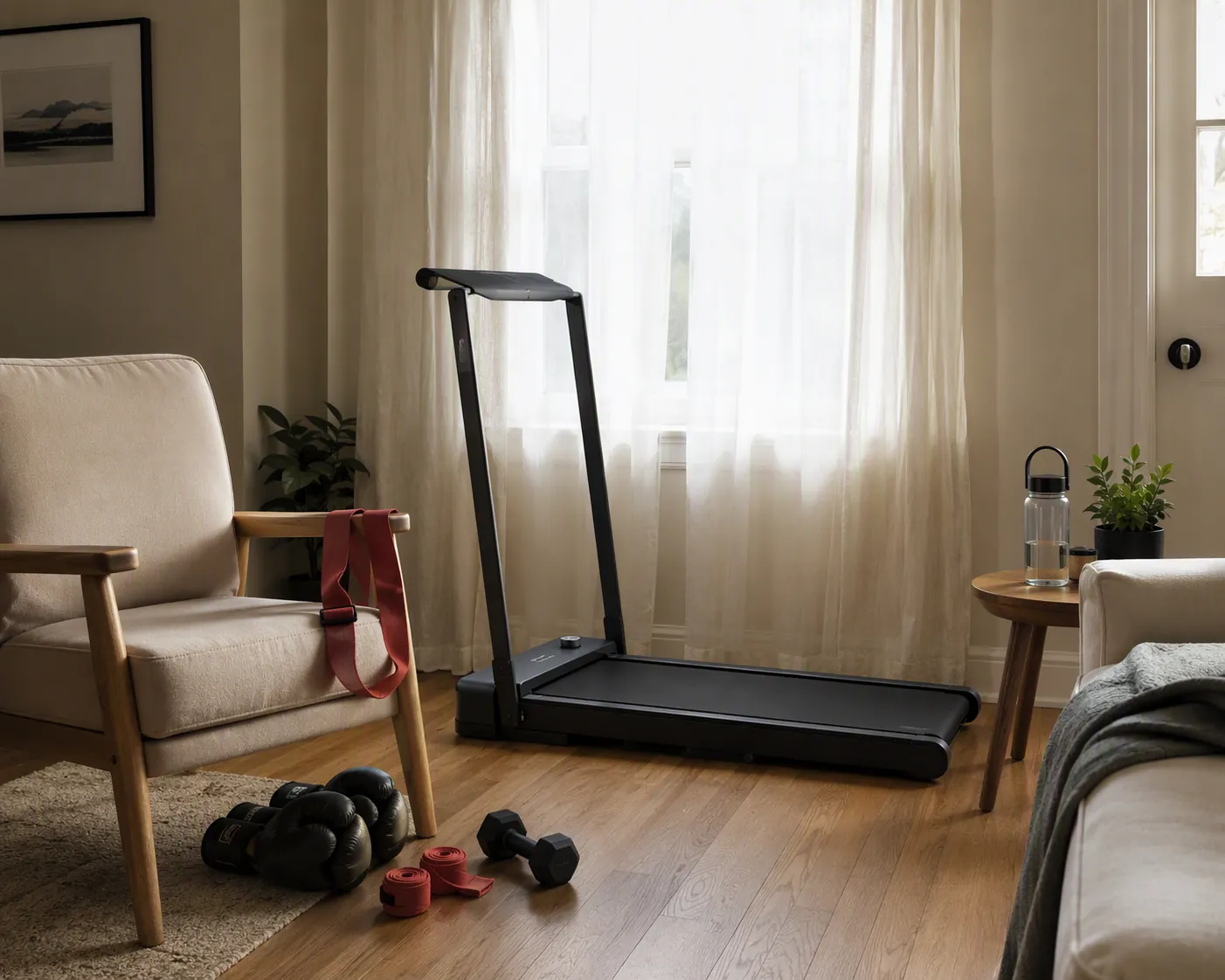
Start with the reported routine, not the legend
The most usable Goodman facts are the least dramatic ones. In 2015, Shilstone described Goodman training six days a week with treadmill and elliptical bicycle work, plus 10,000–12,000 steps a day. The same account described a Mediterranean-style eating pattern built around fish, nuts, olive oil, vegetables, and fruit. [1] Today later repeated the 10,000–12,000 step target and the broader training pattern. [2]
The boxing piece was real, but it should be read correctly. Goodman described it as “an hour, hour and a half of hitting the mitts, hitting the bags, learning footwork,” and said he never sparred. [3] For a home plan, that points toward footwork, rhythm, shadow boxing, light bag-free rounds, and conditioning—not getting punched in a garage.
The food side was just as unspectacular. AARP described Goodman using portion control, and the earlier NY Post account described the Mediterranean-style pattern rather than a named crash diet. [1][4] That matters because the workout alone is not the whole story. The repeatable version is movement volume plus dietary restraint, not a treadmill used as punishment for eating.
Why the slow version is the usable version
The ACSM position stand on physical activity and weight management is a useful check on the scale of this plan. It says 150–250 minutes per week of moderate-intensity physical activity is associated with modest weight loss, especially when paired with moderate diet restriction, while more than 250 minutes per week is associated with clinically significant weight loss. [5] The CDC’s baseline adult guidance is lower than Goodman’s reported routine: 150 minutes a week of moderate-intensity aerobic activity plus two days of muscle-strengthening work. [6]
That does not mean a beginner should jump straight to Goodman’s reported six-days-a-week routine. It means the direction is sensible: build toward frequent moderate movement, then add volume only when your feet, knees, hips, back, and schedule tolerate it. UCLA Health has also reported that people who lost more than 10% of body weight walked about 10,000 steps a day, with about 3,500 of those steps at moderate-to-vigorous intensity. [7] The step count is a target to grow into, not a moral grade on a bad knee day.
Goodman’s own history makes the slower approach more convincing than the headline number. He has described earlier cycles of losing 60 or 70 pounds, then rewarding himself and returning to old habits. [2] That is the familiar trap: fast enough to impress people, not stable enough to live with.
Three at-home versions of the same idea
The home version does not need Goodman’s coach or his equipment. It needs the same categories of work: walking volume, moderate cardio, boxing-style conditioning, simple strength, and a food pattern that does not undo the movement. The equipment tier only changes how you get the minutes.
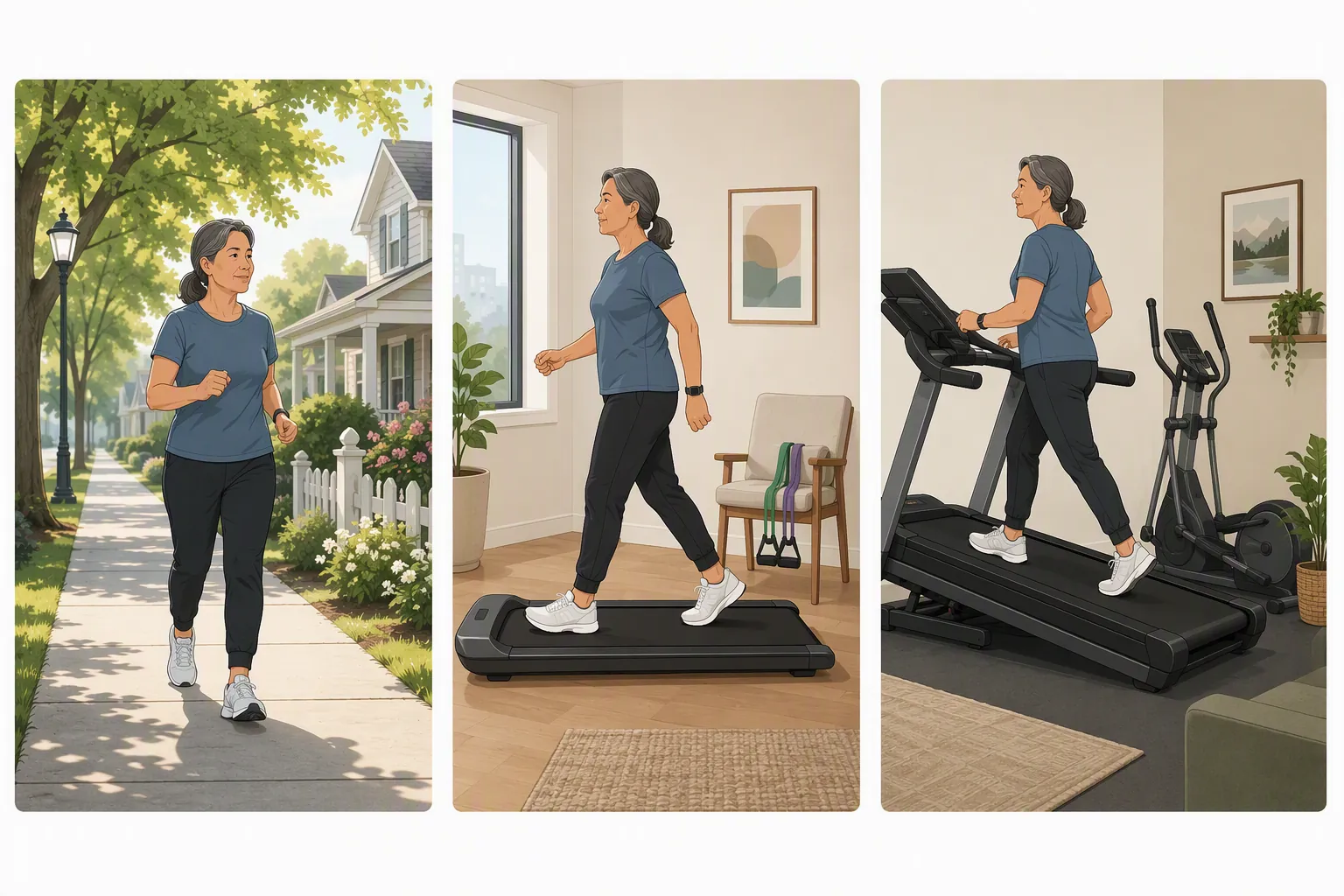
| Tier | Best fit | Main cardio | Conditioning and strength |
|---|---|---|---|
| Tier 1: $0–100 | Apartment dwellers, beginners, anyone testing consistency before buying equipment | Outdoor walking, hallway walking, stair-free routes when joints need it | Shadow boxing, bodyweight sit-to-stand work, wall pushups, gentle mobility |
| Tier 2: $100–300 | People who need weather-proof walking and a small-space setup | Walking pad or flat treadmill | Resistance bands, quiet boxing footwork, simple upper-body pulls and presses |
| Tier 3: $300–800 | People ready for more cardio options or lower-impact machine work | Incline treadmill and/or elliptical | Incline walking, elliptical intervals, bands, shadow boxing, optional light bag work if space and noise allow |
If equipment cost is the sticking point, keep the first purchase boring. A band set and shoes you will actually walk in beat a large machine that becomes a laundry rack. For realistic small-space budgeting, see this home gym cost breakdown.
Tier 1: walking, shadow boxing, and bodyweight work
This is the cleanest translation of the Goodman pattern for someone who owns no machine. Walking supplies the daily volume. Shadow boxing supplies the “training” feeling without sparring, a heavy bag, or a downstairs-neighbor complaint. Bodyweight strength keeps the plan from becoming only steps.
- Walk most days at a pace that raises breathing but still lets you speak in short sentences.
- Use the 10,000–12,000 step range as a later target, not a first-week requirement.
- On boxing days, stay bag-free if noise or joint comfort matters: step, pivot, jab, cross, reset, and keep the punches loose.
- For strength, choose movements that do not require getting down on the floor if knees or hips object: wall pushups, chair sit-to-stands, counter-supported hinges, and easy calf raises.
The Mayo Clinic’s 12-week walking schedule, based on a National Heart, Lung, and Blood Institute plan, is a better beginner model than a dramatic first week. It builds walking gradually over a defined 12-week ramp. [8] If you have been mostly inactive, that kind of ramp is not timid; it is how you avoid turning one enthusiastic Monday into three sore weeks.
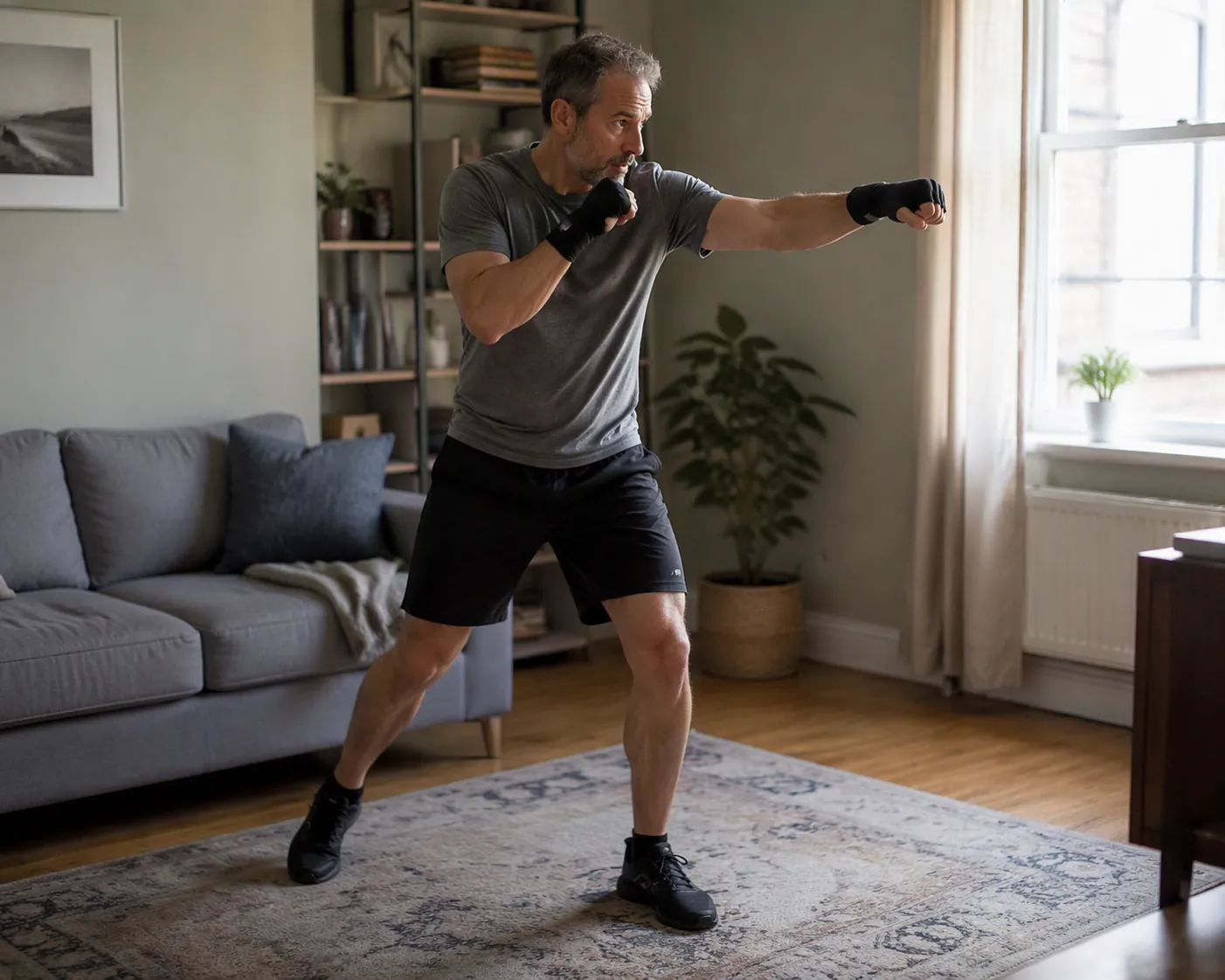
For quiet boxing days, use footwork before force. Mark a small rectangle on the rug with your eyes, not tape if the lease is fussy. Step forward and back, shift left and right, throw easy straight punches, then reset. The goal is rhythm and breathing, not proving anything to an imaginary opponent. If you want a fuller bag-free structure, use these apartment boxing drills or this no-equipment MMA-inspired home workout for cardio days.
Tier 2: walking pad or flat treadmill plus bands
A walking pad does not make the plan more virtuous. It makes it harder for rain, heat, darkness, or neighborhood safety to cancel the plan. That is a legitimate upgrade for someone trying to accumulate moderate minutes week after week.
Keep the machine work deliberately moderate at first. Walk flat, hold posture, and let the step count rise because you are showing up more often, not because you are turning every session into a test. Add bands for rows, presses, pull-aparts, and supported lower-body work. The CDC’s two-day strength guidance is modest enough to fit here without turning the living room into a gym floor. [6]
- Use the walking pad for ordinary accumulation: news, a podcast, or a phone call if your balance is solid.
- Use bands after walking, not before, if strength work tends to become the excuse that prevents cardio.
- Put boxing footwork on a non-slip rug or bare floor; socks on slick flooring are not a training plan.
- If the step counter seems inaccurate, use it for trend direction rather than courtroom evidence.
Tier 3: incline treadmill or elliptical, if your joints and budget allow
Tier 3 is not automatically harder; it is more adjustable. A treadmill gives you speed and incline. An elliptical gives you a lower-impact cardio option because the feet stay on the pedals rather than striking the belt each step. Men’s Health describes the treadmill as closer to natural walking or running mechanics and the elliptical as lower impact, with each machine serving a different purpose. [9] That trade-off matters for older or heavier exercisers, and it is especially worth noting because Goodman has been reported to have titanium knees. [2]
The popular 12-3-30 workout—12% incline, 3 mph, 30 minutes—can fit here only as an optional flavor, not as the plan’s center. Today’s expert coverage treats it as a demanding incline-walking routine and includes safety caveats, especially for people who are new to exercise or not ready for sustained incline work. [10] A gentler incline, a shorter duration, or the elliptical may be the better choice while you are building the base.
Incline is useful because it raises effort without requiring running. It is also easy to overdo. If your calves, Achilles tendons, low back, or knees complain, flatten the belt before you blame your willpower.
A weekly structure that fits the evidence
The simplest evidence-checked target is to work toward the CDC baseline first: 150 weekly minutes of moderate aerobic activity and two strength days. [6] Once that is steady, the ACSM framing gives you the next decision point: staying in the 150–250 minute range may support modest weight loss, while moving beyond 250 minutes is the range associated with clinically significant loss. [5]
| Phase | What to do | What not to rush |
|---|---|---|
| First consistent phase | Accumulate moderate walking or machine minutes across the week; add two simple strength days | Do not chase 10,000–12,000 steps immediately if your current baseline is far lower |
| Base-building phase | Move toward most-days activity: walking, treadmill, elliptical, or quiet boxing conditioning | Do not make every day hard; frequency matters more than drama |
| Higher-volume phase | If recovery is good, increase weekly moderate minutes toward and beyond the ACSM higher-volume range | Do not increase incline, speed, boxing intensity, and duration all at once |
A practical week might have walking or machine cardio on most days, two short strength sessions, and one or more boxing-style conditioning sessions where the feet move more than the ego. The boxing can replace a cardio day or finish a walk; it does not need its own heroic category.
Food, sugar, alcohol, and sleep belong in the plan—but carefully
Goodman’s reported changes included cutting sugar, portion control, Mediterranean-style foods, and sobriety. [1][2][4] Those are not interchangeable. Portion control and lower-sugar eating can be adapted broadly. Sobriety is personal and, for some people, medical; anyone with alcohol dependence or withdrawal risk should involve a qualified clinician rather than treating a celebrity profile as a protocol.
Shilstone has offered coach-style recommendations connected to Goodman’s weight loss: keeping a food journal, limiting sugar, setting goals, scheduling exercise, and getting eight hours of sleep. [11] Those are useful coaching habits, not peer-reviewed proof that the same checklist produces the same result in another body.
The food journal is the most practical of the group. It does not need to be elegant. Write down meals, snacks, drinks, and the time. If portions drift upward when workouts increase, the journal catches it before the scale has to.
Do not build the plan around one weight-loss number
Goodman’s weight-loss totals vary across outlets and eras, which is exactly why one neat number should not run the article. NY Post reported a peak weight of 392 pounds in 2015. [1] Life Extension’s 2016 interview with Shilstone referred to “125 pounds — so far.” [12] Men’s Health UK later described Goodman’s total loss as about 200 pounds by 2023. [13] These are self-reported or media-reported milestones over time, not a laboratory record with one final certified figure.
For a home exerciser, the better number to borrow is not the total pounds. It is the structure around the pounds: most-days movement, a step target built over time, moderate cardio, boxing-style conditioning without sparring, dietary restraint, and enough patience for the routine to become ordinary.
When to modify or get medical advice
If you have heart disease, chest pain, uncontrolled blood pressure, diabetes complications, balance problems, recent joint replacement, severe arthritis, or a long inactive stretch, talk with a health professional before copying even a moderate plan. The same applies if changing alcohol use could create withdrawal risk.
At home, the warning signs are plain enough to respect: joint pain that changes your gait, dizziness, chest pressure, unusual shortness of breath, sharp tendon pain, or soreness that worsens session after session. Swap running for walking, incline for flat, treadmill for elliptical, or boxing footwork for seated upper-body punches when the body gives you that information.
Goodman’s routine is worth adapting because its ordinary pieces can survive inside a real home: walking volume, moderate conditioning, portion control, and consistency. That is a sturdier inheritance than a transformation photo.
References
- The secrets behind John Goodman’s 100-pound weight loss, New York Post, November 10, 2015
- John Goodman weight loss, Today
- John Goodman weight loss walking, Prevention
- John Goodman weight loss, AARP, 2018
- Appropriate physical activity intervention strategies for weight loss and prevention of weight regain for adults, Medicine & Science in Sports & Exercise, 2009
- Adult Activity: An Overview, Centers for Disease Control and Prevention
- How many steps do you need a day to see health benefits?, UCLA Health
- Get walking with this 12-week walking schedule, Mayo Clinic News Network
- Elliptical Machine vs Treadmill, Men’s Health
- 12-3-30 workout, Today
- Mackie: Five keys to John Goodman's 100-pound weight loss, WWLTV, 2010
- Own Your Health, Life Extension, 2016
- John Goodman weight loss, Men’s Health UK
What a small equipment investment adds
We don't have a build tagged to this exact tier yet. Browse all builds.
How often should you repeat this?
See our recovery and rest reference for citation-anchored rest-interval guidance.
Spot something off?
Tell us if a movement, tier assumption, or duration didn't match your experience.