
Apartment Boxing Drills You Can Do Quietly Without a Bag
Learn how to perform effective boxing drills in a small apartment without a heavy bag or annoying the neighbors. This guide covers the minimum space needed, noise-reducing techniques, and a full workout you can do in a 6x6 foot area.
- Equipment tier required
- none
- Duration
- 30 min
- Difficulty
- beginner
- Target area
- full body
- Space footprint needed
- 6.5x6.5 ft
- Noise level
- low
A quiet apartment boxing workout starts with a floor plan, not a heavy bag. If you can clear about a 6.5 by 6.5 foot square, put foam mats over the floor, and keep both feet from slapping the ground, you have enough room for useful home boxing drills and training without turning your lease into a stress test.
That footprint is not a formal boxing standard. It is a practical small-space target: a licensed professional trainer cited by RareBreed says a 2 by 2 meter area is enough for boxing footwork drills, and KO Studio gives a similar 6 by 6 foot minimum for effective shadow boxing at home.[1] In apartment terms, that is a cleared bedroom corner, the rug space in front of a couch, or four large interlocking foam tiles with a little breathing room around the edges.
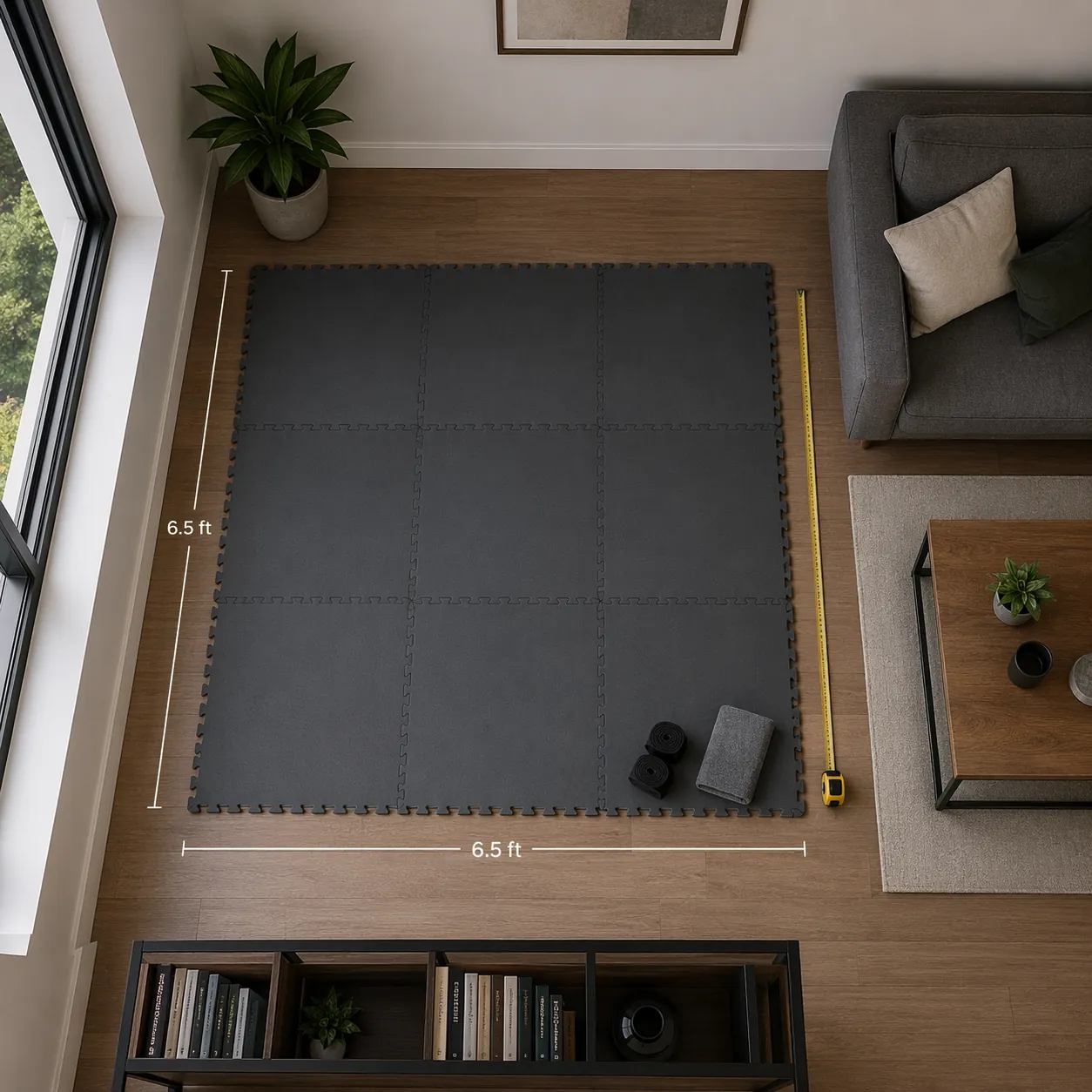
Will It Fit, And Will It Stay Quiet?
Measure the space before you plan the workout. A 6.5 by 6.5 foot training square does not mean you need an empty room. It means you need enough clear floor to stand in boxing stance, step forward and back, pivot without clipping a table leg, and roll under an imaginary punch without hitting a wall.
The furniture test is simple: stand in your boxing stance, extend your lead hand, then turn 90 degrees and do it again. If your fist points into a lamp, a monitor, or a sharp shelf corner, move the object or move the workout. You do not need space for long shuffles across the room. You need enough room to reset your feet safely after each combination.
Shadow boxing is the apartment-friendly base because it has no bag impact. The sound problem usually comes from the floor: heel drops, stomped pivots, jumpy conditioning, and tired footwork that gets heavier as the round goes on. Foam mats matter more here than gloves. Gloves protect hands from impact; mats protect the floor, soften foot noise, and give you a defined training square. FightCamp’s small-space setup guidance also treats floor protection and compact placement as part of making boxing work at home.[2]
If you train above someone, treat quiet hours as a programming rule. After 9 p.m., skip jump squats, burpees with a hard landing, fast running-in-place, and anything that makes your feet drum against the floor. You can still work hard with slower squats, split-stance holds, push-ups, planks, slips, rolls, and clean punching volume.
The best setup is plain: foam mats, shoes with enough grip to pivot without squeaking, a timer, water, and maybe hand wraps if your wrists like the support. A mirror can help, but it is not required. A heavy bag adds resistance and feedback, and some people eventually want that. In an apartment, though, the bag is often the first thing that makes the workout loud, awkward, or impossible. If you are comparing that route later, this FightCamp apartment workout review is the better place to weigh equipment tradeoffs.
What Counts As A Real Workout Without A Bag
A no-bag session is real when the rounds are structured, the punches have intent, and the feet and defense are trained instead of ignored. It is not the same stimulus as sparring or hitting a heavy bag. There is less resistance, less contact feedback, and no opponent pressure. But that does not make it a few casual arm swings in place.
Boxing has enough cardiovascular demand to earn respect, even before you add apartment constraints. NFPT cites Harvard Heart Letter estimates that a 155-pound person burns about 422 calories per hour punching a bag and more than 630 calories per hour sparring; NFPT also reports boxing as 13th among 178 cardio exercises.[3] Those numbers are not proof that quiet shadow boxing in your living room burns the same amount. They do show why boxing rounds can become serious conditioning when the work rate is honest.
No-equipment boxing can also carry a meaningful workload. Legends Boxing says shadow boxing alone can burn more than 200 calories in 30 minutes.[4] FightCamp reported a proprietary case study of 14 participants ages 30 to 39 who averaged 482 calories, a 145 bpm average heart rate, and a 180 bpm peak heart rate during one 8-round workout.[5] That FightCamp result is useful as a sign that home boxing can push the heart rate, but it is still a small brand study with no control group.
The body-composition evidence should be handled with the same restraint. NFPT describes a 16-week University of Western Sydney randomized controlled trial with 12 overweight but healthy participants, where boxing training reduced waist circumference by 2.6 inches, body fat by about 13%, and weight by 11 pounds, compared with much smaller changes in a walking control group.[3] That is encouraging, not a guarantee. It was a small study, not a trial of quiet apartment shadow boxing.
The Apartment Boxing Session
Use boxing’s standard rhythm: 3-minute rounds with 1 minute of rest. That structure keeps the session from turning into a random exercise circuit and makes the work feel like boxing even without a bag.
| Round | Work | Apartment rule |
|---|---|---|
| Warm-up | 3 minutes of stance resets, shoulder rolls, easy punches, and light steps | Keep feet soft; check mat position |
| Round 1 | Shadow boxing basics: jab, cross, guard return, stance discipline | No lunging; punch inside your square |
| Round 2 | Compact footwork: step in, step out, small pivots, angle resets | Slide quietly; do not stomp pivots |
| Round 3 | Combinations with defense: 1-2-slip, jab-cross-roll, cross-hook-roll | Bend knees instead of bouncing |
| Round 4 | Bodyweight conditioning: squats, push-ups, plank shoulder taps, reverse lunges | Choose low-impact versions |
| Round 5 | Pressure round: steady punching volume with compact movement | Stay balanced when tired |
| Round 6 | Skill round: pick one combination and clean it up | Quality over speed |
| Cool-down | 2 to 4 minutes of breathing, calf stretch, hip flexor stretch, shoulder mobility | Let the floor stay quiet to the end |
If you are new, stop at four rounds after the warm-up. If you are trained enough to keep your form under fatigue, run all six. The apartment does not care how motivated you are; once your feet get loud and your stance starts wandering into furniture, the round is done.
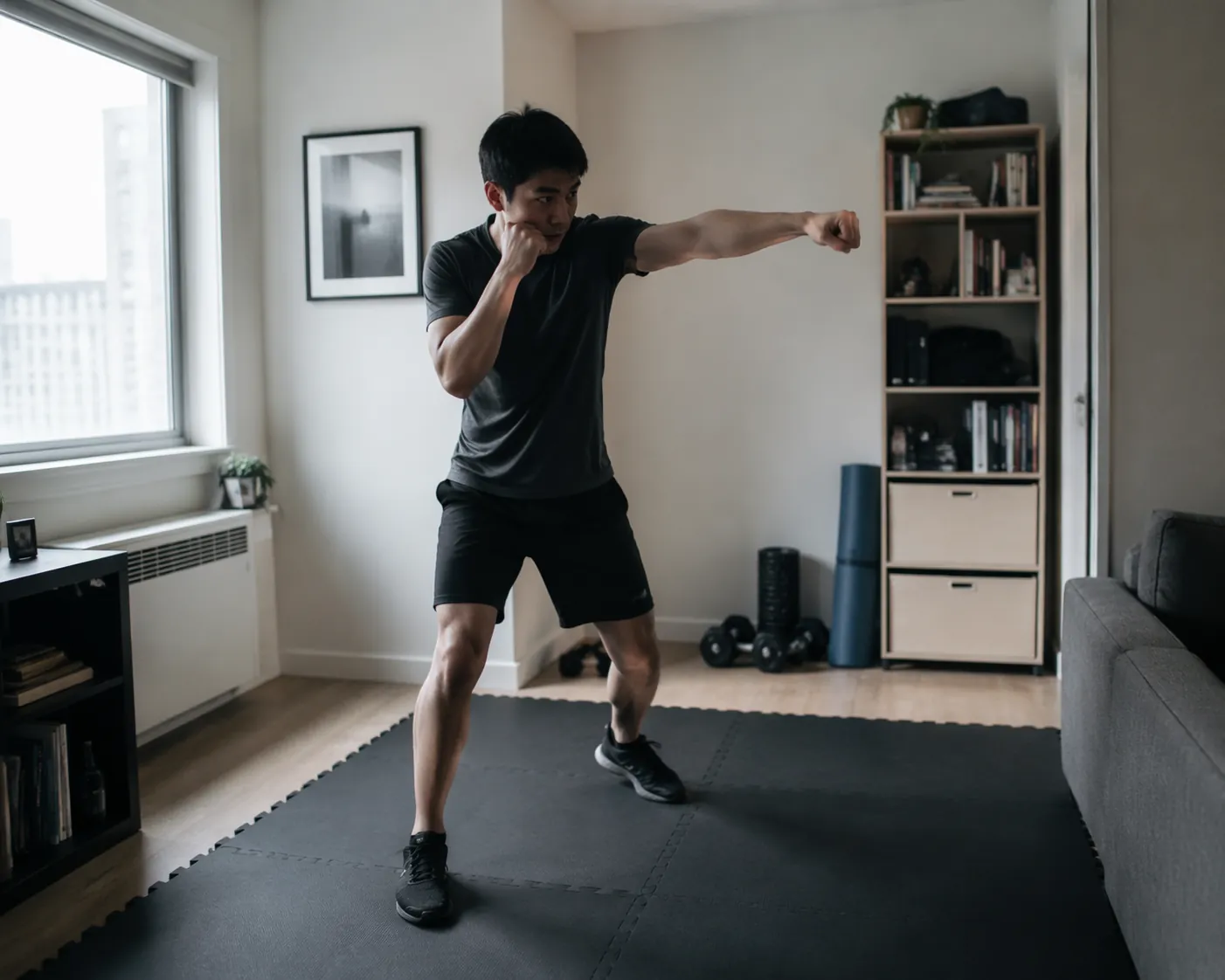
Round 1: Quiet Shadow Boxing
Start with the jab and cross because they reveal most apartment mistakes. If the jab pulls you forward until your lead foot thumps, shorten the punch. If the cross makes your rear foot grind into the mat, soften the pivot. The punch should snap out and come back to guard without dragging the rest of your body across the room.
- Minute 1: jab only, returning the hand to your cheek every time.
- Minute 2: jab-cross, small rear-foot pivot, quiet reset.
- Minute 3: jab-cross-jab, then freeze for one second to check balance.
Do not chase speed first. A fast punch that pulls your chin up, drops your opposite hand, or makes you stamp the floor is not better apartment boxing. It is just louder.
Round 2: Footwork That Fits The Square
Small-space footwork is not fake footwork. It is the part of boxing footwork most people should have practiced before they tried to glide around a gym: move without crossing your feet, keep your stance width, and arrive balanced enough to punch or defend.
Work in short units. Step forward two to four inches, bring the rear foot with you, then step back the same distance. Step left, bring the right foot with you. Step right, bring the left foot with you. Pivot on the ball of the lead foot without dropping your heel like a hammer. If you want a deeper drill library after this session, use these boxing footwork drills for a small apartment as the next layer.
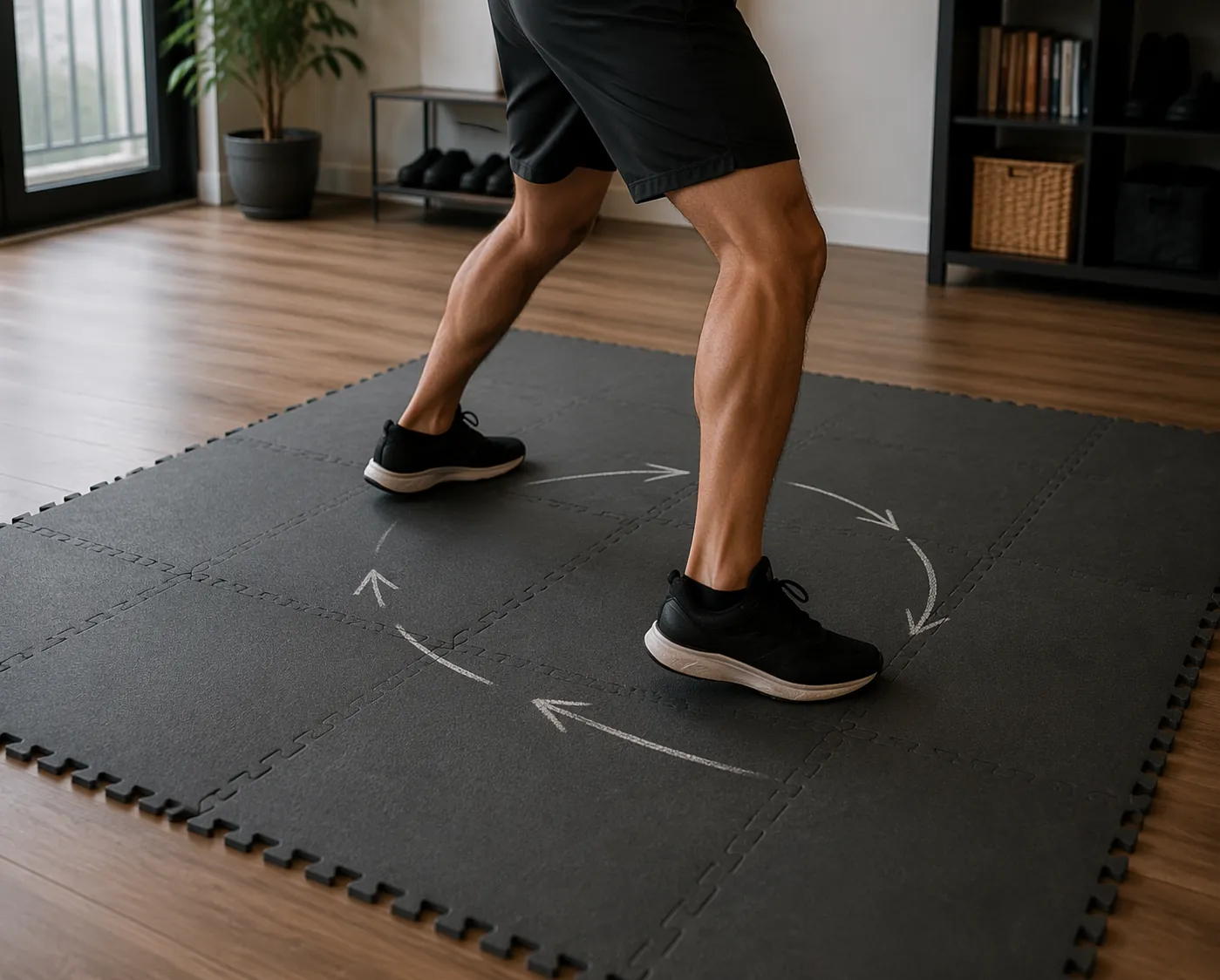
For the round, cycle through this pattern: step in with a jab, step out with your guard high, pivot slightly to your lead side, then reset in the center of the mat. The reset matters. In a small room, uncontrolled drifting is how you end up punching near a window, a television, or a shelf you forgot was behind you.
Round 3: Add Defense Without Adding Noise
Defense is where apartment boxing starts to feel skillful. Slips, rolls, and bob-and-weave patterns raise the leg and trunk demand without needing jumps. They also stop the session from becoming three minutes of punching at air with the same rhythm.
- Jab-cross-slip: punch twice, move your head slightly outside the center line, then return to stance.
- Jab-cross-roll: punch twice, bend the knees, roll under an imaginary hook, and come up balanced.
- Cross-hook-roll: rotate through the punches, roll under, then reset your rear heel softly.
- Jab-slip-cross: use the slip as the bridge into the rear hand rather than as a separate dance move.
Keep the defense small. A slip is not a side bend toward your neighbor’s ceiling fan. A roll is not a squat jump. Move enough to clear an imaginary punch, keep your eyes forward, and make the next punch available.
Round 4: Low-Impact Conditioning
This is the round that replaces the noisy exercises most apartment workouts pretend are harmless. You do not need jump squats to make your legs burn. You need steady time under tension and short transitions.
| Time | Exercise | Quiet cue |
|---|---|---|
| 0:00-0:45 | Slow bodyweight squats | Feet stay fully planted |
| 0:45-1:30 | Push-ups or elevated push-ups | Lower under control |
| 1:30-2:15 | Reverse lunges | Step back softly; no knee drop |
| 2:15-3:00 | Forearm plank or plank shoulder taps | Brace ribs; avoid rocking the floor |
If reverse lunges are too loud in your building, swap them for split squats where both feet stay in place. If push-ups bother your wrists, use a couch or sturdy chair to elevate your hands. The goal is not to copy a bootcamp class. It is to keep the conditioning round hard enough while staying neighbor-safe.
Rounds 5 And 6: Pressure, Then Precision
Round 5 is the closest thing to a cardio push. Choose three combinations and rotate them for the full round: jab-cross, jab-cross-hook, and jab-slip-cross. Stay inside the mat, breathe out on punches, and keep the last 30 seconds tidy instead of frantic.
Round 6 goes the other direction. Pick one combination and make it clean. A good choice is jab-cross-roll-cross. The punch after the roll will tell you whether your feet are still under you. If you have to hop to find balance, slow down and make the roll smaller.
For broader fight-style conditioning after you have this base, move to a wider no-equipment plan such as Train Like a UFC Fighter at Home with Zero Equipment or the 6-week no-equipment UFC training plan. Those are progressions, not requirements for making this apartment session count.
How To Keep The Workout Renter-Safe
Noise control is mostly fatigue control. Most people start quietly and get loud when their legs tire, their stance widens, and every pivot turns into a heel drop. Set the timer where you can see it, and end a round early if you cannot move softly anymore.
- Use foam mats over hard flooring, especially if you train above another unit.
- Keep at least one foot on the floor during conditioning after quiet hours.
- Pivot on the ball of the foot instead of grinding or dropping the heel.
- Move furniture fully out of the square rather than trusting yourself to avoid it mid-round.
- Avoid hanging bags, door-frame rigs, or improvised targets unless your lease and structure can actually handle them.
Floor protection is not just about being polite. It keeps sweat off wood, reduces scuffing, gives your feet a consistent surface, and makes setup repeatable. If you are thinking through apartment flooring, mats, and recovery-friendly movement more broadly, the renter-focused guidance in knee surgery recovery workouts for apartment renters is useful even if your knees are fine.
When To Add Equipment, And When Not To
A bag changes the workout. It gives your punches resistance, lets you hear and feel contact, and can make power training more satisfying. It also adds impact noise, needs stable placement, and can turn a normal apartment session into a negotiation with the person downstairs.
Before buying anything heavy, spend a few weeks making this no-bag session consistent. If you can complete six rounds quietly, keep your stance, and recover well enough to train again, you have built the part of boxing that equipment cannot buy for you. If the workout feels too easy, first increase precision, punch volume, defensive movement, or the number of rounds before adding a bag.
Healthline cites an ACE-certified calorie range of 350 to 450 calories per hour for cardio kickboxing, which is another reminder that boxing-style work can be metabolically demanding.[6] But apartment training should not be sold as magic fat loss. Its better promise is more practical: you can train often because setup is simple, the noise is controlled, and the workout does not depend on owning a garage.
So yes, a complete apartment boxing workout can fit in a small room. Clear roughly a 6.5 by 6.5 foot area, put down foam mats, use 3-minute rounds, keep the feet quiet, and train shadow boxing, compact footwork, defense, and low-impact conditioning with intent. It will not replace sparring, coaching, or every benefit of bag work. It can still be a real session.
References
- Top Boxing Workouts You Can Do In A Small Space — RareBreed
- How to Set Up Your FightCamp Gym in a Small Space — FightCamp
- Fitness Benefits of Boxing — NFPT
- Get Lean and Strong: The No-Equipment Boxing Workout — Legends Boxing
- Calories Burned Boxing — Case Study — FightCamp
- Boxing Workouts: 7 Best Workouts, Tips, Benefits, and More — Healthline
What a small equipment investment adds
We don't have a build tagged to this exact tier yet. Browse all builds.
How often should you repeat this?
See our recovery and rest reference for citation-anchored rest-interval guidance.
Spot something off?
Tell us if a movement, tier assumption, or duration didn't match your experience.