
Home Workout Motivation Doesn't Come From Willpower
Quitting home workouts is usually blamed on weak willpower, but the evidence points to an environment problem: good intentions become action only about half the time. The practical fix is a friction-free setup — visible gear, low setup time, quiet options — that closes the gap and makes consistency stick, mapped to a tiered build for your space and budget.
- Equipment tier required
- $0-100
- Duration
- 10 min
- Difficulty
- beginner
- Target area
- full body
- Space footprint needed
- mat-sized clear area
- Noise level
- low
The skipped home workout usually has a very ordinary ending. The mat stays rolled behind the couch. The dumbbells remain in the closet because pulling them out would mean moving the laundry basket, the coffee table, and whatever else the room collected during the day. You tell yourself you will do it after dinner, then after one email, then tomorrow. By bedtime, the whole thing has somehow become evidence about your character.
That is a harsh way to interpret a setup problem. In Sheeran’s review of 422 studies, goal intentions explained about 28% of the variance in behavior, and people translated intentions into action only about 53% of the time [1]. Wanting to work out at home matters. It is just not enough infrastructure.
This is why self-improvement fitness motivation for home workouts should start less with a speech and more with the room. If the first five minutes of every session are spent negotiating furniture, noise, gear, and energy, then the workout is not really starting when the timer starts. It is starting when you decide whether the setup hassle is worth it.
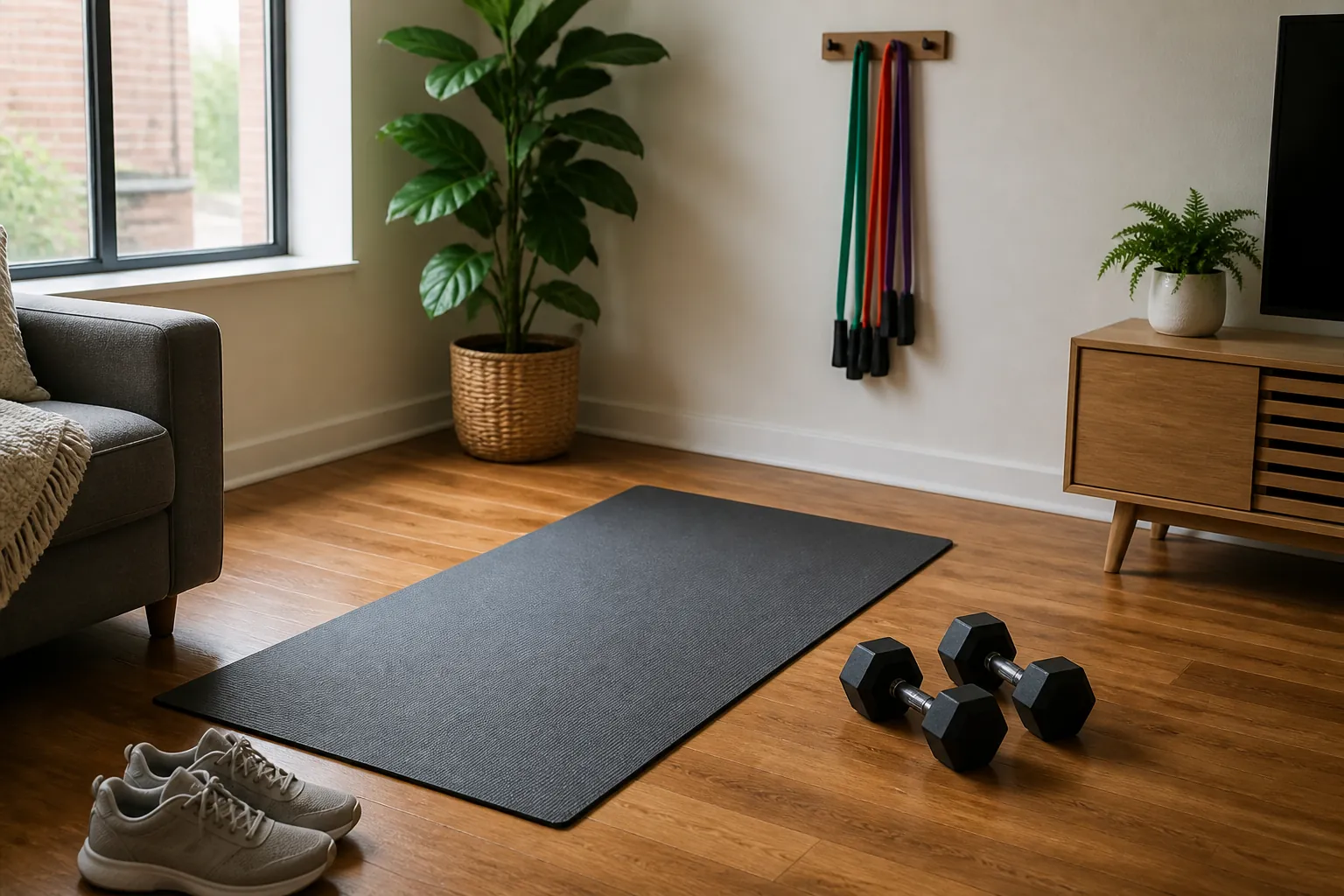
The problem is not rare, and it is not solved by feeling bad
An oft-cited exercise-adherence estimate is that roughly half of people who start an exercise program drop out within six months [2]. Treat that as a broad warning sign, not a precise national rate. It still says something useful: early consistency is fragile, even among people who were motivated enough to begin.
Home workouts add their own traps. A gym has defaults: open floor, equipment already placed, a little social pressure, and fewer household interruptions. A living room has none of those unless you build them. The same apartment can either ask you to begin or ask you to postpone.
Motivation is real. Some days you will feel eager to train. But if the plan only works on those days, the plan is leaning on the least stable part of the system. The fix is to make the first movement easier, more visible, and less dependent on perfect timing.
Run a friction audit before buying more gear
The useful question is not “How do I become more disciplined?” It is “Where, exactly, does the workout fail before it starts?” In small spaces, that failure is usually physical enough to inspect.
| Friction point | What it is really doing | Setup change that helps |
|---|---|---|
| Gear is stored out of sight | The prompt disappears until you already need motivation | Keep one starter set visible: shoes at the mat, bands on a hook, dumbbells beside the training corner |
| The floor is not ready | The session begins with furniture negotiation | Leave a mat unrolled if possible, or create a one-move floor reset |
| Setup takes too long | The warm-up becomes a chore before the workout | Choose the simplest tier that can stay mostly assembled |
| The workout is noisy | Apartment timing becomes a veto | Build quiet substitutions into the default plan: bands, controlled bodyweight work, step-free conditioning |
| Every session starts differently | The brain has to decide again | Use the same corner, same cue, and same first action |
This audit is deliberately unglamorous. It is also where most home-workout consistency is won. The room does not need to look like a studio. It needs to reduce the number of tiny decisions between “I should work out” and the first rep.
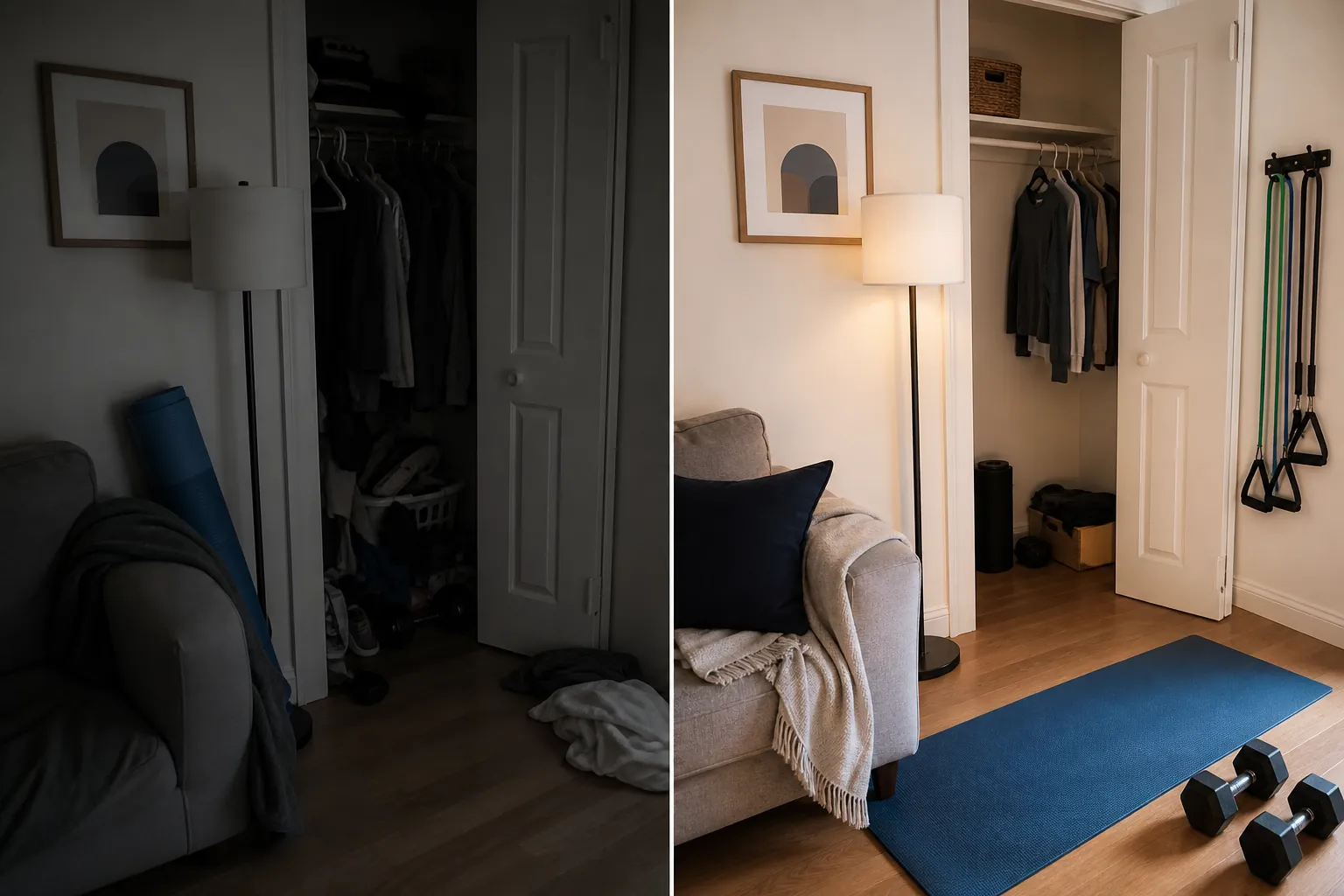
Visibility is a prompt, not decoration
Visible gear is often dismissed as clutter, which is funny given how many abandoned routines are stored very neatly. A rolled mat behind a couch is tidy. It is also silent. A pair of shoes at the edge of the mat is harder to ignore.
The choice-architecture evidence fits this small-space reality. In a systematic review of 88 choice-architecture studies, 74% of prompting interventions, including point-of-decision prompts, changed physical activity while the prompts were present [3]. The important phrase is “while present.” If the prompt disappears, the effect can weaken. That is not a reason to dismiss prompts; it is a reason to stop hiding them.
For a home gym, the prompt should be specific enough to start behavior, not just signal aspiration. A poster on the wall may remind you that exercise exists. A resistance band hanging at shoulder height tells you what to grab. Dumbbells beside the mat tell you where the first set happens. Sneakers placed where you will trip over them are annoying in the useful way.
A ready floor removes the first negotiation
The most expensive equipment in a small apartment is often not the bike, rack, or adjustable dumbbell. It is clear floor. If every workout begins by dragging a coffee table, folding a blanket, moving a dog bed, and hunting for the mat, then your program has a hidden setup circuit before the actual circuit.
A ready floor does not always mean a permanent dedicated room. For renters, it may mean an unrolled mat in a corner, a folded mat leaning in plain sight with nothing blocking it, or a “one-move” rule: only one object has to move before training starts. If the room requires a full reset, the build is too fragile for low-energy days.
This is where tiered home-gym decisions become motivation decisions. A compact band-and-dumbbell setup that stays ready may beat a larger system that has to be unpacked, unfolded, plugged in, or argued with every time. Better gear is not automatically better if it adds steps before the first movement.
Noise can become the hidden veto
Apartment workouts often fail on timing before effort. Jumping, dropping weights, treadmill thud, and late-night conditioning all come with an audience you did not invite: the downstairs neighbor. If the workout depends on the perfect hour when nobody is home, the routine has inherited another excuse.
Quiet options should be built into the setup, not invented while you are already irritated. Bands, controlled dumbbell work, slow bodyweight strength, step-free conditioning, glute bridges, dead bugs, incline pushups, suitcase carries, and tempo squats can all keep the session moving without turning the floor into a drum. The point is not that quiet training is always best. It is that a quiet fallback keeps noise from canceling the workout.
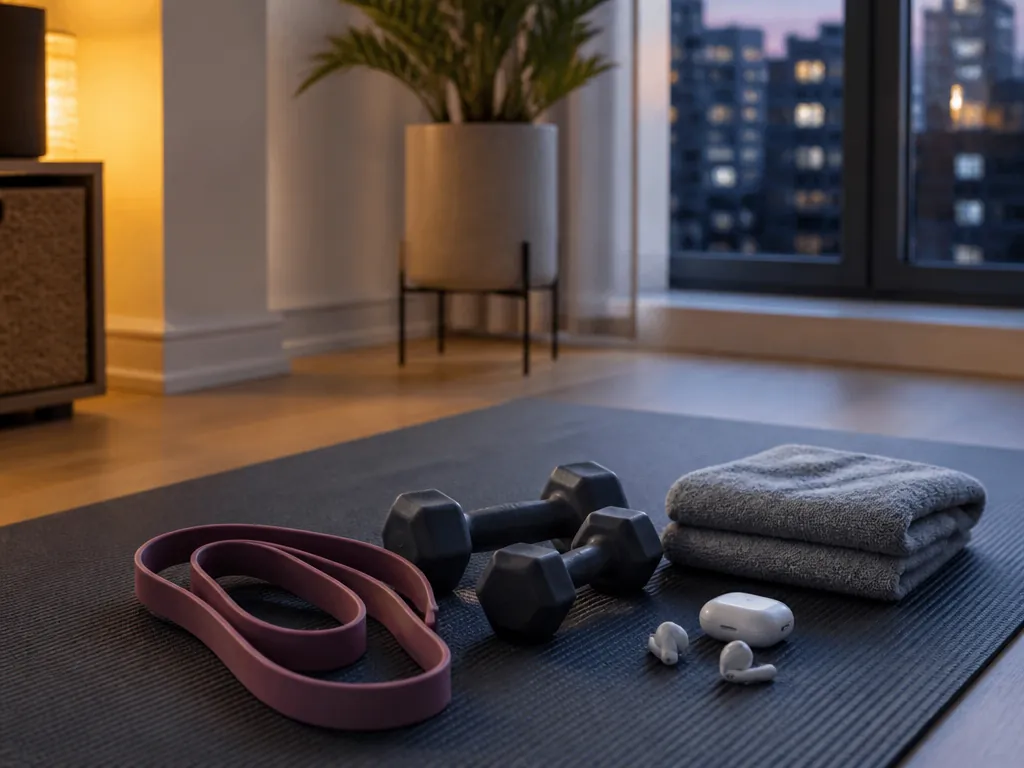
Use an if-then plan for the first movement, not the whole identity
A home-workout plan often fails because it is too vague at the exact moment it needs to be mechanical. “I’ll work out tonight” leaves the future version of you to negotiate the time, place, workout, equipment, and starting exercise. An if-then plan narrows the job.
Implementation-intention research is useful here because it deals with getting started. Gollwitzer and Sheeran’s meta-analysis found a medium-to-large effect on goal attainment across 94 studies, with an effect size of d = .65 overall and d = .61 for getting started [1]. At home, that turns into something plain: “If I finish my first coffee, then I put on my shoes and do one set on the mat.” Or: “If I close my laptop at 6, then I grab the band from the hook.”
The first action should be almost too small to respect. Shoes on. Band in hand. One warm-up set. Ten minutes on the mat. Once the body is moving, you can decide whether the day becomes a full session, a short session, or a maintenance session. The if-then plan is not a personality transplant. It is a bridge over the ugliest part of the intention-action gap.
Habit research does not give you a countdown
The habit literature is often flattened into a promise: do this for a certain number of days and it becomes automatic. The actual finding is more forgiving and less marketable. In Lally and colleagues’ habit-formation work, automaticity plateaued at a median of about 66 days, but the range was 18 to 254 days; simple actions became automatic faster than more elaborate routines, and missing one day did not seriously impair habit formation [4].
That matters for home workouts because one missed Tuesday does not require a confession scene. It requires the same cue to still be there on Wednesday. If the mat is still visible, the band is still hanging, and the first action is still obvious, the system has not collapsed. It has simply missed a repetition.
Choose the setup tier by the friction it removes
Buying more gear is tempting because it feels like commitment. Sometimes it is. Sometimes it creates a better excuse with shipping confirmation. The build decision should start with the audit: which barrier has actually been stopping you?
| If the audit shows this | Do this before spending more | Build direction |
|---|---|---|
| You skip because setup is annoying | Reduce the workout to gear that can stay visible and ready | Mat, bands, and one dumbbell option may be the right first tier |
| You skip because the floor is never clear | Protect a permanent or one-move training zone | Prioritize storage, footprint, and fast reset over equipment variety |
| You skip because of apartment noise | Make quiet substitutions the default, not the backup | Bands, controlled dumbbells, thick matting, and low-impact conditioning |
| You skip because the routine feels stale | Keep the setup stable but rotate the session format | Use novelty in programming, not constant gear replacement |
| You skip because the setup is too limited | Confirm space, ceiling, floor, and noise constraints before scaling | Consider a compact all-in-one only if it removes friction rather than adding it |
For many small-space exercisers, the best first build is the one that can remain half-ready without taking over the apartment: mat, bands, shoes, and a load you will actually use. If the budget question is the blocker, the under-$1,000 home gym guide is the better next step than another motivational video, because it forces the useful tradeoff: where does money remove friction, and where does it just add inventory?
If your current setup is already consistent and the limitation is load, exercise variety, or shared-space storage, then scaling up can make sense. Just do the boring checks first: footprint, ceiling height, door swing, floor protection, neighbor noise, and whether the machine can stay usable without a setup ritual. For that decision, use the small-space all-in-one home gym guide as a constraint filter, not as permission to buy the largest thing that technically fits.
Once the room is ready, then a routine becomes useful. If the real barrier is Monday inertia, run the 20-minute Monday home workout in the setup you just built. If you want a gentler runway, the 8-week heart-healthy home workout routine gives you structure without requiring a studio-sized room. If boredom is the real leak, the elimination challenge workout is a better place to put novelty than your shopping cart.
And if the skipped workouts are not really about starting but about frustration with the scale, that is a different problem. The setup can help you train more consistently, but it will not fix unrealistic outcome timing. That is where weight-loss motivation and expectations need their own conversation.
Make starting easier than postponing
There is no permanent discipline switch hiding under the couch. Home workout consistency improves when the beginning of the workout becomes easier to perform than to postpone.
So do not ask the room to inspire you. Ask it to reduce the first step. Put the shoes where you will see them. Leave the mat ready or make the reset one move. Hang the band where your hand can reach it. Keep a quiet option available so the neighbor does not control your training schedule. Then choose the setup tier that removes the largest friction your audit exposed.
References
- Implementation Intentions, National Cancer Institute
- Attrition and adherence rates of sustained vs intermittent exercise interventions, Annals of Behavioral Medicine, 2011
- Choice architecture interventions to change physical activity and sedentary behavior: a systematic review of effects on intention, behavior and health outcomes during and after intervention, International Journal of Behavioral Nutrition and Physical Activity, 2020
- Making health habitual: the psychology of ‘habit-formation’ and general practice, British Journal of General Practice, 2012
What a small equipment investment adds
Can insect protein build muscle at home?
Insect protein from crickets and mealworms produces a muscle protein synthesis response comparable to milk protein in acute trials, but the only training study in young men found no extra strength or size gain. This verdict sorts out what the human research actually supports so home lifters can decide if insect protein is worth buying.
Swimming Pool Under $5? The Real Price Ladder
No swimming pool under $5 can support home exercise — that budget buys a resistance band or one community-pool day pass. The verified price ladder runs from $125 inflatables to $25,999+ swim spas, with a depth rule that separates pool toys from real training.
Tour a Small Apartment Home Gym at $100, $300, and $800
Three real apartment gym setups at $100, $300, and $800 with itemized costs, measured decibel ratings, floor-protection methods, and honest notes on what each tier can and cannot do — so you can choose the right entry point without risking your deposit or your neighbor's patience.
How often should you repeat this?
See our recovery and rest reference for citation-anchored rest-interval guidance.
Spot something off?
Tell us if a movement, tier assumption, or duration didn't match your experience.