
Monday Workout Motivation Starts With 20 Minutes at Home
Start this Monday with a 20-minute home workout matched to the equipment tier you own — bodyweight, resistance bands, or dumbbells — including jump-free, quiet-floor substitutions for apartments. The setup-matched session targets the time-and-energy barrier that stops beginners before a routine becomes a habit.
- Equipment tier required
- none
- Duration
- 20 min
- Difficulty
- beginner
- Target area
- full body
- Space footprint needed
- one yoga mat
- Noise level
- quiet-friendly
If you came here for Monday workout motivation at home, the useful answer is not a speech. It is this: give yourself 20 minutes, choose the version that matches what you own, keep your feet quiet, and start before the day gets louder.
That matters because the thing that stops a home workout is often smaller and more ordinary than “lack of motivation.” In a one-year follow-up study of new fitness-club members, “priority” — not having the time and energy — was the most important barrier reported among people who dropped out. The study was in a gym setting, not living rooms, but the barrier translates cleanly enough to a Monday morning: if the plan asks for more time, equipment, or noise than your day can handle, it is easy to skip it before the first rep. [1]
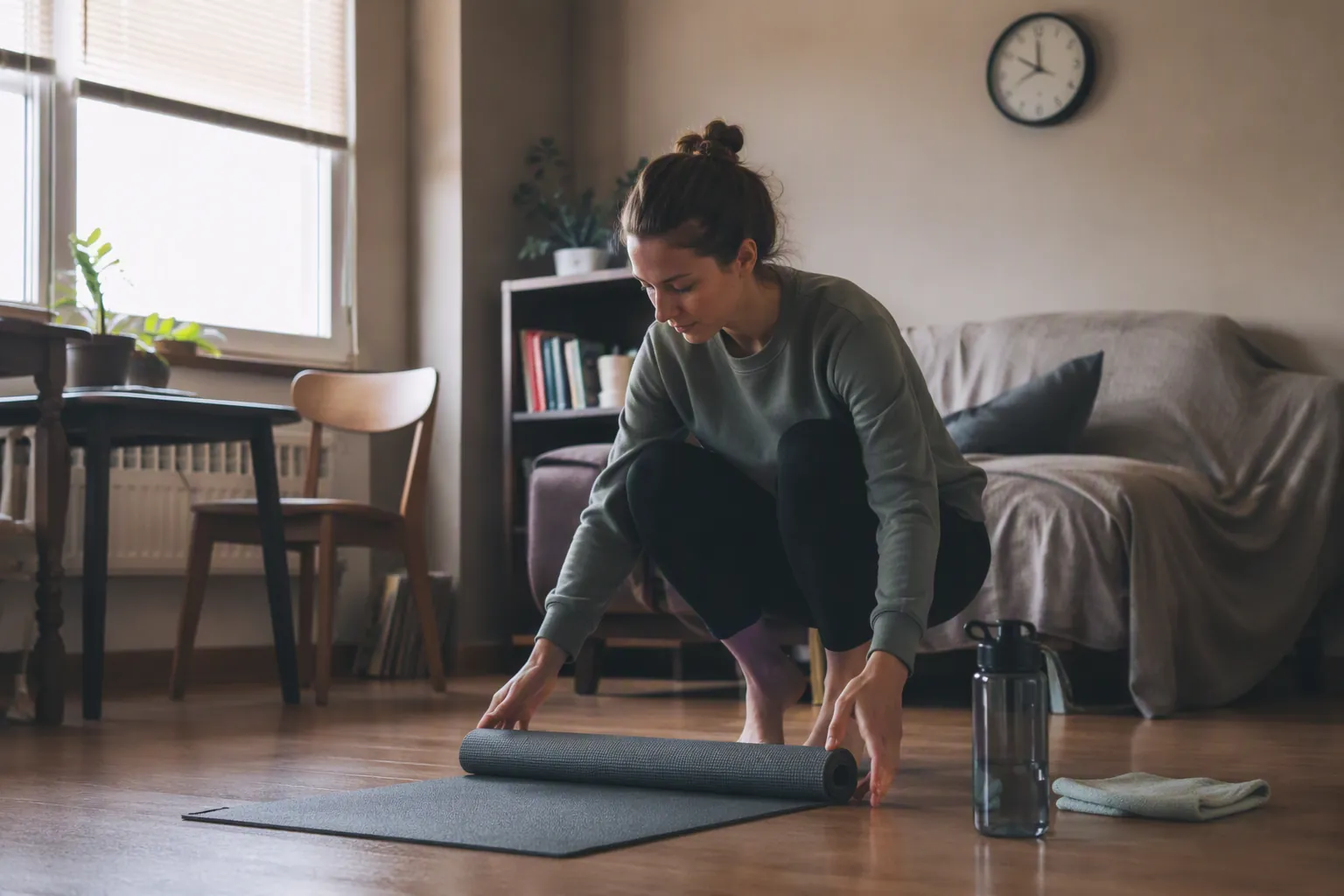
The 20-minute Monday route
This session uses the same practical shape as HealthHub’s 20-minute home workout: warm up, move through a simple circuit, then cool down. HealthHub’s sample circuit includes familiar bodyweight work such as jumping jacks, lunges, squat jumps, burpees, push-ups, mountain climbers, and core work; the version below keeps the structure but swaps in quieter choices where shared floors need it. [2]
| Time | What you do | How hard it should feel |
|---|---|---|
| 0:00–4:00 | Quiet warm-up | Easy; you should feel warmer, not tired |
| 4:00–16:00 | Three rounds of a four-move circuit | Moderate; breathing harder, still controlled |
| 16:00–20:00 | Cooldown and breathing | Easy; bring the session down on purpose |
If 20 minutes is more than you have today, do the warm-up and one circuit round. Short mini-workouts can still accumulate toward weekly exercise totals, and consistent scheduling has been linked with better adherence, especially when the session is simple enough to repeat. [3]
Pick your equipment tier
Bodyweight is the base path. Bands and dumbbells are upgrades, not proof that you are doing a more legitimate workout. The right version is the one you can set up in under two minutes without moving furniture like you are staging a renovation.
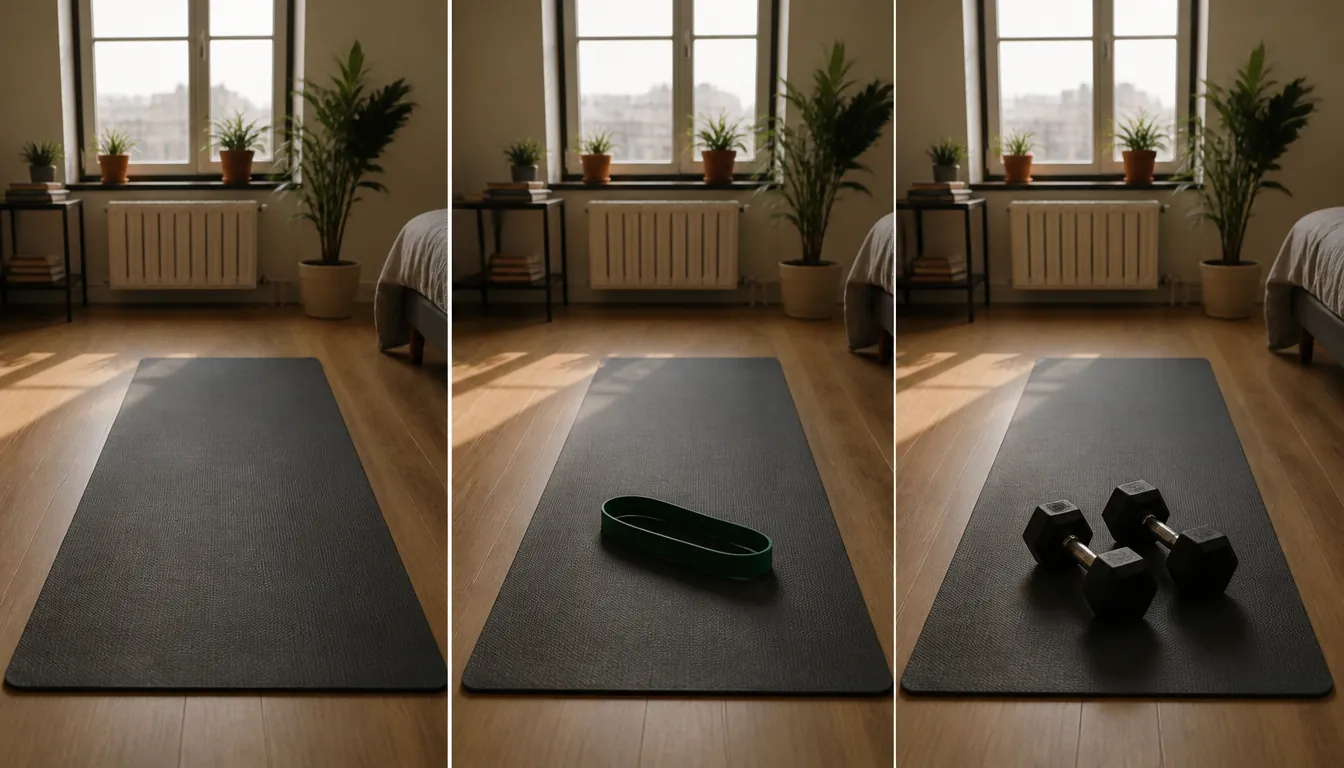
| Tier | Typical setup | Use this version if |
|---|---|---|
| Bodyweight, $0–100 | Mat, towel, chair or couch | You want the lowest-friction start, or you are training in a tight room with no gear |
| Resistance bands, $100–300 | Mat, loop band or handled band, door anchor only if you already use one safely | You want more pulling work and joint-friendly resistance without storing weights |
| Dumbbells, $300–800 | Mat plus one light-to-moderate pair or adjustable dumbbells | You want load you can progress, and you can control the weights quietly |
If you want a full week built around the same equipment logic, use the home gym workout plan by equipment tier after you finish this Monday session. Today, just choose the row that matches the gear already in your room.
0:00–4:00: warm up without bouncing
Do each warm-up move for about 45 seconds, using the remaining time to get into position. Keep your steps soft. If you can hear your heels, your downstairs neighbor probably can too.
- March in place with a tall chest. Roll through the feet instead of stomping.
- Shoulder circles, then arm swings. Keep the ribs down and the neck relaxed.
- Hip hinge to reach. Push the hips back, reach your hands toward the floor or shins, then stand.
- Slow squat to comfortable depth. Use a chair target if your knees or balance prefer it.
- Step-back reach. Step one foot back, reach both arms overhead, return, and alternate.
This should feel almost too easy at first. That is fine. Monday does not need a dramatic opening scene; it needs your joints warm enough for the circuit.
4:00–16:00: the main circuit
Set a timer for 40 seconds of work and 20 seconds to switch. Complete the four stations three times. The pattern is the same across tiers: squat, push, hinge or pull, then quiet core-conditioning.
| Station | Bodyweight tier | Resistance band tier | Dumbbell tier |
|---|---|---|---|
| 1. Squat | Chair squat or slow bodyweight squat | Banded squat, loop above knees or band under feet if secure | Goblet squat, holding one dumbbell close to chest |
| 2. Push | Incline push-up on couch, counter, or sturdy chair | Band chest press or incline push-up | Dumbbell floor press or incline push-up |
| 3. Hinge or pull | Glute bridge with a two-second squeeze at the top | Band row, seated or standing with a secure anchor point | Dumbbell Romanian deadlift or one-arm supported row |
| 4. Quiet core-conditioning | Dead bug, slow mountain climber, or plank shoulder tap | Dead bug with band pulldown or slow band-resisted march | Dead bug, suitcase hold march, or slow plank drag only if the weight stays controlled |
How to run the bodyweight version
Start with the chair squat. Touch the chair lightly and stand without rocking forward. If that is too easy, slow the lowering phase to three seconds. That gives your legs a real job without adding jumps.
For the push-up station, use an incline before you use the floor. A couch, counter, or sturdy table lets you keep a straight-body line while reducing the load. The goal is clean reps for the full 40 seconds, not collapsing into the carpet at second 18.
The bodyweight hinge station is the glute bridge. Lie on your back, feet planted, lift the hips, pause, and lower quietly. If you want more upper-body balance in a no-equipment plan, add a separate pulling solution from this no-equipment upper-body workout later in the week; for this 20-minute Monday, keep the bridge and move on.
For the final station, choose dead bugs if you want the quietest option. Choose slow mountain climbers only if you can step the feet in without scraping or thudding. Plank shoulder taps work well, but widen the feet and keep the hips from rocking.
How to run the band version
Bands help most at the stations where bodyweight training gets awkward: pulling and light resistance. For the squat, use a loop band above the knees only if it helps you feel the hips working. If it turns the squat into a wrestling match, take it off.
For rows, the anchor matters more than the band. A band wrapped around a stable post or used in a seated row is usually simpler than improvising with a door you do not trust. Pull the elbows back, pause briefly, and return slowly. The return is part of the rep; letting the band snap back is both noisy and useless.
For the core station, a dead bug with a light band pulldown can feel surprisingly focused without adding impact. If that setup takes more than a minute, skip the band and use the plain dead bug. The best band exercise on Monday is the one that does not require a hardware inspection.
How to run the dumbbell version
Use dumbbells only as heavy as you can place down quietly. In an apartment, control is part of the exercise. A goblet squat with one dumbbell held close to the chest is usually easier to manage than two weights hanging at your sides in a cramped room.
For the press, a dumbbell floor press keeps the shoulders supported and prevents the weights from traveling too far. Set the dumbbells on the floor, lie down between them, press, lower until the upper arms lightly meet the floor, and pause before the next rep. Do not let the weights tip or clank.
For the hinge or pull station, choose either a Romanian deadlift or a supported one-arm row. If your lower back feels tired from sitting, the supported row may be the better Monday choice: one hand on a couch or sturdy chair, one foot slightly back, row the dumbbell without twisting.
For the final station, the suitcase hold march is the most apartment-friendly loaded option. Hold one dumbbell at your side and march slowly without leaning. Switch sides halfway through the 40 seconds. If the march gets noisy, stop marching and hold still.
The quiet-floor swaps to use without asking permission
Many home circuits are written as if everyone lives over a basement. If you have thin floors, replace the loud move before it becomes a reason to skip the workout.
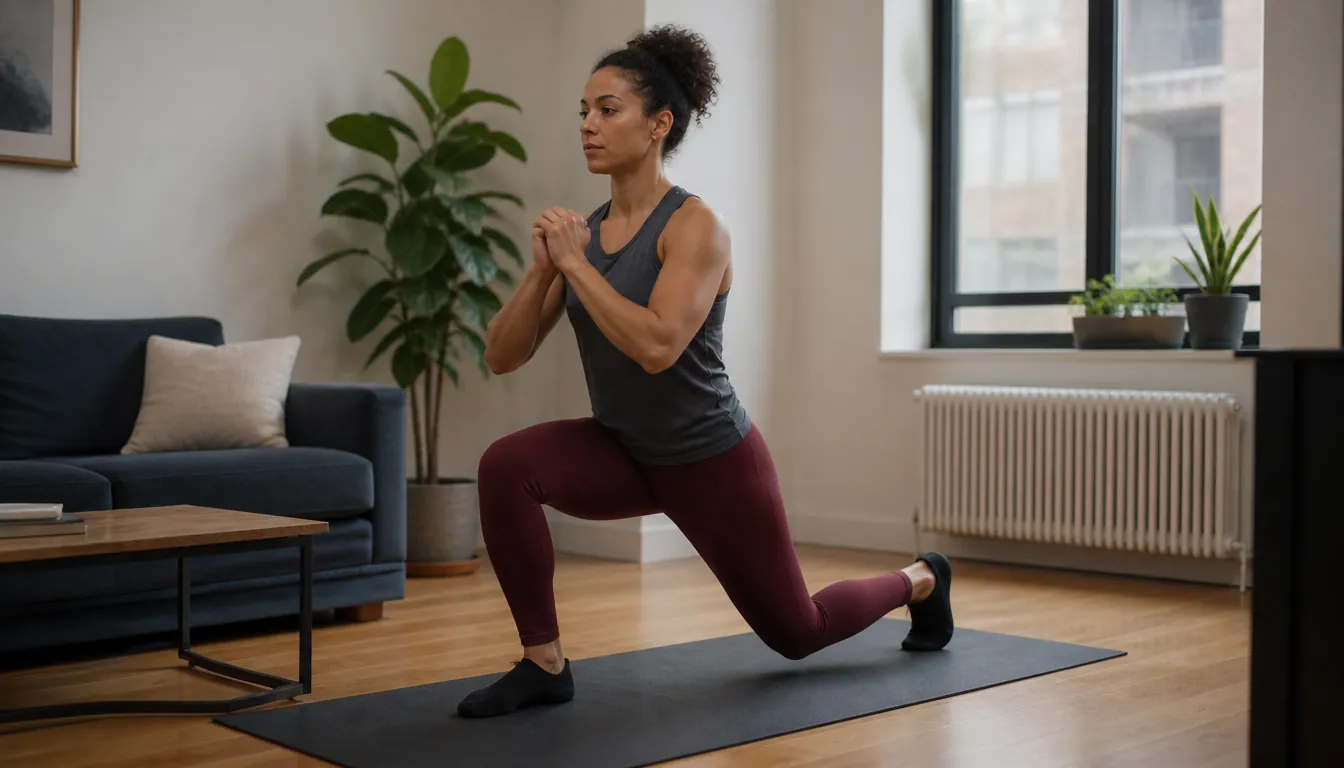
| If the workout says | Use this quiet version | Keep it quiet by |
|---|---|---|
| Jumping jacks | Step jacks | Step one foot out at a time and land through the whole foot |
| Squat jumps | Tempo squats or squat to calf raise | Lower for three seconds and rise without leaving the floor |
| Forward lunges | Reverse lunges or split squats | Step back softly and use a wall touch for balance |
| Burpees | Walk-back plank to stand, hands on couch if needed | Step back one foot at a time; no hop at the top |
| Fast mountain climbers | Slow step climbers or dead bugs | Move the feet deliberately instead of scraping the floor |
| High knees | Low march with strong arm drive | Lift the knees only as high as you can without stomping |
A mat helps, but it is not magic. If your floor is especially thin, put the mat over a rug. For dumbbells, set a folded towel beside the mat as a landing pad for the weights between stations. That does not make dropping them acceptable; it just reduces the little clinks that make a short workout feel less neighborly than it needs to be.
Small rooms also change exercise choice. A reverse lunge usually fits better than a walking lunge. A floor press often fits better than a standing overhead press under a ceiling fan. A dead bug is not a downgrade from mountain climbers if it is the move you can do without kicking the coffee table.
For a full no-jump session on days when quiet matters more than loading, keep this quiet apartment workout nearby. It is a useful sibling routine when the building, the weather, or your nervous system wants less impact.
16:00–20:00: cool down so the workout ends well
Do not spend 16 minutes proving you started and then close the app while breathing hard. The cooldown is part of making this session repeatable. Peloton’s The Output reported a sports psychology point from Judy Van Raalte: exercisers remembered a 15-minute hard effort plus five easy cooldown minutes more positively than the hard 15 minutes alone. Treat that as a useful reason to finish deliberately, not as a magic trick. [4]
- Child’s pose or hands-on-couch breathing, 45 seconds. Breathe through the nose if comfortable.
- Half-kneeling hip flexor stretch, 30 seconds per side. Keep the ribs stacked over the pelvis.
- Figure-four glute stretch or seated glute stretch, 30 seconds per side.
- Chest opener against a doorway or with hands clasped behind the back, 45 seconds.
- Thirty seconds of slow walking around the room, putting the room back the way it was.
That last minute counts. If the mat is rolled, the dumbbells are back in their spot, and the band is not tangled under the couch, tomorrow’s version has one less excuse waiting for it.
If you need to make it easier or harder
Make the workout easier by shortening the work interval to 30 seconds and using the full next 30 seconds to switch. Keep all three rounds if you can. If you are tired, one clean round is still better than turning the session into a negotiation you lose.
Make it harder by keeping the 40-second work interval and adding control, not chaos. Slow the lowering phase of squats. Pause at the top of glute bridges. Hold the band row for one second. Use a slightly heavier dumbbell only if the weight still returns to the floor silently.
| What is happening | Adjustment |
|---|---|
| You feel rushed | Use two rounds instead of three and keep the cooldown |
| Your knees dislike lunges | Use squats, split squats with support, or glute bridges |
| Your wrists dislike floor work | Use incline push-ups and dead bugs instead of planks |
| The dumbbells are too loud | Switch to bodyweight or bands for today |
| You have more energy than expected | Add a fourth round only if you can still cool down |
Where this Monday session goes next
If this was your first workout in a while, repeat the same tier next Monday before changing anything. Repetition is not boring when it removes setup decisions. It also gives you a cleaner read on what actually needs to progress: the load, the range of motion, the number of rounds, or just your confidence moving in a small room.
If you are ready to build from here, use the home gym workout plan that grows with your equipment. If you mostly want the motivation side of Monday explained, read Why Monday Fitness Motivation Is Real — and Why It Fades after the workout, not before it.
For today, the useful win is smaller: you matched the session to your gear, your floor, and the amount of Monday you actually had available. That is the version of home workout motivation most likely to survive contact with real life.
References
- Motives and barriers to initiation and sustained exercise adherence in a fitness club setting—a one-year follow-up study — Scandinavian Journal of Medicine & Science in Sports, 2020.
- The Ultimate 20-minute Home Workout — HealthHub, reviewed May 2023.
- How to Motivate Yourself to Work Out: 32 Tips for All Levels — Healthline.
- Make Workouts a Habit With These Motivating Tips — Peloton The Output, July 2024.
What a small equipment investment adds
We don't have a build tagged to this exact tier yet. Browse all builds.
How often should you repeat this?
See our recovery and rest reference for citation-anchored rest-interval guidance.
Spot something off?
Tell us if a movement, tier assumption, or duration didn't match your experience.