
Why Off-Leash Dogs Are the Leading Cause of Bear Attacks
Hiking with your dog in bear country poses risks most owners underestimate. This article explains why an off-leash dog is the most common trigger of bear attacks and how leashing, proper gear, and species-specific responses keep you both safe.
- Equipment tier required
- none
- Duration
- 60 min
- Difficulty
- beginner
- Target area
- full body
A dog can help you notice a lot on trail: a squirrel before you see it, another hiker around a bend, a fresh scent crossing the tread. That is not the same thing as protection in bear country. The newer evidence points in the other direction: in a 2026 Journal of Wildlife Management analysis of 326 dog-involved bear conflicts, dogs initiated the conflict 54% of the time, warned owners only 9.2% of the time, and incidents involving unleashed dogs outnumbered leashed incidents by nearly 6 to 1.[1]
That matters if hiking with dogs in bear country is part of your fitness routine, not a once-a-year novelty. Trail runners, fast hikers, and backpackers already make decisions under fatigue: pace, footing, water, weather, route-finding. Add a loose dog and a bear, and the most dangerous moment may arrive before the owner knows there is a decision to make.
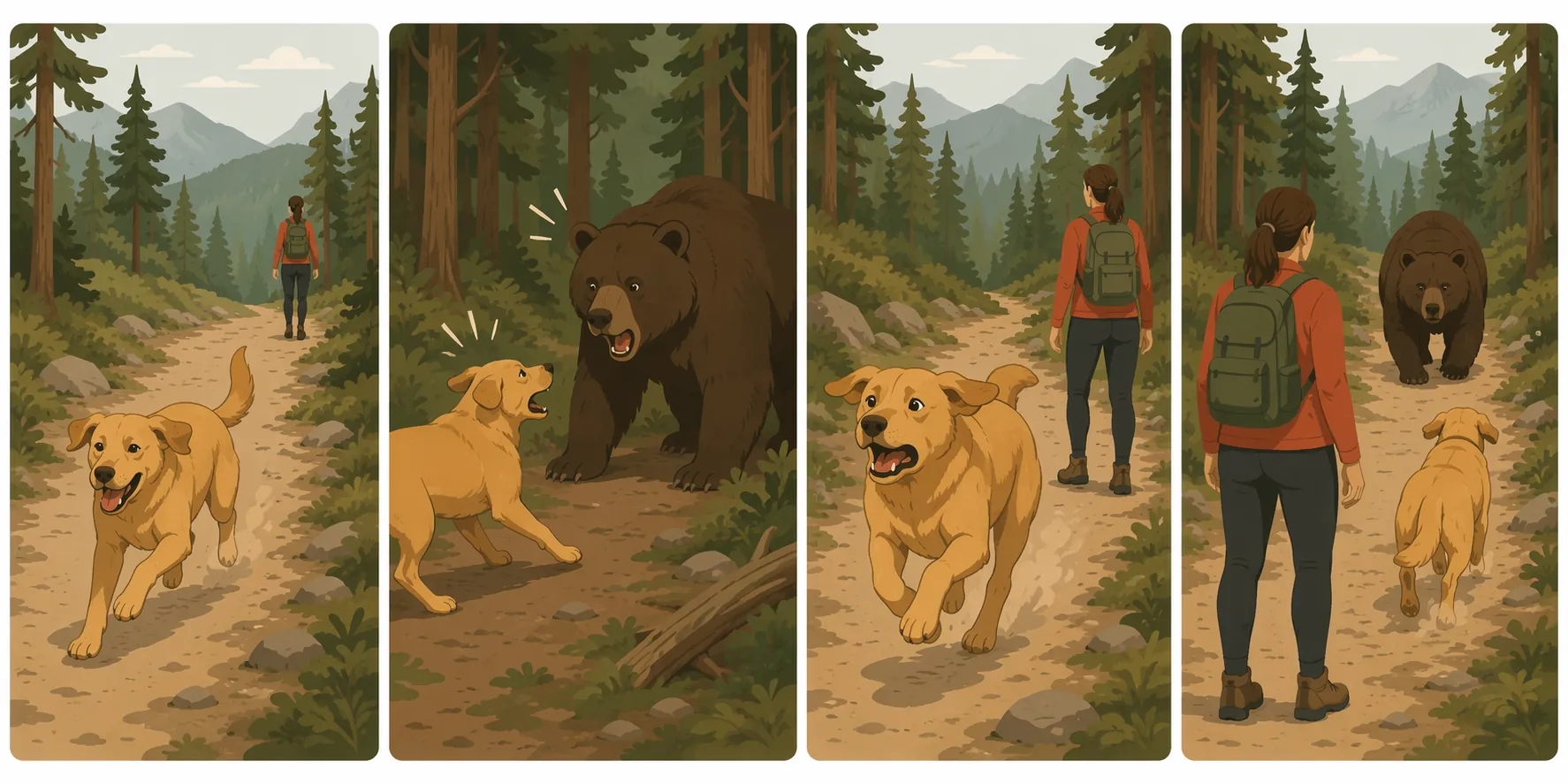
The failure pattern is not complicated
The bad version usually does not start with a bear hunting a person. It starts with a dog ranging ahead, following scent, disappearing around brush, or pushing into a space the owner cannot see. The dog finds or startles a bear. The bear reacts defensively. The dog does what many frightened dogs do: it runs back to the person it trusts. Now the owner is standing at the end of a problem the dog has already delivered.
Smith et al. reported that this exact “dog flushes bear then returns” cascade appeared in 8.3% of cases, and when it happened, 70% of owners were injured.[1] That is the number that should stick. It is not a moral judgment about dogs. It is a mechanical one: a loose dog can extend your encounter distance, shorten your reaction time, and pull the bear’s defensive attention straight back to you.
The dog pays for the fantasy too. In the same analysis, 56 dogs died compared with 5 human fatalities.[1] Owners often picture the dog as an early-warning system or a brave buffer. The record is harsher than that. Dogs are fast enough to start trouble, loyal enough to return to their people, and vulnerable enough to be killed when the situation turns.
The full Smith et al. paper is behind a Wiley paywall, so the exact figures should be checked against the complete text when full access is available. The abstract-accessible and reported findings are still specific enough to cut through the usual trailhead argument: recall is not control once the dog has already crossed into a bear’s space.[1]
What changes when the dog is leashed before the bear appears
A leash is not there to prove you are a responsible citizen in front of other hikers. In bear country, it keeps the dog inside the same decision space as the human. If the dog is close, you can see what it is reacting to, stop forward movement, get bear spray in hand, back away, or leave before the dog turns curiosity into contact.
Use a non-retractable leash, about 4 to 6 feet long, clipped to a well-fitted harness. The short leash matters because it prevents the dog from sweeping into blind corners, brushy edges, creek noise, berry patches, carcass areas, or tight trail corridors before you arrive. The harness matters because scared dogs can twist out of collars, and a panicked dog loose near a bear is now making choices for both of you.
A retractable leash is a bad compromise here. It creates the feeling of connection while allowing the dog to be far enough away to flush wildlife, tangle around vegetation, or hit the end of the line at speed. If the whole point is to prevent the dog from initiating the encounter, a long spool of cord does not solve the problem.
Recall training is useful. It is also not a substitute for physical control in bear habitat. A dog that recalls cleanly at the park may not recall cleanly when it has found a bear, been charged, smelled carrion, or bolted in fear. The test is not whether the dog listens when calm. The test is whether you can prevent the dog from creating the first contact.
A practical leash setup
- Use a 4–6 ft fixed leash, not a retractable leash.
- Clip to a snug harness the dog cannot back out of when startled.
- Keep the dog behind or beside you through brush, blind curves, creek noise, and berry patches.
- Shorten the leash before passing other hikers, dogs, campsites, or limited-visibility sections.
- Do not let “voice control” become permission for the dog to investigate what you cannot see.
Bear spray helps only if it is reachable before the dog returns
Bear spray is worth carrying, but it is not a charm hanging somewhere inside a pack. REI’s bear-country guidance emphasizes EPA-approved bear spray and notes that canisters typically discharge in about 7 to 9 seconds and are intended for close-range use, roughly 12 to 30 feet depending on the product and conditions.[2] Smith et al.’s 2008 bear-spray study reported that spray stopped undesirable behavior in 92% of brown bear incidents and 90% of black bear incidents in the cases examined.[3]
Those numbers do not mean spray will fix sloppy dog handling. Wind, distance, surprise, cold fingers, a buried canister, or a dog tangling your legs can all steal the seconds you need. Carry spray in a body holster where either hand can reach it while your leash hand stays functional. Practice pulling the safety tab until the motion is boring. If the first time you touch the canister under pressure is during a charge, you are asking gear to make up for rehearsal.
The Smith et al. 2026 findings also put intervention in perspective: 44% of people who sprang to their dog’s aid without a deterrent were injured in the analyzed cases.[1] That does not mean abandoning a dog. It means do not rush into a bear-dog fight empty-handed and close the distance for the bear. Get the dog back if you can, use deterrent if needed, and create space without turning yourself into the next target.
Before the trip, check rules that actually change your plan
Dog rules in bear country are not decorative. Some places do not allow dogs on the trails you want to use. For example, Yellowstone prohibits dogs on trails and Glacier restricts dogs in backcountry areas, while bear spray rules also vary by park, with Yosemite cited as banning bear spray and Glacier requiring it.[4] Check the current park or forest page before you build the workout around that route.
This is where outdoor fitness planning has to stay honest. If the route bans dogs, requires bear spray you do not have, runs through heavy berry habitat, or puts you on a narrow trail at low visibility with a high-energy dog, choose a different workout. A dog-safe hike is still training. So is switching to a local hill repeat, a road run, or an indoor session when the bear-country version depends on luck. If you are deciding between trail miles and a controlled alternative, FitAtHome’s guide to using the hourly forecast for run planning is a useful way to make that call without turning every workout into a stubbornness contest.
| Decision point | What to check | Why it matters with a dog |
|---|---|---|
| Destination | Whether dogs are allowed on the specific trail or backcountry route | A legal frontcountry pet area is not the same as a dog-permitted hiking route |
| Bear species | Whether the area has black bears, grizzlies, or both | Your response during an encounter changes by species |
| Bear spray | Whether it is allowed, required, and legal to carry where you are going | Spray in the car or banned from the park cannot help on trail |
| Food storage | Canister, locker, or hanging requirements for human food, dog food, and waste | Dog kibble and waste bags carry odors bears can investigate |
| Route conditions | Brush, blind curves, creek noise, berry patches, carcass reports, and trail crowding | These are places where a dog can reach the bear before you know it is there |
Dog food is bear attractant, not a side item
At camp, dog food gets stored like human food. So do treats, chews, food-smeared bowls, and waste bags. Orvis and Backpacker both emphasize that dog food odors can attract bears and should be secured in approved storage such as canisters, lockers, or proper hangs where required.[5][6]
Do not leave the dog’s backpack outside the tent because it looks empty. Fabric holds odor. A pack that carried kibble, salmon treats, greasy waste bags, or a slobbered chew belongs with the rest of the scented gear. If the storage rule would apply to your trail mix, it applies to your dog’s food system.
A dog first-aid kit also belongs in the pack, but keep it realistic: gauze, self-adherent wrap, antiseptic wipes, a tick key, paw wax or booties where terrain demands it, a muzzle for painful handling, and any medication only with a vet-confirmed dose. None of that prevents a bear encounter. It keeps a small injury from turning the hike into a carry-out while you are already managing bear country, fatigue, and distance from the trailhead.
Encounter response changes by bear species
Dog owners need to know the local bear species before the hike, not while a bear is standing in the trail. The National Park Service gives different defensive guidance for black bears and grizzlies: in a defensive grizzly attack, playing dead may be appropriate, while in a black bear attack, fighting back is the advised response.[7] The American Bear Association also stresses that hikers should understand bear behavior and region-specific risk before traveling in bear habitat.[8]
That species distinction does not erase the first job: keep the dog close, calm, and controlled. If you see a bear at distance, stop, shorten the leash, speak calmly, prepare your spray, and back away without running. If the dog starts barking or lunging, the leash is now doing the work recall cannot. Create distance. Do not let the dog pull you closer so you can “get a better look.”
If a bear approaches, keep the dog from escalating if you can do so without stepping toward the bear. If the dog has slipped loose and is returning to you with a bear behind it, the leash failure has already become an encounter problem. Get spray in hand, avoid running, and follow species-appropriate guidance as the situation develops. The cleanest safety move happened earlier, when the dog was still within reach.
Noise and visibility matter more when the dog wants to investigate
Generic bear advice says to make noise, hike in groups, and avoid surprising bears. With a dog, the point is more specific: make your presence known before the dog becomes the announcement. Talk through blind corners. Slow down near running water where sound is masked. Keep the dog beside you in dense brush instead of letting it spearhead the route.
Bright collars, reflective strips, and a bell can help you track the dog’s position, but they do not turn an off-leash dog into a controlled dog. BearWise advises keeping dogs leashed and under control around bears and warns that loose dogs can provoke defensive behavior.[9] That is the useful distinction: visibility gear helps you manage the dog you already control; it does not make ranging ahead safe.
A simple field flow for hiking with dogs in bear country
The goal is to reduce the number of decisions you have to invent when the dog stiffens, the brush moves, or a bear appears on the trail. Set the rules before the workout starts.
- Before you go: confirm dog access, leash rules, bear species, bear spray rules, food-storage requirements, and recent bear activity.
- At the trailhead: fit the harness, attach a fixed leash, place bear spray on your body, and pack dog food and waste storage as scented items.
- On trail: keep the dog close through blind or noisy terrain, make human noise before tight corners, and stop forward movement when the dog locks onto scent.
- At camp: store dog food, bowls, treats, chews, waste bags, and food-scented dog gear with the rest of your attractants.
- During an encounter: shorten the leash, prepare spray, back away calmly, and follow black bear or grizzly guidance rather than rushing toward the bear.
For dog-free trail days, the broader bear-country habits still matter. FitAtHome’s guide to avoiding bears while running outdoors covers runner-specific movement and timing, while its bear safety tips for outdoor exercisers are a better fit when the dog is staying home.
The honest answer
Bringing a dog into bear country is not automatically reckless. Treating an off-leash dog as protection is. The evidence does not describe dogs as reliable guards; it describes them too often as the first mover in the conflict, the animal most likely to die, and the panicked messenger that can bring the bear back to the owner.
A controlled dog can still be a good trail partner. Keep the dog close before anything happens, carry spray where your hand can reach it, store dog food like bear food, and know the rules of the place you are entering. If those conditions do not fit the day, the dog is not being cheated out of adventure by staying home. Sometimes the safer workout is the one where nobody has to prove anything to a bear.
References
- Dog-involved bear conflicts study, Journal of Wildlife Management, 2026.
- Backpacking in Bear Country, REI.
- Efficacy of Bear Deterrent Spray in Alaska, Journal of Wildlife Management, 2008.
- What to Do if You Encounter a Bear With Your Dog, BearVault.
- What to Do in a Bear Encounter With Your Dog, Orvis.
- How to Keep Your Dog and Yourself Safe in Bear Country, Backpacker.
- Staying Safe Around Bears, National Park Service.
- Hiking & Camping, American Bear Association.
- Dogs and Bears, BearWise.
What a small equipment investment adds
We don't have a build tagged to this exact tier yet. Browse all builds.
How often should you repeat this?
See our recovery and rest reference for citation-anchored rest-interval guidance.
Spot something off?
Tell us if a movement, tier assumption, or duration didn't match your experience.