
25-Minute No-Equipment Hip Hop Dance Workout at Home
Follow a complete 25-minute no-equipment hip hop dance cardio routine at home, built for absolute beginners with teachable moves and intensity check-ins. It shows how the session fits CDC weekly aerobic targets, what calorie range to expect at your bodyweight, and a start-slow progression plan.
- Equipment tier required
- none
- Duration
- 25 min
- Difficulty
- beginner
- Target area
- full body
- Space footprint needed
- 6x6 ft
- Noise level
- low with no-jump modifications
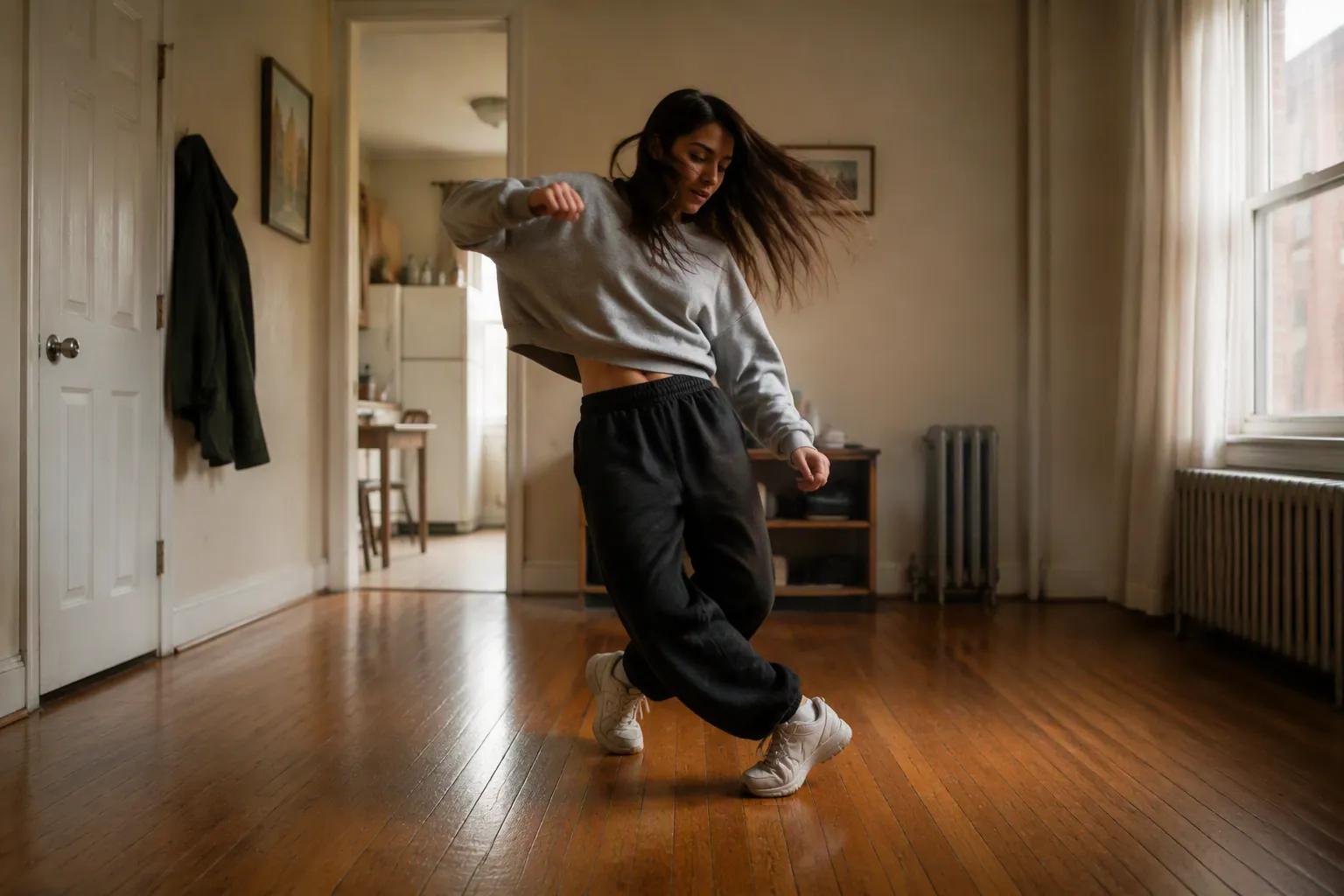
Yes, you can do this hip hop dance workout at home with no equipment today. Clear about a 6-by-6-foot space, put on sneakers if your floor is slippery, and use music with a steady beat you can count in eights. The full session takes 25 minutes, starts slowly, builds to a short cardio peak, and ends with a real cool-down instead of just stopping when the song ends.
| Session | What you need | Effort target | Beginner rule |
|---|---|---|---|
| 25 minutes | No equipment; about 6x6 ft of cleared floor | Moderate to vigorous | Learn the feet first, then add arms |
| Warm-up, drills, combos, peak, cool-down | Music, water nearby, quiet landing space | You should be able to talk at moderate effort, not sing | Make every move smaller before you quit |
If you have no dance background, do not start by trying to look like a music video. Start by finding the beat, shifting your weight, and keeping your breathing under control. Hip hop dance cardio works best for beginners when the moves have names and jobs: bounce, rock, step-touch, grapevine, running man, body roll, and prep. Those are beginner-friendly pieces used in hip hop workout instruction because they can be practiced half-time before they become choreography [1].
The moves you’ll use before the timer starts
Take two minutes to read this once. You do not need to memorize it perfectly. During the workout, come back to the simplest version whenever the arms, rhythm, or direction changes start to pile up.
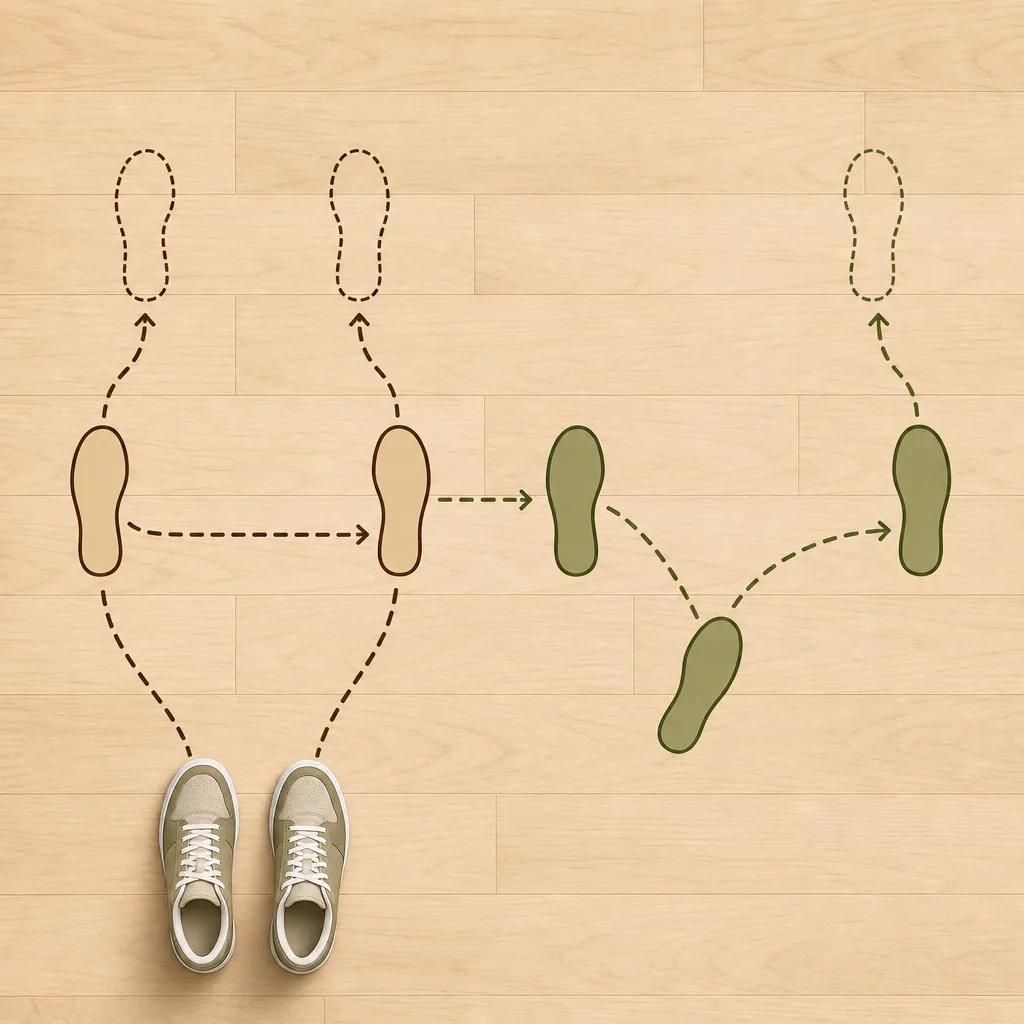
- Bounce: Bend and straighten your knees softly with the beat. Keep your feet under your hips. This is not a squat; it is a pulse. If you live above someone, make the bounce smaller and keep your heels close to the floor.
- Rock: Shift weight from one foot to the other. Think right-left-right-left, with your chest relaxed and your knees loose. Rocking helps you stay musical without traveling across the room.
- Step-touch or two-step: Step your right foot to the right, then tap your left foot beside it. Step left, tap right. That is the whole base. Add arms only after your feet can repeat it for 30 seconds.
- Grapevine: Step right, cross the left foot behind, step right again, tap left. Then reverse: step left, cross right behind, step left, tap right. Keep it narrow if your space is small.
- Running man: Step one foot down as the other foot slides or pulls back, then switch. For a quiet apartment version, do it as a march-and-slide instead of a hop. Several beginner glossaries describe the running man as a recognizable hip hop/social dance move, but your at-home version can stay low-impact [2][3].
- Body roll: Let the chest move first, then ribs, then belly, then hips, like a wave traveling downward. If that feels awkward, do a simple chest lift and release. You are still dancing.
- Prep: A small setup groove before the next move. Step out, bounce twice, bring your hands up, and get ready. A prep is useful because beginners need a reset, not a surprise.
The safest learning order is feet, then bounce, then arms. If you lose the beat, drop the arms first. If you still feel lost, return to a rock in place until the next eight-count begins.
25-minute no-equipment hip hop dance workout
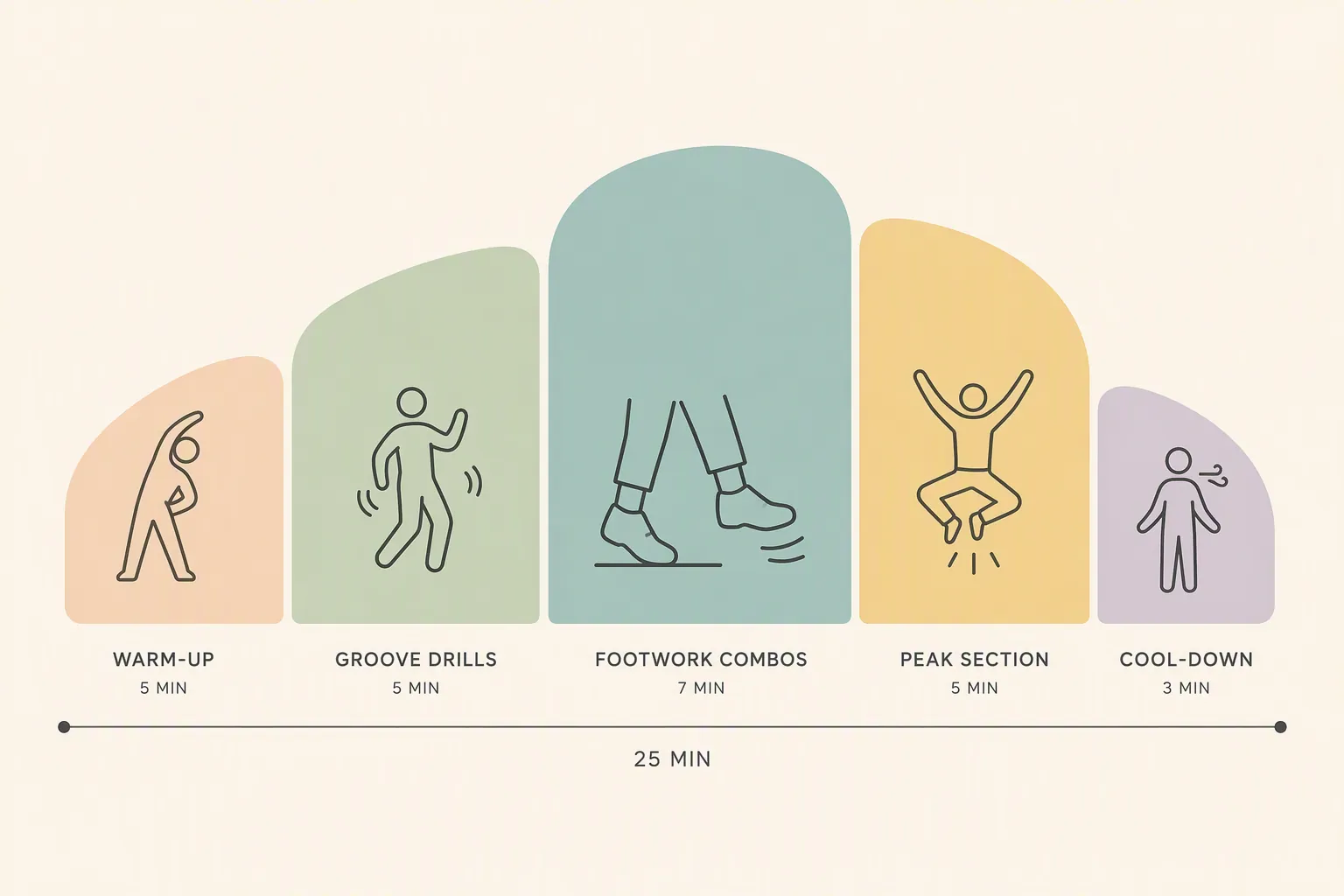
Use one playlist if you like, but keep the timer in charge. A beginner session needs a beginning, a middle, and an ending. If your music is fast, move half-time: one step for every two beats. If your breathing spikes too early, reduce the bounce and keep the pattern.
| Time | Block | Main job |
|---|---|---|
| 0:00–5:00 | Warm-up | Loosen joints, find the beat, add bounce |
| 5:00–10:00 | Groove drills | Practice bounce, rock, prep, and body roll |
| 10:00–18:00 | Footwork combos | Build step-touch, grapevine, and running man |
| 18:00–22:00 | Peak section | Repeat the best moves with more energy |
| 22:00–25:00 | Cool-down | Slow breathing and hold stretches for at least 30 seconds |
0:00–5:00 — Warm-up: isolations and bounce
Start with your feet hip-width apart. Put a soft bend in your knees. For the first minute, just bounce gently to the beat. Let your arms hang, then swing naturally. Your job is not intensity yet; it is landing softly and noticing where the beat is.
- 0:00–1:00: Easy bounce. Count “1, 2, 3, 4, 5, 6, 7, 8” and repeat. Keep your shoulders down.
- 1:00–2:00: Shoulder isolations. Roll shoulders back for four counts, forward for four counts, then alternate right and left shoulder pops. Keep the knees pulsing.
- 2:00–3:00: Rib and chest isolations. Move chest forward, center, back, center. Then side, center, side, center. Small movement is fine.
- 3:00–4:00: Hip rocks. Shift weight right and left while your hips follow. Add a gentle arm swing across the body.
- 4:00–5:00: Bounce plus reach. Bounce for two counts, reach one arm up for two counts, switch. If reaching overhead raises your heart rate too fast, reach forward instead.
At the end of the warm-up, you should feel warmer and more awake, not breathless. If you are already gasping, your bounce is too big for the first five minutes.
5:00–10:00 — Groove drills: bounce, rock, prep, body roll
This block teaches the groove before the footwork gets busier. Stay mostly in place. If you are nervous about coordination, keep your eyes forward and count out loud for the first few rounds.
- 5:00–6:00: Rock right and left. Step right, bring weight back center, step left, bring weight back center. Add a tiny shoulder drop toward the stepping side.
- 6:00–7:00: Rock with arms. As you step right, push both hands slightly right. As you step left, push both hands slightly left. Keep elbows soft, not locked.
- 7:00–8:00: Prep step. Step right, bounce, bounce, tap. Step left, bounce, bounce, tap. Hands come up on the two bounces like you are getting ready for the next move.
- 8:00–9:00: Body roll practice. Do four slow body rolls, then four easy bounces. Repeat. If the roll feels strange, replace it with chest lift, chest release.
- 9:00–10:00: Combine it. Rock right-left for eight counts, prep right-left for eight counts, body roll or chest lift for eight counts, bounce for eight counts.
Check your effort here. You should be breathing more than at rest, but still able to say a full sentence. If the music is pulling you faster than your feet can handle, stay half-time.
10:00–18:00 — Beginner footwork combos
Now the workout starts to feel like choreography, but it is still built from small pieces. Each combo has a plain version and an add-on. Do the plain version for the whole minute if that is what lets you finish cleanly.
10:00–12:00 — Step-touch combo
- First 30 seconds: Step right, touch left. Step left, touch right. Keep it wide enough to feel your legs working, narrow enough that you do not bang into furniture.
- Next 30 seconds: Add a bounce on each touch. Let the tap be light; do not stomp the floor.
- Next 30 seconds: Add arms. Push both hands forward on the touch, then pull elbows back on the next touch.
- Final 30 seconds: Step-touch for four counts, then freeze and bounce for four counts. Repeat.
If your arms and feet disagree, the feet win. Keep the step-touch going and let your hands rest at your hips.
12:00–14:00 — Grapevine combo
- First 30 seconds: Step right, cross left behind, step right, tap left. Then reverse. Keep the cross-behind small.
- Next 30 seconds: Add a shoulder roll on the tap. Right grapevine, tap and roll; left grapevine, tap and roll.
- Next 30 seconds: Add a low arm sweep in the direction you are traveling.
- Final 30 seconds: Grapevine right, grapevine left, then bounce in place for eight counts.
Small-space version: turn the grapevine into step-behind-step-tap with almost no travel. You still get the rhythm without crossing the room.
14:00–16:00 — Running man, quiet version first
This is the move most likely to get too loud. Start low-impact. March the right knee up, place the right foot down while the left foot slides back. Then switch. If sliding does not work on your floor, simply march and step back.
- First 30 seconds: March-and-step-back slowly. No arms.
- Next 30 seconds: Add a small pull of the elbows back as the foot comes down.
- Next 30 seconds: Try a slightly quicker switch if your landing is quiet.
- Final 30 seconds: Alternate eight counts of running man with eight counts of bounce.
No jumping is required. If noise is the limiting factor, use the march version and put the energy into your arms and posture. For more quiet substitutions, use a low-impact plan like no-jump apartment workouts on days when your floor or downstairs neighbor gets a vote.
16:00–18:00 — Put the combo together
Repeat this four-part pattern for two minutes:
- Step-touch right and left for eight counts.
- Grapevine right, grapevine left.
- Running man or march-and-step-back for eight counts.
- Bounce in place for eight counts and reset.
This is the first place you may feel like you are doing a real routine. If you miss a transition, do not chase it. Bounce in place, wait for the next eight-count, and rejoin at the step-touch.
18:00–22:00 — Peak section
The peak is only four minutes. You are allowed to work harder here, but not so hard that your movement gets sloppy or your breathing feels panicked. Use the talk test: at moderate effort you can talk but not sing, while vigorous effort makes breathing noticeably harder [4].
- 18:00–19:00: Step-touch with bigger arms. Reach forward, pull back, reach forward, pull back. Keep knees soft.
- 19:00–20:00: Grapevine with bounce on the tap. If space is tight, make the grapevine tiny and exaggerate the shoulder roll instead.
- 20:00–21:00: Running man intervals. Do 20 seconds running man or march-and-step-back, then 10 seconds easy bounce. Repeat once.
- 21:00–22:00: Final combo. Step-touch eight counts, grapevine right and left, running man eight counts, body roll or chest lift, bounce to finish.
A good peak feels focused, not frantic. If the running man makes you hold your breath, switch to marching. If the arms confuse you, take them out and keep your feet moving.
22:00–25:00 — Cool-down with 30-second holds
Do not drop to the floor immediately after the peak. Spend the first minute bringing the bounce down, then hold simple stretches. Each hold should last at least 30 seconds.
- 22:00–23:00: Slow step-touch. Inhale for two steps, exhale for two steps. Let your arms swing low.
- 23:00–23:30: Calf hold, right side. Step right foot back, press heel toward the floor, keep both toes facing forward.
- 23:30–24:00: Calf hold, left side.
- 24:00–24:30: Standing hamstring hold. Place one heel forward, hinge at the hips, and keep your back long. Choose one side now and repeat the other side after the session if you want both sides even.
- 24:30–25:00: Chest and shoulder hold. Clasp hands behind your back or open arms wide. Breathe slowly and let your heart rate settle.
If you want a longer cool-down, add 30 seconds per side for quads, hip flexors, and glutes. The timer says the workout is done at 25 minutes, but there is no penalty for cooling down more carefully.
Does this count as cardio?
It counts when the session is sustained at moderate-to-vigorous effort, not when it is five scattered minutes of movement between song skips. The CDC’s adult aerobic target is 150 minutes a week of moderate-intensity activity, 75 minutes a week of vigorous-intensity activity, or an equivalent mix [4].
For this workout, the practical test is simple. During the warm-up and early drills, you should be able to talk comfortably. During the footwork and peak, you may need shorter sentences. If you can sing through the peak, make the movement larger or add arms. If you cannot speak at all, bring the bounce down and use the low-impact running man.
If you want the broader evidence argument for dance as aerobic training, use this guide to whether dance counts as real cardio. Here, the more useful question is whether your actual 25 minutes had structure, steady effort, and enough breathing demand to count toward the week.
Calories: what range is realistic?
Calorie estimates for hip hop dance vary because bodyweight, intensity, music speed, rest time, and movement size all change the result. Treat the numbers as rough planning ranges, not a score for whether you danced “hard enough.”
Healthline estimates that a 150-pound person burns about 207 calories in 30 minutes of hip hop dance [5]. Fitness Blender lists hip hop at about 370 to 610 calories per hour across bodyweights from 120 to 190 pounds [6]. The University of Brighton reported about 600 calories per hour for street and hip hop dance in a small study of 15 participants ages 24 to 38, describing it as about the same as recreational swimming, cycling, or jogging [7].
| Source assumption | What it suggests for hip hop dance | How to use it |
|---|---|---|
| 150 lb person, 30 minutes | About 207 calories | A 25-minute beginner session may be somewhat lower or similar depending on intensity |
| 120–190 lb range, 1 hour | About 370–610 calories per hour | Heavier bodies and harder effort generally raise the estimate |
| Small Brighton sample, street/hip hop, 1 hour | About 600 calories per hour | Useful as directional support, not a universal promise |
For this specific 25-minute beginner workout, a smaller, quieter, half-time version will sit below an energetic version with bigger arms and a stronger bounce. That does not make the quieter version a failed workout. It means you chose completion, joint control, and not shaking the ceiling fan loose.
How often to do it without overbuilding the plan
Start with one or two sessions a week. That starting dose matches beginner hip hop workout guidance that emphasizes short sessions, half-time practice, and learning footwork before arms [1]. It also gives your calves, hips, and coordination time to catch up.
A simple first month can look like this:
| Week | Plan | Progress only if |
|---|---|---|
| Week 1 | Do the 25-minute session once | You finish without joint pain or breathless panic |
| Week 2 | Repeat once or twice | You can keep the step-touch and grapevine without stopping |
| Week 3 | Do two sessions or add 5 easy minutes to one session | The running man modification feels controlled |
| Week 4 | Consider a third day or a longer session | The moves feel familiar enough that effort, not confusion, is the main challenge |
Do not turn one good day into a four-day schedule overnight. Add minutes before adding complexity. Add a third day only when the basic moves no longer feel like a coordination test.
On days when you want a different style, try a ballroom-leaning DWTS home cardio routine, a theater-style Broadway dance workout at home, or a quieter Dancing With the Stars home workout. Keep the same rule across styles: if the choreography gets ahead of you, simplify the feet and keep breathing.
Small-space fixes that keep the workout intact
Most home dance problems are not motivation problems. They are floor, noise, and transition problems. Fix those before you decide you are “bad at dance.”
- If the floor is loud: remove hops, keep heels closer to the floor, and make running man a march-and-step-back.
- If the room is tiny: turn grapevines into narrow step-behind-step-taps and keep step-touch under your hips.
- If you lose the beat: bounce in place and count eight beats before rejoining.
- If arms ruin the move: drop them. Add them back in the next round, not in the middle of panic.
- If intensity is too low: make arms bigger, sit slightly deeper into the bounce, or reduce rest bounces during the peak.
- If intensity is too high: go half-time, shrink the steps, and use the talk test until breathing settles.
Hip hop dance at home is credible aerobic training when it is structured and sustained. For a beginner, the win is not looking advanced by Friday. It is repeating a complete 25-minute session once or twice a week, knowing where your feet go, and building only after the moves feel comfortable.
References
- The Ultimate Hip Hop Dance Workout for Beginners, Grind House
- The Dance Move Glossary: Popular Moves To Know, STEEZY
- Top 10 Easy Hip Hop Dance Moves Anyone Can Learn, Chara Dance
- What Counts as Physical Activity for Adults, CDC
- Dancing to Lose Weight, Healthline, February 3, 2026
- Dancing Calories Burned by Type - How many Calories does Dancing Burn?, Fitness Blender
- Get off the sofa, turn up the music – and dance!, University of Brighton
What a small equipment investment adds
We don't have a build tagged to this exact tier yet. Browse all builds.
How often should you repeat this?
See our recovery and rest reference for citation-anchored rest-interval guidance.
Spot something off?
Tell us if a movement, tier assumption, or duration didn't match your experience.