
Is Dance Cardio Actually Real Cardio?
A dance cardio workout at home often gets dismissed as not real exercise, but judged by the same evidence used for running and cycling — intensity, calories, heart and fitness benefits, adherence — it holds up. What matters is doing enough of it, and a one-week starter plan maps sessions to the ACSM/CDC weekly targets.
- Equipment tier required
- none
- Duration
- 30 min
- Difficulty
- beginner
- Target area
- full body
- Space footprint needed
- Small (fits beside a bed)
- Noise level
- low
A dance cardio workout at home in a small space counts as cardio if it does the same job other cardio is asked to do: keep your body working at a moderate-to-vigorous aerobic intensity long enough, often enough, to build a weekly dose. The music, the choreography, and the fact that you can do it beside a bed do not disqualify it. The useful question is more specific: is this session actually raising your effort level, or is it just pleasant movement?
That distinction matters because home exercisers often judge dance by its appearance and running by its measurements. Nobody says a slow jog “doesn’t count” because it looks awkward. They ask how long it lasted, how hard it felt, and whether the heart rate was high enough. Dance deserves the same test.

The standard is intensity, not whether the workout looks serious
Exercise intensity is often classified with METs, or metabolic equivalents. One MET is resting energy use; higher MET values mean the activity asks more of the body. In the 2024 Adult Compendium of Physical Activities, low-impact aerobic dance is listed at 4.8 METs, a Zumba home video at 5.5 METs, and high-impact aerobic dance at 8.0 METs.[1] The CDC classifies moderate intensity as 3.0 to 5.9 METs and vigorous intensity as 6.0 METs or more.[2]
On that scale, the answer is plain. Low-impact dance cardio and many Zumba-style home sessions can sit in moderate territory. High-impact aerobic dance can reach vigorous territory. A gentle follow-along with long pauses may not. The category is not magic; the sustained effort is what counts.
| Home dance style | MET value | What that usually means |
|---|---|---|
| Low-impact aerobic dance | 4.8 METs | Moderate intensity for many adults[1][2] |
| Zumba home video | 5.5 METs | Upper-moderate intensity when followed continuously[1][2] |
| High-impact aerobic dance | 8.0 METs | Vigorous intensity if the jumping and tempo are sustained[1][2] |
The weekly target gives those minutes a frame. ACSM’s adult aerobic guideline is 150 minutes per week of moderate-intensity aerobic activity, 75 minutes per week of vigorous-intensity activity, or an equivalent combination.[3] So a person trying to make dance cardio “real” does not need a treadmill in the bedroom. They need enough minutes at the right effort.
What “real cardio” should feel like in a small room
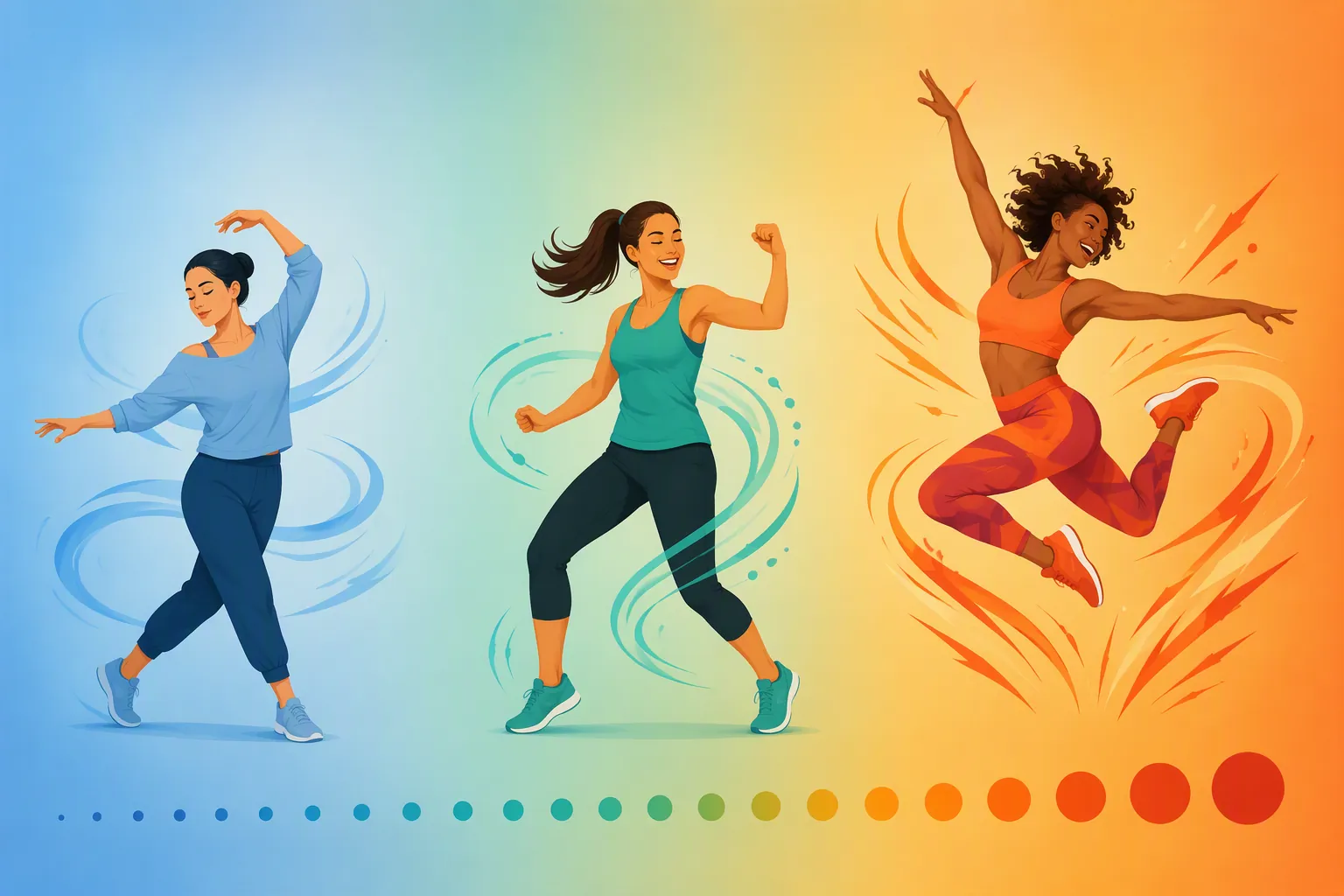
For a moderate dance session, you should feel warm, breathing faster, and clearly working, but not wrecked. The CDC describes moderate intensity as effort where you can talk but not sing; vigorous intensity is hard enough that you can say only a few words before pausing for breath.[2] That cue is useful in a bedroom because you may not have a bike console, treadmill speed, or lab-style heart-rate zones to tell you what is happening.
This is where some dance sessions fail and others absolutely hold up. A beginner choreography class that stops every 30 seconds to teach counts less like continuous cardio and more like skill practice with bursts of movement. A simple routine with repeated steps, limited downtime, and steady arm-and-leg work can accumulate aerobic minutes very efficiently.
Impact is separate from intensity. You can make a session harder by adding jumps, but you can also raise intensity with bigger arm patterns, faster footwork, deeper knee bends, more continuous travel, and fewer breaks. For renters, beginners, and anyone managing knees or downstairs neighbors, that difference is not a small technicality. It is often the difference between a workout that gets repeated and one that gets abandoned.
If you need a practical effort check, use the same calibration you would use for a steady indoor cardio session: stay mostly in a sustainable, talk-but-not-sing range for moderate work, and reserve breathless blocks for shorter vigorous intervals. FitAtHome’s no-equipment Zone 2 cardio routine uses that same kind of effort cue, even when the movements are not dance-based.
The heart and fitness evidence is encouraging, with limits
There is observational evidence connecting dancing with heart-health outcomes. In a cohort analysis of 48,390 UK adults aged 40 and older, moderate-intensity dancing was associated with lower cardiovascular disease mortality risk, with an adjusted hazard ratio of 0.54 and a 95% confidence interval of 0.34 to 0.87. Walking in the same analysis had an adjusted hazard ratio of 0.67.[4]
That is not proof that dancing caused the lower risk. People who dance may differ from people who do not in ways a study cannot fully clean up. But it is a useful signal because it treats dance like other leisure-time physical activity and asks the same health question: are people doing it, and is it associated with better outcomes?
Intervention evidence is narrower but more concrete. In an 8-week randomized trial of 30 sedentary women aged 60 to 75, a dance group trained for 60 minutes, three times per week. VO2peak increased from 23.3 to 25.6 mL·kg−1·min−1, and compliance was above 95%; the walking group showed comparable improvement.[5] That study should not be stretched to every age group, every format, or every already-fit exerciser. It does show that a structured dance program can create measurable cardiorespiratory adaptation in a real human group, not just a theoretical calorie burn on paper.
The compliance number is not decoration. At home, the hardest workout problem is rarely finding one impressive session. It is doing something again when the novelty is gone, the room is cramped, and nobody is watching. A format that people will actually repeat has an advantage before the physiology even gets interesting.
Calories are real, but they are not a dance-style leaderboard
Dance cardio burns energy because moving a large amount of body mass to music still requires work. The University of Brighton describes dancing as burning roughly 600 calories per hour, similar to recreational swimming, cycling, or jogging.[6] That is a broad statement, not a guarantee that every living-room routine will hit that number.
Per-session estimates vary with body weight, dance style, skill, tempo, range of motion, and how much of the class is spent learning versus moving. Healthline’s medically reviewed estimates for a 150-pound person list 30 minutes of hip hop or swing at 207 calories, ballet at 179, line dancing at 172, tap at 164, salsa at 143, and ballroom at 118.[7]
| Dance style | Estimated calories in 30 minutes for a 150-lb person |
|---|---|
| Hip hop | 207[7] |
| Swing | 207[7] |
| Ballet | 179[7] |
| Line dancing | 172[7] |
| Tap | 164[7] |
| Salsa | 143[7] |
| Ballroom | 118[7] |
Those estimates are useful for expectations, not for declaring one style superior. A sharp, continuous salsa session can outwork a lazy hip-hop follow-along. A beginner ballet video with long explanations may not behave like the estimate. If calorie burn is part of the goal, the more reliable lever is not the label on the video; it is sustained movement at an effort you can repeat across the week.
Body composition: possible, not automatic
Dance can contribute to fat loss when it creates enough weekly activity and fits inside an overall energy balance. A 2024 meta-analysis of 10 randomized controlled trials including 646 adults with overweight or obesity found significant reductions versus normal lifestyle in body mass, BMI, waist circumference, body fat percentage, and fat mass. Reported average changes included −1.92 kg body mass, −1.03 BMI, −2.95 cm waist circumference, −2.23 percentage points body fat, and −1.58 kg fat mass.[8]
The honest boundary is important. The analysis was largely based on female participants, and the certainty for several outcomes was rated low or moderate.[8] It also does not cancel the basic math of fat loss: if food intake rises enough to match or exceed the added activity, the scale may not move. Dance cardio can be the activity side of the equation; it is not a loophole around the equation.
How to dose dance cardio across a week
For a first week, the cleanest target is 150 minutes of moderate dance cardio. That is not a special dance guideline. It is a practical way to map dance sessions onto the same ACSM adult aerobic target used for other moderate cardio.[3] If your sessions are genuinely vigorous, the weekly total can be lower; 75 vigorous minutes is the corresponding target.[3]
Most beginners will do better starting with moderate minutes. Vigorous dance can be excellent cardio, but high-impact choreography adds joint load and coordination fatigue. If the workout leaves your calves, knees, or shins annoyed enough that you skip the next two sessions, the weekly dose suffers.
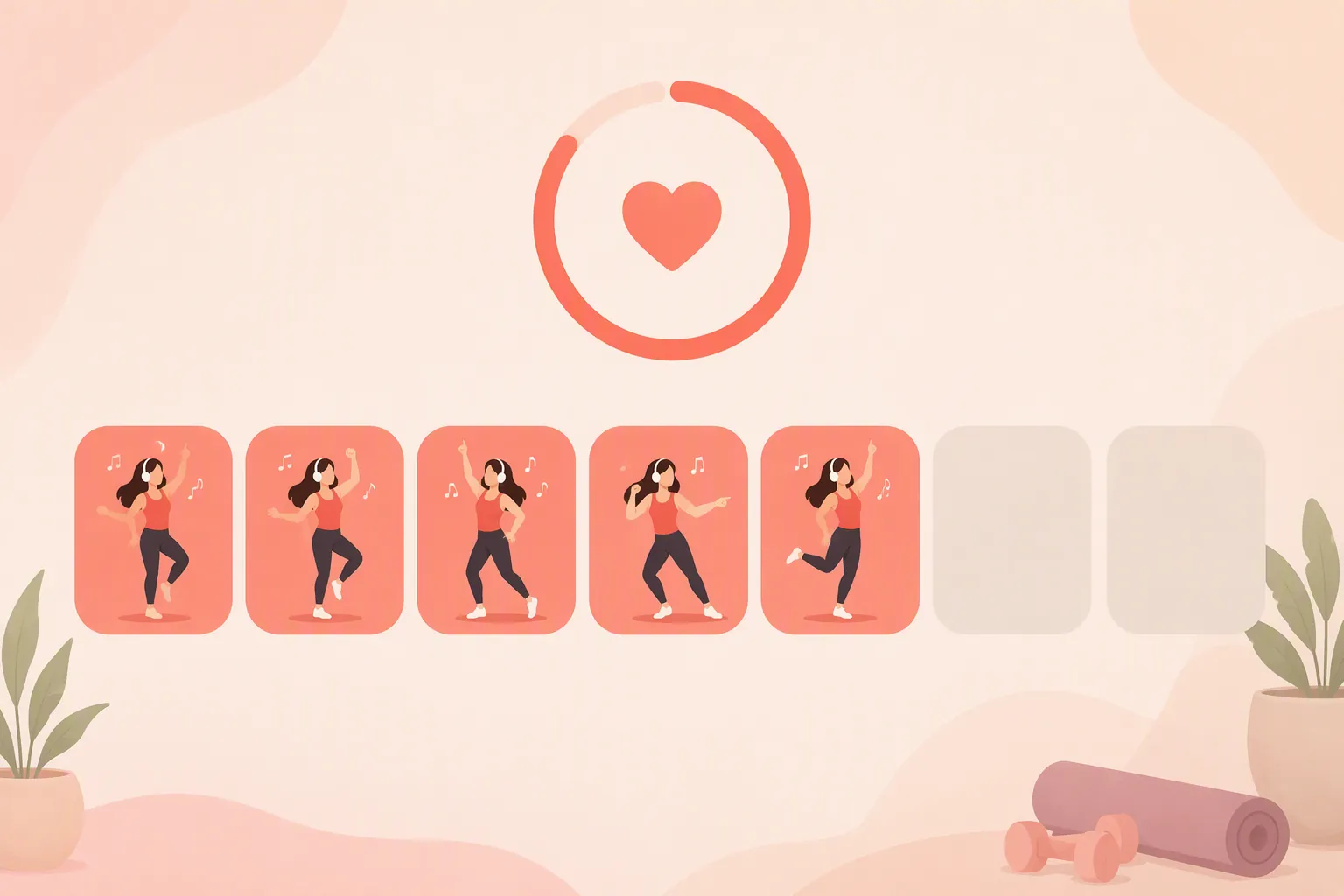
| Day | Session | Intensity target | What to watch |
|---|---|---|---|
| Monday | 30 minutes dance cardio | Moderate | Talk is possible; singing is not |
| Tuesday | 30 minutes dance cardio | Moderate | Keep breaks short enough that effort stays warm |
| Wednesday | Rest, mobility, or strength | Easy | Let feet and knees recover |
| Thursday | 30 minutes dance cardio | Moderate, or brief vigorous blocks | Use bigger arms or tempo before adding jumps |
| Friday | Rest or light walking | Easy | Do not turn every day into a test |
| Saturday | 30 minutes dance cardio | Moderate | Choose a routine you can finish without long pauses |
| Sunday | 30 minutes dance cardio | Moderate | End the week at 150 total minutes |
If you prefer shorter sessions, split the same total into smaller blocks: for example, 20 to 25 minutes on more days. If you prefer harder sessions, combine moderate days with one or two clearly vigorous blocks, but count vigorous work honestly. A routine is not vigorous because the instructor is excited; it is vigorous when your breathing and movement demand are high enough to match that category.
For apartment-friendly scheduling, the pattern used in FitAtHome’s quiet home workouts for cholesterol is a useful companion: build the week around 150 moderate minutes, then leave room for strength work and recovery. Dance can occupy the cardio slot without needing to become the whole fitness plan.
Where small-space routines fit in
Once the evidence question is settled, routine choice becomes practical. Pick a session that matches your floor, coordination, impact tolerance, and attention span. A renter may need quiet footwork. A beginner may need repeatable steps more than complex choreography. Someone bored by marching intervals may need music with enough personality to get them to press play again.
For actual sessions, FitAtHome already has several directions to try: a Dancing with the Stars home workout for quiet apartment cardio, Broadway dance workouts at home, a Derek Hough-style dance workout, a DWTS home cardio routine, and no-jumping cardio for small spaces. Use those for the actual workouts; use the intensity and weekly-minute targets here as the filter.
Music can help with pacing, especially if it keeps you moving through the whole block instead of stopping every time the steps change. If tempo selection is the hard part, the home workout songs by BPM guide can help you match songs to the kind of steady effort you want.
The practical answer
Dance cardio is real cardio when the session reaches moderate-to-vigorous intensity and you accumulate enough weekly minutes. Low-impact aerobic dance and Zumba-style home videos can meet moderate-intensity standards; high-impact aerobic dance can reach vigorous intensity.[1][2] A defensible starting week is 150 minutes of moderate dance cardio, or a lower total only when the work is genuinely vigorous enough to count toward the 75-minute target.[3]
The advantage is not that dance is automatically better than running, cycling, or HIIT. It is that a workout people enjoy enough to repeat has a better chance of becoming the cardio they actually do next Tuesday.
References
- 2024 Adult Compendium of Physical Activities: Conditioning Exercise, Adult Compendium of Physical Activities, 2024.
- Measuring Physical Activity Intensity, Centers for Disease Control and Prevention.
- Physical Activity Guidelines, American College of Sports Medicine.
- Dancing Participation and Cardiovascular Disease Mortality: A Pooled Analysis of 11 Population-Based British Cohorts, American Journal of Preventive Medicine, 2016.
- Effects of Dance Training on Functional Fitness, Body Composition and Cardiovascular Parameters in Older Women, ScienceDirect, 2018.
- Get off the sofa, turn up the music and dance, University of Brighton, 2020.
- Dancing to Lose Weight: Calories Burned, Dance Options, More, Healthline, February 2026.
- Dance-based interventions are effective for weight loss in people with overweight and obesity: A systematic review and meta-analysis, PLOS ONE, 2024.
What a small equipment investment adds
We don't have a build tagged to this exact tier yet. Browse all builds.
How often should you repeat this?
See our recovery and rest reference for citation-anchored rest-interval guidance.
Spot something off?
Tell us if a movement, tier assumption, or duration didn't match your experience.