
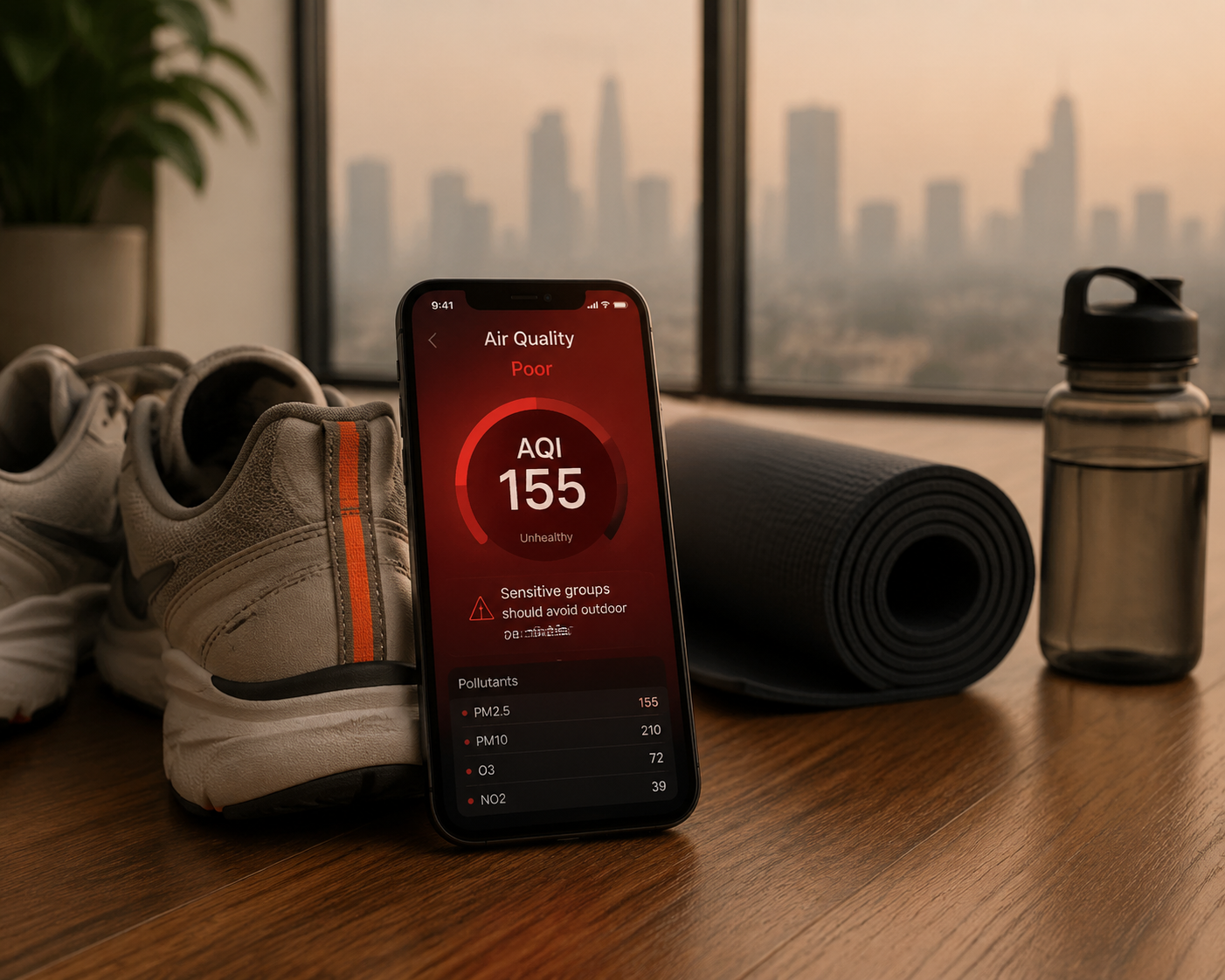
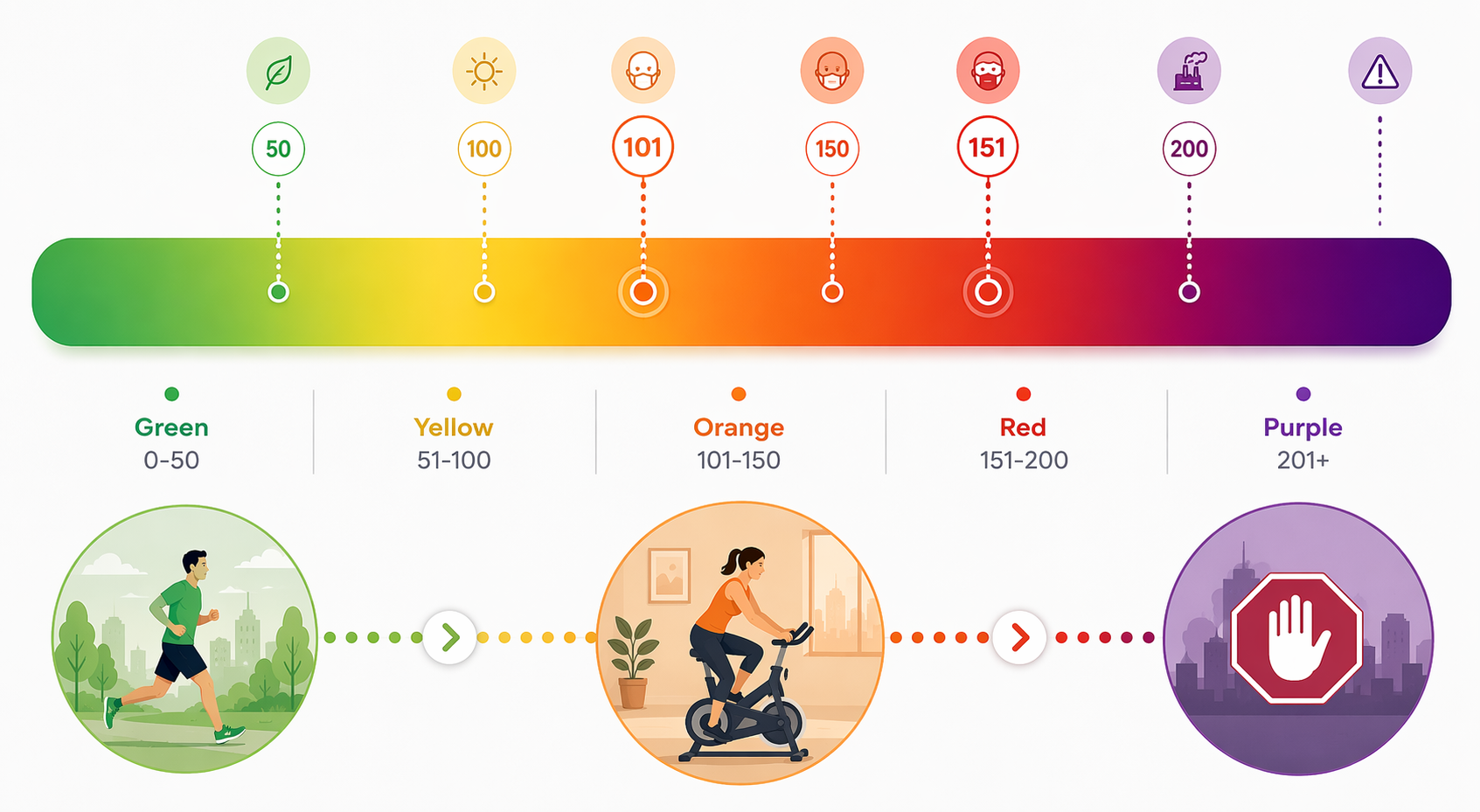
If your phone says AQI 101 or higher and you are in a sensitive group, move the workout indoors. If it says AQI 151 or higher, everyone moves indoors. If it reaches the Purple range, treat outdoor exertion as off the table for the day, not as something to negotiate with a slower pace.[1][2]
The stricter line during exercise is not alarmism. At rest, breathing is roughly 15 breaths per minute and about 12 liters of air. During exercise, that can rise to 40 to 60 breaths per minute and about 100 liters of air, increasing pollutant intake by about eight times.[3] A run that looks “moderate” on paper can become a very different exposure event once your breathing rate climbs.
The AQI Switching Table
Use this table before you lace up, not after the first mile. “Sensitive group” includes people with asthma, COPD, cardiovascular disease, respiratory irritation, older adults, children, and anyone whose clinician has told them to be cautious with smoke, ozone, or particulate pollution.
| Current AQI | General healthy adults | Sensitive groups | Best workout choice | Duration limit |
|---|---|---|---|---|
| 0-50 Green | Outdoor workout is acceptable | Outdoor workout is acceptable unless symptoms say otherwise | Normal outdoor plan or any indoor template | Normal planned duration |
| 51-100 Yellow | Outdoor workout is generally acceptable | Use caution; shorten prolonged outdoor exertion or move indoors | Low, moderate, or shortened vigorous session depending on symptoms | Keep long endurance work shorter than planned if air feels irritating |
| 101-150 Orange | Outdoor light or moderate activity may be acceptable for some, but avoid making it longer than needed | Move indoors | Sensitive groups: low or moderate indoor workout; general adults: moderate indoor workout if choosing caution | 20-40 minutes for most indoor sessions; shorter if symptoms appear |
| 151-200 Red | Move indoors | Move indoors and use a conservative intensity | Low, moderate, or recovery indoor workout; vigorous only if indoor air is clearly good | 10-30 minutes; cap vigorous work at 15-20 minutes |
| 201+ Purple | Avoid outdoor exertion | Avoid outdoor exertion; consider skipping if indoor air is compromised | Recovery only, or skip entirely if smoke smell, irritation, or high indoor PM2.5 is present | 10-20 minutes, or no workout |
How to Use the Table When You Are Already Dressed to Train
First, read the number, not just the color. An AQI of 99 and an AQI of 151 are both “bad air” in casual conversation, but they should not produce the same workout decision. The line that matters most is 101 for sensitive groups and 151 for everyone.
Second, place yourself in the stricter category if there is any real doubt. If you have asthma, recent bronchitis, smoke sensitivity, unusual chest tightness, or a pattern of coughing after smoky or pollen-heavy workouts, do not borrow the threshold for a healthy runner with no symptoms. People with asthma, COPD, or cardiovascular conditions should also ask their healthcare provider whether their personal cutoff should be lower than the general guide.
Third, choose the intensity before choosing the exercises. On alert days, “I’ll just do something indoors” is too vague. Low means you can breathe through your nose most of the time. Moderate means you are warm, working, and able to speak in short sentences. Vigorous means breathing is heavy and sustained. Recovery means the session is there to maintain the habit, loosen up, and avoid adding stress.
There is no clinical trial that proves one perfect indoor replacement workout for every AQI alert. The recommendations here sit on public-health thresholds, the known rise in breathing volume during exercise, and expert guidance rather than direct outcome studies comparing indoor and outdoor workouts during alerts. That is enough to make a practical decision, but not enough to pretend the decision is personalized medicine.
No-Equipment Indoor Workouts by Intensity
For Yellow and Orange days, most home exercisers need a routine that starts quickly, does not require floor space beyond a mat, and does not punish downstairs neighbors. For Red and Purple days, the air decision comes first and the workout ambition comes second.
Low Intensity: 15 to 30 Minutes
Choose this when the AQI is Yellow and you are sensitive, Orange and you want to be conservative, Red and your indoor air seems acceptable, or any time your throat, chest, or eyes are already irritated.
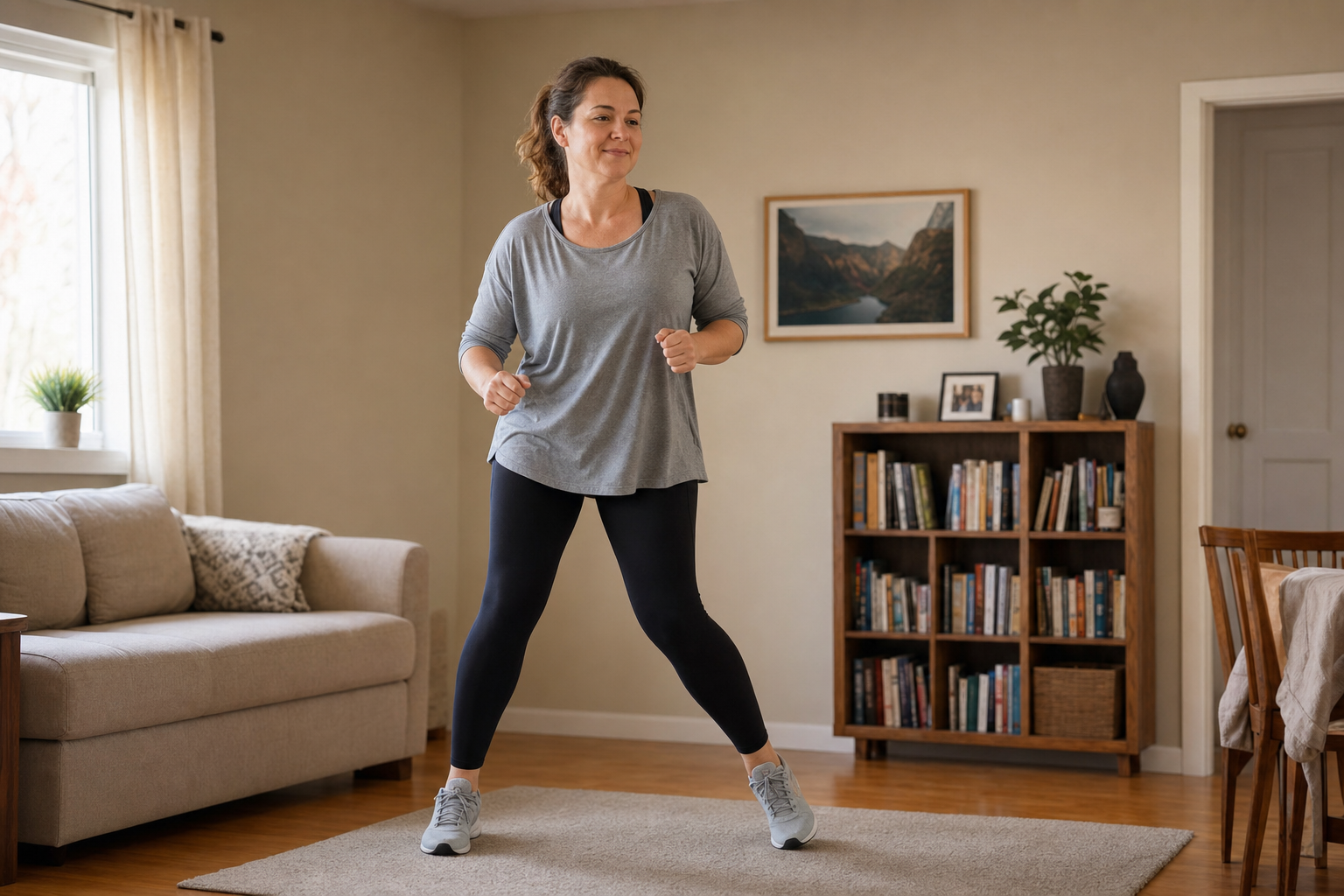
- Warm-up, 3 minutes: march in place, shoulder circles, ankle rolls, gentle side steps.
- Main work, 10 to 20 minutes: alternate 60 seconds of walking in place, 60 seconds of slow step-backs, 60 seconds of hip hinges, and 60 seconds of standing knee lifts.
- Mobility block, 4 to 6 minutes: cat-cow, child’s pose, thoracic rotations, low lunge stretch, and hamstring stretch.
- Cool-down, 2 minutes: slow breathing, easy neck movement, and relaxed walking around the room.
Keep this session deliberately unheroic. If the day is smoky enough to change your plan, the low-intensity option is not a failed workout. It is the option that keeps you moving without forcing high ventilation.
Moderate Intensity: 20 to 40 Minutes
This is the best default for many alert days: enough work to feel like training, not so much that you turn the living room into a lung test. Use it when you have moved inside at Orange as a sensitive exerciser, or at Red as a general exerciser with no symptoms and reasonably clean indoor air.
- Warm-up, 5 minutes: march in place, bodyweight good mornings, arm swings, half-depth squats, and easy plank walkouts.
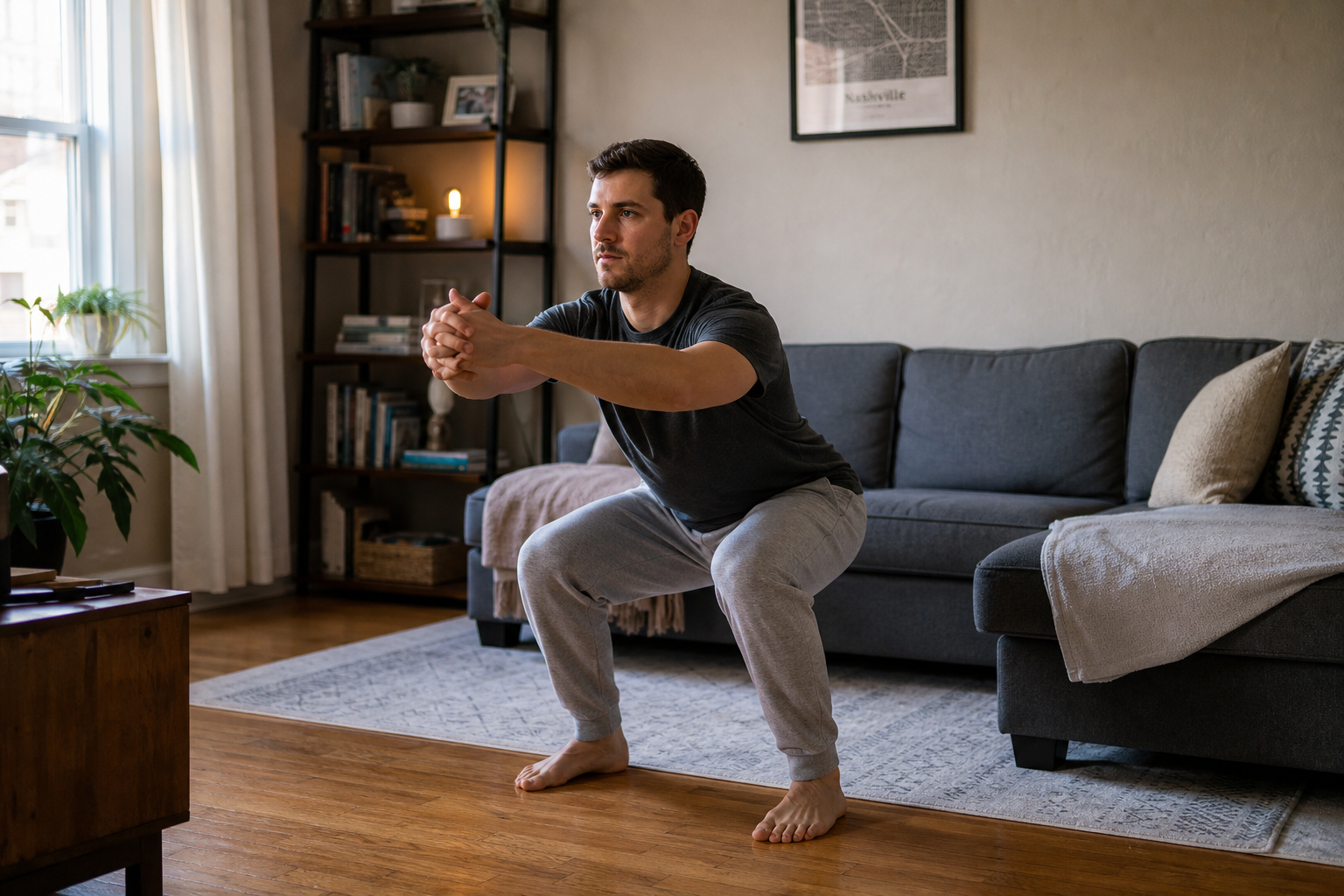
- Circuit, 3 to 5 rounds: 10 squats, 8 incline or floor push-ups, 10 reverse lunges per side, 12 glute bridges, 20 to 30 seconds of plank.
- Pace: rest 30 to 60 seconds between moves, or longer if breathing feels sharp, wheezy, or unusually strained.
- Cool-down, 5 minutes: hip flexor stretch, chest opener, seated forward fold, and slow nasal breathing if comfortable.
If jumping is not practical in your apartment, keep the circuit grounded. Squats, push-ups, lunges, planks, and glute bridges are enough. For a fuller quiet routine, use Build Muscle Without Making Noise — A Small Space Workout Plan as the next progression when alert days keep stacking up.
Vigorous HIIT: Only When Indoor Air Is Clearly Acceptable
Vigorous work is where alert-day advice needs a firmer hand. Because heavy breathing increases intake, a hard indoor session only makes sense if the indoor air is not smoky, irritating, or visibly dusty. Expert commentary from Colorado State University also points toward shortening duration as a more protective adjustment than simply turning a long workout into a slightly easier long workout, though that guidance should be treated as informed advice rather than settled clinical evidence.[4]
- Cap the full session at 15 to 20 minutes, including rests.
- Use 20 seconds of work and 40 seconds of rest, not all-out intervals stacked back to back.
- Choose 4 moves: mountain climbers, squat thrusts, fast step-ups on a stable stair, and skater steps without jumping.
- Stop the HIIT version if coughing, wheezing, chest tightness, dizziness, or throat burning appears.
On Red days, vigorous work should be the exception. On Purple days, it is usually the wrong choice unless you have unusually good indoor air control and no respiratory sensitivity.
Recovery: 10 to 20 Minutes
Use recovery when the AQI is high, the room smells smoky, you do not have a purifier, or your breathing already feels off. This is also the right call after a night of poor sleep during wildfire smoke or a pollen-heavy week when your baseline already feels irritated.
- Do 2 minutes of easy walking around the room.
- Move through 6 to 8 minutes of gentle mobility: cat-cow, open books, hip circles, calf stretch, and child’s pose.
- Add 3 to 5 minutes of relaxed breathing only if it feels comfortable; skip breath drills if they make irritation more noticeable.
- Finish with light stretching instead of chasing a sweat.
Indoors Is a Location Change, Not an Automatic Safety Pass
The easy mistake is treating the front door like an air filter. Outdoor particles can infiltrate indoor spaces, and movement inside can stir particles back into the air. Atmotube’s review of gym air-quality research notes that physical activity in indoor spaces can raise particulate matter by up to 300% through resuspension.[5] A study of fitness centers in Portugal and South Korea found indoor PM2.5 ranging from 0.9 to 777 micrograms per cubic meter, with some facilities reaching levels that would fall in hazardous territory.[6]
Those fitness-center numbers are not a direct measurement of U.S. apartments, and they should not be stretched that far. They do show the point that matters for a home workout: indoor air can be meaningfully contaminated, especially when outdoor smoke infiltrates, windows have been open, dust is stirred up, or the room has poor ventilation and filtration.
Before you start the indoor plan, do a 30-second room check. If you smell smoke indoors, see haze in the room, feel throat or eye irritation, or have a PM2.5 monitor reading above 55 micrograms per cubic meter, downgrade to recovery or skip the session. If you have asthma or COPD and the indoor air feels irritating after moving inside, skip the workout and follow your medical action plan.
| Indoor condition | Workout adjustment |
|---|---|
| No smoke smell, no irritation, room feels normal | Use the table’s recommended low, moderate, or capped vigorous workout |
| Mild smoke smell or slight throat/eye irritation | Use low intensity or recovery only |
| Visible haze, strong smoke smell, or symptoms before warm-up | Skip the workout |
| PM2.5 monitor reads above 55 micrograms per cubic meter | Skip vigorous and moderate work; choose recovery or rest |
| Asthma/COPD symptoms appear indoors | Stop exercising and follow your clinician’s guidance |
A Few Fast Scenarios
AQI 87, no respiratory issues, planned easy run: you can usually keep the outdoor session, but there is no penalty for moving indoors if the air smells bad or pollen is bothering you. If you stay outside, avoid turning it into a long hard workout.
AQI 118, asthma history, planned 45-minute run: move indoors. Use the low or moderate no-equipment template, keep it shorter than the original run, and stop if the indoor air feels irritating.
AQI 162, healthy adult, planned intervals: move indoors. If the room is clean and comfortable, do the capped HIIT version or a moderate circuit. If the room smells smoky, choose recovery or skip.
AQI 220, smoky smell inside, no purifier: do not try to out-discipline the air. Skip training or do a few minutes of gentle mobility only if it does not worsen irritation.
The usable rule is simple enough to keep in a workout log: sensitive groups move indoors at 101, everyone moves indoors at 151, and Purple-level days remove outdoor exertion from the menu. Once inside, match the session to both the AQI and the room you are actually breathing in.
References
- Four Things to Know about Air Quality and Exercising Outdoors — American Lung Association
- Activity Guides Publications — AirNow.gov / EPA
- The AQI Dilemma: Is it Safe to Exercise? — GU Energy Labs
- Is it safe to exercise outside when there is wildfire smoke in the air? — Colorado State University
- Importance of Air Quality in Gyms — Atmotube
- Is Practicing Indoor Physical Activity Safe? Consideration of Exposure to PM2.5 — PMC/NIH
Comments
Join the discussion with an anonymous comment.