
You do not lose the second set only in the second set. By then, the useful choices have already stacked up for you or against you: the meal that was too small, the bottle that stayed in the car, the warm-up that started after the coin toss, the long static stretch that felt responsible but left the legs dull.
Useful tennis match preparation is mostly a timing problem. The same banana, bottle, or lunge sequence can be helpful or nearly useless depending on when it happens. Use this 24-hour clock as the main script, then adjust the details for your start time, stomach, weather, and match length.
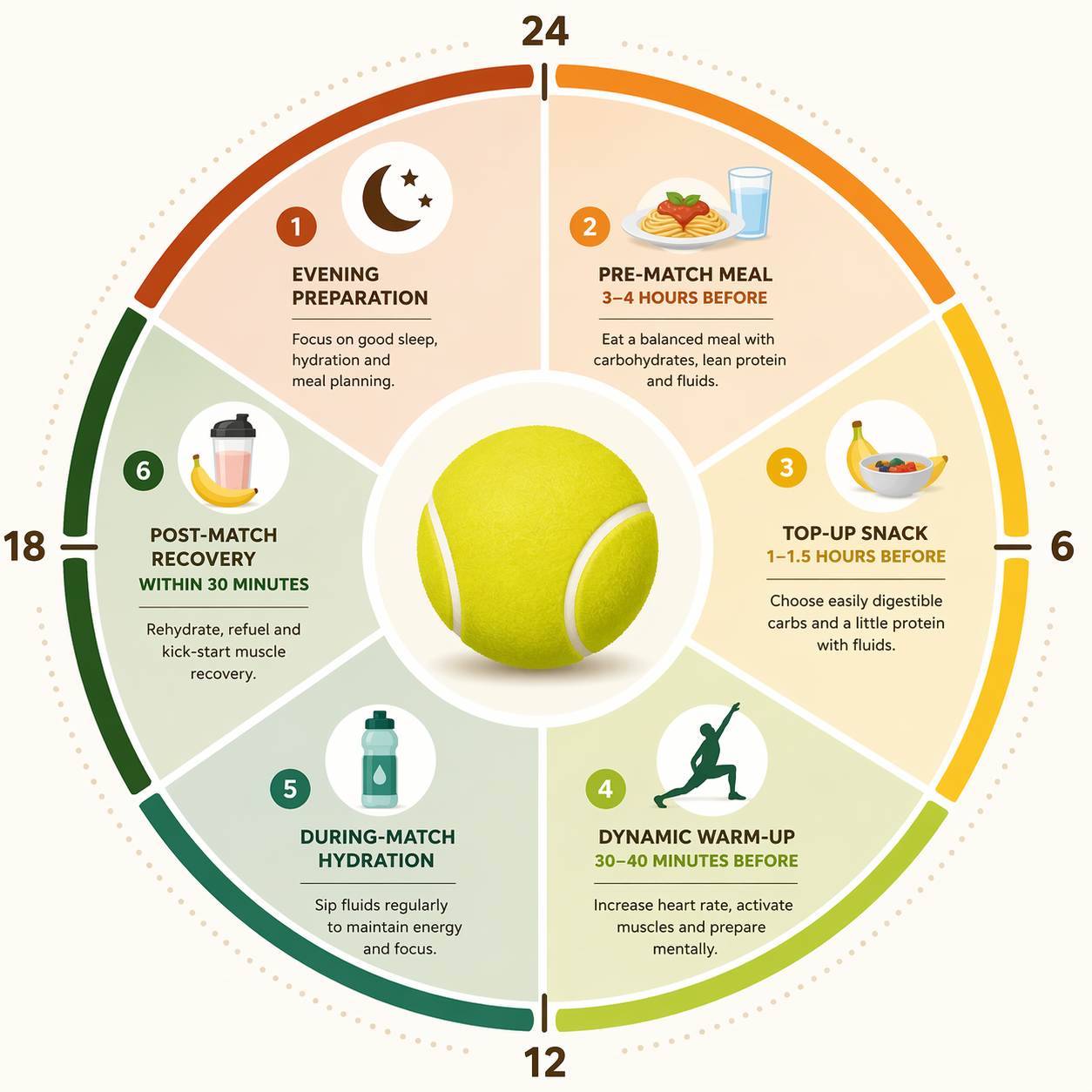
| Time From First Serve | What To Do | Why It Matters |
|---|---|---|
| Night before | Set out clothes, shoes, towel, bottles, snacks, and match food; choose a normal dinner with carbohydrates, protein, and fluids. | Removes morning decisions and prevents the classic rushed arrival. |
| 3-4 hours before | Eat the main pre-match carbohydrate meal: about 2.0-2.5 g carbohydrate per lb body weight, using familiar foods. | This is the main glycogen-storage window recommended by USTA Player Development.[1] |
| 1-1.5 hours before | Add a lighter top-up snack: about 0.5-0.7 g carbohydrate per lb body weight. | Keeps fuel available without turning the first set into a digestion experiment.[1] |
| 30-40 minutes before | Begin an off-court dynamic warm-up; aim for about 15 minutes of progressive movement. | Raises temperature, primes the heart and lungs, opens mobility, rehearses tennis movement, and wakes up the nervous system.[2] |
| During match | Drink at changeovers; add electrolytes and carbohydrates when heat, sweat, or match duration require it. | Dehydration and long-match fueling errors show up as slow feet before they show up as thirst. |
| Within 30 minutes after | Take in carbohydrates plus protein and begin rehydrating. | Delaying post-exercise carbohydrate intake by several hours reduced glycogen storage by 47% in cited recovery research.[3] |
Night Before: Make Tomorrow Boring
The night-before job is not to create a perfect athlete. It is to keep tomorrow from becoming a scavenger hunt. Pack the bag before bed: racquet, shoes, spare socks, towel, sunscreen, hat, water, electrolyte drink, snack, and any food you know sits well. If your league start time is early, put the breakfast ingredients where you can reach them without thinking.
Dinner should be normal enough that your stomach recognizes it. A carbohydrate base, some protein, fluids, and salt from ordinary food will beat a heroic late-night experiment. Recreational players usually do not need a complicated loading ritual; they need to avoid arriving underfed because the morning got away from them.
- Put match snacks in the bag, not just on the kitchen counter.
- Fill bottles or place them beside the sink so hydration starts before you leave.
- Check the forecast and plan extra fluids for heat rather than negotiating with the vending machine later.
- Choose familiar foods; match day is a poor testing ground for a new bar, powder, or giant breakfast.
3-4 Hours Before: Eat the Meal That Actually Fuels the Match
This is the window many club players miss. They eat too close to the match, too lightly, or not at all because they do not want to feel heavy. USTA Player Development recommends 2.0-2.5 g of carbohydrate per lb of body weight 3-4 hours before competition to optimize glycogen stores.[1]
That number is not a demand to force down food that makes you sluggish. It is a sizing guide. For a lighter player, the meal may be modest; for a larger player or someone expecting a long singles match, it may need to be more deliberate. The safest choices are usually ordinary carbohydrates you already tolerate: oatmeal, rice, pasta, potatoes, toast, fruit, pancakes, a bagel, or similar staples, with enough protein to make it a meal but not so much fat or fiber that digestion becomes the main event.
Tennis does not always look like endurance work because points stop and start, but the energy cost is real. A tennis nutrition review reports match-play energy expenditure of about 7.4 kcal per minute for women and 10.8 kcal per minute for men, which places a 90-minute match at roughly 664-973 kcal.[3] That is before you account for heat, nerves, long rallies, or the extra set nobody expected.
If the Start Time Moves
Tournament delays and league court backups are where rigid plans fall apart. If you eat the main meal at the right time and then wait an extra hour, do not panic or start over. Use the snack window to bridge the gap. Sip fluids. Keep moving occasionally. The goal is to stay topped up, not to keep eating because the schedule is annoying.
1-1.5 Hours Before: Top Up, Do Not Load Up
The final snack is smaller and more precise. USTA Player Development recommends 0.5-0.7 g of carbohydrate per lb body weight 1-1.5 hours before match time.[1] Think of this as a top-up, not the meal you forgot to eat.
Good options are portable and familiar: a banana, applesauce pouch, toast with a little honey, pretzels, a simple granola bar you already trust, or a sports drink if solid food feels awkward. If your stomach gets jumpy before matches, choose the plainest version that works. The snack should make the first few games feel steadier, not sit there reminding you that you ate it.
Caffeine belongs here only if you already use it well. In one prolonged tennis match-play study cited in the nutrition review, caffeine at 3 mg per kg increased final-set serve ball speed compared with placebo, 165±15 km/h versus 159±15 km/h.[3] Interesting, yes. Essential, no. If caffeine makes you jittery, urgent, or reckless with shot selection, it is not a magic second-set switch.
Hydration Starts Before the First Changeover
A hydration plan is not just drinking when your mouth feels dry. By then, especially in heat, you may already be negotiating with slower feet. A tennis nutrition review reports that elite tennis players can sweat from 0.5 to more than 5 L per hour, though recreational players in ordinary conditions should not treat the high end as their personal forecast.[3]
The practical version is simple: start sipping before you leave, carry enough fluid to avoid rationing, and drink at changeovers from the beginning. The same review notes that 3% dehydration measurably reduced 5 m and 10 m sprint performance.[3] That matters in tennis because many lost points are not dramatic collapses; they are one late split step, one short recovery, one ball reached with the arm instead of the legs.
During play, the review reports a recommendation of about 200 ml of electrolyte fluid per changeover, increasing up to 400 ml when conditions are above 27°C.[3] That is a habit, not a dare. If your stomach sloshes, back off. If the day is hot and the match is long, plain water alone may not cover what you are losing.
- For a short, cool doubles match: water plus normal pre-match food may be enough.
- For a hot day or heavy sweater: bring electrolytes and start using them early.
- For matches likely to pass two hours: plan carbohydrates during the match, not after the legs fade.
- For court delays: sip steadily and avoid finishing all your fluids before warm-up.
30-40 Minutes Before: Warm Up Before the Official Warm-Up
The five-minute on-court warm-up is not enough to turn a parked, seated, or rushed body into a tennis body. Use the 30-40 minutes before first serve for an off-court dynamic warm-up, with about 15 minutes of real movement before you ever take practice serves.
USTA describes a dynamic warm-up as doing five jobs: increasing body temperature, priming the heart and lungs, actively stretching muscles, ingraining proper movement patterns, and waking up the nervous system.[2] That is the difference between looking warm because you hit a few casual forehands and being ready to stop, start, rotate, split, recover, and serve.

A 15-Minute Dynamic Warm-Up You Can Do Off Court
| Minutes | Focus | Movements |
|---|---|---|
| 0-3 | Raise temperature | Easy jog, brisk walk, side shuffle, carioca, light skipping |
| 3-6 | Active mobility | Leg swings, arm circles, hip circles, ankle bounces, walking knee hugs |
| 6-10 | Tennis movement patterns | Walking lunges with torso twist, lateral lunges, split-step to shuffle, backpedal to forward run |
| 10-13 | Heart/lung priming | Short accelerations, shadow approach steps, controlled change-of-direction bursts |
| 13-15 | Nervous-system activation | Quick feet, split-step reactions, shadow swings, two or three relaxed practice service motions |
Keep the sequence progressive. The first minute should not look like the last minute. Start easy enough that breathing and joints catch up, then move toward tennis-specific patterns: lateral movement, rotation, deceleration, and quick first steps. If you have a history of calf, Achilles, back, or shoulder issues, treat this as preparation, not a test of toughness.
Static stretching is the trap here. It feels disciplined because you can stand still and suffer a little, but that is not the same as preparing to explode into a wide ball. USTA warns that static stretching before activity can reduce force production and power output, and a review cited in the tennis nutrition paper notes impairments lasting more than one hour.[2][3] Save long holds for later or for separate mobility work, not the final runway into a match.
On Court: Use the Official Warm-Up for Tennis, Not Fitness
Once you step onto the court, the warm-up changes purpose. You are no longer trying to raise your body temperature from scratch. You are calibrating bounce, timing, depth, spin, and serve rhythm. If you arrive cold, you will waste this period trying to become mobile while your opponent is already learning the court.
Hit enough balls to feel the day: groundstrokes, volleys, overheads, returns if available, and serves. Build serve speed gradually. A few smooth first serves and reliable second serves are usually more useful than proving you can hit one impressive bomb before the match starts.
During the Match: Changeovers Are Part of the Routine
Changeovers are not only for sitting down and checking the score in your head. They are where your hydration and fueling plan either survives or disappears. Drink early, especially in warm weather, because waiting until the second set to correct a fluid mistake is usually too late.
For matches exceeding two hours, the tennis nutrition review cites recommendations of 30-60 g of carbohydrate per hour during play.[3] That may come from a sports drink, gel, chews, banana, or other familiar quick carbohydrate. The form matters less than whether you can actually take it in without stomach trouble.
Doubles players should not ignore this just because the point load is shared. A long first set with deuce games, heat, and repeated net transitions can still drain the legs. Singles players should be even less casual. If the match is likely to run long, put the carbohydrate where you can reach it on the first changeover, not buried under a towel and two spare shirts.
Within 30 Minutes After: Do the First Repair Job
Post-match recovery starts before the drive home. The most useful first move is carbohydrates plus protein within about 30 minutes, along with continued fluids. The tennis nutrition review cites research in which delaying carbohydrate feeding by several hours reduced glycogen storage by 47%.[3] That is a large penalty for something as ordinary as leaving the snack in the pantry.
You do not need a ceremonial recovery shake. Chocolate milk, yogurt with fruit, a sandwich, rice and eggs, a smoothie, or another familiar protein-plus-carb option can do the job. If the match was hot or you finished with salt on your clothes, keep rehydrating after you leave the club instead of declaring the job done at the final handshake.
If you want a longer recovery sequence for later in the day, use this post-workout recovery routine at home after the immediate refuel is handled. The first priority is not a perfect recovery plan; it is catching the window you can actually control.
Second-set readiness usually comes from this chain: set up the night before, eat the main meal early enough, top up without overloading, warm up dynamically before the official warm-up, drink at changeovers, fuel long matches, and start recovery before the body has to wait.
References
- Pre-Match Tips: Preparing Like a Champion, USTA Player Development
- Dynamic Warm-Up and Flexibility Training, USTA
- Nutrition for Tennis: Practical Recommendations, PMC, 2013


Comments
Join the discussion with an anonymous comment.