You already made the right first call: the run, ride, or outdoor circuit is off. When AQI is 150 or higher, the useful question is no longer whether you can tough it out outside. It is what kind of indoor workout keeps you moving without turning a smoky day into an hour of heavy breathing in a room that has not actually been cleaned.
That distinction matters because “indoors” is a location, not a safety guarantee. During moderate-to-intense exercise, breathing volume can rise from about 12 liters per minute at rest to around 100 liters per minute, which means pollutant dose depends on both the air you are in and how hard you are pulling that air into your lungs [1]. A sealed, filtered bedroom and a leaky living room with a window cracked open are not the same training environment.
So the safer answer is not “do your normal workout inside.” It is: lower the intensity as AQI rises, shorten the session, and clean the room air before you start breathing hard in it.
What “hazardous” Means Here
Technically, the EPA’s AQI system reserves “Hazardous” for the Maroon band, AQI 301 to 500. A lot of people use “hazardous air quality” more loosely when the app turns red or purple and outdoor exercise is clearly a bad idea. This article uses both realities: AQI 151+ as the point where your workout should move fully indoors, and AQI 301+ as the point where a true workout usually gives way to rest, mobility, or the smallest useful amount of movement [2].
If you need the broader outdoor-versus-indoor decision framework, start with exercise during wildfire smoke or the site’s safe exercise in poor air quality guide. The rest of this piece assumes you are already inside and choosing the safest version of today’s session.
Use AQI as an Intensity Ceiling, Not a Vibe Check
The higher the AQI, the less room you have for workouts that depend on sustained heavy breathing. That does not mean every poor-air day becomes a couch day. It does mean the workout has to serve a narrower purpose: maintain movement, preserve routine, or get a strength stimulus without chasing the same respiratory load you would get outdoors.
| AQI outside | Practical indoor ceiling | Better choices | Avoid |
|---|---|---|---|
| 151-200, Red | Moderate indoor activity, about 45 minutes or less | Bodyweight strength, controlled low-impact circuits, easy stationary cycling, yoga | Hard intervals, long tempo work, all-out cardio |
| 201-300, Purple | Low-intensity only, about 30 minutes or less | Mobility, gentle yoga, easy cycling, light strength technique work | HIIT, threshold sessions, long workouts over 60 minutes |
| 301-500, Maroon | Minimal activity | Rest day, breathing-easy mobility, short stretching session | Training sessions that leave you panting |
At AQI 151-200, a moderate indoor session can still make sense if the room air is reasonably protected. This is the day for a 30- to 45-minute strength circuit with full recovery between sets, a beginner-friendly Zone 2 no-equipment routine, or an easy spin where you can breathe through your nose most of the time. If the workout makes you gulp air, it is too hard for the day.
At AQI 201-300, the workout should feel almost disappointingly controlled. Think gentle yoga, hip and thoracic mobility, easy stationary cycling, or low-volume bodyweight practice. This is not the day to convert your apartment into a sprint studio. A low-impact circuit can work, but only if it stays truly low intensity: step-back lunges instead of jump lunges, incline pushups instead of burpee pushups, marching instead of high knees.
At AQI 301-500, the EPA category is actually Hazardous. Treat that as a recovery or mobility day unless a clinician has given you specific advice otherwise. A few minutes of stretching, joint circles, or easy floor work is still movement. Trying to recreate your missed long run indoors under those conditions misunderstands the problem: the goal is to reduce total inhaled pollution, not protect a training streak at any cost.
The Safer Home Workout Menu
The safest exercise guidelines for hazardous air days are boring in a useful way: choose workouts that give muscles and joints something to do while keeping ventilation demand down. The session should end because you planned it to end, not because you are coughing, lightheaded, or breathing hard through your mouth.
Bodyweight Strength
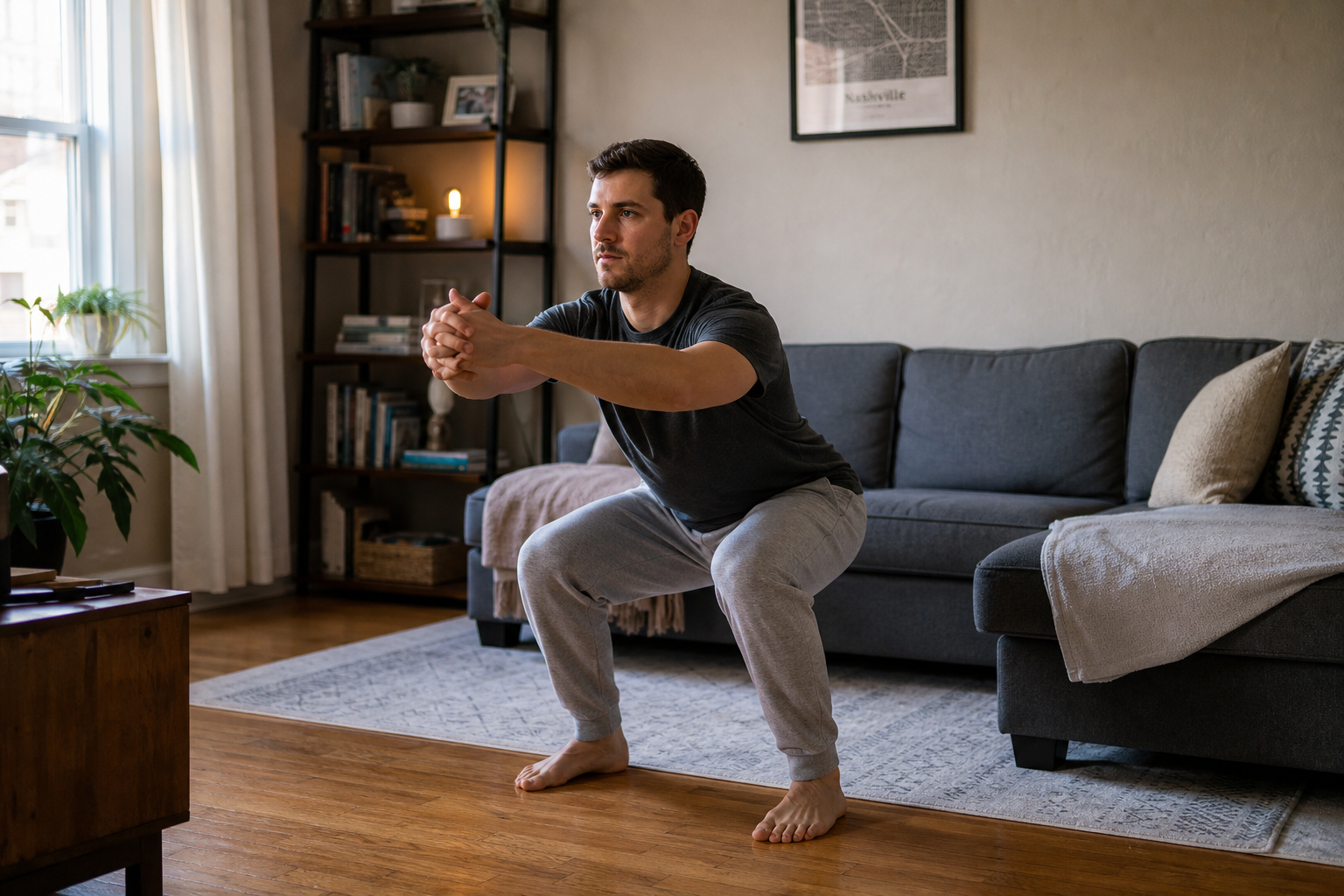
Strength work is often the best substitute because you can separate effort from breathlessness. Squats, hinges, split squats, wall sits, pushups, rows, planks, and carries can be arranged with generous rest so your muscles work without turning the session into cardio.
- Use sets instead of timed AMRAP blocks: 6-12 controlled reps, then rest until breathing settles.
- Skip jump variations and burpees when AQI is purple or worse.
- Keep one or two reps in reserve instead of grinding to failure.
- Progress with range of motion, tempo, leverage, or added sets on cleaner-air days.
If you are building a longer-term indoor strength plan, use progressive overload at home or the guide to bodyweight strength science after the smoke event, not in the middle of a hard-breathing experiment.
Yoga and Mobility
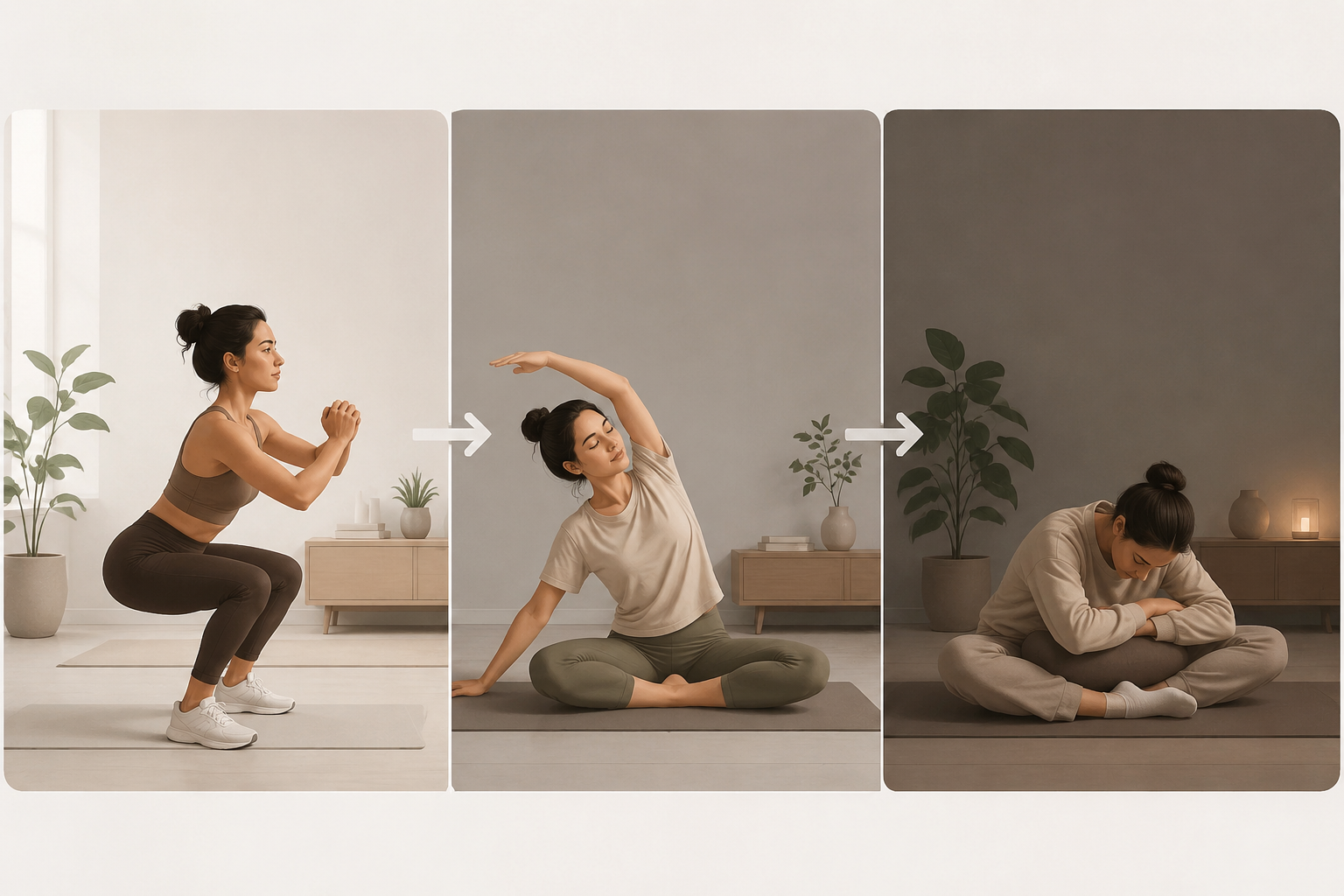
Yoga and mobility sessions are not consolation prizes on high-AQI days. They are the cleanest match for the problem when AQI is very high: low ventilation demand, useful movement, and an easy stopping point. Keep the room calm. Avoid heated sessions, fast power flows, or anything that leaves you panting.
A practical 20-minute version can be simple: cat-cow, child’s pose breathing, thoracic rotations, hip flexor stretches, hamstring flossing, ankle rocks, and a few relaxed squats. On a Maroon day, that may be the whole workout.
Stationary Cycling, If It Stays Easy
A stationary bike is useful because it gives endurance athletes a controlled option, but only if you resist the temptation to turn every ride into intervals. Keep the resistance low, cap the duration based on the AQI tier, and use the talk test: if you cannot speak in full sentences, back off.
For renters and small spaces, the best bike is often the one quiet enough and compact enough that you will actually use it without rearranging your whole room. The stationary bike selection guide is more relevant than a maximal training plan when the outside air is the limiting factor.
Low-Impact Circuits With the Edges Sanded Off
Low-impact does not automatically mean low intensity. A nonstop circuit of squats, mountain climbers, and fast step-ups can still drive breathing volume high. On AQI 151+ days, build circuits around control: chair squats, incline pushups, dead bugs, glute bridges, band rows, calf raises, and slow step-ups.
If your knees already prefer quieter movement, the low-impact workout for knee pain has the right exercise family. On smoke days, use the easier variations and longer rests.
Set Up the Room Before You Start
This is the step that gets skipped in too much advice. If the windows leak, the purifier is too small, the stove is on, and you immediately start a hard circuit, you have moved the workout indoors without necessarily reducing the dose very much.
Indoor PM2.5 can be more than 50% lower than outdoor levels when the space is properly sealed and filtered, but that is not a promise your apartment automatically keeps. Building tightness, HVAC behavior, filter quality, and open doors all change the result [3].
- Close windows and exterior doors. If you can feel or smell smoke near a window, reduce the leak with weatherstripping, a towel, or temporary sealing tape.
- Choose the smallest practical workout room. A purifier has an easier job in a bedroom than in an open-plan living area.
- Run a HEPA purifier before the workout, not only during it. Give the room time to clean down before your breathing rate rises.
- Match CADR to room size. A purifier that is undersized for the room may be comforting background noise rather than meaningful filtration.
- Set central HVAC to recirculate if available, and use a MERV 13 or higher filter if your system can handle it.
- Avoid indoor combustion sources: candles, gas burners, fireplaces, and anything else that adds particles while you are trying to remove them.
CADR matters because it is the cleaner-air delivery rate: the practical measure of how much filtered air a unit can provide for a given room. Air purifier guidance commonly tells buyers to match CADR to room size rather than assuming any HEPA unit works equally well anywhere [4].
If you do not have a purifier, do the unglamorous minimum anyway: close the room, block obvious drafts, avoid cooking during the workout window, and choose mobility or light strength instead of cardio. A temporary box fan plus a high-efficiency furnace filter is often discussed as a lower-cost emergency option, but it has to be assembled and used safely; do not leave a makeshift setup unattended, and do not let the fan overheat.
Small-space setup also affects whether you can keep the room closed without making the workout miserable. If your mat, bike, purifier, and furniture all compete for the same square footage, the small-apartment home gym flooring guide can help you make one workable corner instead of spreading the session across the whole apartment.
What to Skip Even Indoors
Some workouts are poor matches for smoke days even when you have come inside. Coaching guidance for athletes in smoke and pollution events commonly emphasizes reducing intensity and adjusting training rather than forcing planned sessions through bad conditions [5]. For home workouts, that means being suspicious of anything designed to make you breathe as hard as possible.
- Skip HIIT intervals when AQI is purple or maroon outside.
- Skip long indoor cardio sessions over 60 minutes during heavy smoke events.
- Skip workouts that rely on burpees, jump squats, fast mountain climbers, or treadmill sprints.
- Skip heated rooms, incense, candles, or cooking immediately before training.
- Stop if you develop chest tightness, wheezing, unusual shortness of breath, dizziness, or symptoms that feel out of proportion to the effort.
This is also where competitive endurance athletes may need to make the least satisfying tradeoff. An easy spin or short strength session may not maintain the exact stimulus you wanted from a long run. But on a high-smoke day, replacing the missed session is not the same as reproducing it. The replacement has to respect the air you are actually breathing.
A Few Ready-to-Use Substitutions
Use these as templates, not tests of discipline. If your indoor air still smells smoky or your purifier has not had time to run, choose the easier version.
| Missed outdoor workout | AQI 151-200 substitute | AQI 201-300 substitute | AQI 301-500 substitute |
|---|---|---|---|
| Easy run | 30-40 minutes easy stationary bike or low-impact Zone 2 | 20-30 minutes gentle cycling or brisk indoor walking if air is clean | 10-15 minutes mobility |
| Interval run | Controlled full-body strength with long rests | Light technique strength and mobility | Rest or stretching |
| Long ride | 45 minutes easy spin, no hard surges | 20-30 minutes very easy spin | Rest day |
| Outdoor bodyweight circuit | Low-impact circuit with no jumping | Short strength practice with full recovery | Gentle floor mobility |
If you want a more visual AQI card for quick decisions, the indoor guide to working out during bad air quality pairs well with this approach.
After the Workout
Recovery does not need to become another project. Keep the filtered room running for a while if the air outside is still bad, hydrate, and avoid adding indoor pollutants right after the session. If your throat, chest, or breathing feels irritated, that is information for the next workout: lower the intensity sooner, shorten the session, or make it a mobility day.
For more detail on how smoke and pollution can compound post-exercise irritation, use the poor-air-quality recovery guide. It belongs after the main decision, though. The first move is still to reduce the dose going in.
The Practical Standard
On hazardous-air days, the win is not reproducing the outdoor workout indoors. Choose the lowest intensity that still serves the day’s purpose, shorten the session as AQI rises, clean the room air before you breathe hard in it, and treat true Hazardous AQI as a recovery or mobility day.
References
- Air Quality and Outdoor Exercise, ACSM, https://www.acsm.org/air-quality-and-outdoor-exercise/
- Should You Exercise Outside in Air Pollution?, US EPA, https://www.epa.gov/sciencematters/should-you-exercise-outside-air-pollution
- Air Quality Index, American Lung Association, https://www.lung.org/clean-air/outdoors/air-quality-index
- Clean Air for Fitness: Why Blueair Air Purifiers and Humidifiers Belong in Your Home Gym, Blueair, https://www.blueair.com/blogs/news/clean-air-for-fitness-why-blueair-air-purifiers-and-humidifiers-belong-in-your-home-gym
- How To Adjust Training In Response To Air Pollution And Forest Fire Smoke, CTS, https://trainright.com/adjust-training-response-air-pollution-forest-fire-smoke/
Comments
Join the discussion with an anonymous comment.