
How to Use Progressive Overload at Home Without a Gym
Learn how to apply progressive overload to bodyweight exercises using the 3×8 progression rule. This guide provides complete exercise ladders for six movement patterns and a sample 12-week plan so you can keep building strength without any gym equipment.
- Duration
- 30 min
Use this rule first: when you can perform 3 sets of 8 clean, full-range-of-motion reps of a bodyweight exercise, move to the next harder variation. If you cannot, stay where you are and repeat it next session.
That is the simplest way to make progressive overload at home without a gym stop feeling like guesswork. Most home workouts do not fail because push-ups, squats, rows, and bridges are useless. They fail because the plan says “make it harder over time” and then leaves you alone on Tuesday afternoon deciding whether to add reps, slow the tempo, switch exercises, or start a harder move you cannot control yet.
The 3×8 rule gives you an advancement signal. Three sets means the exercise is repeatable, not just a lucky first set. Eight reps gives you enough exposure to show control without turning every strength exercise into a long conditioning set. Clean reps and full range of motion keep you from “earning” a harder variation by shortening the movement.
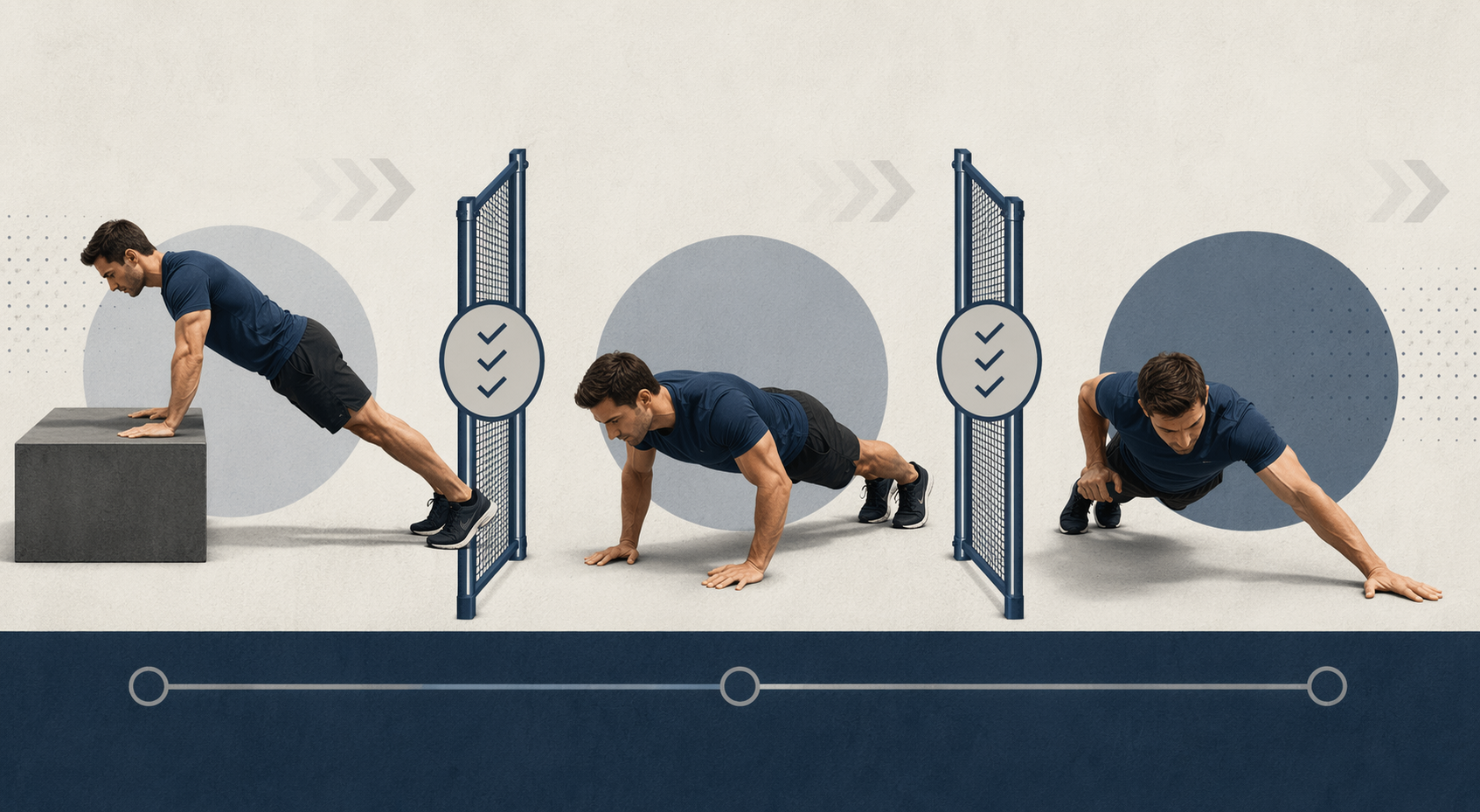
This is a practical coaching benchmark, not a universal law of physiology. No single study proves that the eighth rep is a magic threshold for every body and every movement. But structured calisthenics systems use explicit progression gates because bodyweight training needs a way to replace the small plate jumps that gym lifters get from a barbell, and systems such as FitLoop and the Recommended Routine organize training around advancing through harder movement variations rather than randomly swapping exercises.[1][2]
Progressive overload without plates
Progressive overload means the body gradually faces a greater training demand than it faced before. In a gym, the cleanest version is obvious: lift the same exercise with a little more weight. At home, the load is usually your body, the floor, a chair, a table, a doorway bar if you have one, and gravity. That does not remove overload. It just changes how you create it.
Human Kinetics describes getting stronger without weights through the same underlying mechanism: muscles and connective tissues adapt when training demand increases over time.[3] Bony to Beastly makes the narrower muscle-building point that bodyweight training can produce hypertrophy comparable to weight training when progressive overload is applied systematically.[4] The useful word there is “systematically.” Doing harder-looking moves at random is not a system.
The Cleveland Clinic’s general strength-training guidance places many exercises in a 6–15 rep-per-set range across 5–6 exercises, which is a helpful anchor for understanding why 3×8 sits in a workable strength-and-muscle zone.[5] That framework assumes access to free weights, though. Bodyweight training sometimes needs adjusted ranges because a variation jump can be larger than adding a small dumbbell. Moving from incline push-ups to floor push-ups may be a much bigger jump than adding a few pounds to a bench press.
So the rule is not “only ever do eight reps.” The rule is: use 3×8 as the gate. If you reach it with clean form, test the next variation. If the next variation drops you below clean, repeatable reps, step back or use an in-between version.
The advancement rule
Before choosing harder exercises, decide how you will judge the reps you already have. This is where most home programs get vague. A rep counts only if it meets the same standard every time.
- Stay: if you perform fewer than 3 sets of 8 clean reps, keep the same variation next workout.
- Repeat: if you hit 3×8 but the last reps are shortened, rushed, twisted, bounced, or painful, repeat the same variation.
- Advance: if you hit 3×8 with full range of motion, stable control, and the same setup on every set, move one step up the ladder next time.
- Regress: if the next variation gives you sloppy singles or pain, return to the previous variation or use a smaller bridge step.
Write the decision down immediately after the exercise. Not later, not from memory, not as a feeling. A cheap notebook beats a perfect plan that never gets checked.
Six movement ladders for home progression
A bodyweight program needs more than a harder push-up. It needs enough movement-pattern coverage that one area does not keep progressing while another gets ignored. These six ladders cover horizontal push, vertical push, horizontal pull, vertical pull, squat, and hinge. Choose one current variation from each pattern, then apply the same 3×8 gate.
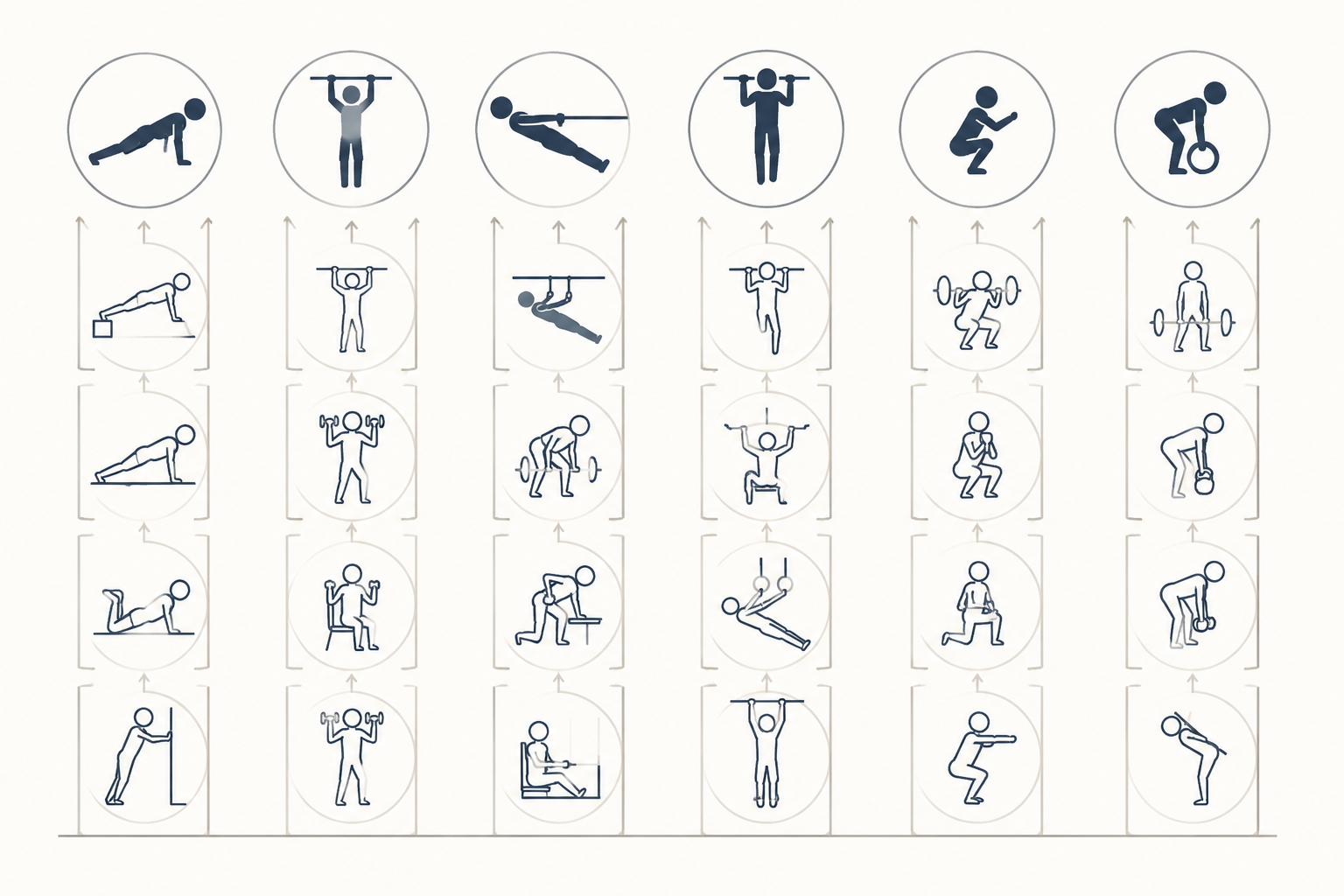
| Movement pattern | Start here | Middle steps | Harder end |
|---|---|---|---|
| Horizontal push | Incline push-up | Floor push-up; close-grip push-up; diamond push-up; archer push-up | One-arm push-up |
| Vertical push | Pike push-up | Feet-elevated pike push-up; wall handstand hold with partial reps; wall handstand push-up | Freestanding or strict handstand push-up |
| Horizontal pull | High inverted row | Lower inverted row; feet-elevated inverted row; wide row; one-arm assisted row | Archer row |
| Vertical pull | Scapular pull | Assisted pull-up; negative pull-up; full pull-up; chest-to-bar pull-up | Weighted pull-up |
| Squat | Air squat | Pause squat; split squat; reverse lunge; Bulgarian split squat; assisted pistol squat | Pistol squat |
| Hinge | Glute bridge | Single-leg glute bridge; hip thrust; sliding leg curl; assisted Nordic curl | Nordic curl |
Horizontal push: from incline push-ups to one-arm push-ups
Horizontal pushing gets harder when you reduce the incline, narrow the base of support, shift more load to one arm, or remove assistance from the working arm. Start with an incline that lets your chest travel all the way down with the body held in one line. A kitchen counter, sturdy table, or couch arm can work if it does not move.
| Step | Variation | Advance when |
|---|---|---|
| 1 | Incline push-up | 3×8 clean reps at the current incline |
| 2 | Lower incline push-up | 3×8 clean reps at a lower surface |
| 3 | Floor push-up | 3×8 with chest-to-floor depth or consistent full available range |
| 4 | Close-grip or diamond push-up | 3×8 without elbows flaring or hips sagging |
| 5 | Archer push-up | 3×8 per side with the assisting arm controlled |
| 6 | One-arm push-up progression | 3×8 per side at the current assistance level |
Do not rush the jump from floor push-ups to one-arm work. Many people need several bridge steps: one hand on a slightly raised surface, one hand wider than the other, or archer reps where the non-working arm still helps. The test is not whether the variation looks advanced. The test is whether the working side can control the descent, press without twisting, and repeat the setup.
Vertical push: from pike push-ups to handstand push-ups
Vertical pushing shifts the work toward the shoulders and upper arms. The ladder gets harder as the torso becomes more vertical and more bodyweight stacks over the hands. A pike push-up is not just a push-up with the hips high; the head should travel down between the hands under control, then press back up without turning it into a horizontal push.
| Step | Variation | What changes |
|---|---|---|
| 1 | Pike push-up | Shoulders take more load than in a floor push-up |
| 2 | Feet-elevated pike push-up | More bodyweight shifts toward the hands |
| 3 | Wall handstand hold plus partial push-up | You learn stacked balance and pressing position |
| 4 | Wall handstand push-up | The press becomes more vertical and heavier |
| 5 | Deeper wall handstand push-up | Range of motion increases |
| 6 | Strict handstand push-up progression | Less wall assistance or stricter control |
Here, range of motion matters more than the name of the exercise. A shallow wall handstand push-up is not automatically better than a strong feet-elevated pike push-up. If the harder version cuts the movement to a few shaky inches, stay with the previous step and build the full rep.
Horizontal pull: from inverted rows to archer rows
Horizontal pulling is where many home programs get thin because it usually needs a sturdy table, low bar, rings, straps, or another safe anchor. If you do not have a reliable pulling setup yet, solve that before pretending towel rows against a flimsy door are the same thing. A safe anchor is not a detail; it is the exercise.
| Step | Variation | Advance when |
|---|---|---|
| 1 | High inverted row | 3×8 with the chest reaching the edge, bar, or handles |
| 2 | Lower inverted row | 3×8 with a straighter body angle |
| 3 | Feet-elevated inverted row | 3×8 without losing body tension |
| 4 | Wide inverted row | 3×8 with shoulder blades moving cleanly |
| 5 | Assisted one-arm row | 3×8 per side with the assisting hand doing less work |
| 6 | Archer row | 3×8 per side with a controlled pull toward the working arm |
The common cheat is turning rows into a hip thrust. Start each rep with the body braced, pull the chest toward the anchor, pause briefly if needed, then lower without collapsing. If your hips shoot upward to finish the rep, log it as a repeat, not an advance.
Vertical pull: from scapular pulls to weighted pull-ups
Vertical pulling is the pattern most likely to require equipment. A pull-up bar is still home training; it is not a gym membership. Start below full pull-ups if you cannot yet control the shoulder blades from a dead hang.
| Step | Variation | Purpose |
|---|---|---|
| 1 | Scapular pull | Build control at the shoulder blades |
| 2 | Assisted pull-up | Practice the full path with reduced load |
| 3 | Negative pull-up | Build controlled lowering strength |
| 4 | Full pull-up | Use bodyweight through the full range |
| 5 | Chest-to-bar pull-up or slower pull-up | Increase range or control demand |
| 6 | Weighted pull-up | Add external load once bodyweight reps are repeatable |
If you are at the scapular-pull or assisted-pull-up stage, the 3×8 rule still works, but use it honestly. Eight half-pull-ups with the chin craned over the bar do not beat six clean assisted reps. If your current setup cannot provide a good vertical pull, use horizontal rows while you arrange better equipment rather than forcing unsafe substitutions.
Squat: from air squats to pistol squats
Bodyweight squat progress is not just adding more and more air squats. Once 3×8 air squats are easy, the useful overload usually comes from pauses, single-leg bias, deeper control, and eventually one-leg squatting. The legs are strong, so the jump from two-leg to one-leg work can be large.
| Step | Variation | What to watch |
|---|---|---|
| 1 | Air squat | Consistent depth and foot pressure |
| 2 | Pause squat | No bounce out of the bottom |
| 3 | Split squat | Back knee lowers under control |
| 4 | Reverse lunge | Step and return without wobbling |
| 5 | Bulgarian split squat | Rear foot elevated, front leg does the work |
| 6 | Assisted pistol squat | Use a doorframe, counter, or strap only as much as needed |
| 7 | Pistol squat | Full controlled single-leg squat |
For single-leg squats, count both sides. If the right leg earns 3×8 and the left leg gives you 3×5 with knee collapse, the exercise has not advanced. The next-step decision belongs to the weaker side.
Hinge: from glute bridges to Nordic curls
The hinge ladder trains the back side of the body: glutes, hamstrings, and the ability to extend the hips without turning every rep into a lower-back crank. This pattern is easy to underload at home if the plan stops at basic glute bridges forever.
| Step | Variation | What makes it harder |
|---|---|---|
| 1 | Glute bridge | Basic hip extension from the floor |
| 2 | Single-leg glute bridge | One leg handles more of the load |
| 3 | Hip thrust | Greater range of motion with shoulders elevated |
| 4 | Single-leg hip thrust | More single-leg load through a longer range |
| 5 | Sliding leg curl | Hamstrings flex the knee while hips stay controlled |
| 6 | Assisted Nordic curl | Hamstrings resist a much harder lowering demand |
| 7 | Nordic curl | Very high hamstring demand with minimal assistance |
Nordic curls are much harder than they look on paper. Most people need assistance, a shortened range, or slow negatives before full reps are realistic. If you cannot anchor your feet safely, do not improvise with furniture that slides. Use bridges, hip thrusts, and sliding curls until the setup is solid.
How to run the system in a week
You do not need a complicated split to use the ladders. For many beginners and early intermediates, two or three full-body sessions per week is enough structure to practice the movements, recover, and make decisions from the log.
| Session | Exercises | Working target |
|---|---|---|
| Workout A | Horizontal push, horizontal pull, squat, hinge | 3 working sets per exercise |
| Workout B | Vertical push, vertical pull, squat, hinge | 3 working sets per exercise |
| Optional Workout C | Repeat weaker patterns or alternate A/B | Keep reps clean; do not turn it into a punishment circuit |
Rest long enough that the next set is a strength set, not just a breathing test. If the first set is clean and the second set falls apart because you rushed back in, the log becomes harder to read. The point is not to make every exercise feel dramatic. The point is to expose whether the variation is ready to advance.
A 12-week beginner progression using the 3×8 gate
This sample shows how progression behaves when the rule is actually followed. It is not a promise that every person reaches the same variation in the same week. The important part is the decision column. If the gate is not met, the exercise repeats. If it is met cleanly, the next variation appears.
| Week | Horizontal push example | Squat example | Pull example | Decision rule |
|---|---|---|---|---|
| 1 | Incline push-up | Air squat | High inverted row or scapular pull | Find a variation that allows clean sets |
| 2 | Incline push-up | Air squat | Same pull variation | Repeat until 3×8 is clean |
| 3 | Lower incline push-up if Week 2 met the gate | Pause squat if air squat met the gate | Lower row angle or assisted pull if ready | Advance only one ladder step |
| 4 | Lower incline push-up or repeat | Pause squat or repeat | Repeat pull variation if reps shorten | Let weak patterns stay behind |
| 5 | Floor push-up if 3×8 lower incline is clean | Split squat | Lower inverted row or negative pull-up | New variations may drop below 8 reps |
| 6 | Floor push-up | Split squat | Same pull variation | Build back toward 3×8 |
| 7 | Floor push-up or close-grip push-up if ready | Reverse lunge if split squat met the gate | Feet-elevated row or full pull-up attempt if ready | Advance only after repeatable control |
| 8 | Close-grip push-up or repeat floor push-up | Reverse lunge | Repeat pull variation | Do not advance on one good set |
| 9 | Diamond push-up if close-grip is clean | Bulgarian split squat if ready | Harder row angle or full pull-up | Use 3×8 per side for unilateral work |
| 10 | Diamond push-up or repeat | Bulgarian split squat | Same pull variation | Hold position if form changes |
| 11 | Archer push-up progression if ready | Assisted pistol squat if ready | Assisted one-arm row or chest-to-bar pull-up | The jump may require a bridge step |
| 12 | Repeat archer step or return to diamond for clean volume | Repeat assisted pistol or Bulgarian split squat | Repeat current pull variation | End the block by logging the next starting point |
Notice what does not happen here: the whole program does not level up at once. Your push-up may move from incline to floor while your pull stays on the same row angle. Your squat may advance quickly until single-leg work exposes a control problem. That is normal. The log should show different speeds across patterns.
If you are an absolute beginner and cannot yet do the starting versions with control, spend a few weeks on easier regressions before using this as written. If you already train consistently and want to know whether bodyweight work is still enough for muscle growth, the answer depends less on the label “bodyweight” and more on whether your current ladders still have hard, trackable steps left.
The printable tracking template
The tracker is the part that makes the rule real. Without it, you will remember the good sets, forget the ugly ones, and advance because a variation feels stale. Use one line per exercise.
| Date | Movement pattern | Exercise variation | Sets × reps | Rep quality | Next-step decision |
|---|---|---|---|---|---|
| Horizontal push | Clean / Short ROM / Shaky / Painful | Stay / Repeat / Advance / Regress | |||
| Vertical push | Clean / Short ROM / Shaky / Painful | Stay / Repeat / Advance / Regress | |||
| Horizontal pull | Clean / Short ROM / Shaky / Painful | Stay / Repeat / Advance / Regress | |||
| Vertical pull | Clean / Short ROM / Shaky / Painful | Stay / Repeat / Advance / Regress | |||
| Squat | Clean / Short ROM / Shaky / Painful | Stay / Repeat / Advance / Regress | |||
| Hinge | Clean / Short ROM / Shaky / Painful | Stay / Repeat / Advance / Regress |
A filled-in line might look like this: “July 14 — horizontal push — floor push-up — 8, 8, 7 — clean until final rep — stay.” That is useful information. It tells you the next workout does not need a new exercise, a new app, or a motivational speech. It needs the same floor push-up again until the third set reaches eight clean reps.
Small adjustments that still count as progression
Sometimes the next named variation is too large a jump. That is where smaller adjustments help. Use them as bridge steps, not as random variety.
- Change leverage: lower the incline on push-ups, move the feet farther forward on rows, or elevate the feet when the current angle is too easy.
- Change assistance: use less hand support on assisted pistol squats, less band help on pull-ups, or less push from the non-working arm on archer movements.
- Change range of motion: increase depth only if you can keep control through the added range.
- Change tempo sparingly: slower lowering can be useful, but do not use tempo tricks to avoid moving to the next clear variation.
- Add load only after bodyweight control is solid: a backpack, weight vest, or weighted pull-up belongs after the base pattern is repeatable.
The adjustment should be visible in the log. “Push-ups, harder” is not a useful entry. “Incline push-up, hands on lower table, 8/8/6” is useful. It tells you exactly what changed and exactly what to repeat.
When not to advance
The fastest way to make a bodyweight progression stall is to promote messy reps. Harder variations are earned by control, not impatience. Stay with the current step when any of these show up:
- Your range of motion shrinks across sets.
- One side twists, shifts, or takes over.
- You need bouncing, kicking, or swinging to finish reps.
- Pain changes the movement.
- You hit 8 reps on the first set but cannot get close on the second and third.
Repeating a variation is not failure. It is the system doing its job. A clean repeat gives your body another exposure to the exact demand it almost owns.
Your next workout
Pick one variation from each movement pattern that you can perform safely: horizontal push, vertical push, horizontal pull, vertical pull, squat, and hinge. Test 3 working sets. Count only clean, full-range reps. Write down the sets and reps. Then make one decision for each exercise: stay, repeat, advance, or regress.
If an exercise reaches 3×8 cleanly, move one step up its ladder next time. If it does not, keep it where it is. That is progressive overload at home without needing a barbell, a rack, or a new routine every week.
References
- FitLoop, FitLoop
- Recommended Routine, Reddit Bodyweight Fitness
- Science of getting stronger without weights, Human Kinetics
- Bodyweight Training for Muscle Growth, Bony to Beastly
- How Many Reps Should You Do When Working Out?, Cleveland Clinic
What a small equipment investment adds
We don't have a build tagged to this exact tier yet. Browse all builds.
How often should you repeat this?
How Whoop and Oura Ring track recovery for home workouts
For home exercisers deciding between WHOOP and Oura Ring, the better sleep and recovery tracker depends on training style: WHOOP's strength-aware tracking fits dumbbell and grip-heavy sessions, while Oura's sleep-first scoring suits yoga and indoor cycling. The verdict hinges on how each builds its daily recovery score, their home-workout tracking gaps, and who pays for hardware versus subscription.
Spot something off?
Tell us if a movement, tier assumption, or duration didn't match your experience.