
The hard part of choosing a stationary bike for home is not finding a model with a good score. It is figuring out whether that bike can live in your room, fit your budget after the free trial ends, support the kind of riding you will actually do, and stay quiet enough for the people on the other side of the wall.
Before comparing brands, narrow the bike type. A folding bike, upright bike, indoor cycling bike, recumbent bike, connected studio bike, and air bike are not small variations on the same purchase. They make different claims on your floor, your knees, your evenings, and your credit card.
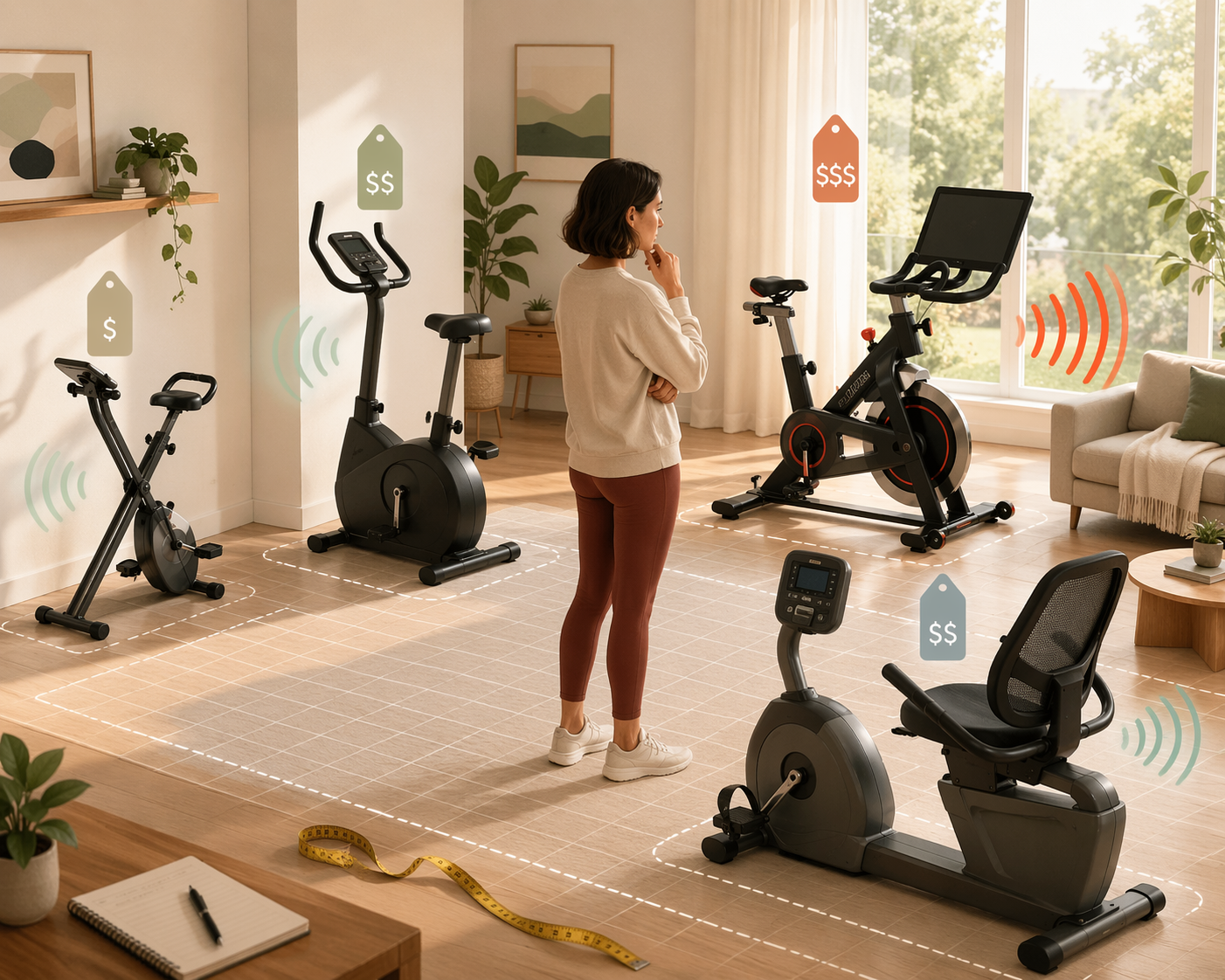
| Constraint to check first | What it changes | Bike types usually worth considering |
|---|---|---|
| Floor space | Whether the bike can stay usable without being folded, rolled, or blocking a walkway | Folding, upright, compact indoor cycling; recumbent only if you have a dedicated footprint |
| Total budget | Whether the real price is the sticker price or the sticker price plus years of app fees | Analog upright or indoor cycling bikes for low recurring cost; connected bikes if classes are part of the plan |
| Fitness goal | Whether you need easy mounting, steady cardio, hard intervals, or guided structure | Recumbent for gentler access, upright for general cardio, indoor cycling for training, air bikes for high-output intervals |
| Noise tolerance | Whether the bike works in an apartment, shared room, or late-night routine | Magnetic resistance first for quiet rooms; air resistance mostly for garages or detached spaces |
Start With the Floor, Not the Flywheel
A bike that has to be dragged out, angled around a bed, and folded back before dinner is not the same purchase as a bike that can stay open and ready. That sounds obvious until a product page shows a clean side profile and skips the lived-in part: the mat, the tablet shelf, the knee clearance, the door swing, and the space you need to get on without clipping a wall.
The footprint spread is large enough to eliminate whole categories before you look at resistance levels. Folding exercise bikes can store around 1.24 square feet, while some recumbent bikes occupy 12.7 square feet or more, a roughly tenfold difference between the smallest stored option and the largest home category discussed in current buying guides.[1][2]
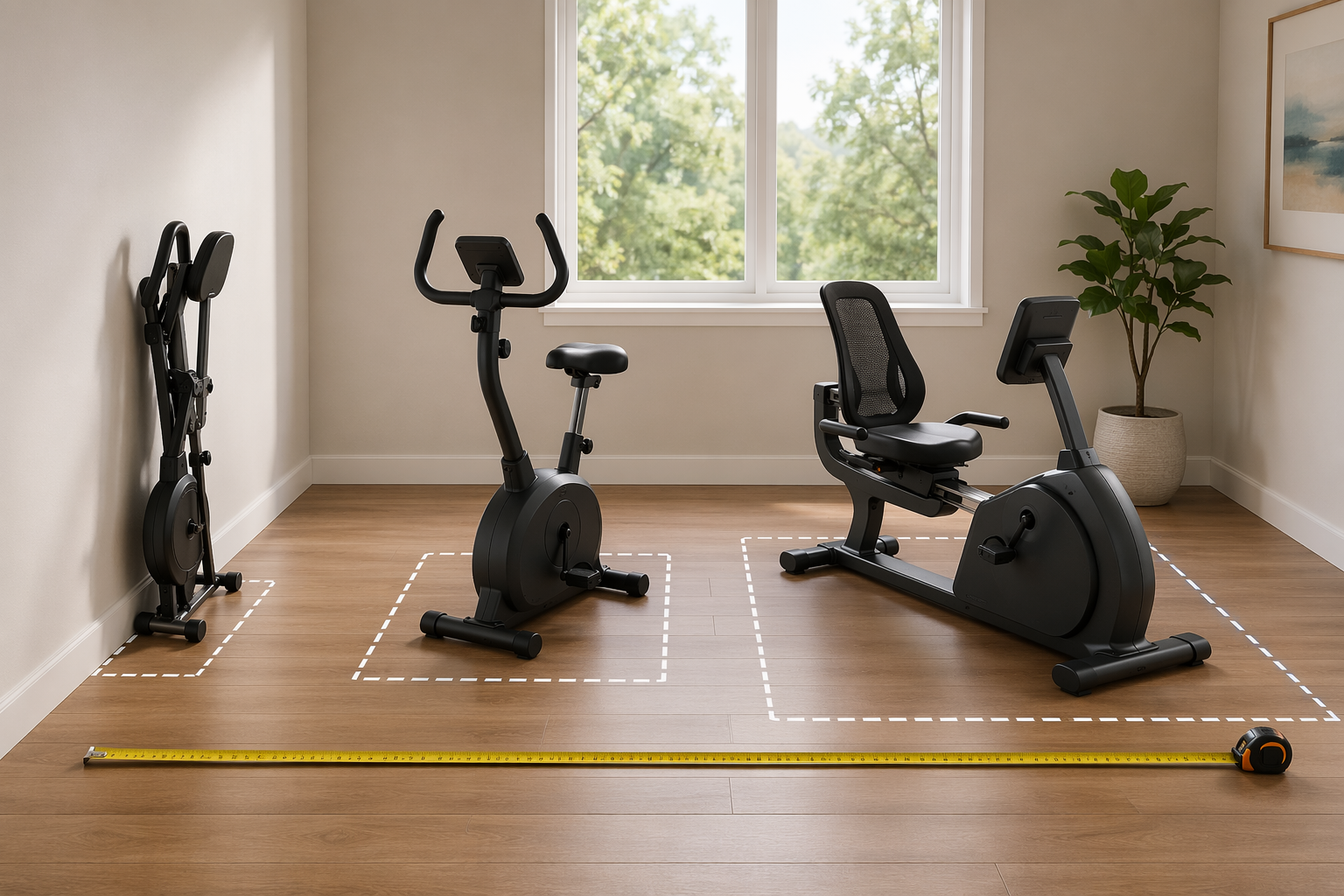
Measure the place where the bike will actually sit, not the room in theory. If it will live beside a bed, leave room for bedding to hang. If it will face a TV, measure from the saddle position, not from the front foot. If it will be stored in a closet, check folded height and wheel placement, because “folding” does not always mean “easy to move.”
For apartments and multipurpose rooms, the first cut usually looks like this: folding bikes solve storage better than ride realism; upright bikes are compact and familiar; indoor cycling bikes take more commitment but usually feel steadier under harder efforts; recumbent bikes are friendlier to mounting and back support but ask for the most permanent floor space.
If your space problem is bigger than one bike, use a broader small-room framework before buying. The guides to home gym cardio equipment for small spaces and compact, quiet, and stowable apartment equipment are useful if the bike has to share space with a desk, sofa, stroller, or strength gear.
Separate the Bike Price From the Ownership Price
Stationary bike pricing gets blurry because two very different purchases can sit next to each other in the same roundup. One bike is hardware. The other is hardware plus a screen, software, instructors, music licensing, metrics, and a monthly bill. Both can be worth buying, but they should not be compared as if their sticker prices tell the whole story.
Garage Gym Reviews found an average exercise bike cost of about $1,409 across a sample of more than 50 bikes, while also noting effective options under $500 from brands such as Sunny, Yosuda, and Marcy for riders who do not need smart features.[1] That average is useful mainly as a warning: the category spans from plain, serviceable machines to premium connected platforms.
The subscription gap is where the decision can change most. Using the mid-2026 prices in the research set, a NordicTrack X24 at $2,299 plus iFIT at $39 per month reaches about $4,639 over five years, while a no-subscription Concept2 BikeErg at $1,100 remains $1,100 before maintenance or accessories. Outdoor Gear Lab’s five-year monthly cost comparisons put full-feature setups from about $38 per month for a BowFlex IC Bike SE with JRNY to about $86 per month for a Peloton Bike+.[3]
That does not make connected bikes a bad deal. For some riders, a class library is the reason the bike gets used. A beginner who needs a coach in the room, a schedule to follow, and visible progress may ride more consistently with a connected bike than with a silent analog model. The mistake is treating that motivation as free.
| Budget reality | What to prioritize |
|---|---|
| Under $500 upfront | Basic upright or indoor cycling bike, usually without premium screens or deep app integration |
| $500 to about $1,500 upfront | Better build quality, smoother adjustment, magnetic resistance options, and some app-compatible bikes |
| Premium connected budget | Hardware plus a recurring membership; compare five-year cost before comparing class libraries |
| No-subscription preference | Durable analog or performance-focused bikes where the console is not the product |
If you are choosing between a connected bike and a simpler machine, run the monthly fee for at least three years and preferably five. Then decide whether that number is buying accountability, coaching, auto-resistance, entertainment, household profiles, or just a screen you could replace with a tablet. For a deeper cost breakdown, see the real cost of a home exercise bike.
Match the Bike Type to the Ride You Need
Once space and budget remove the obvious bad fits, the training goal matters more. Most people do not need the “hardest” bike. They need the bike that makes their intended workout repeatable.
- For low-impact movement, easier mounting, or a more supported position, start with recumbent bikes or gentler upright options. The trade-off is floor space, especially with recumbents.
- For general cardio, beginner conditioning, and casual household use, upright bikes and magnetic indoor cycling bikes are usually the cleanest starting point.
- For structured endurance rides, climbs, and harder interval sessions, indoor cycling bikes make more sense than folding bikes because they are built around a more forward, performance-style riding position.
- For short, very hard efforts that use arms and legs together, air bikes are the obvious category, but only if the noise and space make sense.
The flywheel question belongs mainly in the indoor-cycling decision, not as a universal rule for every stationary bike. For that category, a flywheel around 30 pounds or more is a common guideline for smoother ride stability; lighter flywheels can feel choppy at lower cadences.[4] It is a quality check after you have already decided that an indoor cycling bike fits your room, budget, and riding style.
If the bike is part of a recovery plan, joint-friendly routine, or low-impact setup, do not let studio-bike marketing pull you away from access and comfort. The guide to low-impact exercise equipment for small spaces is a better next stop than another leaderboard-heavy comparison.
Noise Can Decide the Purchase
Noise is easy to underestimate because the loudest part of a home bike is not always the drivetrain. It can be the fan, the pedal stroke, the rider standing out of the saddle, the mat vibrating on a wood floor, or the instructor audio turned up to hear over the machine.
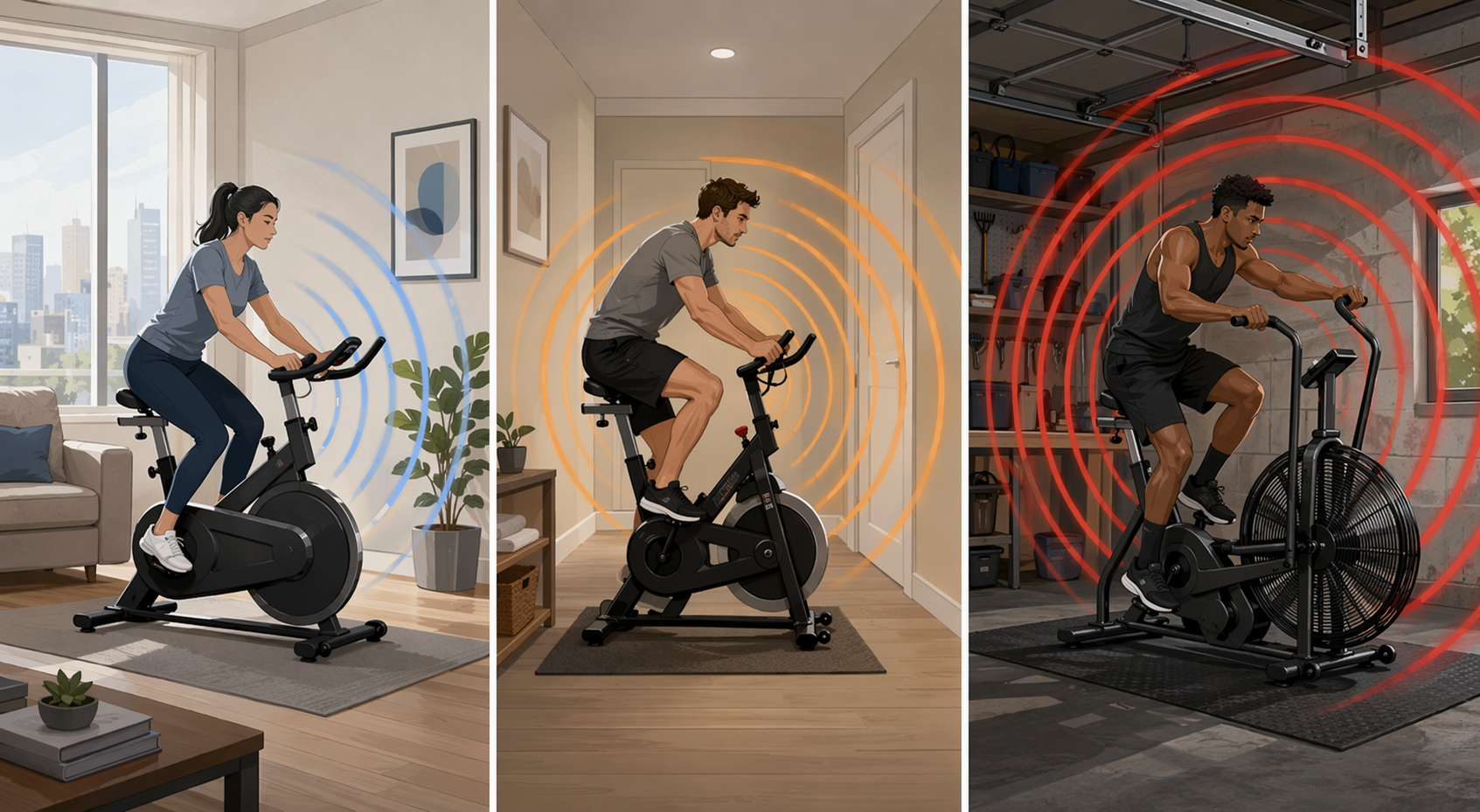
The resistance system gives you the first noise clue. Magnetic resistance is generally the apartment-friendly choice because there is no pad rubbing against the flywheel. Friction resistance adds an audible whoosh and uses pads that may need replacement, with the research set estimating roughly $10 to $30 per year. Air resistance is the loud one: Garage Gym Reviews measured air bikes at 76 to 83 decibels in controlled testing, with actual room noise depending on acoustics and wall proximity.[1]
| Resistance type | Home noise fit | Maintenance note |
|---|---|---|
| Magnetic | Best fit for apartments, shared rooms, and late workouts | Low-contact system; check general hardware and console upkeep |
| Friction | Audible but often manageable if the room and schedule are forgiving | Pads wear and may need periodic replacement |
| Air | Best kept to garages, basements, or detached spaces | Fan noise rises as effort rises |
For apartment buyers, this is where an otherwise excellent air bike can fall apart as a home purchase. It may be perfect for conditioning and wrong for a second-floor bedroom after 9 p.m. If your only workout window is early morning or late night, a magnetic upright or magnetic indoor cycling bike deserves priority even if an air bike looks more versatile on paper.
Connected Bikes Deserve a Fair, Careful Comparison
Connected bikes are not just expensive bikes with tablets attached. The better ones can reduce the mental load of training: choose a program, follow a coach, let the system track output, and come back tomorrow. That structure matters for people who do not want to design workouts from scratch.
The fair comparison is not “screen or no screen.” It is whether the screen, membership, and platform features solve a problem you actually have. If you already know how to train and prefer your own apps, a no-subscription bike may age better. If you need instruction, variety, and external accountability, the recurring fee may be part of the equipment, not an add-on.
There is also a trust and status check to make before buying any premium connected bike. Peloton’s recall history is relevant here: the original Bike was recalled in May 2023 after 35 reports of broken seat posts, and the original Bike+ was recalled by the CPSC in November 2025 for a seat post detachment issue.[5] As of Q3 2026, the practical takeaway is not to write off the brand; it is to confirm whether you are looking at a refurbished original Bike or a current Cross Training Series model, then verify warranty coverage, return terms, and whether any recall remedy applies to that exact unit.
A Short Purchase Checklist Before You Compare Models
- Measure the bike’s living position, storage position, and mounting clearance, not just the product footprint.
- Calculate total cost with subscriptions for three to five years, then compare that number against no-subscription alternatives.
- Choose the category around your main use: supported riding, general cardio, studio-style training, or high-output intervals.
- Prioritize magnetic resistance if you share walls, floors, or workout hours with other people.
- Check warranty length, return shipping rules, assembly requirements, and current recall status before buying new, used, or refurbished.
If you are buying your first bike and need help after the category decision, start with Your First Exercise Bike: A Beginner’s Guide. If the bigger decision is where to buy and how much risk to take on assembly, returns, or floor models, use the online vs. in-store exercise equipment shopping matrix.
Where Your Search Should Start
- Tiny apartment, strict budget, light cardio: start with folding or compact upright bikes, and be honest about whether storage convenience matters more than ride feel.
- Shared wall, late workouts, general fitness: start with magnetic upright or magnetic indoor cycling bikes.
- Beginner who needs coaching and accountability: compare connected bikes, but use five-year cost as the real price.
- Joint comfort, easier mounting, or supported posture: start with recumbent bikes if you have the floor space.
- Hard intervals in a garage or basement: compare air bikes and indoor cycling bikes, with noise treated as a deciding factor rather than a footnote.
After the bike type is clear, model comparisons become much more useful. You can look at adjustment range, console quality, warranty, resistance levels, app support, and long-term upkeep without pretending every bike is competing for the same corner of the same room. For broader equipment planning, the complete compact home gym decision framework can help you decide whether a bike is the right cardio anchor at all. If you have already chosen a resistance type, check exercise bike maintenance costs over five years before you buy.
References
- Best Exercise Bike, Garage Gym Reviews, https://www.garagegymreviews.com/best-exercise-bike
- Best Exercise Bikes for Small Spaces, BarBend, https://barbend.com/best-exercise-bikes-for-small-spaces/
- Best Exercise Bike, Outdoor Gear Lab, https://www.outdoorgearlab.com/topics/fitness/best-exercise-bike
- The Best Exercise Bikes, Wirecutter, https://www.nytimes.com/wirecutter/reviews/best-exercise-bikes/
- Best Exercise Bikes from Consumer Reports' Tests, Consumer Reports, https://www.consumerreports.org/health/exercise-bikes/best-exercise-bikes-from-consumer-reports-tests-a9885016165/

Comments
Join the discussion with an anonymous comment.